
Quick Answer
Unilateral training means working one limb at a time instead of both together, and it corrects muscle imbalances, builds deeper core stability, and lowers injury risk far more effectively than bilateral lifts alone, making it one of the most underused tools in strength training today.
- Unilateral training targets one arm or one leg per rep, unlike bilateral moves like squats and bench presses that train both sides together.
- It exposes and corrects strength differences between the left and right side that bilateral lifts often hide.
- Training one limb triggers cross education, a neural effect where the opposite, resting limb also gains strength.
- It builds functional core stability by forcing the torso to resist rotation and collapse under an uneven load.
- Single-leg strength exercises are especially valuable for runners, older adults, and anyone recovering from a lower-body injury.
Introduction
Anyone who has squatted heavily for a few years has probably felt it. One leg pushing just a little harder than the other. A slight lean nobody else notices but the lifter can feel through the whole rep. Bilateral lifts are strangely good at hiding this. Two legs working together will always find a way to get the job done, even if one side is quietly doing more of the lifting than the other.
Most people carry some degree of strength asymmetry between their dominant and non-dominant side, and a barbell squat or bench press will rarely expose it. That gap does not go away on its own. It usually shows up later, as nagging knee pain on one side, a lower back that only bothers on certain lifts, or a shoulder that never quite feels as stable during pressing movements.
Unilateral training is the tool built specifically for this blind spot. Strength coaches and physical therapists have leaned on it for decades, yet plenty of lifters still treat it as an accessory afterthought rather than a core part of the program. This guide breaks down why single-limb training works, what the science actually says about it, six powerhouse exercises worth adding to any routine, and a sample training plan ready to start this week.
Ready to see it step by step? Click here to watch the full exercise:
What Is Unilateral Training?
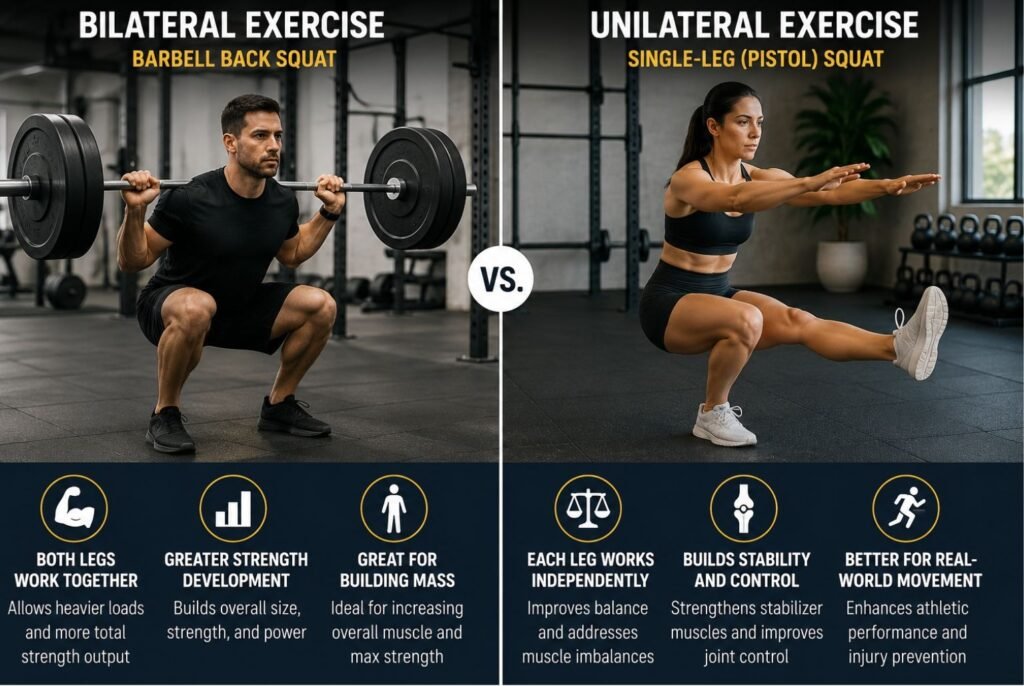
Unilateral training refers to any exercise performed using one arm or one leg at a time, such as a lunge, single-arm row, or single-leg deadlift, as opposed to bilateral exercises like squats, deadlifts, and bench presses that use both limbs simultaneously and allow the stronger side to compensate for the weaker one.
Unilateral vs Bilateral Training: What Actually Changes
Bilateral lifts build overall strength and power efficiently, and they remain the backbone of most strength programs for good reason. But they tend to mask side-to-side differences in a way unilateral movements simply cannot. A dumbbell bench press pressed one arm at a time uses identical equipment to a barbell bench press, yet it produces a completely different training effect. One side can no longer hide behind the other.
For a deeper look at how bilateral compound lifts like squats build the foundation strength this article assumes, the squats every day benefits guide breaks down exactly what consistent squatting does for the body.
Why Unilateral Training Deserves a Place in Every Strength Program
Unilateral training deserves a spot in nearly every strength program because it solves problems bilateral lifting cannot, specifically muscle imbalances, weak core stabilization, and asymmetrical injury risk, all of which quietly limit performance and increase long-term injury potential if left unaddressed.
1. Fixes Muscle Imbalances That Bilateral Lifts Hide
In a standard barbell squat or bench press, the stronger side of the body subconsciously takes on more of the load. A single-leg squat or single-arm press cannot hide that gap, which is exactly why it becomes the diagnostic and corrective tool of choice for muscle imbalance correction. The weaker side gets exposed, and once it is exposed, it can finally be addressed.
2. Builds Deeper Core Stability
Loading only one side forces the core to resist rotation and stop the torso from collapsing sideways. That demand builds the kind of functional core strength that carries directly into posture and lower back health, something isolated ab work performed in a fixed, symmetrical position simply cannot replicate. Readers who want to build this kind of stability without any equipment at all can start with the isometric workout for beginners guide, which pairs well with unilateral training for building a genuinely resilient midsection.
3. Triggers Cross Education for Injury Recovery
Training one limb stimulates the same muscle group on the opposite, resting limb through shared neural pathways. This effect is strongest in the lower body and most pronounced with eccentric, slow-lowering contractions. That makes unilateral training genuinely useful during rehabilitation, since training the uninjured leg can help slow strength loss in an immobilized or recovering leg, buying valuable time during a recovery window when direct training is not an option.
4. Reduces Joint Stress While Building Real Strength
Single-limb movements naturally use lighter total loads than two-limb lifts, since the body has to balance and stabilize on top of lifting. That reduces compressive stress on the spine and lowers strain on the knees and shoulders, making unilateral training a genuinely joint-friendly option for building strength over the long haul. This connects closely to how tendons adapt to load over time, something covered in more depth in the tendon strengthening exercises guide.
The Research Behind Single-Leg Strength Exercises
Research on unilateral training consistently shows measurable improvements in balance, coordination, and muscular symmetry, with the strongest evidence supporting its use for correcting asymmetries in athletes, older adults working on fall prevention, and anyone recovering from a single-limb injury.
Single-limb exercises significantly increase demand on stabilizer muscles compared to bilateral versions of the same movement. Cross education effects are strongest in lower-body muscles and during eccentric-focused training. Athletes who incorporate single-leg strength exercises show improved proprioception, which directly reduces fall and injury risk during sport-specific movement. Runners benefit specifically from unilateral leg training since running itself is a repeated single-leg activity, and every single stride is essentially a single-leg test the body has to pass thousands of times per session.
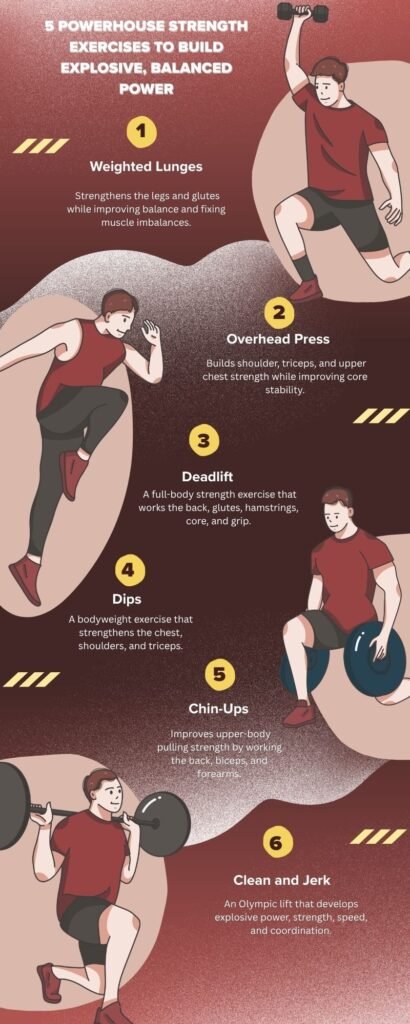
6 Powerhouse Strength Exercises to Build Explosive, Balanced Power
Building serious strength does not require abandoning heavy compound lifts. It requires pairing them intelligently with unilateral work that closes the gaps those lifts leave behind. These six exercises cover both approaches for a complete, athletic strength foundation.
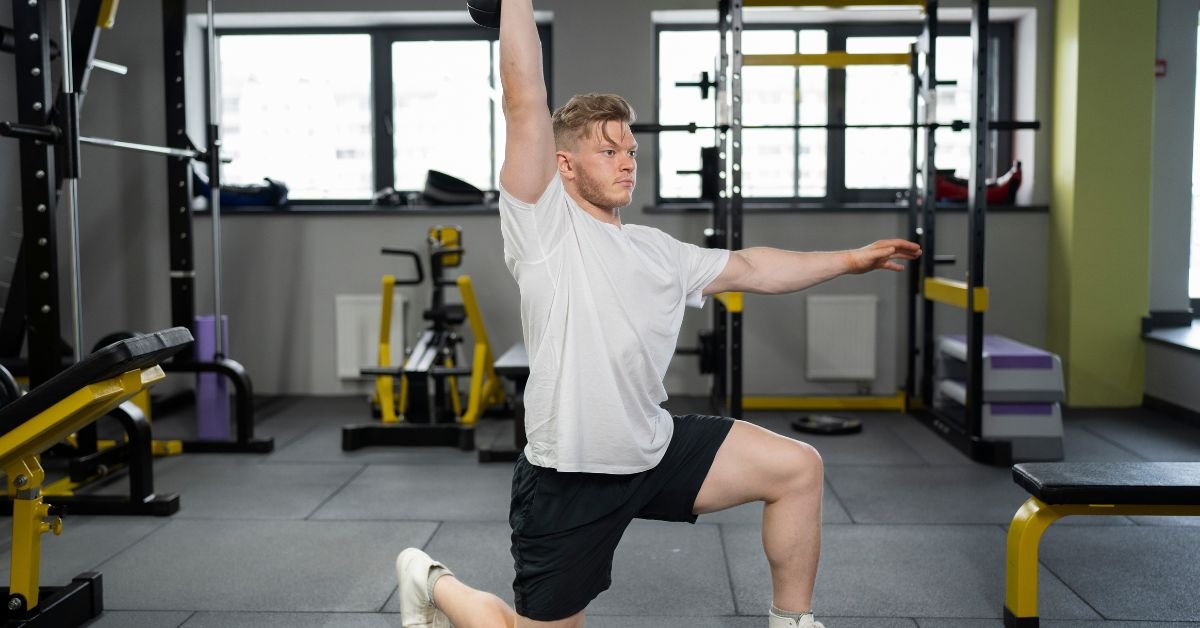
1. Weighted Lunges
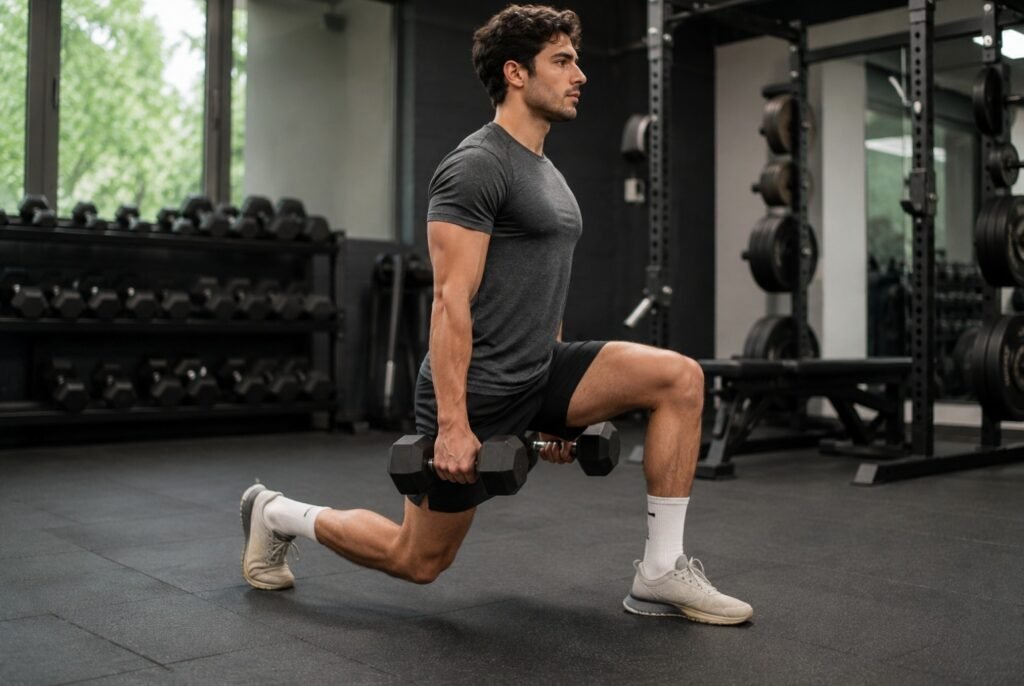
A unilateral leg exercise targeting quads, hamstrings, and glutes while improving balance, coordination, and flexibility. Directly corrects muscle imbalances and reduces injury risk.
Hold dumbbells or place a barbell across the shoulders. Step forward with one leg. Lower the back knee just above the floor. Push through the front heel to return to the starting position. Alternate legs while keeping the movement controlled rather than rushed.
2. Overhead Press
A bilateral upper-body movement included here as the pressing counterpart, targeting the shoulders, triceps, and upper chest while forcing the core to stabilize the load overhead.
Stand with feet shoulder-width apart. Press the weight directly overhead until the arms are fully extended. Lower it back down slowly and under control. Maintain proper posture throughout the entire lift, not just the first rep.
3. Deadlift
Often called the king of all lifts, and for good reason. This full-body movement develops raw strength by working the hamstrings, glutes, back, core, and grip all at once.
Stand with feet under the barbell. Keep the back straight and core engaged. Drive through the heels as the weight lifts. Keep the bar close to the body throughout the movement. Lower the weight under control rather than dropping it.
4. Dips
One of the most effective bodyweight exercises for upper-body pushing strength, primarily targeting the triceps, chest, and shoulders while improving shoulder stability.
Grip parallel bars firmly. Lower until the upper arms are roughly parallel to the floor. Push back to the starting position. Once bodyweight dips feel easy, add extra resistance to keep progressing.
5. Chin-Ups
One of the best exercises available for building pulling strength, strengthening the lats, biceps, forearms, and grip while improving overall upper-body control.
Grip the pull-up bar with palms facing in. Pull the chest toward the bar. Lower slowly and with control. Avoid swinging or using momentum to cheat the rep. Strict repetitions produce far better results than sloppy ones.
6. Clean and Jerk
The final exercise, and the real game changer for anyone chasing explosive power. This Olympic lift develops explosive strength, coordination, speed, and total-body athleticism in a way few other exercises can match.
Lift the barbell from the floor to the shoulders. Drive the bar overhead using explosive leg and hip power. Lock out the arms overhead before lowering the weight safely. Start with light loads until the technique is fully mastered. This same explosive principle shows up throughout athletic performance training, covered in detail in the plyometric training for speed and agility guide.
Sample Weekly Strength Training Plan
A well-structured week pairs heavy bilateral compound lifts with targeted unilateral accessory work, giving the body both raw strength development and the balance correction that single-limb training provides.
Day 1, Lower Body
Deadlifts, 4 sets of 5 reps. Weighted lunges, 4 sets of 10 reps per leg.
Day 2, Upper Body
Overhead press, 4 sets of 8 reps. Dips, 4 sets of 10 to 12 reps.
Day 3, Power and Pull
Clean and jerk, 5 sets of 3 reps. Chin-ups, 4 sets to maximum quality repetitions.
Increase the weight gradually, prioritize recovery between sessions, and stay consistent. Results tend to show up within a few weeks for anyone who actually sticks to the plan instead of hopping between programs every ten days.
Unilateral vs Bilateral Exercises Compared
| Exercise Type | Example | Primary Benefit | Core Demand | Best For |
| Unilateral | Weighted lunge | Corrects muscle imbalances and improves single-leg strength | High | Runners, rehabilitation, functional lower-body training |
| Unilateral | Single-arm row | Improves postural stability, grip strength, and left to right strength balance | High | Correcting arm strength asymmetry and enhancing back development |
| Bilateral | Deadlift | Builds maximal total-body strength and posterior chain power | Moderate | Developing maximal strength and overall muscle mass |
| Bilateral | Overhead press | Increases shoulder, triceps, and upper-body pressing strength | Moderate | Building upper-body strength and overhead stability |
| Unilateral | Single-leg squat | Enhances balance, proprioception, and lower-body stability | Very High | Fall prevention, athletic performance, and functional strength |
| Bilateral | Clean and jerk | Develops explosive full-body power, coordination, and force production | High | Athletic performance, Olympic lifting, and power development |
How to Add Unilateral Training Without Overhauling a Routine
Unilateral training works best as a complement to bilateral lifting, not a replacement. The simplest approach is pairing one unilateral accessory movement with each major bilateral lift already built into a program.
Common mistakes to avoid:
Using too much weight before the stabilizer muscles are ready raises injury risk fast. Skipping the weaker side or doing uneven reps between sides defeats the entire purpose of the training. Rushing through reps instead of moving with control reduces muscle engagement and undermines the very balanced benefits being trained for in the first place. Mobility also plays a bigger role here than most people expect, and readers dealing with tightness at the bottom of a lunge or single-leg squat may find the deep squat mobility guide genuinely useful before adding heavier load.
Conclusion
Unilateral training is not a niche accessory method tucked away for physical therapists and rehab clinics. It is the missing correction most lifters need to build strength that is actually balanced, resilient, and transferable to real-world and athletic movement. Two legs that lift the same weight on paper are not the same thing as two legs that are equally strong.
Pick two unilateral exercises from this list, pair them with the existing weekly training split, and track how each side performs over the next four weeks. The difference usually shows up faster than expected.
For more strength and mobility guides built to keep the body training hard and staying injury-free, explore the full library at Fitness Geekz, and start working unilateral training into the very next session rather than waiting for an imbalance to turn into an injury first.
Frequently Asked Questions
Unilateral training means working one arm or one leg at a time, and it matters because it exposes and corrects the strength imbalances that bilateral exercises like squats and bench presses often hide.
Weighted lunges, box step-ups, and single-leg Romanian deadlifts are among the most effective and beginner-friendly single leg strength exercises, since they build strength while teaching balance and control at a manageable intensity.
Yes, unilateral training is one of the most effective tools for muscle imbalance correction because it forces each side of the body to work independently, preventing a dominant side from compensating for a weaker one.
Neither is better on its own. Bilateral lifts build raw total-body strength efficiently, while unilateral exercises correct imbalances and build stability. The most effective programs combine both rather than choosing one over the other.
Adding one or two unilateral exercises per training session, two to four times per week, is generally enough to see meaningful improvements in balance, symmetry, and injury resilience without overhauling an existing routine.