
Quick Answer: Plyometric training improves speed, agility, and athletic performance by training the stretch-shortening cycle, the rapid eccentric-to-concentric transition that builds explosive power. Studies show just 3 weeks of twice-weekly training can boost sprint speed by ~11% and agility by ~7%. It strengthens fast-twitch fibers, stiffens tendons for faster energy transfer, and improves neuromuscular coordination, making athletes faster, more powerful, and less injury-prone than conventional strength training alone produces.
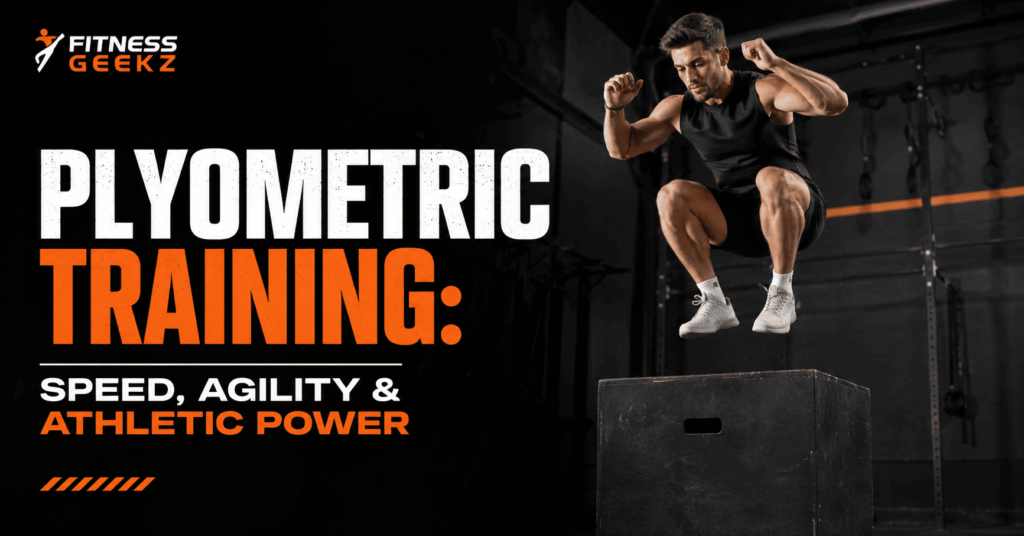
Want to build insane speed, explosive power, and athleticism that shows up when it matters? The answer is not spending more time grinding through slow, heavy lifts. It is teaching the body to work like a spring, and plyometric training is one of the most effective, science-backed ways to do exactly that.
The research is compelling. A peer-reviewed study found that just three weeks of plyometric training twice per week improved 30-metre sprint times by around 11 percent and agility by roughly 7 percent compared with a control group that showed little change. The National Academy of Sports Medicine identifies plyometrics as one of the best methods for improving vertical jump, running speed, agility, quickness, and throwing power. Nike Well Collective Coach David Carson describes it as one of the most effective ways to develop explosive power.
Plyometrics is not simply jumping around. It is a structured training method that teaches the muscles and nervous system to produce maximum force in the shortest possible time. That ability to generate explosive power on demand is what separates good athletes from great ones.
This guide explains the science behind plyometric training, the six best exercises for building speed and power, a three-stage progression for all fitness levels, and the recovery and injury prevention strategies that help maximize results.
Discover the complete routine and see every step in action: Watch the Full Video
The Science Behind Plyometric Training
Every plyometric movement operates through a three-phase process called the stretch-shortening cycle, and understanding it changes how every rep is approached.
The eccentric phase is where the muscle lengthens and stores elastic energy under load, like a compressed spring being wound tight. In a box jump this is the quarter squat before takeoff. In a clap push-up it is the controlled descent toward the floor before the explosive push.
The amortization phase is the brief critical transition between absorbing and releasing force. The shorter this pause, the more explosive and powerful the resulting movement. This is the phase that plyometric training most specifically targets and most dramatically improves with consistent practice. Trained athletes generate far more force from the same movement as untrained ones not because their muscles are bigger but because this transition phase is faster and more efficient.
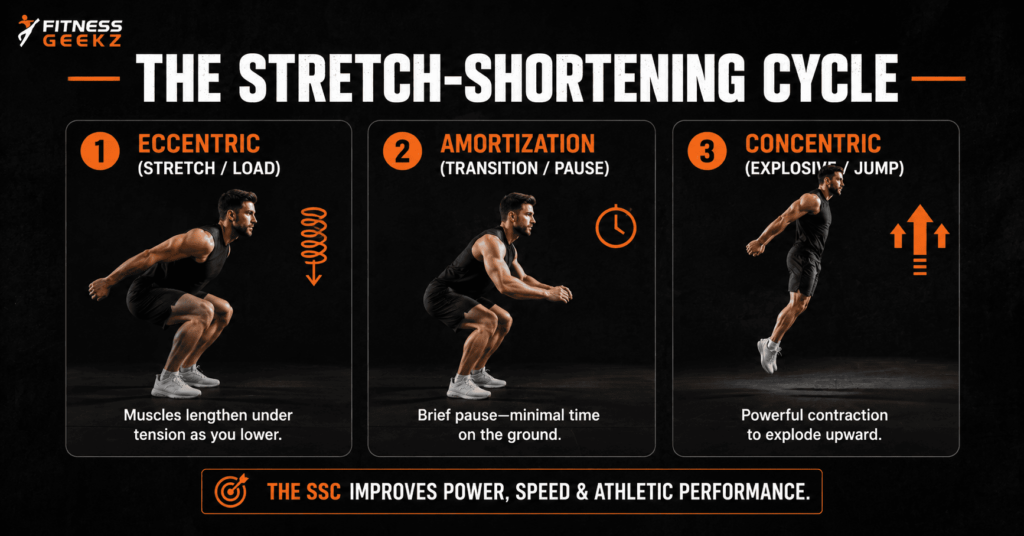
The concentric phase is the explosive release. The spring uncoils. The jump happens. The throw is launched. The sprint accelerates. Everything that produces visible athleticism lives here, but it is only as powerful as the two phases that preceded it.
What Plyometrics Do to the Body That Conventional Training Cannot
Traditional strength training builds raw muscular capacity. Plyometrics teach the body to use that capacity rapidly and on demand. This is exactly why two athletes can have nearly identical squat numbers but completely different sprint speeds and vertical jump heights.
Plyometric training recruits fast-twitch muscle fibres, the ones responsible for explosive bursts of speed and power that slow heavy lifting cannot adequately develop. It makes tendons stiffer and more elastic over time, allowing faster energy transfer between muscle contraction and movement output. This is a structural adaptation that accumulates progressively and directly improves every explosive athletic quality. Building this kind of tendon resilience is also the focus of dedicated tendon strengthening exercises, which can complement a plyometric programme by reinforcing the connective tissue these explosive movements rely on.
The neuromuscular coordination benefit is equally significant. The brain and muscles learn to fire more efficiently and in better synchrony, which is why plyometrically trained athletes not only move faster but move more accurately under fatigue. Research from PMC confirms that lateral plyometric movements specifically improve intermuscular coordination and proprioception, the body’s awareness of its own position in space during dynamic movement.
And perhaps the most underappreciated benefit: most sports injuries happen during uncontrolled deceleration. Plyometric training strengthens the connective tissue and stabilising muscles around the knees and ankles, improves landing mechanics, and directly reduces the injury risk that comes with high-speed sport-specific movement.
The 6 Best Plyometric Exercises for Speed, Power, and Agility
These six movements cover the full spectrum of explosive athletic qualities from lower body power and sprint speed to upper body force production and conditioning endurance. Together they form a complete athletic performance training stimulus.
Exercise 1: Box Jumps: For Lower Body Explosiveness and Sprint Speed
Box jumps are the cornerstone lower body plyometric exercise. They strengthen the quads, hamstrings, glutes, and calves through the full stretch-shortening cycle while improving the neuromuscular coordination that makes muscles fire faster and more efficiently under athletic demand. Research consistently confirms that athletes who train deep full-range jumps produce greater performance improvements than those using partial range alternatives.
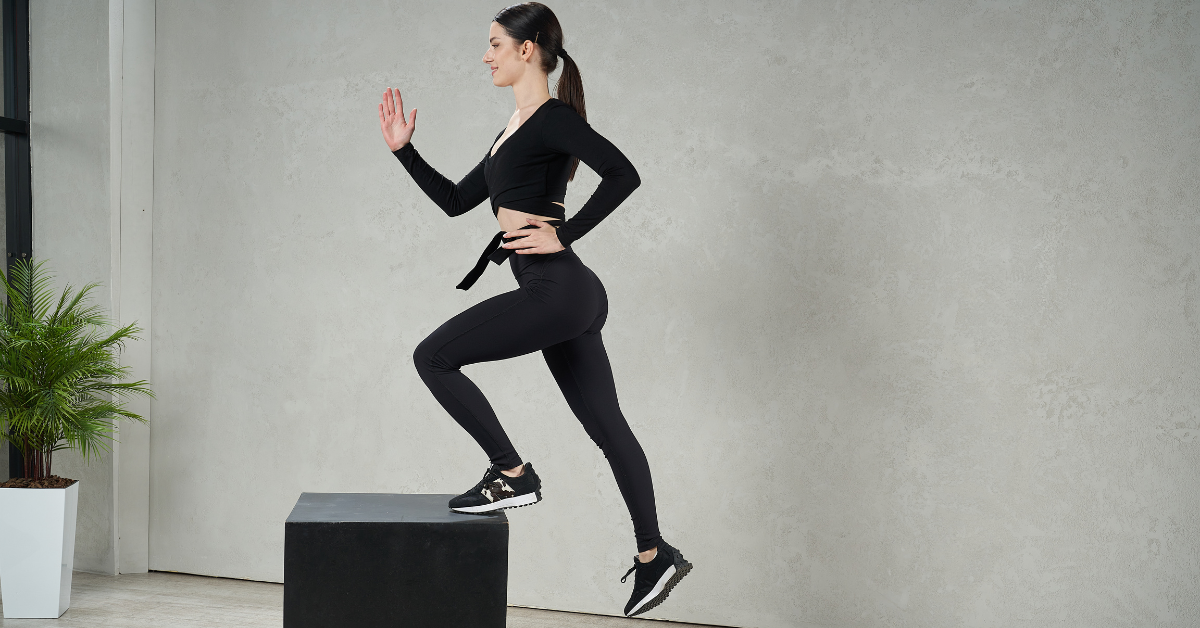
Stand a few inches from a sturdy box. Drop into a quarter squat and explode upward with maximum intent. Land softly on the box with bent knees to absorb the impact properly. Step down carefully before the next rep rather than jumping down, which adds unnecessary eccentric stress to joints that are already working hard.
Box jumps are essential for basketball, soccer, and football athletes where vertical power and first-step explosiveness directly determine performance outcomes. Begin with a low box height and bodyweight. Progress to higher boxes, a weighted vest, or eventually depth jumps where the athlete steps off the box and immediately explodes upward upon landing.
Exercise 2: Squat Jumps: For Fast-Twitch Power and Joint Stability
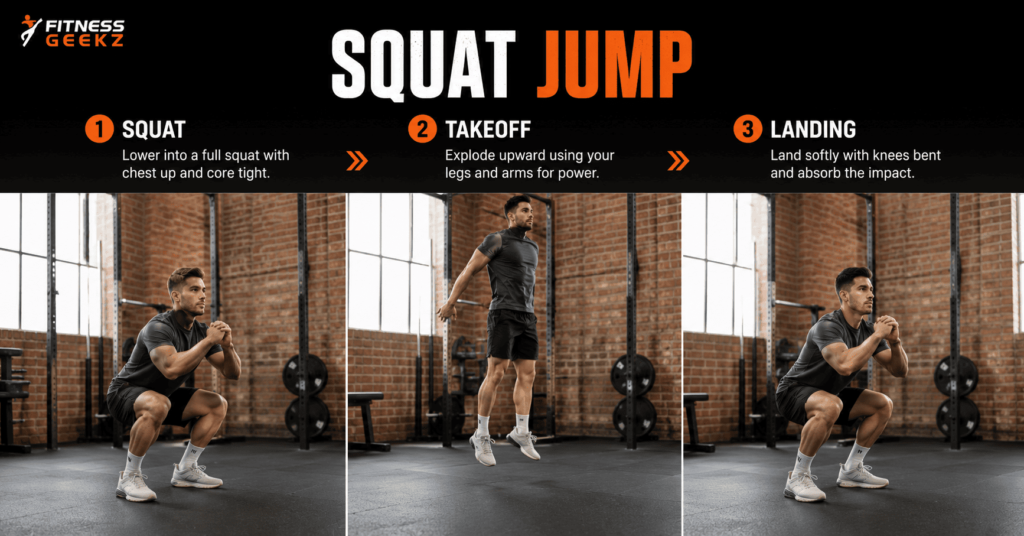
Squat jumps are the most accessible explosive workout in the entire list requiring absolutely zero equipment. They develop the fast-twitch muscle power needed for quick bursts of speed while simultaneously improving the ankle and knee stability that reduces injury risk during high-speed athletic movements across every sport.
Lower into a full squat with intention. Explode upward as high as possible with maximum effort on every single rep. Land softly with bent knees and transition immediately into the next repetition to maintain the amortization phase training stimulus that makes this exercise genuinely plyometric rather than simply a jumping squat.
Progress by adding a weighted vest, increasing the squat depth before the jump, or moving to split squat jumps for unilateral power development that directly corrects the side-to-side imbalances that bilateral training consistently misses.
Exercise 3: Clap Push-Ups: For Upper Body Explosive Strength
Clap push-ups develop the explosive upper body strength that most athletic training programmes completely neglect. They activate fast-twitch muscle fibres in the chest, shoulders, and triceps for faster reaction time and directly mimic the explosive force production needed for punches, throws, and blocking movements in combat and field sports.
Start in a standard push-up position. Lower the chest toward the floor with controlled intention. Explode upward with maximum force, clap the hands together, and land with soft elbows to absorb the impact before the next rep. The core must stay braced throughout for proper stabilisation.
For beginners, explosive push-ups where the hands leave the floor without the clap build the foundational strength needed before adding the coordination demand of the clap. Never sacrifice landing mechanics to achieve the clap before the strength is actually there.
Exercise 4: Medicine Ball Throws: For Total Body Force Transfer
Medicine ball throws are one of the only plyometric exercises that train the complete kinetic chain from the ground through the hips and core to the upper body in a single explosive movement. They directly replicate real-world athletic actions including sprinting, throwing, and striking by training the force transfer from the lower body through the core to the upper extremity that every rotational and overhead sport demands.
Hold the medicine ball at chest or hip height. Lower into a slight squat to load the lower body and store elastic energy. Explode upward while simultaneously launching the ball overhead or against a wall with maximum force generated from the entire body, not just the arms.
Quarterbacks, baseball pitchers, cricket fast bowlers, and any athlete who needs rotational power and throwing velocity consistently rank this among their most important training tools. The force transfer pattern it develops is genuinely irreplaceable.
Exercise 5: Jump Rope: For Foot Speed and Athletic Coordination
Do not underestimate the jump rope. It is one of the most underrated speed and agility training tools available and one of the most sport-transferable. It improves coordination and agility through the rapid foot patterns it demands, strengthens the lower legs for better sprinting and jumping mechanics, boosts cardiovascular fitness, and trains the body to maintain explosive rhythm under cumulative fatigue.
Stay on the balls of the feet throughout every session. Use the wrists rather than the arms to turn the rope. Keep jumps quick and light, barely clearing the rope, to build the fast-twitch foot speed rhythm that transfers directly into sprint mechanics and agility work.
Progress from basic two-foot jumps to alternating feet, single-leg jumps, double under, and speed intervals to continuously increase the neurological and conditioning demand across training phases.
Exercise 6: Battle Ropes: The Game Changer
Battle ropes are not just a conditioning tool and that framing massively undervalues what they actually develop. They build explosive endurance and upper body power that sustained athletic performance genuinely requires. Unlike isolated upper body exercises, battle ropes target the shoulders, arms, and core simultaneously while demanding that power is generated from the entire body rather than isolated muscle groups.
Keep the core tight throughout every set. Generate power from the hips and legs while the arms transmit that force into the rope. This is a full-body explosive effort, not an arm exercise. The grip strength, shoulder endurance, and full-body coordination battle ropes develop transfer directly into lifting, climbing, and combat sport performance in ways that few other training tools can replicate. For athletes looking to build a similar kind of full-body explosive conditioning with a single tool, kettlebell swings offer a comparable way to build explosive power and muscle conditioning using a hip-driven, total-body movement.
Best Plyometric Exercises at a Glance
| Exercise | Primary Benefit | Muscles Targeted | Intensity | Equipment |
| Box Jumps | Lower-body explosiveness and sprint speed | Quadriceps, glutes, hamstrings, calves | High | Plyometric box |
| Squat Jumps | Fast-twitch power and joint stability | Quadriceps, glutes, calves | Moderate to High | None |
| Clap Push-Ups | Upper-body explosive strength | Chest, shoulders, triceps, core | Moderate to High | None |
| Medicine Ball Throws | Total-body force transfer | Core, hips, shoulders | High | Medicine ball |
| Jump Rope | Foot speed, coordination, and conditioning | Calves, core, cardiovascular system | Moderate | Jump rope |
| Battle Ropes | Explosive endurance and grip strength | Shoulders, arms, core | High | Battle ropes |
How to Build a Progressive Plyometric Training Programme
1. Start with Stabilisation
Build a foundation before attempting high-impact movements. Focus on bilateral exercises such as jumping jacks, moderate-paced jump rope, and low step-ups while practicing soft, controlled landings with bent knees.
2. Progress to Strength Development
Once landing mechanics are solid, introduce moderate-intensity exercises like squat jumps, lateral bounds, and skater hops. This stage develops tendon stiffness, fast-twitch muscle recruitment, and structural resilience. Building this baseline strength is also where dumbbell exercises for muscle mass and a full body workout at home can play a complementary role, since stronger muscles give the nervous system more raw capacity to draw on once plyometric demands increase.
3. Advance to Power Training
Incorporate high-intensity movements such as box jumps, depth jumps, clap push-ups, and medicine ball throws. Perform every repetition with maximum intent while allowing adequate rest between sets to preserve explosive performance.
4. Train Two to Three Times Per Week
Complete plyometric sessions two to three days per week and allow 48 to 72 hours of recovery between workouts to support adaptation and reduce injury risk.
5. Structure Each Session Properly
A balanced plyometric workout should include:
- 10 minutes of light jogging and dynamic stretching for the warm-up
- 20 to 25 minutes of progressive plyometric exercises
- 5 minutes of light jogging and static stretching for the cool-down
6. Prioritize Landing Quality
Land softly with controlled mechanics on every repetition. If technique deteriorates because of fatigue, stop the set. In plyometric training, movement quality consistently produces better results than simply doing more repetitions.
Recovery and Nutrition
The neurological adaptations that plyometric training produces occur during recovery, not during the training itself. Seven to nine hours of quality sleep per night is the most powerful performance recovery tool available and the most commonly neglected one. The fast-twitch fibre adaptations, tendon remodelling, and neuromuscular coordination improvements that produce explosive athletic gains require consistent sleep quality to consolidate between sessions.
Carbohydrate availability is the most critical nutritional variable for plyometric performance. Explosive workouts draw heavily on the phosphocreatine and glycolytic energy systems that require adequate glycogen stores to sustain quality output across multiple sets. Training in a severely carbohydrate-depleted state reduces explosive output and measurably increases injury risk.
Protein intake at 1.6 to 2.2 grams per kilogram of bodyweight supports the connective tissue and muscle repair that high-impact plyometric training demands. Adequate hydration supports the neuromuscular function that plyometric training most directly develops and that dehydration most acutely impairs.
Conclusion
Plyometric training is not an advanced-only practice reserved for elite athletes. It is a scientifically validated, progressively structured, and genuinely accessible training method that builds the explosive speed, agility, and athletic power that conventional gym training simply cannot develop alone.
The evidence is concrete. Three weeks of twice-weekly plyometric training produced 11 percent sprint speed improvement in a peer-reviewed controlled study. NASM identifies it as the primary tool for improving vertical jump, sprint speed, agility, and throwing velocity simultaneously. Nike’s top coaches call it the best power exercises available to any athlete at any level.
The question is not whether plyometric training works. The question is when to start building the explosive athletic foundation that every other training quality is built on top of.
Ready to add explosive power to the training programme? If you found this guide helpful, share it with teammates, training partners, or anyone looking to improve speed, power, and athleticism. For more science-informed performance guides and practical training strategies, explore the full Fitness Geekz resource library and stay updated with future content.
Frequently Asked Questions
Plyometric training uses explosive movements to train the muscles and nervous system to produce maximum force in the shortest possible time through the stretch-shortening cycle. While popular in sports like basketball, volleyball, football, tennis, and baseball, it can benefit any healthy individual who progresses through the stabilisation and strength phases before attempting high-intensity exercises.
Research has shown significant improvements in sprint speed and agility after just three weeks of twice-weekly plyometric training. In practice, most people notice measurable gains in explosive power and movement quality within four to six weeks of consistent, progressive training.
Beginners should focus on low-intensity movements that reinforce proper landing mechanics, including jumping jacks, moderate-paced jump rope, squat jumps with controlled landings, and low box step-ups. These exercises develop the foundation needed before progressing to more advanced drills like box jumps or clap push-ups.
Two to three sessions per week with 48 to 72 hours of recovery between workouts is ideal for most athletes and recreational trainees. Adequate recovery is essential for developing power while minimizing fatigue and injury risk.
Yes, when progressed appropriately. The key to injury prevention is mastering landing mechanics by absorbing impact with soft, bent knees rather than locked joints. Start with lower-intensity bilateral exercises, correct imbalances through unilateral work, and seek medical guidance before beginning if you have existing joint or musculoskeletal conditions.