
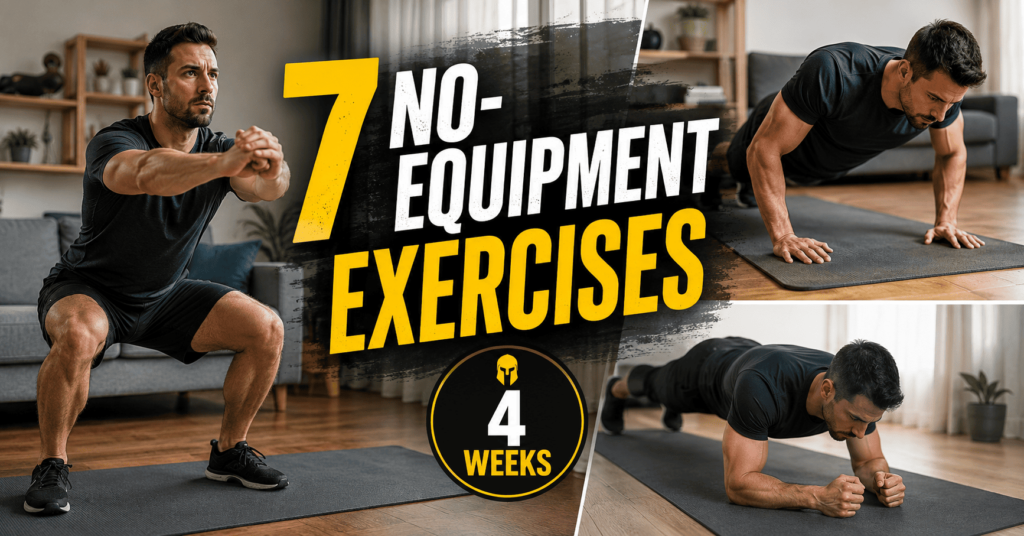
Quick Answer: You can transform your body in 4 weeks without any gym equipment. Seven bodyweight exercises, squats, push-ups, planks, lunges, mountain climbers, bicycle crunches, and jumping jacks, target every major muscle group while building strength, burning calories, and improving mobility. Performed 3–4 times per week with progressive overload (more reps, slower tempo, less rest), these movements trigger real neurological and structural changes: faster strength gains in weeks 1–2, visible muscle tone and body composition changes by weeks 3–4. No equipment, no membership, and no prior fitness experience needed, just 20–30 minutes a day and consistency.
According to the U.S. Department of Health and Human Services , only 1 in 4 adults meets the recommended weekly activity levels. The most commonly cited reason is not laziness. It is access. No gym nearby, no time to travel, no budget for a membership. The good news is that none of those barriers actually stand between anyone and real, meaningful physical transformation.
Seven bodyweight exercises performed consistently for four weeks, three to four times per week, are genuinely enough to build visible strength, improve body composition, increase energy, and develop the movement foundations that support long-term health. No equipment. No gym. No complicated programming required.
The exercises in this guide are not random. Each one is chosen because it targets multiple muscle groups simultaneously, produces measurable strength and endurance gains through progressive overload, and can be scaled from complete beginner to intermediate without any additional tools. Whether the goal is losing fat, building lean muscle, improving posture, or simply feeling stronger and more capable in daily life, this full body workout at home delivers all of it in a single 20 to 30 minute session.
Don’t just read about it, see the technique in action! Click below to watch the full workout:
Why Bodyweight Training Produces Real Results
Muscle growth and strength development require three things: mechanical tension, metabolic stress, and muscle damage. Bodyweight exercises, when performed with controlled tempo, full range of motion, and progressively increasing volume, deliver all three without a single piece of equipment.
The variable that separates effective bodyweight training from casual movement is progressive overload, the principle of gradually increasing the demand placed on the muscles over time. In a no-equipment context this means adding reps, slowing the lowering phase of each movement, shortening rest periods, or moving to more challenging variations as the body adapts.
Research consistently shows that bodyweight training produces comparable strength and hypertrophy outcomes to gym-based resistance training when progressive overload is applied and consistency is maintained across weeks and months.
One honest caveat worth stating clearly: bodyweight training has a natural ceiling for building maximum muscle mass. For people whose primary goal is significant hypertrophy, adding external resistance with the right dumbbell exercises will eventually become necessary. For building a leaner, stronger, and more functional body from a beginner or intermediate starting point, a structured exercise at home programme is completely sufficient and in many cases more sustainable than gym-based training over the long term.
Why 4 Weeks Is Enough to See Real Change
The first two weeks of any new training stimulus produce primarily neurological adaptations. The brain and nervous system learn to recruit muscle fibres more efficiently, which is why strength improvements in the early weeks happen faster than visible physical changes.
By weeks three and four, structural adaptations begin. This includes early hypertrophy, improved cardiovascular efficiency, and measurable changes in body composition. Four weeks is enough time to feel significantly stronger, notice improved posture and movement quality, and see early visible changes in muscle tone, provided the routine is followed consistently and nutrition supports recovery between sessions.
The 7 No-Equipment Exercises
These seven movements cover every major muscle group across the full body. Together they form a complete workout routine for beginners that builds strength, burns calories, improves mobility, and develops the cardiovascular endurance needed for an active daily life.
Exercise 1: Squats: For Lower Body Strength and Daily Function
Squats are the most fundamental human movement pattern available. They directly replicate the mechanics of sitting and standing, climbing stairs, and carrying loads, making them the single most transferable exercise for functional daily life.
Stand with feet shoulder-width apart. Lower the hips as if sitting back into a chair, keeping the chest upright and the knees tracking in line with the toes throughout the descent. Push through the heels to return to the starting position.
The most important form cue is keeping the chest up from start to finish. Letting the torso fold forward shifts the load away from the glutes and quads and into the lower back, which reduces the training benefit and increases injury risk simultaneously.
For an added challenge, hold the bottom position for 2 to 3 seconds before standing. That pause increases time under tension and muscle activation without changing anything about the movement pattern itself.
Start with 15 to 20 reps per set.
Exercise 2: Push Ups: For Upper Body Strength and Core Stability
Push ups are the most accessible upper body pressing exercise available and one of the most effective for developing chest and shoulder strength when performed through a full range of motion. They also demand significant core stability throughout, making them a genuinely compound movement rather than a simple arm exercise.
Place hands slightly wider than shoulder-width on the floor. Keep the body in a completely straight line from head to heels. Lower the chest toward the ground with control, then press back up to full extension.
The hips must not sag or rise during the movement. A sagging hip removes the core demand and places unnecessary stress on the lower back. A rising hip reduces chest engagement and turns the movement into something far less effective.
For anyone not yet able to perform a full push up, dropping to the knees while maintaining correct upper body mechanics is a completely valid starting point, not a lesser version of the exercise.
Start with 10 to 15 reps per set.
Exercise 3: Plank: For Core Strength and Spinal Stability
The plank is not just an ab exercise. It trains the entire anterior chain to maintain spinal alignment under sustained load, which is the foundational quality that makes every other movement in this routine safer and more effective. Core stability directly supports posture, reduces lower back pain risk, and improves the efficiency of every physical task performed throughout the day.
Place elbows on the ground directly under the shoulders. Keep the body in a straight line from head to toe with the core braced and the glutes actively squeezed throughout the hold. Do not let the hips sag toward the floor or rise toward the ceiling.
Actively squeezing the glutes during the hold significantly increases core muscle activation and reduces lower back strain simultaneously. That single cue transforms the quality of the exercise for most people.
Start with 20 to 30 seconds and add 5 to 10 seconds each week as endurance improves.
Exercise 4: Lunges: For Single Leg Strength and Balance
Lunges train each leg independently, which identifies and corrects the strength imbalances between sides that bilateral squats consistently mask. Single-leg strength is directly connected to balance, hip stability, and the injury resilience needed for daily activities like walking, climbing stairs, and changing direction.
Step forward with one leg and lower the body until the front thigh is parallel to the ground. Keep the back straight and the core engaged throughout. Push off the front foot to return to the starting position and then repeat on the opposite side.
The front knee should stay directly above the ankle throughout the movement. Letting it drift forward past the toes increases knee joint stress without adding any training benefit whatsoever.
Start with 10 reps per leg per set.
Exercise 5: Mountain Climbers: For Core Strength and Cardiovascular Conditioning
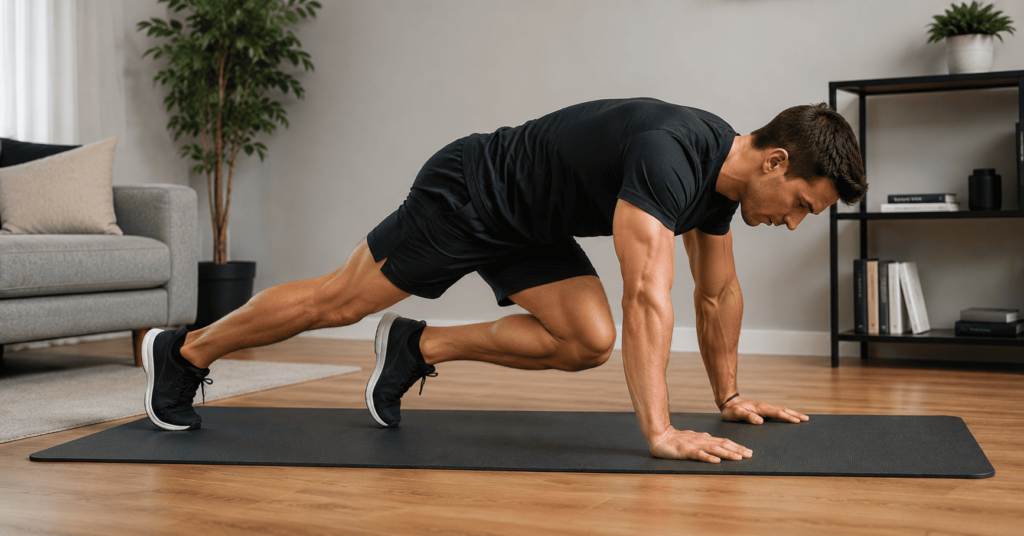
Mountain climbers are one of the most efficient exercises in this routine because they simultaneously build core strength, hip flexor endurance, shoulder stability, and cardiovascular capacity in a single movement. They provide the cardio element that elevates the heart rate, increases calorie burn, and builds the metabolic conditioning that supports fat loss alongside strength development.
Start in a full plank position. Rapidly alternate driving each knee toward the chest while keeping the back flat and the core braced throughout. The hips should not rise during the movement regardless of the speed being used.
Speed only becomes valuable when form is maintained. Sloppy fast reps with a rising hip and rounding back produce far less benefit than controlled movement at a moderate pace. Start at a speed that allows full form control and build from there.
Start with 30 to 60 seconds per set.
Exercise 6: Bicycle Crunches: For Abs and Oblique Strength
Bicycle crunches produce significantly higher rectus abdominis and oblique muscle activation than standard crunches according to electromyography research. The rotational component develops the lateral core strength that protects the spine during twisting movements in daily life and sport.
Lie on the back with hands loosely behind the head. Lift both legs and bring the left elbow toward the right knee while extending the left leg simultaneously. Alternate sides in a controlled pedalling motion throughout the set.
The key cue here is focusing on the rotation of the torso rather than pulling the head forward with the hands. The hands provide only light support. The actual effort comes from the core rotating the ribcage toward the opposite knee on every rep.
Start with 15 to 20 reps per set.
Exercise 7: Jumping Jacks: For Full Body Cardio and Energy
Jumping jacks serve as both the cardiovascular finisher and the active recovery movement that completes this routine. They elevate the heart rate, increase total calorie burn for the session, improve coordination, and leave the body energised rather than depleted at the end of the workout.
Jump while simultaneously spreading the legs and raising the arms overhead. Return to the starting position and repeat at a consistent and sustainable rhythm.
Land with soft knees rather than locked joints on every rep. That single habit reduces impact stress on the ankles and knees significantly over the cumulative volume of the four-week plan.
Start with 30 to 60 seconds per set.
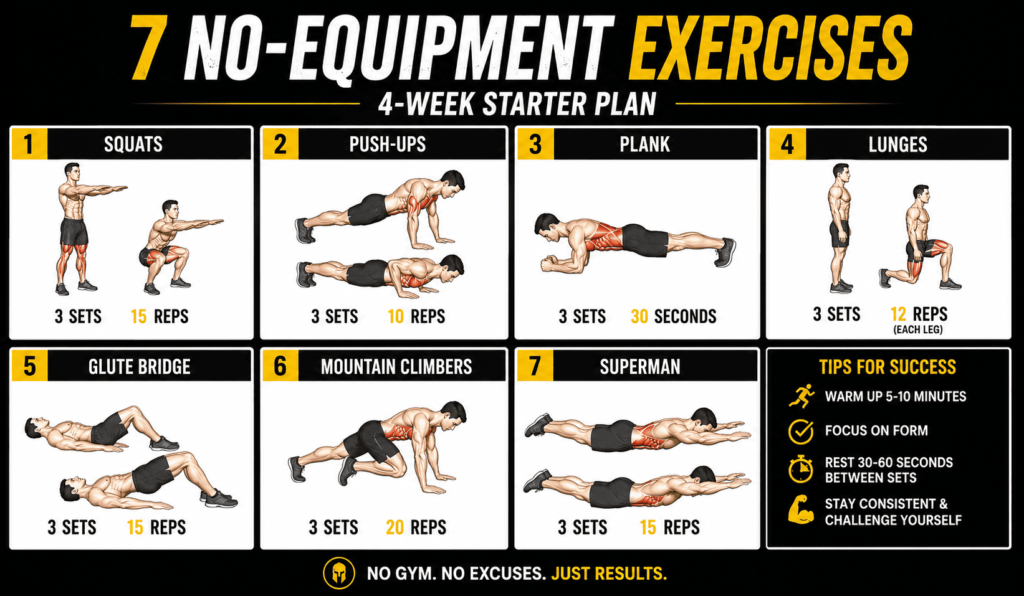
The 7 No-Equipment Exercises at a Glance
| Exercise | Primary Muscles | Secondary Muscles | Starting Prescription | Difficulty |
| Squats | Quadriceps, glutes | Hamstrings, core | 15 to 20 reps | Beginner |
| Push-Ups | Chest, triceps | Shoulders, core | 10 to 15 reps | Beginner |
| Plank | Deep core | Shoulders, back, glutes | 20 to 30 seconds | Beginner |
| Lunges | Quadriceps, glutes | Hamstrings, hip stabilisers | 10 reps per leg | Beginner |
| Mountain Climbers | Core, hip flexors | Shoulders, cardiovascular system | 30 to 60 seconds | Beginner |
| Bicycle Crunches | Abdominals, obliques | Hip flexors | 15 to 20 reps | Beginner |
| Jumping Jacks | Full body, cardiovascular system | Calves, shoulders | 30 to 60 seconds | Beginner |
The Complete 4 Week Progressive Plan
The plan uses a wave loading structure, alternating between a foundation week and a progression week, to prevent adaptation while allowing the body to consolidate strength gains before the challenge increases again. This approach is grounded in established periodisation principles from sports science and is far more effective than simply repeating the same routine every week. For another structured option built around the same principle, the three-week home workout plan to build muscle without equipment follows a similar progressive approach.
Week 1 and Week 3: Foundation Sessions, 6 days per week:
2 minutes plank, 1 minute push ups, 1 minute squats, 1 minute lunges each leg, 1 minute mountain climbers, 1 minute bicycle crunches, 1 minute jumping jacks. Rest 10 seconds between exercises.
Week 2 and Week 4: Progression Sessions, 6 days per week, alternating two sets:
Set 1: 3 minutes plank, 3 minutes squats with a pause at the bottom of each rep, 3 minutes mountain climbers. Rest 15 seconds between exercises.
Set 2: 3 minutes push ups, 3 minutes bicycle crunches, 3 minutes jumping jacks. Rest 15 seconds between exercises.
Weekly Progressive Overload Targets:
Week 1 is about establishing correct form on every exercise. Technique comes before reps at every stage of this programme. Week 2 increases duration and introduces the bottom pause on squats. Week 3 repeats the week 1 volume but with noticeably better movement quality throughout. Week 4 pushes toward the upper end of every rep and duration range across all exercises.
Recovery, Nutrition, and Making the 4 Weeks Actually Work
Rest at least one day between full training sessions. The body does not get stronger during training. It gets stronger during the recovery period that follows. Skipping rest days in the early weeks is the most common reason beginners plateau or drop out before visible results arrive.
Sleep is the single most powerful recovery tool available and it costs nothing. Seven to nine hours per night supports the hormonal environment needed for muscle repair, fat metabolism, and the neurological adaptations that make each session feel progressively more manageable over time.
On rest days, light walking, gentle stretching, or basic mobility work accelerates recovery more effectively than complete inactivity and maintains the daily movement habit that the four-week plan is designed to build and reinforce.
From a nutrition standpoint, sufficient daily protein, roughly 0.7 to 1 gram per pound of bodyweight, provides the amino acids needed for muscle repair and adaptation after each session. Staying consistently hydrated supports joint lubrication, cardiovascular efficiency during exercise, and the cognitive performance that determines training motivation and follow-through. No extreme dietary changes are necessary or recommended alongside this plan. Whole food nutrition, adequate protein, and consistent hydration are the three fundamentals that determine whether the training produces its full potential.
Never skip the warm-up. Two to three minutes of light movement including arm circles, leg swings, and easy bodyweight squats before each session reduces injury risk and measurably improves performance throughout the workout. Form always comes before reps. One clean push up is worth five sloppy ones, and that principle applies to every exercise in this plan without exception.
Conclusion
These 7 no-equipment exercises are not a shortcut. They are a structured, science-informed, genuinely accessible starting point for anyone who wants to build a stronger, leaner, and more capable body without needing a gym, expensive equipment, or hours of spare time.
Four weeks of consistent effort, three to four sessions per week, will produce measurable improvements in strength, endurance, body composition, and energy. The most significant change will not appear in the mirror first. It will show up in how daily movement feels and how much easier physical tasks become across every area of life.
The four-week structure is designed to produce results and to establish a sustainable daily exercise habit that continues long after the plan ends. That habit, more than any single workout or any four-week result, is what determines long-term health outcomes. For those ready for a tougher, more demanding challenge once this foundation is built, the Spartan workout routine is a natural next step.
Start today. Stay consistent. Let the body catch up to what it is capable of.
For more structured, science-informed training guides that work in the real world without a gym, explore the full resource library at Fitness Geekz.
Frequently Asked Questions
Yes, with realistic expectations. Four weeks of consistent bodyweight training three to four times per week can improve muscle tone, strength, endurance, and overall fitness. The most noticeable physical transformations usually occur over 8 to 12 weeks, but the first month builds the foundation through better movement, increased energy, and stronger habits.
Three to four times per week is the ideal starting frequency. This provides enough stimulus for progress while allowing adequate recovery for muscles and the nervous system. Training every day often leads to excessive soreness, reduced motivation, and inconsistent adherence.
Yes. Bodyweight training helps build muscle, which can increase resting calorie expenditure over time. Exercises such as mountain climbers and jumping jacks also elevate heart rate and burn calories during the workout. Combined with sufficient protein intake and a moderate calorie deficit, bodyweight training can support both fat loss and strength development.
No extreme diet is necessary. Prioritize adequate protein, consistent hydration, and mostly whole, nutrient-dense foods. A general target of 0.7 to 1 gram of protein per pound of bodyweight supports recovery and muscle development. Avoid aggressive calorie restriction when starting a new training program, as the body needs fuel to adapt and recover.
Think of this plan as a starting point, not an endpoint. After four weeks, progress by adding sets, reducing rest periods, slowing exercise tempo, or moving to more challenging variations such as single-leg squats, decline push-ups, or longer plank holds. Gradual progression is what drives continued results.