

Quick Answer: The 7 best barbell exercises for fast muscle mass are the back squat, bench press, conventional deadlift, overhead press, bent-over row, Romanian deadlift, and front squat. These compound movements train multiple muscle groups simultaneously, maximizing mechanical tension and metabolic stress, the two primary drivers of hypertrophy. Performed at 3–4 sets of 6–12 reps, 3–4 days per week, with progressive overload (added weight, slower tempo, shorter rest), they build more total muscle than isolation or machine exercises by forcing full-body coordination to control heavy load through space.

Research published in the Journal of Strength and Conditioning Research consistently shows that compound multi-joint exercises produce significantly greater anabolic hormone responses than isolation movements. Yet most gym-goers spend the majority of their training time on machines and single-joint exercises that deliver a fraction of the muscle-building stimulus available from a single well-executed barbell session.
The 7 barbell exercises in this guide are not randomly selected. Each one is chosen because it maximises mechanical tension and metabolic stress across multiple major muscle groups simultaneously, the two primary drivers of hypertrophy according to current exercise science. Together they form a complete full body barbell workout that builds serious muscle mass faster than any machine-based programme can match.
Here is what most people miss about machines. They stabilise the movement for the user, which means only the targeted muscle works while everything else does nothing. That isolation is not only inefficient for muscle building but produces strength that does not transfer into real-world movement. The barbell forces activation of multiple muscle groups simultaneously to control the load through space, which builds greater total muscle mass, better coordination, and functional strength that carries over into daily life and athletic performance.
The barbell also has a progressive overload advantage that bodyweight training and dumbbell training both lack. Bodyweight training eventually stagnates. Dumbbells often require large weight jumps between available sizes. The barbell enables precise, incremental loading that drives continuous hypertrophy adaptation over months and years of consistent training.
Want the complete walkthrough? Click here:
The Exercise Science Behind Rapid Muscle Growth
Muscle growth requires three primary stimuli working together. Mechanical tension generated by moving heavy loads through a full range of motion. Metabolic stress from sustained muscular effort that creates the pump and burn associated with effective training. And muscle damage from the eccentric lowering phase of each repetition that triggers the repair and growth response.
Compound strength training exercises like the squat, deadlift, bench press, and overhead press deliver all three stimuli across multiple muscle groups in a single movement. That is why they produce disproportionately greater muscle mass gains compared to isolation exercises that target only one muscle at a time. For anyone looking to accelerate results further, these proven tips to build muscle faster naturally explain exactly how to maximise the hypertrophic response from each session.
The variable most people overlook is time under tension. Taking 3 to 4 seconds on the lowering phase of every barbell movement dramatically increases muscle fibre recruitment and the hypertrophic stimulus without changing anything about the exercise itself.
The established hypertrophy rep range of 6 to 12 repetitions per set creates the optimal balance of mechanical tension and metabolic stress for muscle building. Sets below 6 reps build primarily neural strength with less hypertrophic stimulus. Sets above 15 shift toward muscular endurance with reduced mechanical tension per rep. Perform 3 to 4 sets per exercise with 90 to 120 seconds of rest between sets to allow adequate recovery while maintaining sufficient metabolic stress across the full session.
The 7 Best Barbell Exercises for Maximum Muscle Mass
These 7 compound exercises cover every major muscle group across the upper and lower body. Together they form the most efficient muscle building exercises programme available for anyone training with a barbell.
Exercise 1: Barbell Back Squat: The King of Lower Body Mass

The barbell squat is widely regarded as the king of all exercises for a reason that goes beyond reputation. It requires full-body coordination across virtually every major muscle group simultaneously. The quads, glutes, hamstrings, lower back, and core all work together to control a heavy load through the deepest range of motion the hip and knee joints are capable of. No other single movement produces comparable total lower body muscle activation.
Rest the bar on the upper traps with feet shoulder-width apart and toes turned slightly outward. Lower into a deep squat keeping the chest up and the back straight throughout. Push the knees outward actively rather than letting them cave inward on the descent. Drive through the heels to return to the starting position.
A deep squat with hips below the knees ensures maximum glute and hamstring activation. Stopping above parallel reduces the stimulus to the posterior chain significantly and limits the total muscle-building potential of the movement. Building the hip mobility and ankle flexibility needed to squat deeply is a process in itself, and the Asian squat and its benefits for hip mobility and lower body mechanics is worth understanding for anyone working toward a deeper, more effective squat position.
For beginners, box squats allow confidence and hip mobility to develop by sitting to a controlled stop before standing, reducing the risk of depth-related form breakdown.
Perform 3 to 4 sets of 6 to 10 reps.
Exercise 2: Barbell Bench Press: For a Powerful, Muscular Upper Body
The bench press is the definitive horizontal push movement for upper body muscle mass. It allows heavier loading than any comparable pressing variation, which means greater mechanical tension across the chest, shoulders, and triceps simultaneously. Squeezing the chest muscles at the top of every rep significantly increases pectoral activation compared to simply pressing the weight up without intention behind the contraction.
Lie on the bench with grip slightly wider than shoulder width and feet flat on the floor. Lower the bar slowly and with full control to the lower chest. Press back up explosively without fully locking the elbows at the top. Keep the back flat against the bench and maintain a stable base throughout every single rep.
The bar path should be straight and controlled on every rep. An erratic bar path indicates either too much weight or insufficient shoulder stability, and both increase injury risk while reducing the muscle-building stimulus delivered per rep.
For beginners, dumbbell press or floor press builds shoulder stability and pressing mechanics before progressing to barbell loading.
Perform 3 to 4 sets of 6 to 10 reps.
Exercise 3: Conventional Barbell Deadlift: The Ultimate Full Body Strength Builder
The deadlift is quite possibly the single best muscle builder available. It requires intense full-body tension from the calves to the upper traps, stimulating muscle growth across more total muscle mass than any other single exercise. It also improves posture, builds crushing grip strength, and develops the spinal stability that reduces injury risk across every other barbell movement in the programme.
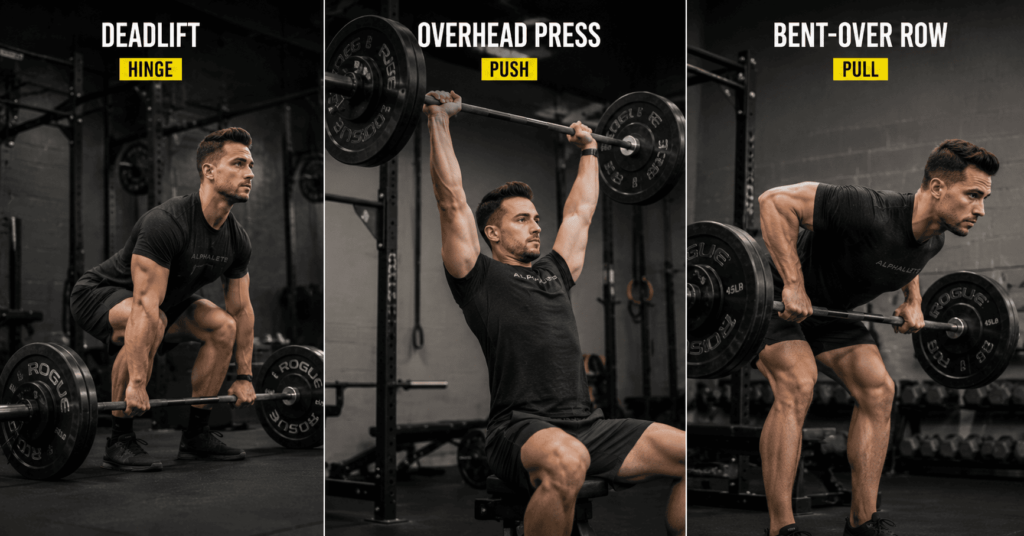
Stand with feet hip-width apart and the bar positioned over the ball of the big toe. Grip the bar at shoulder width with a flat back and engaged lats. Drive the hips forward to lift the bar while keeping it close to the body throughout the movement. Stand tall at the top without leaning backward into hyperextension. Hinge at the hips to lower the bar back to the floor with full control.
Keeping the bar close to the body throughout the entire lift reduces the moment arm and protects the lower back. The bar should drag up the shins and thighs on every rep. If it drifts forward, the lower back absorbs load it was never designed to handle.
For beginners, rack pulls starting with the bar at knee height reduce the range of motion and allow the hip hinge mechanics and back engagement to be learned before pulling from the floor.
Perform 3 to 4 sets of 5 to 8 reps.
Exercise 4: Barbell Overhead Press: For Broad, Three-Dimensional Shoulders
The overhead press is the most effective compound exercise for building broad, three-dimensional shoulder mass and it is genuinely underutilised in most training programmes. It forces intense core stabilisation to protect the spine from the overhead loading, making it a full body strength training exercise rather than an isolated shoulder movement. Posture also improves over time as the overhead pressing pattern requires and develops proper thoracic extension and scapular positioning.
Begin with the bar at collarbone height and hands slightly wider than shoulder width. Brace the core firmly before beginning the press. Drive the bar straight overhead to full arm extension. Hold briefly at the top and return the bar slowly to the starting position. Avoid swaying or arching the lower back throughout.
A rigid core brace before and throughout every rep is the single most important technique cue for this exercise. Any arching of the lower back is a sign that either the weight is too heavy or the core bracing is insufficient.
For beginners, a landmine press or seated dumbbell press builds shoulder mobility and pressing confidence before standing barbell loading.
Perform 3 to 4 sets of 6 to 10 reps.
Exercise 5: Barbell Bent-Over Row: For a Thick, Wide Back
The bent-over row is the perfect horizontal pull to balance the horizontal push of the bench press. Most people push far more than they pull, which creates the rounded shoulder posture and chronic shoulder pain that accumulates quietly over months of imbalanced training. Rows build the V-taper, thick mid-back, and rear delta development that makes the upper body look genuinely three-dimensional rather than flat and underdeveloped from behind.
Hinge at the hips until the torso is roughly parallel to the floor with knees slightly bent and back flat. Pull the bar to the lower chest by driving the elbows back behind the torso. Lower slowly back to the starting position without using momentum or jerking the body. The elbows drive the movement throughout, not the hands.
Pulling through the elbows rather than the hands is the most important cue for maximising lat and mid-back activation while minimising bicep dominance. A slow controlled lowering phase doubles the time under tension and significantly increases the hypertrophic stimulus per set.
For beginners, Pendlay rows or seated cable rows work well for those who find controlling the barbell position challenging initially.
Perform 3 to 4 sets of 6 to 10 reps.
Exercise 6: Romanian Deadlift: For Hamstring and Glute Hypertrophy
The conventional deadlift trains the full posterior chain through a pulling pattern. The Romanian deadlift isolates the hamstrings and glutes through a hinging pattern with a deep stretch at the bottom that produces significantly greater hamstring hypertrophy than conventional pulling alone. It directly complements the squat by strengthening the hip extensors in the lengthened position where most lower body injuries actually occur. The tendons involved in these hinging movements also benefit from targeted conditioning, and dedicated tendon strengthening exercises build the connective tissue resilience that keeps heavy posterior chain work sustainable over time.
Start standing with a slight bend in the knees. Lower the barbell by pushing the hips backward rather than bending the knees forward. Keep the back straight and feel the hamstring stretch build throughout the descent. Lower until a strong stretch is clearly felt, then drive the hips forward to return to the starting position. Squeeze the glutes firmly at the top of every single rep.
The slower the descent the more effective this exercise becomes. A 3 to 4 second lowering phase with a brief pause at the bottom maximises the stretch under load that drives hamstring and glute hypertrophy more than any other posterior chain movement available.
Perform 3 to 4 sets of 8 to 12 reps.
Exercise 7: Barbell Front Squat: For Complete Lower Body Development
Where the back squat emphasises glutes and hamstrings, the front squat shifts the load forward and places greater demand on the quadriceps and upper back. Together these two squat variations develop balanced lower body muscle mass across all three major muscle groups of the legs without the spinal loading that very heavy back squats accumulate over time. The front squat also requires and develops thoracic mobility and core strength that directly improve every other barbell movement in the programme.
Position the bar at the front of the shoulders with hands shoulder-width apart, elbows bent high, and palms facing forward. Lower the hips back and down while keeping the elbows high and the chest tall throughout. Push through the heels to return to the starting position. Keep the back flat and head up from start to finish.
Keeping the elbows high throughout the entire movement prevents the bar from rolling forward off the shoulders, which is the most common technique breakdown in this exercise. Start lighter than the back squat and prioritise form mastery before adding load.
For beginners, a goblet squat with a dumbbell develops the front squat pattern and thoracic mobility before transitioning to barbell loading.
Perform 3 to 4 sets of 6 to 10 reps.
The 7 Best Barbell Exercises at a Glance
| Exercise | Primary Muscles | Secondary Muscles | Sets and Reps | Primary Goal |
| Barbell Back Squat | Quadriceps, glutes, hamstrings | Lower back, core | 3 to 4 sets of 6 to 10 reps | Lower-body mass and strength |
| Barbell Bench Press | Chest, triceps | Anterior deltoids, serratus anterior | 3 to 4 sets of 6 to 10 reps | Upper-body pressing power |
| Conventional Deadlift | Entire posterior chain | Lats, traps, core | 3 to 4 sets of 5 to 8 reps | Total-body strength and muscle mass |
| Overhead Press | Deltoids, triceps | Traps, core | 3 to 4 sets of 6 to 10 reps | Shoulder size and stability |
| Bent-Over Row | Lats, rhomboids, traps | Biceps, rear deltoids | 3 to 4 sets of 6 to 10 reps | Back thickness and V-taper development |
| Romanian Deadlift | Hamstrings, glutes | Hip stabilisers, spinal erectors | 3 to 4 sets of 8 to 12 reps | Posterior chain hypertrophy |
| Barbell Front Squat | Quadriceps, upper back | Glutes, core | 3 to 4 sets of 6 to 10 reps | Quad development and core strength |
How to Build These Into a Weekly Barbell Workout Programme
- Perform barbell lifts first in every workout. Complete them immediately after a thorough warm-up when energy, focus, and strength are at their highest.
- Prioritise form over fatigue. Performing heavy compounds while fresh helps maintain technique, maximise force production, and reduce long-term injury risk.
- Train 3 to 4 days per week. This frequency provides enough stimulus for muscle growth while allowing adequate recovery between sessions.
- Allow 48 to 72 hours of recovery before training the same muscle groups again to support muscle repair and growth.
- Use an upper/lower split for simplicity and balance.
- Upper Body Days: Bench Press, Overhead Press, Bent-Over Row
- Lower Body Days: Back Squat, Deadlift, Romanian Deadlift, Front Squat
- Progressively add weight when possible. In the early stages, small weight increases from session to session are often the most effective way to build strength and muscle.
- Use other progression methods when weight increases stall.
- Slow the lowering phase to 3 to 4 seconds
- Reduce rest periods
- Add an extra set
- Progress to more challenging variations
- Track every workout. Record weights, sets, and reps to ensure progressive overload is happening consistently rather than relying on memory.
- Prioritise protein intake. Aim for approximately 0.7 to 1 gram of protein per pound of bodyweight daily to support recovery and muscle growth.
- Get 7 to 9 hours of sleep each night. Quality sleep is one of the most important factors for strength gains, recovery, and hypertrophy.
- Treat rest days as part of the programme. Muscles grow and adapt during recovery, not during the workout itself.
- Build a foundation before heavy barbell training. Develop stability and movement control through isometric exercises, bodyweight compounds, and unilateral training.
- Master the movement pattern first. Learn bodyweight or dumbbell versions of squats, presses, rows, and hinges before progressing to a barbell.
- Use a spotter when lifting heavy. This is especially important for challenging sets of bench presses and squats.
- Focus on long-term training habits. Consistent technique, recovery, progression, and injury prevention are what allow lifters to keep improving for years.
Conclusion
The 7 best barbell exercises in this guide are not a complicated programme or a secret formula. They are the foundational compound movements that have built more muscle mass and developed more genuine strength than any other exercises in the history of the sport. Squat, bench, deadlift, overhead press, row, Romanian deadlift, and front squat. Seven movements. One barbell. Everything the body needs to build serious, lasting muscle mass.
Beginners following this programme consistently for 12 weeks will experience significant strength improvements, visible muscle development, and improved movement quality across daily life. The variables that determine whether that happens are consistency, progressive overload, adequate protein, and sufficient sleep. All four must be present for the training to deliver its full potential.
Grab the barbell, commit to the fundamentals, and let the results do the talking.
For more structured, science-informed training guides covering everything from barbell programming to bodyweight training and beyond, explore the full resource library at Fitness Geekz.
Frequently Asked Questions
The most effective barbell exercises for muscle growth are the back squat, bench press, conventional deadlift, overhead press, bent-over row, Romanian deadlift, and front squat. These compound movements train multiple muscle groups simultaneously and create the mechanical tension and training stimulus needed for hypertrophy.
Three to four days per week is ideal for most lifters. This frequency provides enough training volume to stimulate muscle growth while allowing the 48 to 72 hours of recovery needed between sessions. More training is not always better if recovery is insufficient.
Yes, but beginners should first develop basic stability and movement quality through bodyweight exercises, unilateral movements, and isometric holds. Learning the movement pattern with dumbbells or machines before progressing to heavier barbell work can improve technique and reduce injury risk.
Use a weight that allows you to complete all prescribed reps with good form while making the final few reps challenging. Starting with an empty barbell is completely appropriate until technique is mastered. Gradual weight increases over time produce better long-term results than lifting too heavy too soon.
Protein intake of roughly 0.7 to 1 gram per pound of bodyweight is the most important nutritional factor for muscle growth and recovery. Adequate overall calorie intake is equally important. For building muscle, a modest daily calorie surplus of 200 to 300 calories above maintenance can support growth while helping limit unnecessary fat gain.