


Building muscle faster is not about training harder. It is about training smarter. Most people get stuck because they are missing at least one of the three non-negotiables: structured training, consistent nutrition, and real recovery. This guide breaks down 10 science-backed tips that actually work, from training frequency and compound movements to protein timing, caloric surplus, and the one supplement worth taking. Whether you are just starting out or hitting a frustrating plateau, these principles give your body a clear reason to grow. Follow them consistently and the results will come.
Building muscle often feels frustrating. Some people seem to grow effortlessly, while others train for years with minimal results. The difference isn’t luck. It comes down to applying the right principles consistently.
Research shows beginners can gain around 1-1.5% of their body weight in lean muscle per month when training, nutrition, and recovery are aligned. Yet most people miss at least one of these pillars. They either train hard without structure, eat inconsistently, or ignore recovery.
If the goal is to build muscle faster naturally, the approach needs to be smarter, not just harder. This guide breaks down 10 proven, science-based tips that actually work in real-world training.
Skip the guesswork and watch the full demonstration 👉Watch Now
The Science Behind Natural Muscle Growth

Muscle growth, or hypertrophy, is driven by three key physiological factors that work together during training.
- Mechanical tension occurs when muscles contract against resistance, especially during controlled, challenging lifts. This is the primary driver of strength and size gains, as it signals the body to adapt and grow stronger.
- Metabolic stress builds up during sustained effort, particularly in higher rep ranges or longer sets. This creates a “burn” sensation and contributes to muscle growth by increasing cellular swelling and metabolic byproducts that support adaptation.
- Muscle damage happens when fibers experience controlled stress, especially during the lowering phase of a movement. This damage triggers repair processes, leading to stronger and thicker muscle tissue over time.
To maximize natural muscle growth, three foundational pillars must align.
Progressive resistance training ensures the muscles are consistently challenged with increasing load or difficulty.
Adequate nutrition provides the protein and calories needed to repair and build muscle tissue.
Quality recovery, especially proper sleep, allows the body to rebuild and adapt effectively.
Miss one of these pillars, and progress slows. Align all three consistently, and long-term results follow.
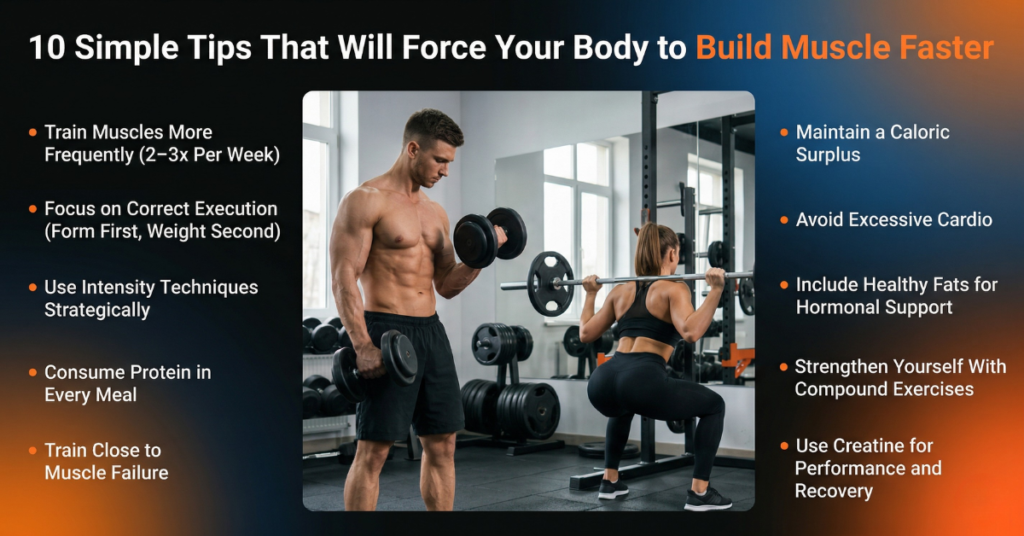
10 Simple Tips That Will Force Your Body to Build Muscle Faster
1. Train Muscles More Frequently (2–3x Per Week)
Training a muscle once a week is no longer considered optimal for hypertrophy. Muscle protein synthesis increases for about 24–48 hours after training. That means more frequent stimulation leads to better growth.
Practical approach:
- Full body training 3 times per week
- Upper-lower split 4 times per week
Higher frequency improves both strength and muscle development without increasing total workload excessively.
2. Focus on Correct Execution (Form First, Weight Second)
Muscles respond to tension, not ego lifting. Poor form shifts tension away from the target muscle and increases injury risk.
Key focus points:
- Controlled reps
- Full range of motion
- Strong mind-muscle connection
Better execution leads to better muscle activation, which directly improves results.
3. Use Intensity Techniques Strategically
Once basic training becomes less effective, intensity techniques can push growth further.
Effective methods:
- Drop sets
- Rest-pause sets
- Isometric holds
These increase time under tension and metabolic stress, both key drivers of hypertrophy. Use them sparingly to avoid fatigue buildup.
4. Consume Protein in Every Meal
Protein is the building block of muscle. Without enough of it, recovery and growth slow down.
Target intake:
- 1.6 to 2.2 grams per kg of body weight
Spread protein across the day:
- 20 to 40 grams every 3–4 hours
Simple sources include eggs, chicken, fish, dairy, lentils, and tofu. Consistency matters more than perfection.
5. Train Close to Muscle Failure
To stimulate growth, muscles need to be pushed hard. Training close to failure ensures maximum fiber recruitment.
Ideal approach:
- Stop 1–3 reps before failure
- Maintain proper form
Going to complete failure on every set is not necessary and can harm recovery. Smart intensity always beats reckless effort.
6. Maintain a Caloric Surplus
Muscle growth requires energy. If calorie intake is too low, the body prioritizes survival over building muscle.
Recommended surplus:
- 300–500 calories above maintenance
Focus on whole foods:
- Rice, potatoes, oats
- Lean proteins
- Healthy fats
If weight is not increasing gradually, muscle gain will not happen. Tracking body weight weekly keeps progress on track.
7. Avoid Excessive Cardio
Cardio has benefits, but too much of it can slow muscle growth by increasing fatigue and cortisol levels.
Balanced approach:
- 30–45 minutes of walking
- 3–4 times per week
This supports heart health without interfering with recovery or strength gains.
8. Include Healthy Fats for Hormonal Support
Hormones play a key role in muscle growth, especially testosterone. Healthy fats support hormone production and recovery.
Best sources:
- Nuts and seeds
- Olive oil
- Fatty fish
- Egg yolks
Omega-3 fatty acids also help reduce inflammation and improve recovery between workouts.
9. Strengthen Yourself With Compound Exercises
Compound lifts should form at least half of any muscle-building program. They recruit multiple muscle groups and allow heavier loading.
Key movements:
- Squats
- Deadlifts
- Bench press
- Pull-ups
- Rows
These exercises create a strong foundation for natural muscle growth and improve overall strength.
10. Use Creatine for Performance and Recovery
Creatine is one of the most researched and effective supplements available.
Benefits include:
- Increased strength output
- Better recovery
- Improved muscle cell hydration
Recommended dosage:
- 3–5 grams daily
It supports performance but does not replace proper training and nutrition.
Real-World Application
| Category | Focus | Key Actions |
| Beginners | Build foundation | Full-body workouts, learn proper form, stay consistent |
| Intermediate Lifters | Increase progress | Higher training frequency, add isolation work, use intensity techniques |
| Busy Individuals | Maximize efficiency | Focus on compound exercises, keep workouts around 45 minutes, prioritize quality over quantity |
The goal is not perfection. It is sustainability.
Injury Prevention and Long-Term Growth

Long-term progress depends on avoiding common mistakes and building sustainable habits.
Most setbacks come from:
• Poor technique that places stress on joints instead of muscles
• Excessive volume that leads to fatigue and overtraining
• Ignoring recovery, which limits muscle repair and growth
Smart habits to follow:
• Proper warm-ups to prepare muscles and joints before training
• Gradual progression to safely increase strength over time
• Deload weeks every 6 to 8 weeks to reduce fatigue and prevent burnout
Consistent training, combined with smart recovery, is what drives long-term natural muscle growth without unnecessary setbacks.
Conclusion: Build Muscle Faster Naturally With the Right Approach
Building muscle naturally comes down to a few core principles done consistently. Train with purpose, eat in a way that supports growth, and prioritize recovery as much as the workout itself. There are no shortcuts, but there is a clear and proven path. Those who follow it with discipline will always outperform those looking for quick fixes.
Start simple by training three times per week, meeting daily protein targets, and tracking progress over time. The body adapts when it is exposed to the right stimulus repeatedly. With patience and consistency, strength and muscle will follow. For more practical muscle-building strategies and expert fitness guidance, explore detailed resources at Fitness Geekz.
FAQs
Focus on progressive overload, proper nutrition, and recovery. Supplements are optional, not essential.
Train full-body workouts three times per week, prioritize compound exercises, and maintain a calorie surplus.
About 1.6 to 2.2 grams per kilogram of body weight daily is considered optimal.
Yes, with bodyweight training and progressive overload, although gym training allows easier load progression.
Common reasons include insufficient calorie intake, low protein, lack of progression, and poor recovery habits.