
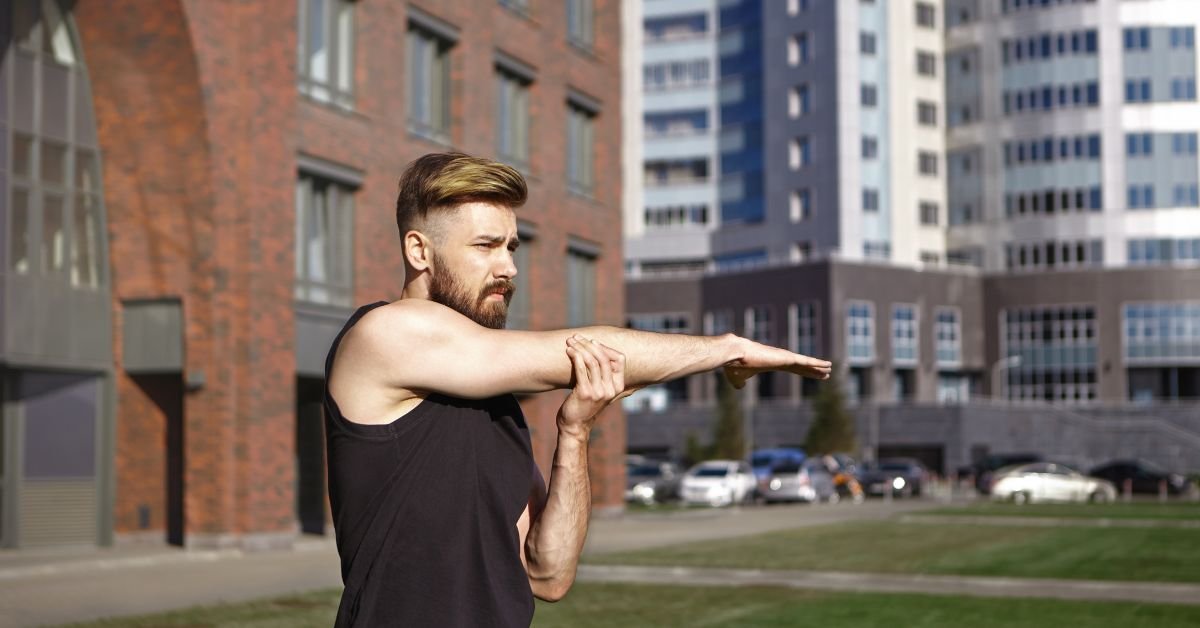

Quick Answer: Rotator cuff exercises strengthen the four muscles that stabilize the shoulder joint, reducing the risk of impingement, tears, and chronic pain. Slow, controlled movements using light resistance target the supraspinatus, infraspinatus, teres minor, and subscapularis, building shoulder durability for lifting, reaching, and daily overhead movement.
- The rotator cuff is made up of four muscles: supraspinatus, infraspinatus, teres minor, and subscapularis
- Rotator cuff tears send more than 2 million people to the doctor each year in the United States
- Effective rotator cuff exercises use light resistance and slow, controlled movement, not heavy loading
- A common training target is 2–3 sets of 10–15 reps, 2–3 days per week
- Building rear and lateral shoulder strength alongside rotator cuff work helps correct posture-related shoulder instability
Introduction
More than 2 million people visit a doctor in the United States every year because of a rotator cuff tear. That number alone says something most training routines quietly ignore: the shoulder is one of the most neglected, misunderstood joints in fitness, right up until the moment it stops cooperating.
The frustrating part is how this usually plays out. By the time shoulder pain actually shows up, the damage is already underway, mobility has quietly declined, strength has slipped, and reaching for something on a high shelf suddenly feels like a full-body negotiation. Rotator cuff exercises exist to catch this before it happens, using targeted, low-load movements that keep the shoulder joint stable and resilient. This guide breaks down exactly what the rotator cuff does, the core exercises that protect it, how to layer in surrounding shoulder strength, and how to build all of it into a routine that actually sticks.
Curious how it’s done? Watch the full exercise here:
What Is the Rotator Cuff?
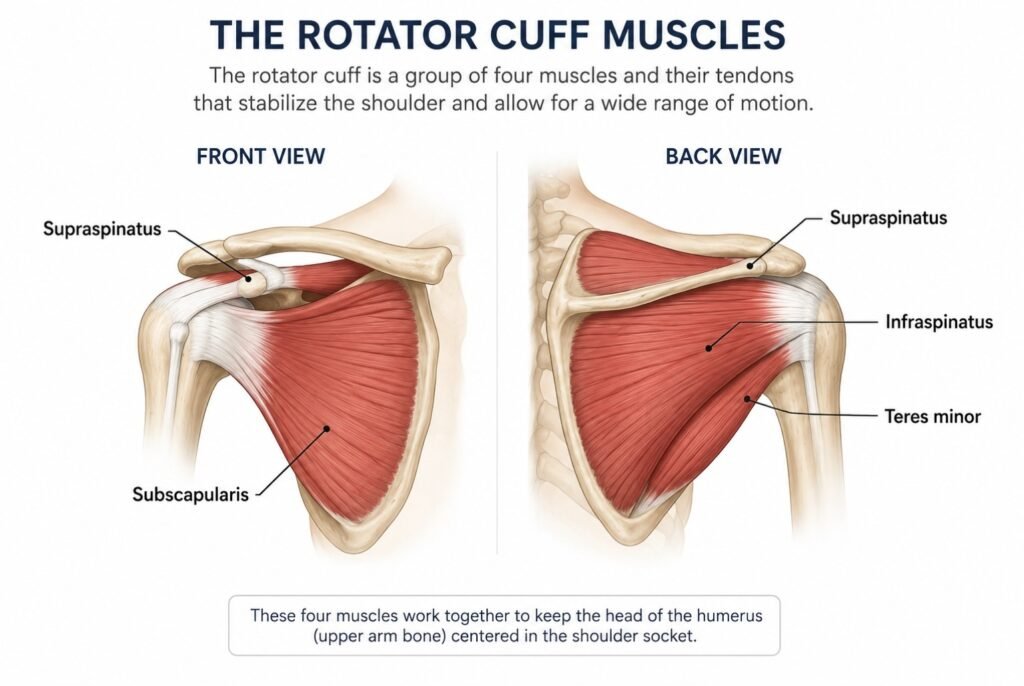
The rotator cuff is a group of four muscles, the supraspinatus, infraspinatus, teres minor, and subscapularis, that stabilize the shoulder joint and allow the arm to move through an unusually wide range of motion without slipping out of place.
Physical therapist Heidi Jannenga, founder of WebPT, describes it with a simple image worth remembering: picture the head of the arm bone as a golf ball resting on a golf tee, which is the shallow socket of the shoulder blade. The rotator cuff acts as the sleeve that lets that ball spin and roll freely while keeping it securely on the tee. It’s a small, unglamorous group of muscles doing an enormous amount of stabilizing work every time the arm moves.
Common Rotator Cuff Injuries
The two most common rotator cuff injuries are impingement, where a tendon becomes compressed and irritated as it passes through the shoulder joint, and tears, where a tendon or muscle fiber is partially or fully torn. Repetitive overhead motion, think throwing athletes, painters, or anyone doing repeated reaching overhead, is a frequent cause, along with traumatic injuries like falling directly onto an outstretched arm. Risk climbs with age as accumulated wear catches up with the joint.
Best Rotator Cuff Exercises to Prevent Shoulder Pain
Effective rotator cuff training depends on light resistance, slow tempo, and precise form. These are small stabilizing muscles, not prime movers built for heavy loading, and treating them like a bicep curl defeats the purpose entirely.
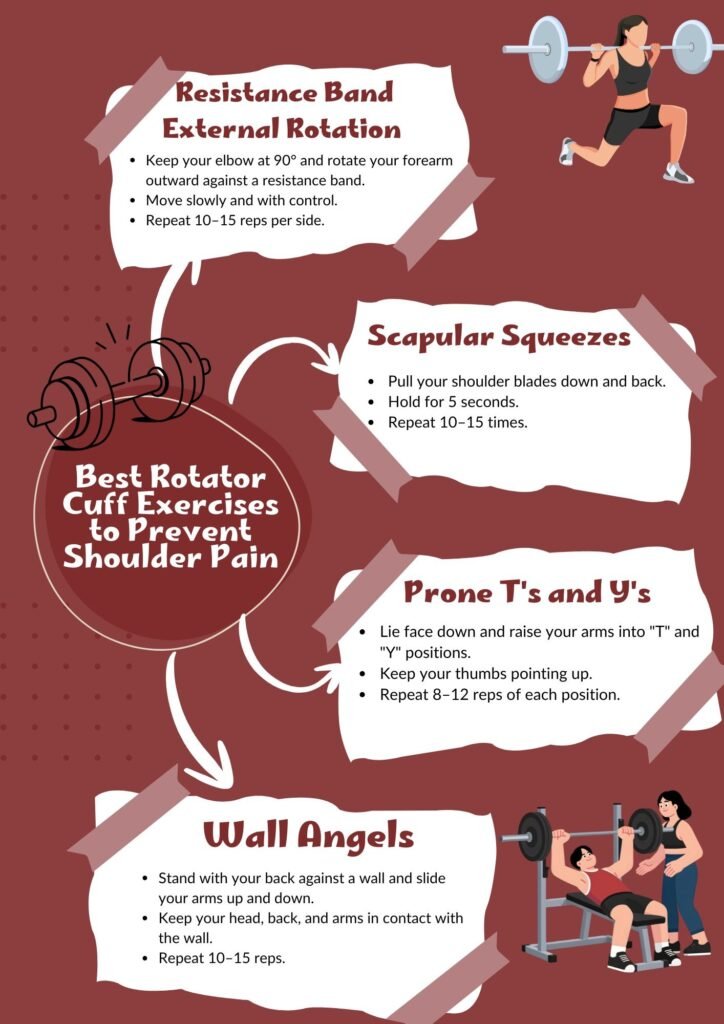
1. Resistance Band External Rotation
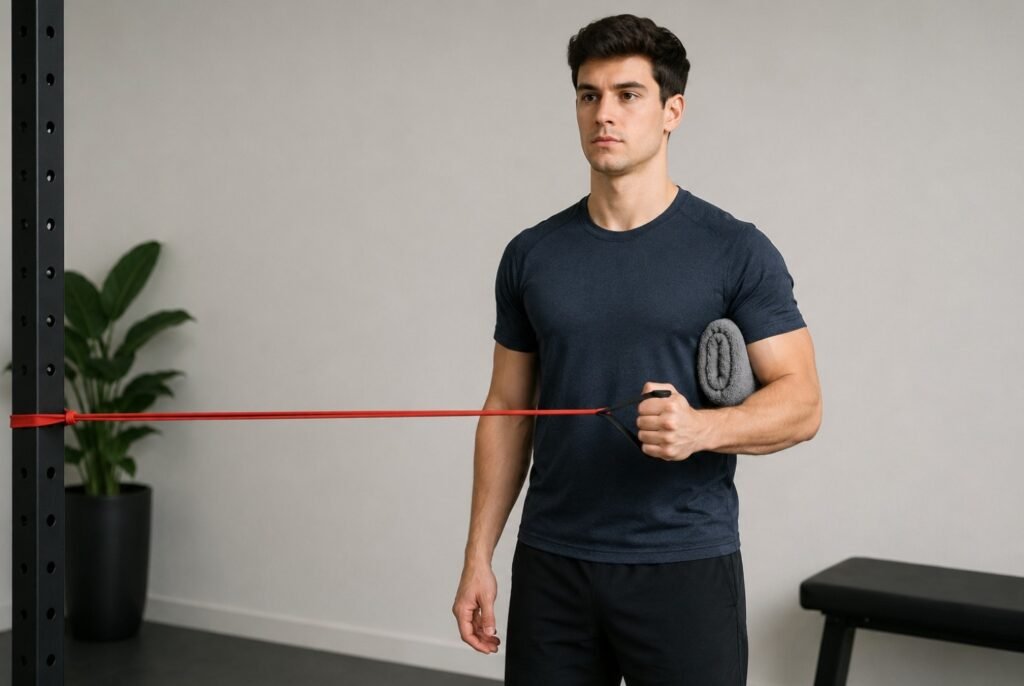
Anchor a light resistance band at belly-button height. Tuck a rolled towel between the ribcage and the elbow to keep the rotator cuff isolated, keep the elbow bent at 90 degrees, and slowly rotate the forearm away from the body. This movement targets the infraspinatus and teres minor directly, two muscles that are frequently underdeveloped compared to the front of the shoulder, since most pushing exercises never touch them.
2. Scapular Squeezes
Sit or stand with the arms at the sides, then pull the shoulder blades down and back as if trying to hold a pencil between them. Hold for 5 seconds. This simple movement improves posture and reduces tendon pinching by creating more space within the shoulder joint itself.
3. Prone T’s and Y’s
Lie face-down on a bench or bed with the arms hanging, thumbs pointed up. Raise the arms out to the sides to form a “T,” then to a 45-degree angle to form a “Y.” This builds the mid and lower trapezius, which support healthy shoulder blade positioning during any kind of overhead reaching or lifting.
4. Wall Angels
Stand with the back, head, and hips flat against a wall, arms raised to a 90-degree angle. Slide the arms up and down like making a snow angel, keeping contact with the wall throughout. This movement tends to expose limited shoulder mobility almost immediately, and repeating it consistently helps reinforce a healthier scapular movement pattern over time. These holds are, at their core, a form of isometric control training, for readers interested in how static holds like this build joint-friendly strength, this isometric training guide covers the underlying principles in more depth.
General prescription: most rotator cuff exercises are performed for 3 sets of 10–15 repetitions, 2 to 3 days per week, using light resistance or bodyweight only.
Do Lateral and Rear Delt Exercises Help Prevent Shoulder Injury?
Yes. Rotator cuff exercises stabilize the joint itself, but building strength in the surrounding deltoid muscles helps distribute load more evenly and corrects the postural habits that contribute to shoulder pain in the first place.
Here’s the pattern worth recognizing: prolonged sitting, screen use, and desk work all tend to weaken the rear deltoids and upper back over time, which encourages rounded shoulders and internal rotation. That posture places ongoing extra strain on the rotator cuff, even without any single traumatic injury causing it. Lateral raises and reverse flyes are useful complementary movements here, performed with light weight, a controlled tempo, and a stable scapula rather than a shrug through the top of the movement, they build shoulder width while directly targeting rear-deltoid weakness. Anyone tackling posture from the upper-back side of things might also find real value in this comparison of why inverted rows outperform lat pulldowns for posture and upper back strength, since scapular retraction strength plays into shoulder stability from a different angle.
Rotator Cuff and Shoulder Exercises Compared
| Exercise | Primary Muscles Targeted | Equipment Needed | Best For |
| Resistance Band External Rotation | Infraspinatus and teres minor | Light resistance band | Rotator cuff isolation and shoulder stability |
| Scapular Squeezes | Rhomboids and middle trapezius | None | Improving posture and scapular control |
| Prone T’s and Y’s | Trapezius and rear deltoids | None or light dumbbells | Enhancing overhead stability and shoulder health |
| Wall Angels | Rotator cuff and scapular stabilizers | Wall | Improving mobility and correcting movement patterns |
| Reverse Flyes | Rear deltoids and rhomboids | Light dumbbells | Postural correction and upper back strength |
| Lateral Raises | Medial deltoids | Light dumbbells | Building shoulder width and supporting joint stability |
How to Program Rotator Cuff Exercises Into a Weekly Routine
Building a sustainable shoulder routine follows a clear structure:
- Warm up with 5–10 minutes of light movement to increase blood flow to the shoulder joint
- Perform rotator cuff exercises for 2–3 sets of 10–15 reps, using light resistance and a slow, controlled tempo
- Train 2 to 3 days per week, allowing rest between sessions so the smaller stabilizing muscles can recover
- Layer in complementary rear and lateral deltoid work on separate training days to build broader shoulder strength
- Stop immediately and consult a doctor or physical therapist if any exercise causes pain, none of these movements should hurt when performed correctly
A few recovery-supporting habits are worth adding alongside this routine: gentle self-myofascial release using a tennis ball on the upper back and chest can ease tension between sessions, and following basic RICE guidance (rest, ice, compression, elevation) immediately after any acute injury supports faster, safer recovery. Bodyweight upper-body work also fits well into this same joint-conscious approach; this breakdown of chair dips versus push-ups for upper body strength is a useful reference for anyone building pushing strength without overloading a shoulder that’s still stabilizing.
Moving Forward With Stronger, More Resilient Shoulders
The shoulder rarely gets the attention it deserves until it stops cooperating, and by then the fix takes far longer than the prevention would have. A small, consistent investment in slow, controlled rotator cuff work pays off in long-term mobility, reduced injury risk, and shoulders that hold up to lifting, reaching, and daily life without complaint.
The next step is straightforward: start with the four core exercises above, two to three times a week, and layer in rear and lateral deltoid training as stability improves. Explore more training resources on Fitness Geekz to build a complete, sustainable approach to shoulder health and long-term joint resilience.
FAQs
Resistance band external rotations, scapular squeezes, prone T’s and Y’s, and wall angels are among the most effective exercises for building rotator cuff strength and stability, typically performed with light resistance and controlled movement.
Most guidance recommends 2 to 3 sessions per week, performing 2 to 3 sets of 10 to 15 repetitions with light resistance to strengthen the shoulder without overloading the smaller stabilizing muscles.
Yes, strengthening the muscles that stabilize the shoulder joint helps distribute load more evenly during daily and athletic movement, which can reduce the risk of impingement and tears over time.
A strain or tear occurs when a rotator cuff tendon or muscle fiber is stretched or torn, while an impingement involves a tendon becoming compressed and irritated within the shoulder joint; both can cause pain but require different management approaches.
Gentle, controlled exercises can support recovery once acute swelling has subsided, but persistent pain, swelling, or difficulty raising the arm should be evaluated by a doctor or physical therapist before continuing an exercise program.