

Quick Answer
Progressive overload is the training principle of gradually increasing weight, reps, sets, or intensity so muscles are forced to adapt, and it remains the single most reliable method for building strength and muscle safely, provided the increases stay small, consistent, and matched to proper recovery.
- Progressive overload means gradually increasing training stress over time through added weight, reps, sets, or reduced rest.
- The safest weekly load increase is typically 2 to 5 percent once form is solid at the current weight.
- Strength gains rely more on added load with lower reps. Muscle growth responds well to moderate reps and added volume.
- Recovery of 48 to 72 hours between sessions targeting the same muscle group is required for the adaptation to actually happen.
- Progressive overload applies to bodyweight training, running, and cardio, not just barbell lifting.
Introduction
There is a moment almost every lifter eventually hits. The weight that used to feel brutal now moves without much thought. No soreness the next day. Nothing new in the mirror. The workout log looks exactly the same as it did a month ago, and so does the body.
That moment is not a sign of failure. It is a sign the training worked, and the body already caught up to it. Research backs this up clearly. A study tracking gradual load increases of 2 to 5 percent per week over eight weeks found significantly greater strength gains than unstructured, random training. The difference was not effort. It was structured.
This is exactly what progressive overload solves. It is the reason some people keep getting stronger year after year while others stall out doing the same 3 sets of 10 for months. This guide breaks down how progressive overload actually works, why the body stops responding to repeated stimulus, and how to apply it correctly across weight training, bodyweight training, and even running, without turning it into an injury risk.
Want to check your form against the real thing? Click here to watch the full exercise:
What Is Progressive Overload?
Progressive overload is the gradual increase of stress placed on muscles during training, achieved by adding weight, reps, sets, or training frequency, or by reducing rest time and slowing tempo, so the body is continually forced to adapt and grow stronger rather than plateauing at the same fixed workload.
Why the Body Stops Responding to the Same Workout
Every workout places three demands on muscle tissue: mechanical tension from the load itself, small amounts of muscle damage that get repaired stronger during recovery, and metabolic stress from pushing close to fatigue. Together, these three things trigger adaptation.
The problem is simple. Repeat the exact same stimulus long enough, and there is nothing left to adapt to. That flat stretch where nothing improves is called a training plateau, and it happens to nearly everyone who trains without a plan for progression. It is not a lack of discipline. It is biology doing exactly what biology does when a challenge stops being a challenge.
For anyone working through a lower body focused programme, pairing progressive overload with proper squat mechanics makes a measurable difference, something covered in more depth in the site’s squat mobility guide.
Why Progressive Overload Is the Fastest Way to Build Strength
Progressive overload works faster than random training variation because it applies a measurable, structured increase in demand every few sessions, which keeps the nervous system and muscle fibres adapting instead of coasting at a maintained level.
The Real Benefits Backed by Research
- Increases maximal strength and muscular endurance at the same time
- Builds lasting hypertrophy rather than a temporary pump or water retention
- Prevents the plateaus that stall most home and gym routines within 6 to 8 weeks
- Improves body composition through added lean muscle over time
- Keeps training motivating by giving a clear, trackable marker of progress
A 2011 study published in the European Journal of Applied Physiology followed 83 people over 12 weeks and found progressive overload effective for increasing bicep strength and muscle growth in both men and women. That result matters because it was not limited to elite lifters. It applied to regular people doing structured, gradually increasing arm exercises.
How to Apply Progressive Overload Safely
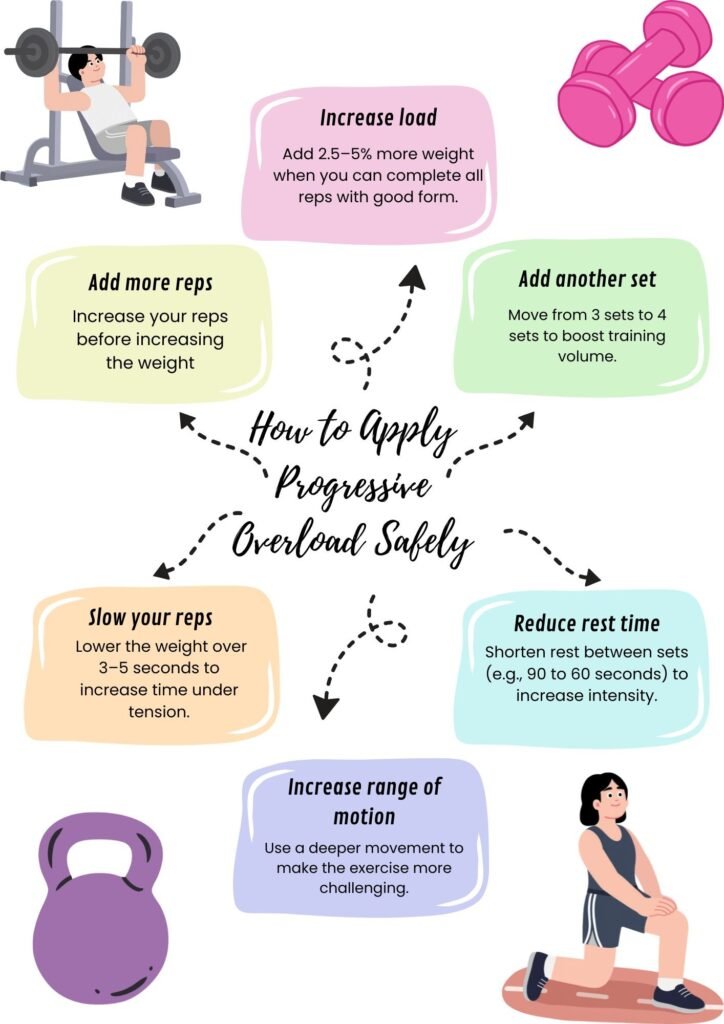
Progressive overload should be applied in small, trackable increments, never through sudden jumps in weight or volume, since the injury risk rises sharply when load increases outpace the body’s ability to adapt.
6 Proven Methods to Progressively Overload
- Increase load. Add roughly 2.5 to 5 percent to the working weight once the current load feels controlled for the full rep range.
- Add reps before adding weight. Push from 3 sets of 8 to 3 sets of 10 before loading the bar further.
- Add sets. Move from 3 sets to 4 to increase total training volume without touching the load.
- Reduce rest between sets. Cutting rest from 90 seconds to 60 seconds raises intensity and metabolic stress.
- Slow the tempo. A 3 to 5 second lowering phase increases time under tension without changing the weight on the bar.
- Extend range of motion. Deeper squats or deficit deadlifts increase total work performed at the same external load, a strategy explained further in the site’s squat depth and mobility guide.
How Much Weight to Add Each Week
A safe general guideline is adding no more than 10 percent to the working weight per week, though most lifters see better long term results staying closer to 2 to 5 percent weekly increases once form is consistent, since larger jumps tend to compromise technique and increase injury risk.
Progressive Overload for Beginners vs Experienced Lifters
Beginners typically progress fastest by simply adding small amounts of weight each week, while experienced lifters usually need to increase training frequency or manipulate volume and tempo, since their nervous system has already adapted to straightforward load increases.
New to Training
Early on, the nervous system adapts quickly, producing what many coaches call newbie gains, a window where consistent small increases of 1 to 2 kilograms produce real, visible strength improvements. The priority here is not complexity. It is mastering form, tracking every session, and adding load or reps steadily without rushing the process.
Training for Years With Progress Stalling
Research from 2017 found that trained individuals often benefit more from increased training frequency than from simply piling on more weight or sets within fewer sessions. For someone stuck at a plateau, spreading a muscle group across 2 to 3 shorter sessions per week, rather than one long grinding workout, tends to break through the wall far faster.
The 7 Best Strength Building Exercises for Progressive Overload
Certain compound exercises respond especially well to progressive overload because they recruit multiple large muscle groups simultaneously, making them the most efficient movements for building total body strength over a structured training block.
1. Deadlift
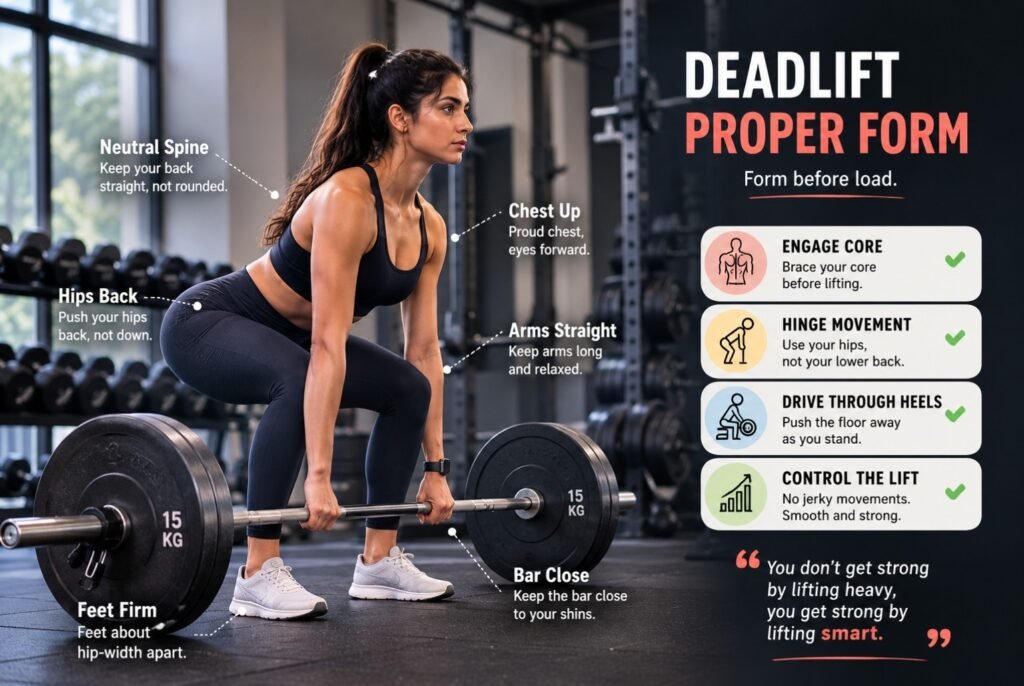
The deadlift is often called the king of lifts for good reason. It hits the hamstrings, glutes, back, and core in one movement, building the kind of real world strength that makes carrying heavy groceries or moving furniture feel manageable. Hafthor Björnsson, known for playing The Mountain, once deadlifted an astonishing 1,104 pounds. Before chasing heavy numbers, mastering the hip hinge pattern matters far more than the weight on the bar.
2. Standing Overhead Press
This movement builds broader shoulders and stronger triceps while forcing the core and legs to stabilise a heavy load overhead. It is one of the most underrated builders of total body pressing power.
3. Pull-Up
Pull-ups target the lats, biceps, and grip strength while demanding full control over bodyweight. The world record for pull-ups completed in 24 hours sits above 10,000, a reminder of just how scalable this movement is when tempo, range, and reps are manipulated correctly.
4. Kettlebell Swing
This exercise blends strength training with cardiovascular conditioning. It builds explosive hip power, core strength, and grip endurance while burning real calories in the process. Kettlebells have been used in strength training for centuries, and the swing remains one of the most efficient functional movements available.
5. Squats
Squats build powerful legs, glutes, and a strong core, and they translate directly into easier daily movement and better athletic performance. Athletes and wrestlers have relied on squats for generations to build strength, endurance, and resilience.
6. Bench Press
The bench press remains the gold standard for upper body pressing strength, targeting the chest, shoulders, and triceps. It is also one of the easiest lifts to track progressive overload on week to week, which is likely why the question “how much do you bench” became a gym cliché in the first place.
7. Sled Push
Popular among football players and elite athletes, the sled push builds explosive leg power, speed, endurance, and full body strength with minimal joint impact. It challenges nearly every major muscle group while improving conditioning, making it one of the most effective and joint-friendly tools for progressive overload.
A Simple 4 Week Progressive Overload Plan
A structured 4 week plan alternating upper and lower body sessions across 4 training days per week is enough to produce noticeable strength gains, provided load, reps, or tempo increases slightly each week and recovery is respected between sessions.
Weekly structure: Day 1 lower body, Day 2 upper body, Day 3 rest or active recovery, Day 4 lower body, Day 5 upper body, remaining days rest.
Weekly progression pattern:
Week 1 focuses on mastering form and establishing baseline loads. Week 2 adds reps or a small load increase. Week 3 adds a set or trims rest time slightly. Week 4 pushes load or tempo for one final measurable increase before reassessing where the body stands.
Stay consistent across these four weeks, and noticeable improvements in strength, endurance, and overall performance follow naturally.
Progressive Overload Methods Compared
| Method | Best For | Typical Progression | Recovery Needed |
| Increase load | Maximal strength | Increase weight by 2% to 5% when target reps are achieved | 48 to 72 hours |
| Increase reps | Muscular endurance and hypertrophy | Add 1 to 2 reps per set before increasing weight | Around 48 hours |
| Increase sets | Increasing total training volume | Add 1 extra set per exercise | 48 to 72 hours |
| Reduce rest periods | Metabolic stress and muscular conditioning | Reduce rest by 15 to 30 seconds | 24 to 48 hours |
| Slow the tempo | Time under tension, technique, and muscle control | Use a 3 to 5 second eccentric (lowering) phase | Around 48 hours |
| Increase training frequency | Experienced lifters overcoming plateaus | Add 1 additional training session per week | Monitor fatigue and recovery closely |
Recovery, Injury Prevention, and Nutrition for Safe Progression
Progressive overload only produces strength and muscle gains when paired with adequate recovery, since the actual adaptation happens during rest, not during the training session itself.
1. Recovery Windows That Actually Matter
Muscle groups need 48 to 72 hours between sessions to properly repair. Building in a deload week every 4 to 6 weeks of consistent progression prevents accumulated fatigue from quietly turning into overtraining.
2. Injury Prevention Rules Worth Following
Form always comes before load. Only one variable should increase at a time rather than weight and reps together in the same week. Joint discomfort, prolonged soreness, or declining performance across sessions are all signals to scale back rather than push through.
3. Nutrition to Support the Adaptation
Adequate protein intake, roughly 1.6 to 2.2 grams per kilogram of bodyweight, supports the muscle repair that progressive overload depends on. Sufficient sleep and hydration directly affect how much load can safely be added week to week, something that gets easy to overlook when the focus stays entirely on the numbers on the bar.
Conclusion
Progressive overload is not a trend, a hack, or a single clever technique. It is the underlying principle that makes every effective strength programme actually work, whether that programme runs on barbells, bodyweight, or a running plan building toward a longer distance.
The path forward does not need to be complicated. Pick one method from the six covered here, apply it consistently for four weeks, track every session honestly, and let recovery do the share of the work that training alone cannot.
Ready to build a plan around this? Explore the strength training and squat mobility guides available on Fitness Geekz, and start the first progressive overload cycle this week. There is no perfect starting point waiting somewhere in the future. The best one is the next workout on the calendar.
Frequently Asked Questions
Progressive overload is the practice of gradually increasing the weight, reps, or intensity of a workout over time so muscles are consistently challenged to adapt and grow stronger.
Small increases can be applied every 1 to 2 weeks once form is consistent, though some lifters using very small increments progress on a near weekly basis without issue.
Yes, beginners typically respond well to progressive overload since the nervous system adapts quickly early on, but form should always be mastered at a given weight before increasing load.
Yes, bodyweight training applies the same principle through added reps, slower tempo, reduced rest, or progressing to harder exercise variations, such as moving from a standard push up to a decline or archer push up.
Increasing load or volume too fast raises the risk of joint strain, poor form, and injury, which is why gradual weekly increases of 2 to 5 percent are recommended over large, unstructured jumps.