
Quick answer: Strength training for women over 40 means working every major muscle group against resistance. Three 30 minute sessions a week, using dumbbells, bands or bodyweight, are a practical start. It helps preserve muscle, bone and daily function in ways cardio alone does not fully replace.
- Two days a week of muscle strengthening is the official minimum. Three short sessions are a practical starting structure.
- Five movement patterns cover most needs: squat, hinge, push, pull, and carry or core.
- Bodyweight, bands or light dumbbells are enough at the start. Technique comes before load.
- Progress by adding reps first, then a small amount of weight.
- Rest 60 to 90 seconds between sets, with a rest day between sessions.
- Cardio still matters, but it does not replace resistance work.
- Heart or blood pressure conditions, low bone density, joint pain or recent surgery call for a conversation with a clinician first.
Introduction

Strength training means making muscles work against a load, whether that is a dumbbell, a resistance band or body weight. Regular muscle-strengthening exercise is recommended for adults at least twice a week, with exercises targeting all major muscle groups. That is the minimum. A three day structure with short sessions gives beginners more practice and a more comfortable learning curve.
Many women arrive at this topic with the same questions. Where should a beginner start? Is 40 too late? Will lifting make the body bulky? Advice online tends to pull in opposite directions, from “walk more” to “lift as heavy as possible.”
This guide sets out what the evidence supports and what is practical guidance. It covers the five core movements, a sample week, a simple progression rule, recovery basics and the situations where a clinician should be consulted first. The aim is a plan that a beginner can start this week and repeat with confidence.
Why Strength Training Matters More After 40
Muscle mass and strength tend to decline gradually with age, and bone density follows a similar pattern, particularly around and after menopause. Resistance training is one of the most direct tools for slowing both trends. Position stands from the American College of Sports Medicine (ACSM) and guidance from the CDC and WHO all include muscle strengthening as a core part of healthy adult activity.
The practical benefits show up in ordinary life. Climbing stairs, carrying shopping bags, lifting a child or grandchild, and getting up from the floor all depend on muscle strength. Training these abilities on purpose makes them easier to keep.
Bone is the second reason. Bone responds to mechanical load, and the transition through menopause is a period when bone density can fall faster. Systematic reviews of exercise in postmenopausal women support resistance training as one of the more effective exercise options for bone health. One well known trial, LIFTMOR, published in the Journal of Bone and Mineral Research, found improvements in bone density and function in postmenopausal women with low bone mass. That trial used supervised, high intensity training, so it does not describe what a home beginner program looks like. It shows what is possible over time, not where to start.
Cardio alone does not cover this ground. Walking, cycling and swimming support heart and lung health and mood, but they place less of the specific mechanical load that muscle and bone respond to. This is why health guidelines recommend both aerobic activity and muscle strengthening rather than choosing one.
Metabolic health is a further benefit. Muscle plays a role in how the body handles blood sugar, and resistance training is associated with improved insulin sensitivity in research. The size of the effect varies between individuals, and no exercise plan guarantees a particular outcome.
How Much Strength Training Is Needed Each Week?
The WHO guidelines on physical activity for adults aged 18 to 64 recommend muscle strengthening activities at moderate or greater intensity, involving all major muscle groups, on two or more days a week. The CDC gives the same advice. These two days are the floor, not the ideal.
A three day plan sits above that minimum and suits many beginners for a practical reason. Short sessions of about 30 minutes, including a warm up, are easier to fit into a working week. Repeating each movement three times a week also speeds up the learning of technique, which matters most in the first month.
Some points shape the weekly structure:
- Rest between sessions. Leaving a day between sessions that work the same muscles allows recovery. Monday, Wednesday and Friday is a common pattern.
- Session length. Thirty minutes is enough at the start. Longer sessions are not required to see progress.
- Aerobic activity. Guidelines recommend 150 to 300 minutes of moderate aerobic activity weekly alongside strength work. Walking counts, and the two types of exercise support each other.
How many days a week should a woman over 40 lift weights? Two days meets the guideline minimum. Three days is a practical starting structure for beginners, with rest days between sessions.
The 5 Core Movements Every Beginner Needs

A beginner does not need dozens of exercises. Five movement patterns cover the major muscle groups and give a base for almost any later program. Each has an easy starting version and a clear path to a harder one.
1. The Squat
The squat trains the quadriceps, glutes and core. It mirrors sitting down and standing up, so it transfers directly to daily life.
- Beginner version: Chair sit to stand, lowering slowly to a stable chair and standing back up.
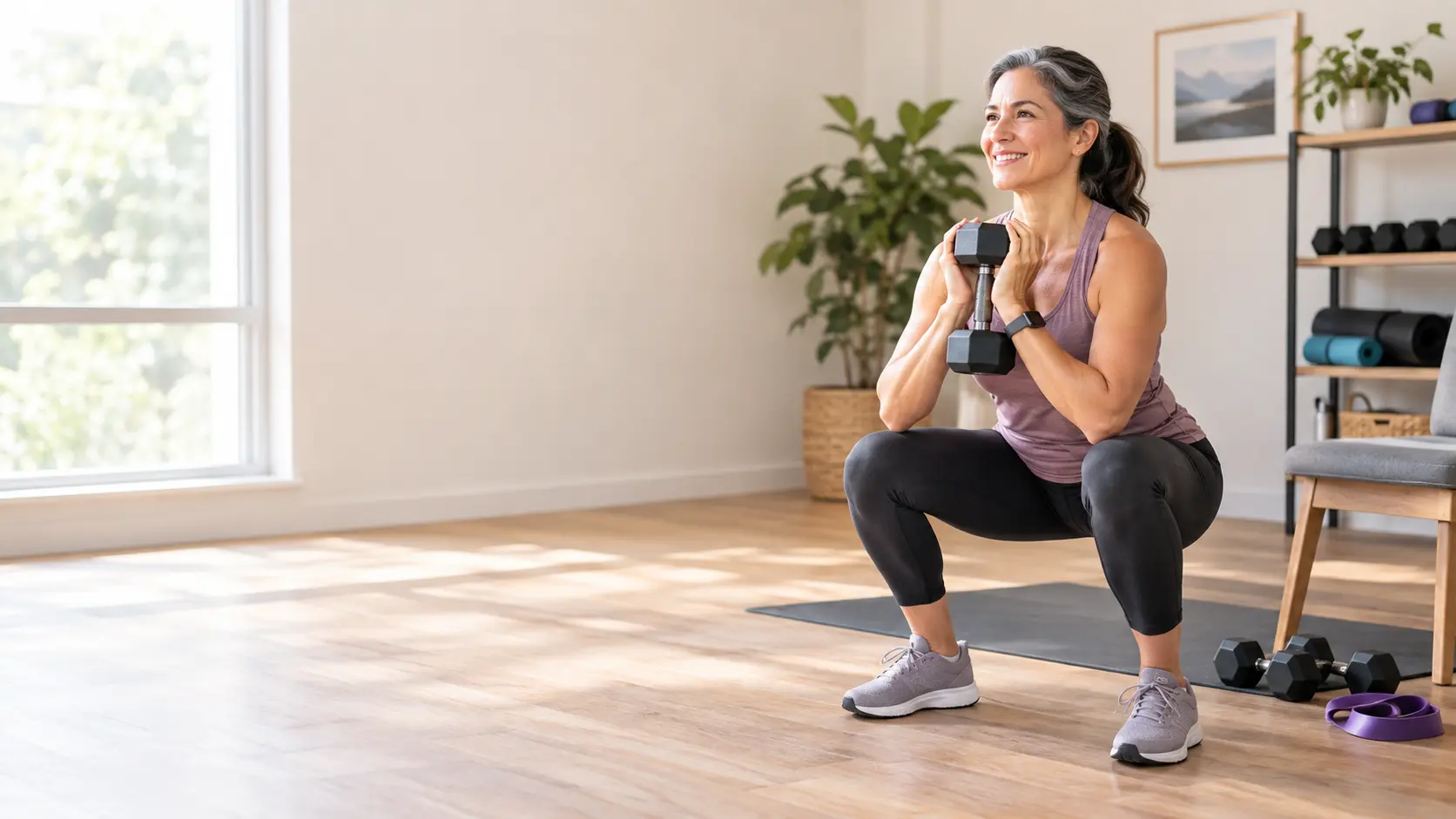
- Later progression: Goblet squat, holding one dumbbell at the chest.
- Form cue: Weight spread through the whole foot, chest tall, knees tracking in line with the toes.
2. The Hip Hinge
The hinge trains the glutes, hamstrings and lower back. These muscles support posture and are often undertrained in people who mostly walk or sit.
- Beginner version: Glute bridge on the floor.
- Later progression: Romanian deadlift with light dumbbells.
- Form cue: Push the hips back rather than bending from the waist, and keep the spine long.
3. The Push
Pushing trains the chest, shoulders and triceps.
- Beginner version: Wall push up or incline push up with hands on a sturdy counter or bench.
- Later progression: Dumbbell floor press, then a full push up.
- Form cue: Ribs down, body in one line, elbows at roughly 45 degrees from the body.
4. The Pull
Pulling trains the upper back, rear shoulders and biceps. It balances the forward rounding that comes with desk work and phone use, and it earns equal weight to pushing in a balanced plan.
- Beginner version: Resistance band row anchored at waist height.
- Later progression: One arm dumbbell row with a hand supported on a bench.
- Form cue: Lead with the elbow, and keep the shoulders away from the ears.
5. Carry or Core
This pattern trains the trunk to stay stable while the limbs move or carry a load. It focuses on stability rather than sit ups.
- Beginner version: Dead bug, lying on the back and extending opposite arm and leg while the lower back stays gently pressed to the floor.
- Later progression: Farmer carry with dumbbells, or a forearm plank.
- Form cue: Ribs stacked over hips, with steady breathing throughout.
| Movement | Main muscles trained | Beginner version | Later progression | Key form cue |
| Squat | Quads, glutes, core | Chair sit to stand | Goblet squat | Weight through the whole foot, chest tall |
| Hinge | Glutes, hamstrings, lower back | Glute bridge | Romanian deadlift | Push hips back, keep the spine long |
| Push | Chest, shoulders, triceps | Wall or incline push up | Floor press or full push up | Ribs down, elbows about 45 degrees |
| Pull | Upper back, rear shoulders, biceps | Band row | One arm dumbbell row | Lead with the elbow, shoulders down |
| Carry or core | Core, grip, upper back | Dead bug | Farmer carry or plank | Ribs over hips, steady breathing |
What are the basic strength exercises for beginners? The five basics are a squat, a hip hinge, a push, a pull, and a carry or core exercise. Each has an easier version for the first weeks.
Anyone unsure about balance can use chair supported or wall based variations until confidence builds.
A Sample Week: 3 Days, 30 Minutes Each
The plan below is a starting template. Set and rep ranges reflect commonly used, evidence supported ranges in resistance training guidance, not exact prescriptions. Individual needs differ, and loads should always be chosen for good technique first.
Warm up (about 5 minutes): Arm circles, hip circles, leg swings, marching in place and a few slow bodyweight squats. The first set of each exercise should feel light.
| Day | Movements | Sets × reps | Rest |
| Day 1 | Chair or goblet squat, dumbbell row, incline push up, glute bridge, dead bug | 2 to 3 × 8 to 12 | 60 to 90 sec |
| Day 2 | Romanian deadlift (light dumbbells), floor press, band row, step up, farmer carry | 2 to 3 × 8 to 12 | 60 to 90 sec |
| Day 3 | Squat variation, hip hinge variation, push, pull, plank | 2 to 3 × 8 to 12 | 60 to 90 sec |
What does a beginner strength training week look like? Three full body sessions of about 30 minutes, on non consecutive days, using five basic movements at 2 to 3 sets of 8 to 12 reps.
Choosing the Right Effort
Effort is easier to judge with a simple rule: finish each set with about two or three good reps still available. This is often called “reps in reserve.” The last few reps should feel challenging but controlled, and form should stay clean. If technique breaks down, the weight is too heavy. If the set feels easy enough to repeat twice over, the weight is too light to drive much change.
If a Session Is Missed
A missed session does not need to be doubled up later. Repeating the week’s plan as scheduled works better than cramming, and one missed day rarely affects long term progress. Low energy days, including days affected by perimenopause or menopause symptoms, are a reason to reduce sets or weight rather than skip entirely.
How to Progress Week by Week
One simple rule keeps progression manageable: add reps first, then add weight.
- Choose a weight that allows 8 reps with good form.
- Add a rep each session or each week until all sets reach 12 reps with control.
- Increase the weight slightly, then return to 8 reps and repeat.
How do you progress in strength training as a beginner? Add repetitions first. When every set reaches the top of the rep range with good form, increase the weight slightly and return to the lower end of the range.
A Worked Example
A dumbbell row might start at 3 sets of 8 with a 4 kg dumbbell. Over the next few weeks it rises to 3 sets of 9, 10, 11 and then 12. Once 3 sets of 12 feel controlled, the weight moves to 5 kg, and the reps drop back to 3 sets of 8. This is an illustration, not a prescription. Rates of progress vary widely.
Practical Rules
- Change one variable at a time. Adding reps and weight and a new exercise together makes it hard to tell what is working.
- Hold the plan for 6 to 8 weeks. Repeating the same exercises builds skill and gives a clear picture of progress.
- Hold or reduce load when needed. Persistent joint pain, poor sleep or breakdown in form are signals to hold the weight steady or lower it for a week.
- Track something. A simple notebook with weight, sets and reps shows progress more reliably than memory.
Early improvements in strength usually come from the nervous system learning the movement, often within the first few weeks. Visible changes in muscle take longer and differ between people. No timeline is guaranteed.
Related reading: [8 week muscle plan, link to be added].
Recovery, Nutrition and Mobility Basics
Recovery and nutrition support training but do not replace it. They work best as steady habits rather than shortcuts.
Sleep and rest days. Muscle adapts during recovery, not during the session itself. Rest days between sessions and consistent sleep help the body handle training. Poor sleep over several days is a reasonable cue to lighten a session.
Protein. The International Society of Sports Nutrition (ISSN) position stand suggests that 1.4 to 2.0 grams of protein per kilogram of body weight per day is sufficient for most exercising adults. Needs vary by individual, and anyone with kidney disease or another medical condition should confirm targets with a doctor or registered dietitian. Spreading protein across meals is a practical approach. Supplements are not required.
Soreness versus pain. Delayed onset muscle soreness, or DOMS, usually appears 24 to 48 hours after unfamiliar exercise and fades within a few days. It is expected in the first weeks and is not a measure of workout quality. Sharp pain during a movement, pain in a joint, or soreness that lasts beyond several days is a reason to stop, rest and reduce load.
Mobility. Short mobility work for the hips, shoulders and upper back can make the movements above feel smoother. Five minutes before a session is enough for most beginners. Mobility practice supports training but is not a treatment for any condition.
Related reading: [protein needs for women over 40, link to be added].
At Home or in the Gym?

Both settings work. Home training needs a mat, a set of resistance bands and one or two pairs of dumbbells, roughly 3 to 8 kg for lighter movements and 8 to 15 kg for heavier ones. A sturdy chair covers squats, step ups and incline push ups. Bodyweight, band and dumbbell training all fit within current physical activity guidance.
Gyms offer a wider range of weights, machines and coaching, which becomes useful as loads increase. A beginner can begin at home and move to a gym later if the plan outgrows the equipment.
Can strength be built at home after 40? Yes. Bodyweight, resistance bands and dumbbells can all provide enough challenge for beginners, provided the load increases gradually over time.
Related reading: [gym execution guide, link to be added].
Common Mistakes Women Make After 40
| Mistake | Practical correction |
| Lifting too light for too long | Choose a load that leaves 2 to 3 reps in reserve, then progress on schedule. |
| Skipping the warm up | Five minutes of joint mobility and a light first set. |
| Cutting rest short | Rest 60 to 90 seconds so that form and effort stay consistent. |
| Changing the plan every week | Repeat the same plan for 6 to 8 weeks before swapping exercises. |
| Comparing with others | Track personal numbers: reps, load and ease of daily tasks. |
| Ignoring pulling work | Match every push with a pull across the week. |
Underlying most of these is the same pattern: progress takes patience, and steady repetition of a simple plan tends to beat constant variety.
When to Check With a Doctor First
Most healthy adults can begin light strength training safely, but a conversation with a clinician is advisable before starting if any of the following apply:
- A heart or blood pressure condition
- Osteoporosis or low bone density
- Ongoing joint pain
- Recent surgery
- Pregnancy or the postpartum period
- Unexplained symptoms such as chest pain, dizziness or unusual shortness of breath
A doctor or physiotherapist can advise on which movements suit a specific situation and which to modify or avoid. This article does not diagnose or treat any condition.
During any session, an exercise that causes sharp or unexpected pain should be stopped. Persistent pain that follows training is worth raising with a healthcare professional.
Conclusion
Strength training after 40 does not require a gym, complex equipment or long sessions. Working all major muscle groups at least twice a week meets the WHO guideline, and three short sessions give a beginner more practice. Five movements, the squat, hinge, push, pull and carry or core, form a complete starting toolkit. Progress comes from adding reps first, then a small amount of weight.
Safety comes first. Anyone with a heart or blood pressure condition, low bone density, joint pain or recent surgery should speak with a clinician before beginning.
Consistency across weeks counts for more than any single perfect session. Ready to make strength training part of your routine? Explore Fitness Geekz for practical guides on muscle building, protein needs and gym training, and find the next step that works for you.
Frequently Asked Questions
Two days a week meets the WHO and CDC minimum for muscle strengthening. Three days is a common starting structure for beginners, with at least one rest day between sessions.
No. Research on resistance training includes adults in their 50s, 60s and beyond who gained strength after starting later in life. A beginner starts with light loads, learns the movements, and progresses gradually.
Effort matters more than a fixed weight. A beginner starts with loads that allow clean technique, then builds up over weeks and months. Heavier training has supervised research support for bone health, as in the LIFTMOR trial, but it is not a starting requirement.
They serve different purposes, and guidelines recommend both. Cardio supports heart and lung health. Strength training loads muscle and bone in ways that cardio does not fully cover.
Many beginners notice gains in strength and confidence within a few weeks, largely because the body learns the movements. Visible changes in muscle take longer and vary between individuals. No timeline can be promised.