


Overview
The World Health Organization recommends muscle-strengthening activity on at least 2 days a week, working all major muscle groups. Two 25-minute sessions a week meet that guideline and produce meaningful strength gains for most healthy adults, though more volume generally adds further benefit for those with bigger goals.
- WHO physical activity guidelines set the floor at 2 or more days per week of muscle-strengthening activity covering all major muscle groups.
- Two structured 25-minute sessions can meet that guideline without needing a gym membership or hour-long workouts.
- Research on training volume shows low-volume programs (as little as one set per exercise) still produce real strength gains, especially for people newer to training.
- Higher weekly volume tends to produce somewhat larger strength gains over time, but the gap is often smaller than assumed.
- Only an estimated 10–30% of adults currently meet the muscle-strengthening guideline, so doing “the minimum” already puts someone ahead of most people.
- A third day or added sets makes sense once progress stalls, more time becomes available, or a specific muscle-building or performance goal enters the picture.
- This approach is not intended for people training toward a specific sport, physique, or strength performance goal, or those needing supervised rehab.
Introduction

Most people quit strength training not because it does not work, but because the version they tried was too big to sustain. The floor is much lower than the fitness industry usually suggests: the World Health Organization recommends muscle-strengthening activity involving all major muscle groups at least 2 days a week, and current estimates suggest only about 10–30% of adults actually meet that guideline. That gap is less about willpower and more about programs being pitched at a volume busy adults cannot sustain. This article explains what “minimum effective dose” means in strength training, what WHO actually recommends, what the evidence says about low-volume training, a simple 2-day, 25-minute template to start with, and the signals that mean it is time to add a third day.
What “Minimum Effective Dose” Means
The minimum effective dose is the smallest amount of training that still produces a meaningful, real-world benefit, not the smallest amount that technically “counts.”
- Borrowed concept from pharmacology and training science: past a certain point, more input produces diminishing returns relative to the added time and fatigue cost.
- Reframe for a busy-adult audience: the goal is not maximum results, it is a sustainable floor that still delivers strength, bone, and metabolic benefits.
- Distinguishing this from “junk volume” minimum effective dose still requires the sessions to be structured (progressive, covering major muscle groups), not just occasional movement.
What WHO Recommends
WHO recommends muscle-strengthening activity at moderate or greater intensity, involving all major muscle groups, on at least 2 days per week.
- State the guideline plainly and cite it directly: the WHO Guidelines on Physical Activity and Sedentary Behaviour (2020).
- Note this sits alongside (not instead of) the separate aerobic activity guideline (150–300 minutes/week moderate intensity), but this article’s focus is the strength component.
- Mention that major public health bodies echo the same 2-day minimum, including the CDC’s Physical Activity Guidelines for Americans.
- “How many days a week should I lift weights?” WHO guideline text; CDC guideline text.
What the Evidence Says About Low-Volume Training

Research comparing training volumes shows low-volume programs (as few as one set per exercise, two days a week) produce real, measurable strength gains, particularly for people newer to structured training, though higher weekly volume tends to add modestly more over time.
- Cite a meta-analysis comparing low, medium, and high weekly set volumes and their effect on strength gains, describing the direction of the effect honestly (higher volume trends toward greater gains, but low volume still produces a substantial effect) see Ralston et al., weekly set volume meta-analysis, Sports Medicine, 2017 .
- Reference research and reviews on time-efficient strategies for meeting the WHO muscle-strengthening guideline, including “exercise snacks” and minimal-dose approaches, to reinforce that time-efficient training is an active area of research, not just a marketing angle see this 2026 review on time-saving strategies for meeting the WHO guideline .
- Be explicit about who these studies typically involve: often general or untrained/recreationally trained adults over program lengths of a few months, not elite athletes chasing marginal gains.
- State plainly what the evidence cannot say: it cannot promise a specific personal rate of gain, and results vary by starting point, consistency, and exercise selection “Is low-volume strength training effective?” Ralston et al. 2017 Sports Medicine meta-analysis; time-saving strategies review.
A 2-Day, 25-Minute Template
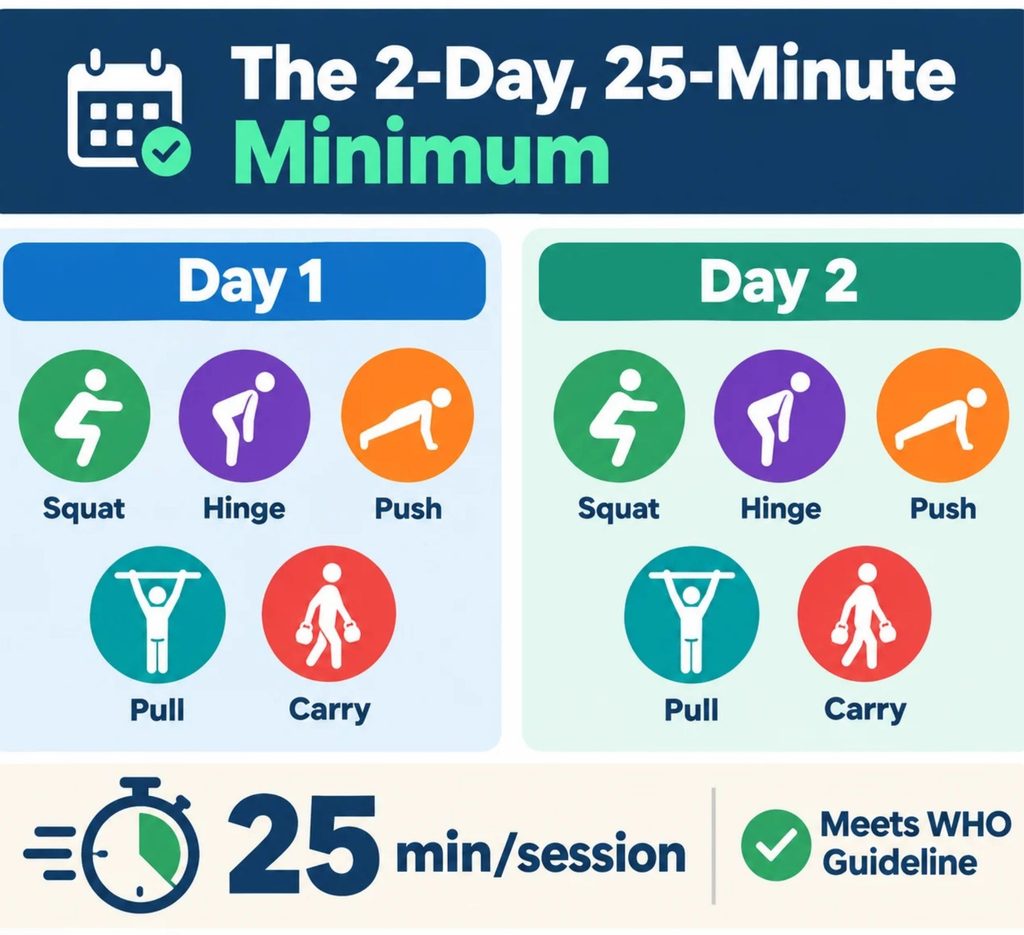
A simple two-day split covering squat, hinge, push, pull, and carry patterns across the week satisfies the WHO minimum without requiring more than 25 minutes per session.
| Session | Focus | Target Time |
| Day A | Squat pattern, push, pull, core | 25 minutes |
| Day B | Hip hinge, push or pull variation, carry | 25 minutes |
Comparative Table: Volume vs. Outcome
| Weekly Volume | Typical Time Cost | Strength Outcome (general pattern) | Best Fit For |
| 1 set per exercise, 2x/week | ~25 min x 2 sessions | Meaningful gains, especially for newer trainees | Busy adults meeting the WHO minimum |
| 2–3 sets per exercise, 2–3x/week | ~35–45 min x 2–3 sessions | Somewhat larger average gains than low volume | Adults with more time or a strength/muscle goal |
| 4+ sets per exercise, 3–4x/week | 60+ min x 3–4 sessions | Highest average gains in the reviewed literature, with rising fatigue and time cost | People training for performance, physique, or sport-specific goals |
When to Add a Third Day
A third session (or added sets) makes sense once progress stalls on the 2-day template, more consistent time becomes available, or a specific muscle-building or performance goal enters the picture.
- Signal 1: strength plateaus for several consecutive weeks despite consistent progression on the 2-day plan.
- Signal 2: schedule genuinely allows for more consistent training, not just an ambitious week.
- Signal 3: the goal shifts from “meet the minimum for health” to a defined muscle-building or performance target.
Who This Is Not For
This minimum-dose approach is built for general health and time-strapped adults, not for people with a specific performance, physique, or medical-supervision need.
- Readers training for a specific sport, competition, or aesthetic goal will likely need more structured volume point to Brief 4 or Brief 5.
- Readers recovering from injury, managing a diagnosed condition, or otherwise needing supervised programming should work with a qualified professional rather than a general template.
Common Mistakes
| Mistake | Practical correction |
| Treating “minimum” as an excuse for sloppy form or no progression. | Keep the two sessions structured: full range of motion, gradual increases in reps or load. |
| Skipping one of the major movement patterns to save time. | Keep squat, hinge, push, pull, and carry patterns represented across the two sessions. |
| Assuming more is always better and burning out on a bigger program. | Start at the 2-day minimum and add volume only when a clear signal (Section 10) shows up. |
| Never progressing because “it’s just the minimum”. | Progression still matters at low volume, add reps first, then load, over several weeks. |
| Confusing this template with a muscle-building or performance program. | Redirect goal-specific readers to Brief 4 or Brief 5, which are built for more volume.. |
Conclusion
The version of strength training that actually gets done beats the version that looks impressive on paper but gets abandoned by week three. Two structured 25-minute sessions a week meet the WHO minimum for muscle-strengthening activity and, per the available evidence, still produce real strength gains particularly for anyone newer to training. That is not a compromise; for most busy adults it is a sustainable, evidence-supported starting point that already puts them ahead of the majority who do not meet the guideline at all. When progress stalls, more time opens up, or a specific goal takes shape, the path forward is straightforward: add a day or add volume, using Fitness Geekz’s fuller plans as the next step.
Start with the two-day template above, stay consistent, and build from there.
FAQs
WHO’s minimum is 2 or more days a week covering all major muscle groups per the WHO Guidelines on Physical Activity and Sedentary Behaviour.
Yes, to meet public health guidelines and produce meaningful strength gains for most healthy adults.
Yes, per the weekly-set-volume meta-analysis in Section 7, though higher volume tends to add more over time.
Point to the 25-minute, 2-day template in Section 8.
Point to the three signals in Section 10 (plateau, more available time, a specific goal).