

Quick answer:
Weight training for women over 40 works best with loads that reach moderate-to-high effort, roughly 2 to 4 reps left “in the tank”, for 6 to 15 reps across 2 to 4 sets per exercise, resting 60 to 120 seconds between sets. A mix of machines and free weights, done 2 to 3 times a week, covers most beginner goals safely.
- “Heavy enough” is about effort relative to the individual, not a fixed number on the dumbbell rack
- Rep ranges shift slightly by goal (strength vs. muscle vs. endurance), but overlap more than most beginners assume
- Machines are a reasonable, safe starting point, free weights aren’t mandatory from day one
- A 45-minute session comfortably covers 5 to 6 exercises without rushing
- Progression across the first 4 weeks should be gradual, not aggressive
- Basic gym etiquette removes a surprising amount of first, timer anxiety
Walking Into the Free Weight Section Without a Plan

The machines are self explanatory enough, pick a weight, sit down, push. The free weight section is where most first timers hesitate: which dumbbells, how many reps, and whether anyone’s watching to see if it’s being done “right.” That hesitation is rarely about fitness level. It’s about not having a clear number to work from.
Weight training remains one of the more consistently supported interventions for maintaining muscle mass, bone density, and metabolic health as women move through their 40s and beyond. A systematic review and meta-analysis in the Journal of Orthopaedic Surgery and Research found that structured resistance training, particularly higher intensity programs performed several times a week, measurably improves bone mineral density in postmenopausal women. Getting started doesn’t require memorizing percentages of a one-rep max or intimidating training jargon. It requires a working sense of effort, a rep range, and a plan for what to do with 45 minutes at the gym, all of which this guide lays out directly.
How Heavy Should You Lift?
The right weight is the one that brings an exercise close to genuine effort by the last couple of reps, not a fixed number that applies to everyone equally.
Effort-Based Loading, in Plain Language
Rather than chasing a specific weight on the rack, the more useful measure is how much is left “in the tank” at the end of a set. A weight that could be lifted for another 8 to 10 reps past the target is too light to drive meaningful progress. A weight where the last 2 to 3 reps genuinely require focused effort, without breaking form, is generally in the right zone for most goals. This effort-based approach, known as Reps in Reserve (RIR), is described in the National Strength and Conditioning Association’s Strength and Conditioning Journal and has been shown to be a reliable way to guide training load.
This matters more than a specific number because strength, starting point, and recovery capacity vary enormously between individuals. Two women of the same age can have very different starting weights and both be training correctly, as long as the effort level is appropriately challenging.
How much weight should a woman over 40 lift starting out? There’s no universal starting weight, the right load is one that makes the last 2 to 3 reps of a set genuinely challenging without breaking form, which varies by individual.
Why This Shifts as Strength Improves

As a given weight starts to feel easier over several sessions, when the last reps stop requiring real effort, that’s the signal to add load, not a fixed schedule. This effort-based approach removes the guesswork of “should I go up in weight yet” and replaces it with a felt, trackable signal.
Related reading: the progressive overload guide explains the principle behind gradual increases in training demand.
Sets and Reps by Goal
Rep ranges do shift somewhat depending on the primary goal, though for beginners the overlap between goals is larger than most training content suggests.
| Goal | Reps | Sets | Rest |
| Strength | 4–6 | 3–4 | 90–120 sec |
| Muscle (hypertrophy) | 8–12 | 3–4 | 60–90 sec |
| Muscular endurance | 12–15 | 2–3 | 30–60 sec |
These ranges reflect resistance training prescription guidance from the American College of Sports Medicine (ACSM), whose 2026 Position Stand reviewed 137 systematic reviews covering more than 30,000 participants. Worth noting: that same position also found that consistent training effort and proximity to fatigue matter more than rigidly following one specific rep range; a wide range of reps can build both strength and muscle effectively as long as sets are taken reasonably close to failure. The table above is a practical starting framework, not a strict rule. Actual results depend on consistency, nutrition, recovery, and individual variation, none of which a rep scheme alone can guarantee.
For most beginners without a specific competitive goal, training in the 8 to 12 rep range for most exercises is a practical default: heavy enough to build real strength, with enough volume to also support muscle maintenance.
Machines vs. Free Weights, What Should a Beginner Actually Use?
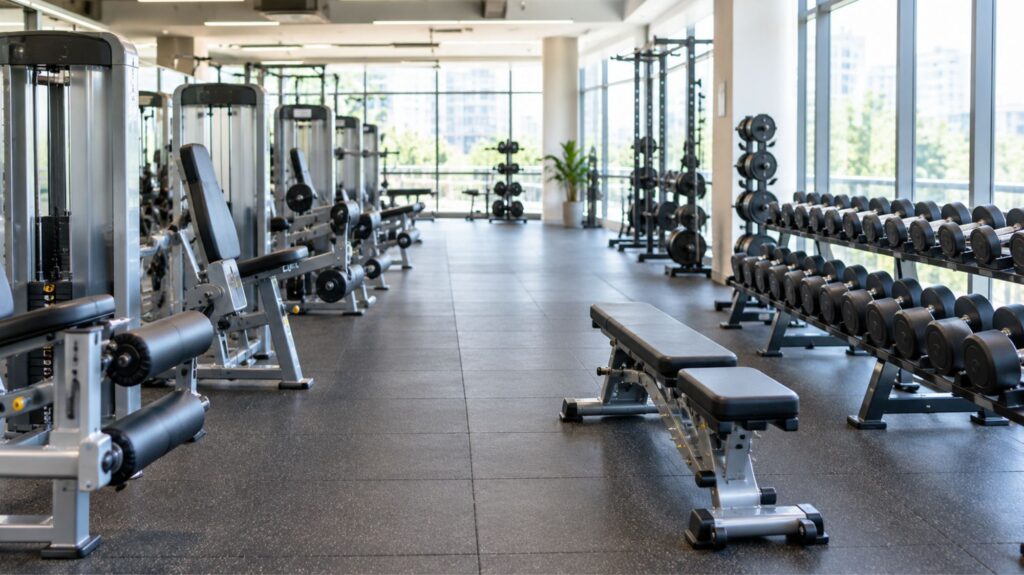
Both have a place, and the most sensible approach for most beginners is a mix rather than picking one exclusively.
When Machines Make Sense First
Machines guide the movement path, which reduces the coordination and balance demand while learning proper form. They’re a reasonable, safe entry point for exercises like the leg press, chest press, or seated row, especially in the first few weeks while getting comfortable with effort levels and gym routine generally.
When to Introduce Free Weights
Free weights require the body to stabilize the movement itself, which builds a kind of functional strength machines don’t train as directly. Starting to layer in dumbbell exercises, a goblet squat, a dumbbell row, a shoulder press, once basic comfort and confidence are established, rounds out a program in a way that relying on machines alone doesn’t.
Is it better to use machines or free weights as a beginner?
Neither is strictly better. Machines are a safe, guided starting point while learning form, and free weights add stabilizer strength as confidence builds. Most beginners benefit from a mix of both rather than choosing one exclusively, a woman who trains entirely on machines for her first month and gradually adds free weights afterward is training just as validly as someone who starts with dumbbells on day one.
A 45-Minute Gym Session, Start to Finish
Five to six exercises fit comfortably into 45 minutes without rushing warm-up, working sets, or rest periods, enough to train every major movement pattern in one session.
| Exercise | Sets × Reps | Rest | Machine or Free-Weight Option |
| Leg press or goblet squat | 3×10 | 90 sec | Both listed |
| Chest press (machine or dumbbell) | 3×10 | 90 sec | Both listed |
| Seated row or one-arm dumbbell row | 3×10 | 90 sec | Both listed |
| Shoulder press (machine or dumbbell) | 3×10 | 60 sec | Both listed |
| Leg curl or dumbbell Romanian deadlift | 2×12 | 60 sec | Both listed |
| Plank or dead bug | 2×30–45 sec | 45 sec | Bodyweight |
This structure covers lower body, upper body push and pull, and core in a single session, which is a practical way to train 2 to 3 times a week without needing a different plan for every day.
Related reading: Fitness Geekz’s 8-week muscle-building plan for women builds directly on this single-session structure.
Your First 4 Weeks
Progression in the first month should be gradual, the goal is building a consistent habit and learning correct form, not maximizing intensity out of the gate.
| Week | Focus | Adjustment Guidance |
| Week 1 | Learning form, moderate effort | Choose lighter loads; prioritize technique over weight |
| Week 2 | Same exercises, slightly closer to effort | Increase weight only if the prior week felt clearly manageable |
| Week 3 | Consistency, first small load increases | Add weight only on exercises that felt easy by the last rep |
| Week 4 | Full working effort established | Reassess loads across all exercises; expect most to have increased modestly |
This pacing reflects the same ACSM 2026 Position Stand guidance on training progression, which found that novice trainees typically adapt faster than more experienced lifters but still benefit from gradual, controlled increases rather than large early jumps, and that consistency across sessions is a stronger predictor of results than aggressive early progression. Rushing this phase is one of the more common ways beginning weight training for women over 40 leads to early burnout or minor strains that could otherwise be avoided.
Recovery and nutrition support this progression as much as the training itself does. Fitness Geekz’s guide to creatine for women covers what the evidence actually supports for readers curious whether supplementation has a place in this picture.
Beginner Mistakes on the Gym Floor
- Choosing a weight that’s too light out of caution. This feels safer but doesn’t create enough stimulus for progress, the last few reps of a set should require genuine effort.
- Skipping rest between sets to save time. Cutting rest short undermines the quality of the next set, especially for strength-focused rep ranges that need fuller recovery between efforts.
- Avoiding the free-weight section entirely out of intimidation. Easing gradually, starting with one or two dumbbell exercises alongside machine work, is more sustainable than avoiding it indefinitely.
- Increasing weight and reps at the same time. Changing both variables at once makes it impossible to tell what’s actually driving progress, increasing one at a time.
- Skipping warm-up sets before working sets. A lighter warm-up set or two prepares the joints and muscles for the working weight and reduces injury risk.
Gym Etiquette Nobody Explains
A surprising amount of first-timer anxiety has nothing to do with the exercises themselves and everything to do with unwritten gym rules nobody bothers to explain.
Wiping down equipment after use is standard practice at most gyms and simply expected, not optional. Re-racking weights, returning plates and dumbbells to their designated spots, keeps the gym floor usable for everyone and is one of the fastest ways to avoid dirty looks from regulars. During busy hours, sharing equipment by asking “how many sets do you have left” is completely normal gym etiquette, not an imposition. And asking a nearby gym-goer for a spot on a heavier lift is a routine, expected request, most people are glad to help, and it’s a far more common interaction than beginners tend to assume.
The Bottom Line
Weight training doesn’t require memorizing a percentage chart or picking a side between machines and free weights, it requires understanding effort, working within a sensible rep range, and progressing gradually over the first month while the habit takes hold. The 45-minute session and 4-week structure above are a practical starting point that can be adjusted as strength and confidence build.
For a next step, Fitness Geekz has guides on progressive overload, creatine for women, and structured training plans to build on this foundation.
Frequently Asked Questions
It depends on the goal: roughly 4 to 6 reps for strength, 8 to 12 for muscle growth, and 12 to 15 for muscular endurance, though beginners often see good results training in the 8 to 12 range across most exercises.
Neither is strictly better, machines are a safe, guided starting point while learning form, and free weights add stabilizer strength as confidence builds. Most beginners benefit from a mix of both rather than choosing one exclusively.
There’s no universal starting weight, the right load is one that makes the last 2 to 3 reps of a set genuinely challenging without breaking form, which varies by individual. This effort-based (Reps in Reserve) approach is detailed in the NSCA’s Strength and Conditioning Journal.
Two to three sessions per week, covering all major muscle groups, is a commonly recommended starting frequency that allows adequate recovery between sessions.
Yes, at least one rest or active-recovery day between sessions targeting the same muscle groups allows for proper recovery, which is part of how strength and muscle adaptations actually occur.