
Most adults over 50 do strength training two to three days a week, with a rest day between sessions, plus walking. Five moves, squats, incline push ups, rows, glute bridges and farmer’s carries, cover the whole body. Check with a doctor first if unsure.
The short version
- The WHO recommends muscle strengthening on at least 2 days a week, and for adults 65 and over, balance and strength work on 3 or more days.
- Training each muscle twice a week is enough for most people.
- A rest day between sessions gives muscles time to recover.
- Five basic moves can be done at home with no machines.
- Every move has an easier version, so you can start exactly where you are.
- Walking on the other days keeps the week active.
- Check with a doctor first if there is an injury or health concern, and stop any move that causes sharp pain.
The friendly answer
If you are past 50 and wondering how much exercise is actually enough, here it is: two to three strength sessions a week, a rest day between them, and some walking on the other days. No gym, no machines, no hour long workouts. The trouble is that most advice sounds either vague or intense, and it is easy to worry about doing too much or too little. This guide keeps it simple with five basic moves that build muscle, go easy on the joints and fit into a normal week. Each one comes with an easier version, so you can begin wherever you are today.
Time to get active! Click the link below to watch the full exercise and follow along.
How often should you exercise after 50?
Start with the guidelines. The WHO recommends that adults do muscle strengthening activities on at least two days a week, covering all the major muscle groups. For adults 65 and over, it also suggests varied activity that mixes balance and strength on three or more days a week.
More is not always better. A review of adults over 60 found that training frequency did not change muscle growth, and that going beyond two sessions a week for the same muscle seemed unlikely to add benefit. In plain terms: you do not need to live in the gym. A few well chosen sessions, done regularly, do the job.
So a good starting point is three short sessions a week, like Monday, Wednesday and Friday, with an easy walk or rest on the days in between. If three feels like too much at first, begin with two. Showing up consistently matters more than pushing hard, and that is an opinion worth keeping in mind on the days motivation dips. For more on building muscle in your 40s and 50s, see Fitness Geekz’s guide to gaining muscle after 40.
Five moves that cover the whole body

Strength training in general has strong support for keeping people strong and independent. These five moves are simply a practical way to do it at home, working the legs, push muscles, pull muscles, glutes and the body’s ability to carry things.
1. Bodyweight squat
This works the quads, glutes and hamstrings, the big muscles behind standing up, climbing stairs and getting out of a car.
Stand with your feet shoulder width apart and your toes turned out a little. Push your hips back and bend your knees as if sitting down in a chair. Think “sit back,” not just “sit down.” Keep your chest up, your weight in your heels and your knees from caving in. Go down until your thighs are close to parallel, or as low as feels comfortable, then push through your heels to stand.
Aim for 10 to 12 reps. If that is too hard, try a chair squat: tap the chair behind you and stand back up, or do a half squat and only go down a few inches until you feel steadier. Muscle does use a little more energy than fat even at rest, but the effect is modest, so think of it as a bonus, not a metabolism hack.
2. Incline push up
A strong chest, shoulders and arms help with pushing open a heavy door and getting up off the floor. The incline version gives that pushing strength without piling stress on the wrists and shoulders.
Put your hands on a sturdy counter, table or wall, a little wider than your shoulders. Step your feet back until your body makes one straight line from head to heels. Bend your elbows and lower your chest toward the surface, keeping your core tight so the hips do not sag. Push back up.
Go slowly and focus on form. Aim for 8 to 10 reps. If your wrists or shoulders complain, raise the surface. As you get stronger, use a lower surface, and eventually you can work up to full push ups on the floor.
3. Bent over row
Many of us spend the day hunched over a phone or a steering wheel. Rows balance out all that pushing and leaning forward.
You do not need fancy equipment: light dumbbells, a resistance band or two water bottles all work. Stand with your feet hip width apart and a soft bend in your knees. Hinge forward from the hips with your back flat and let your arms hang straight down. Keep your neck relaxed and look at the floor a few feet ahead. Pull your elbows back and squeeze your shoulder blades together, like cracking a walnut between them. Pause a second, then lower with control.
Do 10 to 12 slow reps. As it gets easier, add weight.
4. Glute bridge
The glutes are among the largest muscles in the body, and this move works them along with the hamstrings and lower back, without pounding the joints. If getting up from a low chair feels harder than it used to, this one is a good friend.
Lie on your back with your knees bent and your feet flat, about hip width apart, arms at your sides. Push through your heels and lift your hips toward the ceiling, squeezing your glutes at the top. Do not arch your lower back, and keep your core lightly tight. Hold for two to three seconds, then lower slowly. The slow lowering is where a lot of the work happens.
Work up to 15 reps over time. When it gets easy, rest a light weight across your hips. Keep breathing and stay relaxed. This is not a race.
5. Farmer’s carry
It does not look like much, but it works your grip, shoulders, core and legs, the same muscles you use to carry groceries, walk the dog or catch yourself on a stumble.
Pick up a dumbbell, kettlebell or even a gallon jug in each hand. Choose something fairly heavy, but not so heavy that your posture falls apart. Stand tall with your shoulders back and your core braced. Walk forward in a straight line for 20 to 40 steps, keeping your shoulders away from your ears and breathing normally. Turn around and walk back.
Start with one or two rounds and rest as much as you need. Later, add distance, weight or another round. For more guidance on this exercise, see the farmer’s walk benefits guide.
Your simple weekly plan
| Exercise | Reps | Easier version | Harder version |
| Bodyweight squat | 10 to 12 | Chair squat or half squat | Slower lowering |
| Incline push up | 8 to 10 | Higher surface | Lower surface, then floor |
| Bent over row | 10 to 12, slow | Lighter weight or band | More weight |
| Glute bridge | Work up to 15, hold 2 to 3 seconds | Smaller lift | Light weight on hips |
| Farmer’s carry | 20 to 40 steps, 1 or 2 rounds | Lighter weight | More distance or weight |
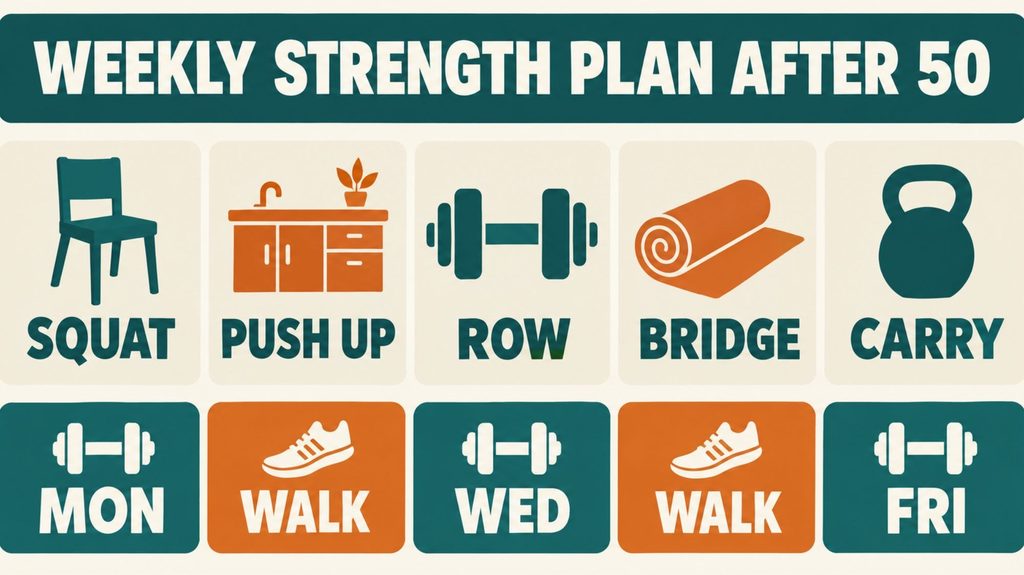
Here is how a week might look:
- Monday: the full routine
- Tuesday: an easy walk or rest
- Wednesday: the full routine
- Thursday: an easy walk or rest
- Friday: the full routine
- Weekend: rest, or a relaxed walk
A good starting point is two rounds of the routine (two sets of each move), adding a third once it feels comfortable. Rest about a minute between exercises, and stop any move that causes sharp pain. For more variety, see the exercises for healthy aging and staying strong after 50 guide.
Getting a little stronger each week
When a move feels easy, make it a bit harder: add a rep, then add weight, move to a harder version, or slow the lowering down. That idea has a name, progressive overload, and the progressive overload explained guide breaks it down. Small steps are fine. You are playing a long game.
Food matters too. Experts in the PROT-AGE study group suggest adults over 65 aim for at least 1.0 to 1.2 g of protein per kg of body weight a day, and more if exercising. Including a protein food at each meal is an easy way to start. People with kidney disease or other health conditions should ask a doctor before changing how much protein they eat.
Stay safe
This is general information, not medical advice. If you have an injury or any health concern, such as joint problems, a heart condition, uncontrolled high blood pressure, dizziness or osteoporosis, check with your doctor first, and move at a pace that feels right. Muscle effort is normal. Sharp or lasting pain is not, so stop the move and get it checked if that happens.
Mistakes that slow people down
- Training the same muscles on back to back days. Leave a rest day between sessions.
- Going too heavy too soon on rows and carries. Keep your posture upright and start lighter.
- Rushing the lowering phase. Slow and controlled does more.
- Skipping the easy version. There is no prize for starting hard.
- Relying on the workout alone. Walking on other days keeps the week active.
The bottom line
Exercise after 50 does not need to be complicated. Two to three short strength sessions a week, a rest day between, and regular walking are a solid plan. Start with the easy versions, add a little each week, and be kind to yourself on the slow days. Progress varies from person to person, and there are no guarantees, but consistency is what pays off over the years. It is never too late to feel better and move better.
For more guides, visit Fitness Geekz.
FAQs
Aim for two to three days of strength training, plus walking on the other days.
Yes, for most people. Training each muscle about twice a week is enough, and extra sessions did not add muscle growth in adults over 60.
Easy walking every day is fine, but the same muscles benefit from a rest day between sessions.
Short sessions work well. Five moves with a minute of rest between them fit comfortably into a normal day.
No. Bodyweight, a band, light dumbbells or household items like a gallon jug are enough. Questions about exercising with a health condition belong with a doctor.
Disclosure statement
This article is for education and is not medical advice. It does not diagnose any condition or recommend starting, stopping or changing medication. Speak with a doctor before starting if there is an injury, joint problems, a heart condition, uncontrolled high blood pressure, dizziness, osteoporosis or any other health concern.