

The best exercises for healthy aging build strength, balance and stamina. Five movements can cover these needs: a plank, a single leg Romanian deadlift, a push up, a horse stance hold and a kettlebell swing. Add walking, and check with a doctor first if unsure.
The short version
- The WHO advises muscle strengthening on at least 2 days a week, covering all the major muscle groups.
- Balance and functional exercise reduced the rate of falls by 24% in people 60 and over, and adding strength work probably cut it by 34%.
- About 30 to 60 minutes a week of strength training was linked with 10 to 20% lower mortality risk. This is an association, not proof.
- Start with the easy version of each movement and progress slowly.
- The full routine takes roughly 30 to 40 minutes, three days a week.
- Walking and a pulling exercise, such as a row, fill the gaps these five leave.
- Check with a doctor first if there is heart disease, chest pain, dizziness, balance problems or joint pain.
You do not need hundreds of exercises
Open any fitness app and the choices pile up fast. Hundreds of exercises, endless programs, and a quiet worry underneath: Am I losing strength and balance, and what should I actually be doing about it?
Good news: a handful of simple movements can cover most of what the body needs as the years go by. These five each do a different job: bracing, balancing, hinging, pushing and generating power. Below, each one comes with an easier and a harder version, plus an honest note on how much research stands behind it, because some have plenty and some have very little.
Let’s take your fitness routine up a notch! Click below to watch the full exercise and follow along.
Why these five?

The big guidelines point in a clear direction. The WHO 2020 guidelines recommend muscle strengthening at moderate or greater intensity on at least two days a week, involving all major muscle groups. For adults 65 and over, they also suggest varied activity that mixes balance and strength on three or more days.
The balance part matters. A Cochrane review of trials in people aged 60 and over found that exercise reduced the rate of falls by 23% overall. Balance and functional exercises cut falls by 24% (high certainty), and programs that added strength work probably cut them by 34% (moderate certainty). The review was uncertain about the effect of resistance training on its own, which is a good reason to pair strength with balance.
There is also a longevity angle. A review of 16 cohort studies found muscle strengthening was linked to a 10 to 17% lower risk of death from any cause, heart disease, total cancer and diabetes. The biggest benefit showed up at about 30 to 60 minutes a week. Cohort studies show associations, not cause and effect, but the message is encouraging: you do not need hours.
1. The plank
A plank works the abs, shoulders, back and glutes, but the real prize is the core, the trunk muscles that steady the body when you stand, walk, bend and lift.
How to do it:
- Place your elbows under your shoulders and lift your body off the floor.
- Keep a straight line from head to heels.
- Tighten your abs and glutes, and do not let the hips sag or rise.
- Start with 20 to 30 seconds and build up gradually.
Too hard? Try a knee plank. Want more? Try a side plank. The goal is good form, not holding on forever. For more core options, see Fitness Geekz’s guide to core stability exercises for seniors.
What the research says: A 2025 meta analysis of 11 small studies with about 440 adults aged 60 and over found core training improved balance on several tests, including about 3 more seconds on a one leg stand. The studies varied a lot, one result was less certain after adjusting for possible missing studies, and long term effects are unknown. The review did not single out the plank itself.
2. The single leg Romanian deadlift
Balance fades with age, and the encouraging part is that it can be trained. This exercise works the hamstrings, hips and lower back while challenging coordination.
How to do it:
- Stand with feet hip width apart and shift your weight onto one leg, knee slightly bent.
- Hinge forward from the hips as the other leg extends behind you.
- Keep your back straight and core tight, and lower only as far as you can control.
- Return slowly to standing.
Begin with bodyweight and a hand on a wall if needed. Add dumbbells once it feels steady. The guide to the best dumbbell exercises for muscle mass at home can help with that step.
What the research says: The exercise itself was not tested in the studies reviewed, but balance and functional training clearly reduces falls (see above). One more finding is worth knowing about. In a study of 1,702 adults aged 51 to 75, people who could not stand on one leg for 10 seconds had an 84% higher risk of death from any cause over the follow up. The authors note it is observational and could not control for things like recent falls and activity level. It is a reason to train balance, not a diagnosis. Tell a doctor if balance is a worry.
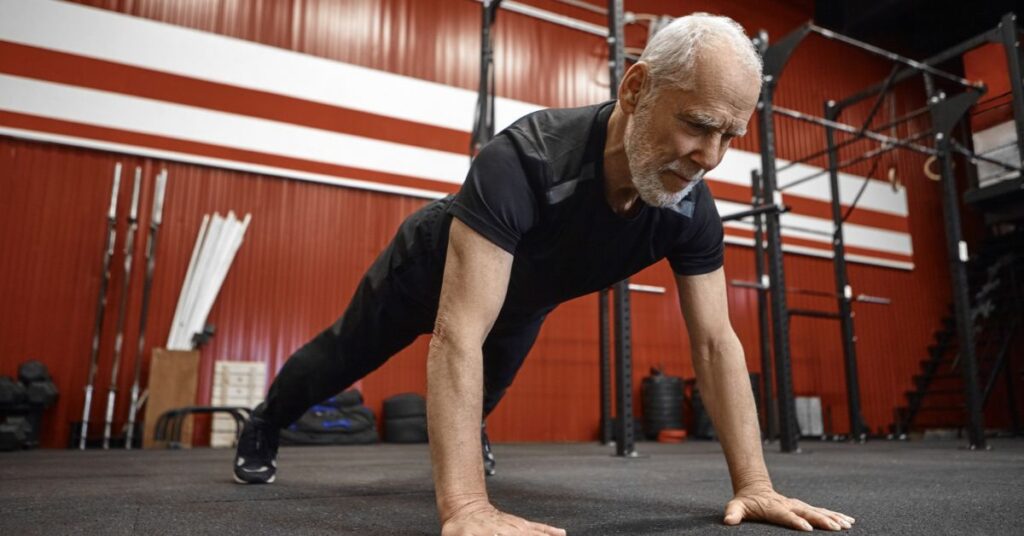
3. The push up
Push ups work the chest, shoulders, triceps and core, making them one of the most useful bodyweight moves for upper body strength.
How to do it:
- Start in a high plank with hands slightly wider than shoulder width.
- Lower slowly, keeping elbows around 45 degrees, not flared out.
- Keep the body straight and the core tight, then push back up.
Slow and controlled beats fast and sloppy. If a standard push up is too hard, use an incline push up on a sturdy elevated surface, then lower the height over time. The building muscle after 40 plan shows how to fold this into a bigger routine.
What the research says: A 2019 study of active, middle aged men found those who managed more than 40 push ups at the start had fewer cardiovascular events over 10 years than those who managed fewer than 10. There were only 37 events in total, and the authors say the results may not apply to women, older men or less active people. Think of it as a hint, not a target.
4. The horse stance
This one may be new to you. It looks easy until the legs start to burn. It strengthens the legs, glutes and core while building stability and body control.
How to do it:
- Stand with feet wider than shoulder width, toes pointing slightly outward.
- Lower into a squat, chest up and core tight, thighs roughly parallel to the floor.
- Hold for 30 to 60 seconds, breathing steadily.
Start with a higher stance or shorter holds of 20 to 30 seconds if your knees complain. A wall sit is a simple alternative.
What the research says: No trials of the horse stance in older adults turned up in the research behind this article, so its benefits rest on general principles about leg strength training, not direct proof. It is a useful way to practice controlling your body, and strength is not always about heavy weights.
5. The kettlebell swing
The swing mixes strength and cardio, working the glutes, hamstrings, hips and core. One rule matters most: the movement comes from the hips, not the arms.
How to do it:
- Stand with feet about shoulder width apart, holding the kettlebell with both hands.
- Hinge your hips back and let the bell swing between your legs.
- Drive your hips forward so the bell rises to about chest height.
- Let it swing back down under control.
Start light and learn the movement before adding weight. The single leg Romanian deadlift teaches the same hip hinge, so doing both is a smart sequence, and a coach can help.
What the research says: In the BELL trial, insufficiently active adults aged 59 to 79 did three months of supervised kettlebell training. They stuck with it well (91.5% attendance), had four non serious adverse events, and improved grip strength and other fitness measures. It was a single group exploratory study, and one author is a kettlebell instructor. The researchers also noted there are no clinical guidelines for kettlebells in older adults. Supervised, light and gradual is the way to start.
The five at a glance
| Movement | Easier | Harder | Evidence |
| Plank | Knee plank | Side plank | Core training improves balance in adults 60 and over |
| Single leg RDL | Hand on a wall | Add dumbbells | Balance training reduces falls |
| Push up | Incline push up | Standard push up | Strength training linked to lower mortality (observational) |
| Horse stance | Higher stance, shorter hold | Longer hold | No older adult trials found |
| Kettlebell swing | Light bell with coaching | Heavier bell | One supervised trial, ages 59 to 79 |
Putting it together
Try this routine three days a week, with a rest day between sessions:
- Horse stance: 3 sets of 30 to 60 seconds
- Single leg RDL: 3 sets of 8 to 10 reps per leg
- Kettlebell swings: 3 sets of 12 to 15 reps
- Push ups: 3 sets of 8 to 15 reps
- Plank: 3 sets of 30 to 60 seconds
That is roughly 30 to 40 minutes, depending on rest. Aim for effort that feels moderate to hard, then make it a little harder over time. The progressive overload guide explains how.
These five miss two things. There is no pulling exercise, so a dumbbell row is worth adding. And there is no steady cardio, so add walking, since the WHO recommends 150 to 300 minutes of moderate aerobic activity a week for adults. For men starting out, best exercises for men over 40 have more ideas.
Stay safe

This is general information, not medical advice. Talk to a doctor first if there is heart disease, chest pain, uncontrolled high blood pressure, dizziness, frequent falls, osteoporosis, joint pain or replacement, or a recent injury or surgery. The WHO notes that people with chronic conditions may need advice from a health professional. Stop and get assessed for sharp, lasting or worsening pain, which is different from normal muscle effort.
Mistakes to avoid
- Holding a plank until form collapses. Stop when the hips sag.
- Swinging the kettlebell with the arms. Drive from the hips.
- Treating the one leg stand as a test you pass or fail. Use it as a prompt to train.
- Jumping to the hard version. Start easy and progress slowly.
- Doing only these five. Add walking and a row.
The bottom line

Healthy aging does not need a complicated program. Five simple movements, done three days a week, can build strength, balance and stamina, especially when paired with walking and a row. Start where you are, progress slowly, and be patient. Results vary from person to person, there are no guarantees, and some of these moves have limited direct research. The goal is not just to look strong. It is to stay strong, steady and capable for years to come.
Ready for more? Explore Fitness Geekz’s guides on building muscle after 40.
FAQs
A mix of strength, balance and walking. The WHO advises muscle strengthening on at least two days a week.
Yes. Balance and functional exercises reduced falls by 24% in people 60 and over.
Core training improves balance, and planks can be scaled with a knee or incline version. The plank itself was not singled out in the research.
A supervised trial in adults aged 59 to 79 found it well tolerated. Learn it with a coach, start light and check with a doctor first.
Roughly 30 to 40 minutes, three days a week.
Disclosure statement
This article is for education and is not medical advice. It does not diagnose any condition or recommend starting, stopping or changing medication. Speak with a doctor before starting if there is heart disease, uncontrolled high blood pressure, chest pain, dizziness, joint pain, a recent injury or surgery, or any chronic condition.