
Quick answer:
The best exercises for men over 40 train fundamental movement patterns, squat, hinge, push, pull, carry, and core while allowing load and range of motion to be adjusted for joint health. Goblet squats, Romanian deadlifts, push-ups, rows, presses, split squats, farmer’s carries, and dead bugs cover all the bases safely.
- Full-body compound movements outperform isolated “arm day” exercises for long-term strength and function.
- Every exercise on this list has both an easier regression and a harder progression
- Joint-friendly modifications don’t mean lower effort load and range of motion can be adjusted without losing the training effect.
- Grip and carry strength is frequently skipped, but matters more with age, not less.
- Core work should stabilize the spine under load, not just target visible “abs”.
Why These 8, and Why Now
Muscle mass and strength don’t decline overnight at 40 the process is gradual and begins earlier than most people assume. After age 50, leg muscle mass is lost at about 1–2% per year, with strength declining even faster, a process that tends to accelerate if resistance training isn’t part of the routine. The American College of Sports Medicine’s 2026 Position Stand on resistance training, which reviewed 137 systematic reviews covering more than 30,000 participants, supports regular resistance training as a core part of maintaining muscle function and long-term physical performance in adults.
None of this means training has to look different at 40 than it did at 25 it means the exercises need to be chosen and modified deliberately, with joints and recovery capacity factored in rather than ignored. The 8 exercises below cover every major movement pattern the body relies on daily, and each comes with a way to make it easier or harder depending on where things currently stand.
What are the best exercises for men over 40? The best exercises for men over 40 train the fundamental movement patterns squat, hinge, push, pull, single-leg, carry, and core while allowing load and range of motion to be adjusted for individual joint health.
Related reading: Fitness Geekz’s progressive overload guide explains how to safely increase difficulty on any of the 8 exercises below over time.
How to Use This List

This isn’t a full workout program, it’s a curated set of patterns that can anchor one. Each exercise below includes why it matters after 40, form cues, an easier version, a harder version, and the most common mistake to watch for. The table below summarizes all 8 for a quick scan before reading the full breakdowns.
The 8 Exercises at a Glance
| Exercise | Pattern | Main Benefit | Easier/Modified Version |
| Goblet Squat | Squat | Lower-body strength, hip/knee mobility | Box squat to a bench |
| DB Romanian Deadlift | Hip hinge | Back-friendly hip and hamstring strength | Deadlift from blocks |
| Push-Up | Push | Chest/shoulder strength, no equipment needed | Incline push-up |
| One-Arm DB Row | Pull | Posture, upper-back and pulling strength | Chest-supported row |
| Neutral-Grip/Landmine Press | Angled push | Shoulder-friendlier overhead strength | Half-kneeling or incline press |
| Split Squat/Reverse Lunge | Single leg | Balance and fall-risk reduction | Supported split squat |
| Farmer’s Carry | Carry/grip | Grip strength, core and postural stability | Suitcase carry, shorter distance |
| Dead Bug | Core | Spine-safe core stability | Heel taps only |
1. Goblet Squat
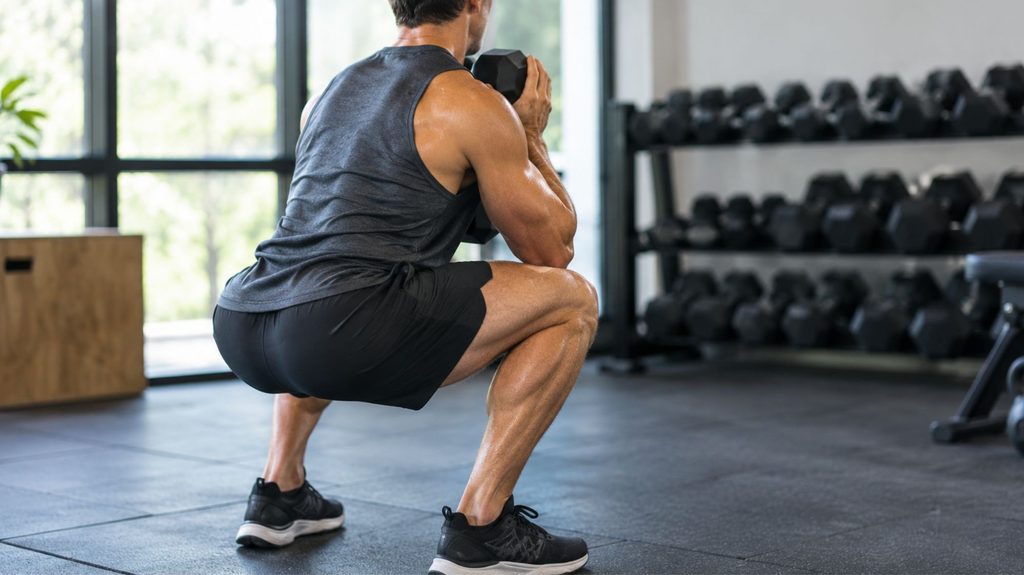
The goblet squat is one of the more forgiving ways to train the squat pattern, which underpins everyday movements like standing up from a chair or climbing stairs functions worth protecting deliberately rather than assuming they’ll stay intact on their own.
Form cues: Hold a dumbbell vertically against the chest, feet roughly shoulder-width apart. Sit the hips back and down, keeping the chest upright and the weight held close to the body. Descend only as far as hip and ankle mobility comfortably allow.
Easier version: Box squat to a bench sitting back to lightly touch a bench or box before standing gives a consistent depth target and reduces the range of motion for cranky knees.
Harder version: Increase the dumbbell load, or slow the descent to increase time under tension.
Common mistake: Letting the knees cave inward on the way up, which places uneven stress on the knee joint. Pushing the knees out in line with the toes throughout the movement helps avoid this.
Who should modify or avoid it: Anyone with acute knee pain or a recent knee injury should keep the range of motion shallow and consult a physical therapist before adding load. Research on squat depth published by the NSCA notes that most safety concerns come from adding load faster than the joint tolerates, not depth itself.
2. Dumbbell Romanian Deadlift
The Romanian deadlift trains the hip hinge, the pattern responsible for safely picking things up off the ground and is one of the more effective ways to build hamstring and glute strength without excessive spinal loading when performed correctly.
Form cues: Holding dumbbells in front of the thighs, push the hips back while keeping a soft bend in the knees and the spine neutral. Lower the weights along the legs until a stretch is felt in the hamstrings, then drive the hips forward to return upright.
Easier version: Deadlift from an elevated position dumbbells resting on blocks or a step limiting the range of motion to where the lower back can stay neutral throughout.
Harder version: Increase the load, or perform the movement from a slight deficit to increase range of motion once mobility allows.
Common mistake: Rounding the lower back to chase a deeper stretch. Range of motion should stop wherever neutral spine position can no longer be maintained, regardless of how far that is from a “full” range.
Who should modify or avoid it: Anyone with a current lower-back injury or disc issue should have this movement reviewed by a physical therapist before loading it, and may need to substitute a hip hinge variation with reduced range, such as a cable pull-through. The NSCA’s guidance on deadlifting and low-back injury notes that a well-coached hip hinge, kept within a pain-free range, can often be maintained or reintroduced even during back rehabilitation, under appropriate guidance.
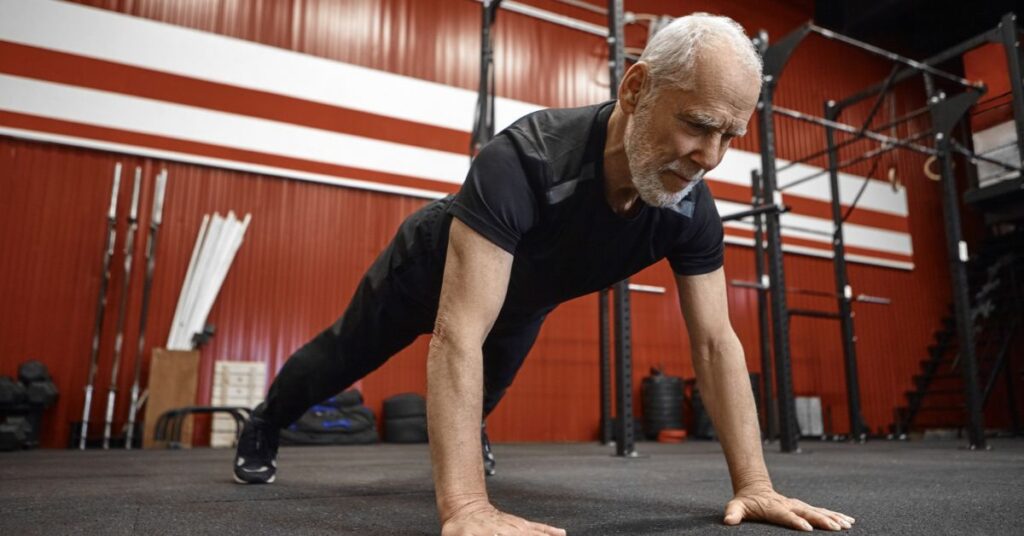
3. Push-Up
The push-up trains the chest, shoulders, and triceps through a pattern that requires no equipment and scales easily by adjusting body angle, making it one of the most accessible ways to maintain upper-body pushing strength.
Form cues: Hands roughly shoulder-width apart, body in a straight line from head to heels, elbows tracking at roughly a 45-degree angle from the torso rather than flared out to the sides. Lower until the chest nearly touches the floor, then press back up.
Easier version: Incline push-up, with hands elevated on a bench or sturdy surface, reducing the percentage of body weight lifted.
Harder version: Deficit push-up (hands elevated slightly, feet on the floor, increasing range of motion) or a weighted push-up with a plate on the upper back.
Common mistake: Flaring the elbows out to a full 90 degrees from the torso, which increases strain on the shoulder joint. Keeping elbows closer to the body reduces this stress.
Who should modify or avoid it: Anyone with existing shoulder impingement or rotator cuff issues should start with the incline version and monitor for pinching pain, stopping the movement if it occurs. Research on pressing technique and shoulder load points to wider elbow angles increasing compressive forces at the shoulder joint, which is part of why a more tucked elbow position tends to feel safer for those with existing shoulder irritation.
4. One-Arm Dumbbell Row
The one-arm row directly counters the forward-shoulder, rounded-upper-back posture common after years of desk work, training the pulling strength that’s often neglected relative to pushing movements in typical routines.
Form cues: With one knee and hand supported on a bench, hold a dumbbell in the opposite hand with the arm extended. Pull the elbow back and up, keeping the torso stable and avoiding rotation, then lower under control.
Easier version: Chest-supported row, using an inclined bench to support the torso and remove the need to stabilize the lower back during the movement.
Harder version: Increase the load, or slow the eccentric (lowering) portion of the movement to increase difficulty without adding weight.
Common mistake: Rotating the torso to help heave the weight up, which shifts work away from the back muscles and adds unnecessary rotational stress to the spine. Keeping the torso square to the floor throughout fixes this.
Who should modify or avoid it: Anyone with a shoulder instability history should keep the range of motion controlled and avoid letting the arm drop into a fully stretched, unsupported position at the bottom.
5. Neutral-Grip Dumbbell or Landmine Press
This press trains overhead pressing strength through a shoulder-friendlier path than a straight barbell overhead press, since the angled or neutral-grip position tends to reduce impingement risk for many lifters.
Form cues: For the landmine version, hold the angled end of the barbell at shoulder height and press up and slightly forward along its natural arc. For the neutral-grip dumbbell version, press the dumbbells overhead with palms facing each other throughout.
Easier version: Perform the press from a half-kneeling or seated incline position if the shoulder pinches when pressing overhead from standing.
Harder version: Progress to a standing strict overhead press once the shoulder tolerates the angled version without discomfort.
Common mistake: Continuing to press through a pinching or sharp sensation in the shoulder instead of adjusting the angle or reducing the range of motion. Discomfort that persists across sessions warrants a professional evaluation rather than continued pushing through it.
Who should modify or avoid it: Anyone with a diagnosed rotator cuff tear or significant shoulder impingement should have this movement cleared by a physical therapist before attempting overhead pressing in any form. Shoulder biomechanics research has found that the space available to the rotator cuff tendons narrows most around 90 degrees of arm elevation, which is part of why an angled pressing path tends to feel more comfortable for irritated shoulders than a straight-overhead one.
6. Split Squat or Reverse Lunge
Single-leg training builds balance and unilateral strength that’s directly tied to reducing fall risk with age, addressing a dimension of fitness that bilateral exercises like the standard squat don’t train as effectively.
Form cues: Step one foot back (reverse lunge) or set up in a staggered stance (split squat), lowering the back knee toward the floor while keeping the front shin roughly vertical. Drive through the front heel to return to standing.
Easier version: Supported split squat, holding onto a rack, wall, or sturdy chair for balance while performing the same movement pattern.
Harder version: Rear-foot-elevated split squat (Bulgarian split squat), with the back foot raised on a bench to increase range of motion and demand on the front leg.
Common mistake: Letting the front knee drift far past the toes under heavy load without control, which can add unnecessary stress to the knee joint over time. A more vertical shin angle reduces this.
Who should modify or avoid it: Anyone with balance impairments or a recent lower-body injury should use the supported version and progress gradually. A British Journal of Sports Medicine systematic review and meta-analysis found that exercise programs challenging balance specifically reduce fall rates in older adults by a wider margin than general exercise alone.
7. Farmer’s Carry
The farmer’s carry trains grip strength, core stability, and postural endurance simultaneously. A systematic review and meta-analysis in Geriatrics & Gerontology International found that grip strength consistently predicts broader measures of functional status and mobility with age, which is part of why it’s worth training deliberately rather than as an afterthought.
Form cues: Hold a heavy dumbbell or kettlebell in each hand, standing tall with shoulders pulled back and down. Walk for a set distance or time while keeping the torso upright and avoiding leaning to either side.
Easier version: Suitcase carry, using a single weight in one hand for a shorter distance, which also adds an anti-lateral-flexion core demand.
Harder version: Increase the load or the distance/duration of the carry.
Common mistake: Letting the shoulders shrug up toward the ears under load instead of staying packed down and back, which reduces the postural benefit of the exercise.
Who should modify or avoid it: Anyone with a grip-limiting condition such as significant arthritis in the hands should use lighter loads or strap assistance to avoid excessive strain on the joints.
8. Dead Bug
The dead bug trains core stability in an anti-extension pattern, protecting the lower back rather than repeatedly flexing the spine the way traditional crunches do, making it a safer default core exercise for most people over 40.
Form cues: Lying on the back with arms reaching toward the ceiling and knees bent at 90 degrees, slowly lower one arm and the opposite leg toward the floor while keeping the lower back pressed flat against the ground. Return to start and alternate sides.
Easier version: Heel taps only, lowering just the legs to lightly tap a heel on the floor without extending the arms overhead.
Harder version: Add a light dumbbell held between the hands, or a resistance band anchored overhead, to increase the anti-extension demand.
Common mistake: Letting the lower back arch off the floor as the leg lowers, which defeats the purpose of the exercise. Stopping the leg lower at the point just before the back starts to arch keeps the movement effective.
Who should modify or avoid it: Generally well-tolerated, though anyone with acute lower-back pain should start with heel taps only and progress gradually.
Putting the 8 Together
These 8 exercises cover every major movement pattern the body relies on, squat, hinge, push (flat and overhead), pull, single-leg, carry, and core which makes them a solid foundation for a 2–3 day per week full-body routine rather than a scattered list of unrelated moves. For a structured starting point, see Fitness Geekz’s beginner strength guide for men and for a complete session built around these patterns, see Fitness Geekz’s 30-minute workout plan for men over 40.
Common Mistakes Beyond the Individual Exercises

- Chasing range of motion before mobility supports it, especially in squats and hinges, depth and range should be earned gradually, not forced from day one.
- Skipping grip and carry work entirely it’s one of the most neglected patterns in typical routines, despite its connection to broader functional strength.
- Training through joint pain instead of adjusting the angle, load, or range of motion persistent pain warrants a professional evaluation, not just “pushing through it”.
- Assuming “over 40” means lighter across the board rather than adjusting selectively per joint some patterns may need more caution than others depending on individual injury history.
What Makes This List Different
- Every exercise includes both a regression and a progression, not just one direction of modification
- Each entry names who should specifically modify or avoid it, based on realistic injury scenarios rather than a blanket disclaimer
- The summary table doubles as a decision framework, letting readers scan patterns and modifications before committing to the full breakdowns
Frequently Asked Questions
No single exercise needs to be avoided by every man over 40; it depends on individual joint health and injury history. Movements that cause sharp or persistent pain, rather than normal training fatigue, are the ones worth modifying or replacing.
No. The ACSM’s 2026 Position Stand on resistance training confirms that adults can build meaningful strength and muscle well beyond 40, and that starting later in life still provides real benefits for long-term function.
Two to three full-body sessions per week, with adequate recovery between them, is the frequency the ACSM’s 2026 Position Stand recommends as a starting point for novice trainees, building strength without overreaching recovery capacity.
The core exercises and principles remain largely the same; what typically changes is more deliberate attention to warm-up, joint-specific modifications, and recovery time between sessions.
The dead bug is generally a safer starting point for core training with a sensitive lower back, since it trains stability without repeatedly flexing the spine. Anyone with an existing back condition should have their program reviewed by a physical therapist before adding load.