

Quick answer: Building muscle after 40 works well with a 3-day, 45-minute full-body plan using six compound exercises, moderate reps, controlled tempo and 60 to 90 seconds of rest. Progress by adding reps first, then weight, and include a lighter deload week roughly every 6 to 8 weeks.
- Three full-body sessions a week, on non-consecutive days, cover every major muscle group.
- Six exercises per session are enough: a squat, a hinge, an upper push, an upper pull, a secondary push or pull, and core work.
- A controlled tempo, especially a slower lowering phase, keeps tension on the muscle and protects the joints.
- Rest 60 to 90 seconds between sets, longer on the heaviest lift.
- Add repetitions first. Once every set reaches the top of the rep range with good form, add a small amount of weight.
- A deload week every 6 to 8 weeks, with lighter loads, supports recovery.
- Anyone with a heart or blood pressure condition, low bone density, joint pain or recent surgery should speak with a clinician first.
Introduction
Building muscle after 40 does not require a complicated program or hours in the gym. A 3-day, 45-minute full-body plan, built on six exercises and a clear progression rule, covers what matters most. The World Health Organization and the CDC recommend muscle strengthening activity for all major muscle groups on at least two days a week. This plan sits above that minimum, giving each muscle group more frequent practice across the week.
This is a general starting template, not a personal prescription, and it works for both men and women. Individual needs vary with experience, joints, equipment and schedule, so the exercises here have gym and home substitutions built in.
What follows is the plan at a glance, a short warm-up, the six exercises with substitutions, an explanation of tempo and rest, an 8-week progression guide, and a deload week. For the evidence behind why this approach works, see the companion article on [gaining muscle after 40, link to be added].
The Plan at a Glance

One table covers the entire session structure. The same six exercises are used across all three weekly sessions, which keeps the plan simple to learn and easy to track.
| Exercise | Movement pattern | Sets × reps | Tempo | Rest |
| Goblet squat or leg press | Squat | 3 × 8 to 12 | 3-1-1 | 90 sec |
| Romanian deadlift (dumbbell) | Hinge | 3 × 8 to 12 | 3-1-1 | 90 sec |
| Dumbbell floor press or incline press | Upper push | 3 × 8 to 12 | 2-1-1 | 60 to 90 sec |
| Dumbbell row or band row | Upper pull | 3 × 8 to 12 | 2-1-1 | 60 to 90 sec |
| Dumbbell overhead press | Secondary push | 2 × 10 to 12 | 2-1-1 | 60 sec |
| Plank or dead bug | Core | 2 to 3 × 20 to 45 sec, or 8 to 12 reps | Controlled | 45 to 60 sec |
What is a good muscle building plan for someone over 40? A 3-day, 45-minute full-body plan using six exercises across the major movement patterns, with 60 to 90 seconds of rest and a clear rule for adding weight, covers most of what a beginner or early intermediate needs.
The full session takes about 45 minutes once the warm-up and rest periods are included. Trainers may adjust the exact exercise selection to fit an individual’s equipment or joint history, while keeping the same overall structure.
Warm Up (5 to 7 Minutes)
A short warm-up raises body temperature and prepares the joints before the first working set.
- Marching or step touches (60 to 90 seconds). Build heat gradually with a relaxed pace.
- Arm circles and shoulder rolls (45 seconds). Small circles first, then larger ones.
- Hip circles and leg swings (60 seconds). Hold a wall or chair for balance if needed.
- Bodyweight squats (45 seconds). Move through a comfortable range.
- One or two light warm-up sets of the first working exercise. Work up gradually toward the session’s working weight.
For the heaviest lift of the day, usually the squat or hinge, one or two ramped warm-up sets at lighter loads are worth the extra few minutes.
How long should a warm-up be before lifting weights? About 5 to 7 minutes, covering light cardio, joint mobility and one or two warm-up sets of the first exercise, is enough for most beginners.
The 6 Exercises
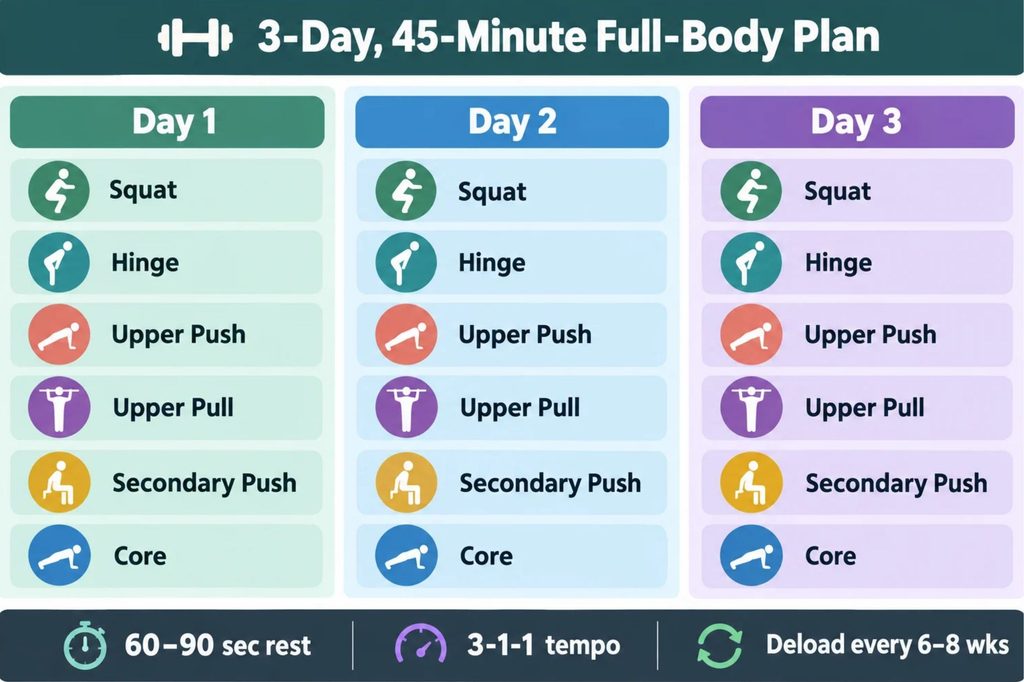
Six exercises across five patterns train the whole body in each session.
1. Squat. Trains the quadriceps, glutes and core. Weight stays through the whole foot, with the chest tall.
2. Hinge. Trains the glutes, hamstrings and lower back. The hips push back rather than bending from the waist.
3. Upper push. Trains the chest, shoulders and triceps. Elbows stay at roughly 45 degrees from the body.
4. Upper pull. Trains the upper back, rear shoulders and biceps. The elbow leads the movement, with the shoulders away from the ears.
5. Secondary push. The overhead press adds a vertical pressing pattern and works the shoulders through a different angle than the floor or incline press.
6. Core. Trains the muscles that stabilize the spine and pelvis under load, with steady breathing throughout.
| Exercise (as in the plan) | Gym substitution | Home substitution |
| Goblet squat | Leg press or barbell back squat | Bodyweight squat or chair sit-to-stand for a lighter start |
| Romanian deadlift | Barbell Romanian deadlift or hip thrust machine | Dumbbell Romanian deadlift or glute bridge |
| Dumbbell floor press | Bench press (barbell or dumbbell) | Floor press or incline push-up |
| Dumbbell row | Cable row or lat pulldown | Band row or one-arm dumbbell row |
| Dumbbell overhead press | Shoulder press machine or barbell press | Dumbbell overhead press, seated for more control |
| Plank or dead bug | Cable crunch or weighted plank | Bodyweight plank or dead bug |
Anyone with a shoulder, knee or back issue can use a joint-friendly variation, such as a neutral grip press, a shorter range squat, or a hip-supported hinge, instead of forcing the listed version.
What exercises are best for building muscle after 40? A squat, a hinge, an upper push, an upper pull, a secondary push, and core work cover the major muscle groups, with substitutions available for a gym or a home setup.
Tempo and Rest Times

Tempo notation describes the speed of each phase of a lift. Controlling it, especially the lowering phase, keeps tension on the working muscle and gives more time to notice and correct form.
A tempo written as “3-1-1” means 3 seconds lowering the weight, 1 second pausing at the bottom, and 1 second lifting it back up. This kind of slower lowering phase is common in beginner and intermediate programming, since it is easy to control without extra equipment and gives the muscle more time under load per repetition.
Rest. Rest 60 to 90 seconds on most exercises, and up to 90 seconds to 2 minutes on the heaviest compound lift of the session, usually the squat or hinge. Cutting rest short tends to reduce the quality of later sets, since the muscle has not fully recovered between efforts.
What does 3-1-1 tempo mean in weightlifting? A 3-1-1 tempo means taking 3 seconds to lower the weight, pausing for 1 second at the bottom, and taking 1 second to lift it back to the start.
8-Week Progression
One clear rule drives progress: add repetitions first. Once every set of an exercise reaches the top of its rep range with good form, add a small amount of weight and return to the lower end of the range.
| Weeks | Focus | How to know it is time to add weight |
| 1 to 2 | Learn the six exercises and the tempo. Use light to moderate loads. | Not yet. Focus on form and completing the lower end of each rep range. |
| 3 to 5 | Build toward the top of each rep range across all sets. | When every set of an exercise hits 12 reps with control, add a small amount of weight next session. |
| 6 to 8 | Continue the same pattern with the new loads, returning to the lower rep range after each increase. | Repeat the same rule for every exercise, tracked independently. |
Change one variable at a time. Adding weight, more reps and a new exercise together makes it hard to tell what is actually working. A simple training log, with date, exercise, weight, sets and reps, and an effort rating, makes the rule easy to follow week to week.
Early strength gains are often largely neural, meaning the nervous system is learning the movement before much new muscle is added. Visible muscle change usually takes longer and varies between people. No specific timeline or amount of gain is promised here.
How do you know when to add weight when lifting? Add weight once every set of an exercise reaches the top of its rep range with good form, then return to the lower end of the range at the new weight.
Deload Week
A deload week, taken roughly every 6 to 8 weeks, reduces training load for a short period to support recovery of muscles and connective tissue.
A practical approach is to keep the same six exercises, but reduce the number of sets by about a third, or lower the weights by about 10 to 20 percent, for one week. This is common coaching practice rather than a precisely researched protocol, and it is offered here as practical guidance.
Signs a deload may be due sooner than planned include joint discomfort that lingers, poor sleep, or flat performance across several sessions in a row. A deload is not a rest week. Light training continues, just with less total stress.
What is a deload week and when should you take one? A deload week is a short period, often every 6 to 8 weeks, with reduced sets or lighter weights, used to support recovery before returning to normal training.
Common Mistakes
| Mistake | Practical correction |
| Skipping the warm-up to save time | Keep the 5 to 7 minute warm-up. It costs little and protects the rest of the session. |
| Rushing tempo, especially the lowering phase | Count the tempo out loud at first until it feels natural. |
| Cutting rest short to finish faster | Rest 60 to 90 seconds, longer on the heaviest lift, rather than shortening the plan. |
| Adding weight before hitting the top of the rep range | Follow the progression rule exactly. Extra reps come before extra weight. |
| Skipping the deload week | Treat it as part of the plan, not an optional extra. |
| Changing exercises every week | Repeat the same six for at least 6 to 8 weeks before swapping. |
When to Check With a Doctor First
A conversation with a clinician is advisable before starting this plan for anyone with a heart or blood pressure condition, osteoporosis or low bone density, ongoing joint pain, a recent surgery, or unexplained symptoms such as chest pain, dizziness or unusual shortness of breath. This article does not diagnose or treat any condition, and any exercise causing sharp or unexpected pain should be stopped.
Conclusion
Building muscle after 40 comes down to a simple, repeatable structure: three 45-minute full-body sessions a week, six exercises covering the major movement patterns, a controlled tempo, and 60 to 90 seconds of rest between sets. Progress by adding reps first, then a small amount of weight, and build in a deload week every 6 to 8 weeks to support recovery.
Safety comes first. Anyone with a heart or blood pressure condition, low bone density, joint pain or a recent surgery should speak with a clinician before starting.
Ready to build a stronger, more consistent routine? Explore more practical, evidence-based fitness guidance with Fitness Geekz and find workout strategies that fit your goals and lifestyle.
Frequently Asked Questions
A 3-day, 45-minute full-body plan using six exercises across the major movement patterns, with 60 to 90 seconds of rest and a clear progression rule, covers most beginner and early intermediate needs.
Three full-body sessions a week, on non-consecutive days, is a practical starting structure above the guideline minimum of two days recommended by the WHO and CDC.
A squat, a hinge, an upper push, an upper pull, a secondary push or pull, and core work, with joint-friendly swaps available for anyone with a sore shoulder, knee or back.
When every set of an exercise reaches the top of its rep range with good form, add a small amount of weight and drop back to the lower end of the range at the new load.
Roughly every 6 to 8 weeks, or sooner if joint discomfort, poor sleep or flat performance persist across several sessions.