
Quick answer: Lifting matters through perimenopause because muscle and bone both change during the transition, and resistance training supports both. Two to three full-body sessions a week suit many women. Joint aches, poor sleep and fatigue call for exercise swaps, adjustable volume and a simple low-energy plan.
- Resistance training is part of official adult activity guidelines, at two or more days a week
- Lean mass falls and fat mass rises faster during the menopause transition, even when the scale barely moves
- Exercise has a small but meaningful effect on bone density in postmenopausal women
- Joint aches, disrupted sleep and fatigue are common and change how training should be set up
- Exercise is not a treatment for hot flashes, and no workout cures menopause symptoms
- Any new, severe or worsening symptom deserves a conversation with a clinician
Short Answer: Why Lifting Matters Through Perimenopause
Why does strength training matter more at this stage? Because the body composition changes that accompany the transition respond to it. Evidence shows that lean mass declines and fat gain accelerates around the start of the menopause transition. The SWAN cohort study, published in JCI Insight, found that the rate of fat gain doubled at the start of the transition while lean mass declined, with changes continuing until about two years after the final period. Total weight did not accelerate, so the scale hid the shift.
Evidence also shows that official guidance already asks for it. The WHO recommendations advise adults aged 18 to 64 to do muscle-strengthening activities on two or more days a week, alongside at least 150 minutes of moderate aerobic activity.
Practical guidance: perimenopause strength training does not require a new method. It requires the same progressive lifting, with more room to adjust on difficult days.
Related reading: Weight Loss for Women Over 40 covers how lifting and walking fit together. [INTERNAL LINK: #12]
What Changes in Training: Joint Aches, Sleep Disruption and Fatigue
Perimenopause is the lead-up to menopause, when symptoms start but periods have not yet stopped. Menopause is reached after 12 months without a period. A clinician, not an article, confirms whether symptoms relate to this transition.
Evidence shows that the NHS lists muscle aches and joint pains and difficulty sleeping among the common symptoms of perimenopause and menopause, with sleep problems sometimes linked to night sweats and tiredness during the day. Symptoms vary widely between women and can change over time.
Evidence also shows limits on what exercise can do. The Menopause Society’s 2023 nonhormone therapy position statement did not recommend exercise as a treatment for hot flashes and night sweats, because evidence for that purpose was sparse. Exercise has other well-established health benefits. It is simply not a symptom treatment, and this article makes no such claim.
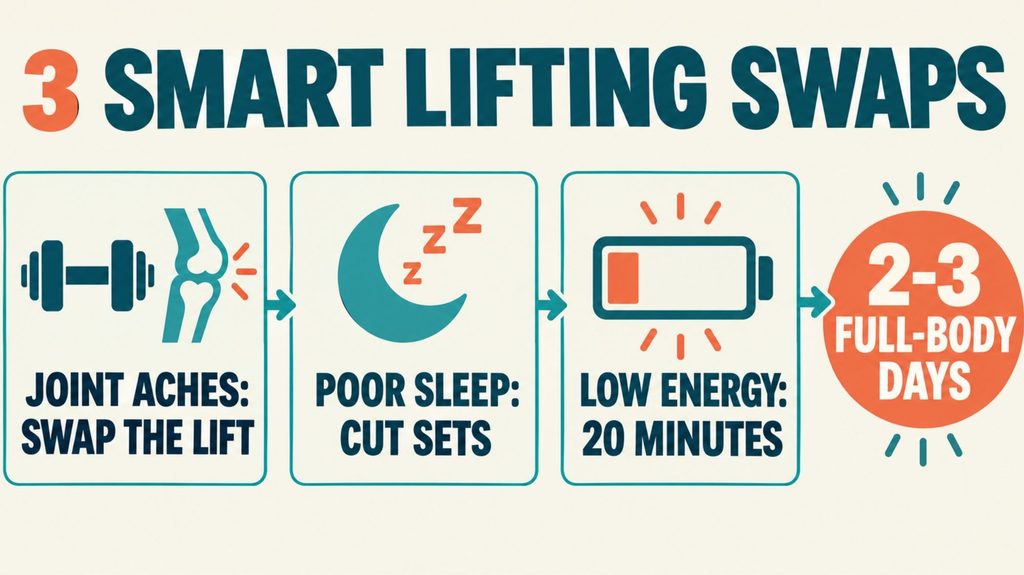
Practical guidance: three symptoms change training most.
- Joint aches: movement range, exercise selection and warm-up length matter more than weight on the bar
- Disrupted sleep: recovery is lower, so volume and effort need to flex
- Fatigue: a minimum viable session keeps the habit alive on low-energy days
Coach to add which of these three adjustments are requested most by real trainees in this life stage, from direct observation. [FIRST-HAND NOTE]
Bone and Muscle Benefits
Muscle. Evidence shows that muscle strength and mass decline with age and through the transition, and that adding muscle-strengthening activity can help delay the loss of muscle mass and function. An editorial in the Menopause Society’s journal, Lee and Schroeder in Menopause, describes this emerging evidence and its link to osteoporosis, sarcopenia, falls and fractures. It is an editorial, not a trial, and should be cited as such.
Bone. Evidence shows exercise has a relatively small but possibly important effect on bone density. The Cochrane review, Exercise for preventing and treating osteoporosis in postmenopausal women, pooled 43 trials. It found progressive lower-limb resistance training was the most effective single approach at the femoral neck, and combined exercise programmes were most effective at the spine. Evidence for preventing fractures was limited. Most trials enrolled postmenopausal women, so evidence specific to perimenopause is thinner.
Practical guidance: bone responds to load that gets progressively harder, not to activity alone. Exercise supports bone health but does not replace medical assessment or treatment. Anyone with osteoporosis, previous fractures or a bone health concern should ask a clinician what loading suits them.
Related reading: Muscle Loss After 40. [INTERNAL LINK: #19, suggested]
[MEDIA: real photo or video of the coach demonstrating a goblet squat to a box and a one-arm row.]
Programming Tweaks: Swaps, Volume, Rest and a Low-Energy Day
Practical guidance throughout this section. Details need sign-off from the reviewing coach. [REVIEWER NAME, CREDENTIAL, REVIEW DATE]
Which exercises suit sore joints? Choices that reduce joint stress without removing load.
| Common Lift | Joint-Friendlier Swap | Why It Helps |
| Barbell back squat | Goblet squat to a box | Controls depth, lightens knee and hip load |
| Standard push-up | Incline push-up | Reduces wrist and shoulder load |
| Barbell overhead press | Neutral-grip dumbbell press, seated | Eases shoulder position |
| Conventional deadlift | Dumbbell Romanian deadlift to a block | Shorter range, controlled hinge |
| Lunge | Step-up or supported split squat | More stability, less knee shear |
| Bent-over row | Chest-supported or band row | Spares the lower back |
Rule of thumb for joint discomfort: mild aching that settles within a day is usually workable. Sharp, worsening or night-time pain is a reason to stop and seek advice. [MEDICAL REVIEWER TO CONFIRM]
Longer warm-ups, slower lowering phases and rest between sets of two minutes or more help many lifters whose joints complain.
Volume and frequency. Start at two full-body sessions a week and move to three only when recovery allows. Two to three sets of 8 to 12 repetitions, finishing two or three repetitions short of failure, is a reasonable base. Increase load slightly when all sets feel controlled. Plan a lighter week every fourth to sixth week, or when symptoms flare.
After a poor night. Keep the session but cut sets by about a third, hold the load steady, and skip maximal efforts. Evidence shows that adults are advised to sleep at least seven hours, according to the AASM. Practical guidance: protecting sleep is part of the training plan, not separate from it.
Low-energy-day option (20 minutes):
- Goblet squat to box, 2 sets of 8
- Incline push-up or band row, 2 sets of 10
- Glute bridge, 2 sets of 12
- Easy 10-minute walk
Coach to add how low-energy days are handled with real trainees, without inventing client stories. [FIRST-HAND NOTE]
Nutrition support, including protein, is covered in Weight Loss for Women Over 40. [INTERNAL LINK: #12] A dietitian can personalise targets.
A Sample Week

| Day | Session |
| Monday | Full-body A: goblet squat to box, dumbbell Romanian deadlift to block, incline push-up, one-arm row, dead bug |
| Tuesday | Easy walk, 20 to 30 minutes |
| Wednesday | Full-body B: step-up, glute bridge, seated neutral-grip dumbbell press, band row, side plank |
| Thursday | Gentle mobility or easy walk |
| Friday | Full-body A, or the 20-minute low-energy option |
| Saturday | Longer easy walk or active outing |
| Sunday | Rest |
On a two-session week, keep Monday and Friday. On a rough week, the low-energy option counts. For beginners, Strength Training for Women Over 40: The Complete Beginner’s Guide explains technique and setup.
[MEDIA: real photos or video of the coach demonstrating the swaps in Sessions A and B.]
When to Consult a Clinician
Medical reviewer to confirm this section before publication.
This article does not diagnose menopause, advise on hormone therapy or recommend any change to medication. A clinician should be consulted:
- Before starting, for heart conditions, high blood pressure, diabetes, osteoporosis or previous fractures, pregnancy, current injuries or regular medication use
- For joint pain with swelling, redness or warmth, pain that wakes from sleep, or pain that keeps worsening
- For chest pain, dizziness, fainting or palpitations that are new or concerning
- For heavy, unusual or unexpected bleeding
- For leaking urine, pelvic heaviness or pain during training, where a pelvic health physiotherapist may help
- For ongoing poor sleep, low mood or exhaustion that affects daily life
Questions about hormone therapy or other treatments for symptoms belong with a doctor. Medications can affect energy, sleep and joints, and any concern about them should go to the prescribing doctor.
Common Mistakes
Stopping lifting because joints ache. Swapping exercises and adjusting range usually works better than quitting.
Lifting light forever. Weights that never get harder give muscle and bone little reason to adapt.
Training hard after a bad night. Cutting volume is a smarter answer than pushing through or skipping the week.
Expecting workouts to fix hot flashes. Exercise has wide benefits, but position statements do not recommend it as treatment for them.
Skipping medical review. Persistent or new symptoms are not a training problem.
Information Gain: What Sets This Apart
- A swap table matched to specific joint complaints
- A 20-minute low-energy-day session that keeps the habit going
- A plain statement of what exercise can and cannot do for symptoms
- Honest framing of bone evidence, including its limits and the thinner perimenopause data
Conclusion
Perimenopause strength training protects muscle and supports bone, and it works best when it flexes with the day. Two to three full-body sessions a week, joint-friendly swaps, adjustable volume and a short low-energy option keep progress going through disrupted sleep and aching joints.
No workout treats menopause symptoms, and new or worsening symptoms deserve a clinician’s attention. Fitness Geekz covers the next steps in its guides to Strength Training for Women Over 40 and Muscle Loss After 40. [INTERNAL LINKS: #1, #19]
Frequently Asked Questions
Yes, for most healthy women. Official guidance recommends muscle-strengthening on two or more days a week, and the transition brings shifts in muscle and fat. A doctor should be consulted first for heart, bone or joint conditions.
Two to three full-body sessions a week suit many women. Fewer sessions on rough weeks still count.
The Menopause Society’s 2023 position statement did not recommend exercise as a hot flash treatment, though exercise has other health benefits. Questions about treating hot flashes belong with a doctor.
Swap exercises, shorten range, slow the lowering phase and warm up longer. Sharp, swelling or persistent pain should be checked by a clinician.
Exercise has a small but possibly important effect on bone density in postmenopausal women, according to a Cochrane review. It does not replace medical advice about bone health.