
To prevent muscle loss after 60, train strength at least two days a week, add balance work, walk often and eat enough protein. Chair squats, calf raises, hip raises and side leg raises can start at home. Check with a doctor first if in doubt.
The short version
- Strength falls faster than muscle size, so training for strength matters most.
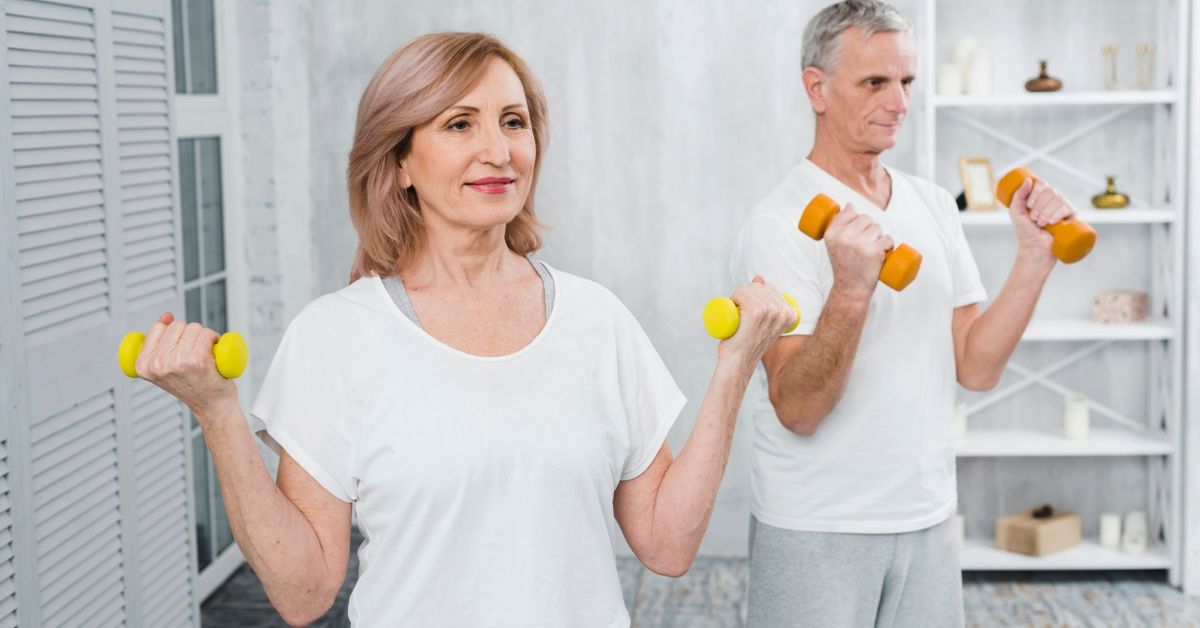
- Resistance training improved strength even in adults aged 75 and over, including those 80 and older.
- Home programs gave modest gains in leg strength, power and balance.
- The WHO recommends muscle strengthening at least 2 days a week, and for adults 65 and over, balance and strength work on 3 or more days.
- Healthy adults over 65 are advised to eat at least 1.0 to 1.2 g of protein per kg of body weight a day, and more if exercising.
- Calf raises engage the calf muscle pump, which helps return blood from the legs.
- Check with a doctor first if there are joint problems, a heart condition or a history of blood clots.
It is not too late, and you do not need a gym
Maybe the signs have started to show: shorter steps, a hand pushing on the armrest to stand up, a quiet decision to skip the walk or the invitation. It is easy to assume that is simply how aging goes. The research tells a more hopeful story. Strength responds to training well into the 80s, and a sturdy chair and a wall are enough to begin. This guide covers what happens to muscle with age, five simple exercises, how to fit them into a week, and the safety points worth knowing. For readers still in their 40s and 50s, the same habits pay off later, and the gaining muscle after 40 guide goes further.
Ready to move and feel the burn? Click below to watch the complete exercise and give it a try!
What actually happens to muscle
Muscle shrinks slowly, but strength drops faster. A quantitative review of the research found that across studies, muscle loss had a median rate of 0.47% a year in men and 0.37% in women. By age 75, longitudinal studies show muscle mass falling about 0.80 to 0.98% a year in men and 0.64 to 0.70% in women, while strength falls 3 to 4% a year in men and 2.5 to 3% in women. Strength is lost 2 to 5 times faster than mass, and loss of strength is a more consistent risk for disability and death than loss of muscle size.
Those are averages across groups, not predictions for any one person. The takeaway is practical: strength is the thing to protect, and strength is trainable.
Does exercise still work at 70, 80 or 90?
For strength, yes. A Sports Medicine review of 22 randomised trials in adults aged 75 and over found resistance training clearly improved muscle strength, and the benefit held in those 80 and older. Whole muscle size also increased, though changes in muscle fibre size and handgrip were not significant. Few adverse events were reported.
Results are less uniform in people who already have sarcopenia (significant muscle loss). A 2021 meta analysis of 14 studies and 561 adults found resistance training improved strength and muscle performance, but did not significantly change muscle mass. The honest summary: strength gains are reliable, muscle size gains vary.
Home training works too. A review of unsupervised home programs in adults 60 and over found modest improvements in leg strength, power (measured by sit to stand tests) and balance, though keeping people consistent remains a challenge.
Five exercises with a chair and a wall

1. Chair squat, wall sit or chair stand
These train the thighs, glutes and lower back, and they are the exercises behind getting up from a chair and climbing stairs.
- Squat: Hold a sturdy chair or table, push the hips back as if sitting, bend the knees a little, then stand. Breathe in going down and out coming up. Keep it small at first, and over time work toward knees bent close to 90 degrees.
- Wall sit (if squats bother the knees): Lean against a wall and slide into an imaginary chair. Hold 15 seconds, then build to 30 and eventually 60.
- Chair stand: Cross the arms over the chest, stand up slowly and sit back down slowly. Start with 10 reps every other day and work up to 20.
2. Balance
Balance training matters because a smaller world often starts with a fear of falling. A Cochrane review of trials in people 60 and over found balance and functional exercises reduced falls by 24%.
Stand next to a wall or hold a chair. Lift one foot and hold 30 seconds, then switch. One side will feel harder, which is normal. Work up to a full minute each side. For more challenge, try the three point touch: stand on one leg and tap the other foot in front, then to the side, then behind. Two or three times a week is enough. Try it with eyes closed only right next to something solid. The core stability exercises for seniors guide has more options.
3. Calf raises
Reviews describe the calf muscle pump as the main way blood returns from the legs to the heart, which is why calves are nicknamed the “second heart”. A systematic review found that calf strength and ankle movement exercises improved calf pump function in people with or at risk of venous leg ulcers. Those are specific groups, so the benefit for everyone else is likely but less directly tested.
Hold a chair, rise onto the toes and lower slowly. Start with 10 to 15 and build toward 30 or more. To make it harder, go one leg at a time or stand with the heels hanging off a step. An easy habit: do 10 calf raises every time you get up from a chair. Even while seated, lifting and tapping the heels counts as light movement.
4. Hip raises
Lie on your back on a firm surface, knees bent and feet flat. Lift the hips until shoulders, hips and knees form a straight line. Squeeze the glutes, hold a few seconds and lower slowly. Do 10 to 15. When it gets easier, hold the top longer or lift one leg off the floor. Direct research on this exact exercise in older adults was not found, but it trains the same lower body muscles used in standing and walking.
5. Side leg raises
Hold a wall or chair, keep one leg planted and lift the other out to the side without twisting. Pause, then bring it back. Do 10 to 15 on each side. Control matters more than height. This works the outer hip muscles. Like hip raises, it lacks direct trial evidence, so treat it as a sensible add on.
The five at a glance
| Exercise | Easier | Harder | Starting dose | Evidence |
| Chair squat or wall sit | Smaller bend, shorter hold | Closer to 90 degrees, longer hold | 10 reps every other day, wall sit 15 seconds | Home training gives modest leg strength gains |
| Single leg balance | Hold a chair | Three point touch | 30 seconds each side | Balance training cuts falls by 24% |
| Calf raise | Hold a chair | One leg or heels off a step | 10 to 15 reps | Calf pump engagement |
| Hip raise | Shorter hold | One leg lifted | 10 to 15 reps | No direct trial found |
| Side leg raise | Hold a wall | More reps | 10 to 15 per side | No direct trial found |
Protein: the other half of the plan

Exercise works better with enough protein. The PROT-AGE study group recommends adults over 65 average at least 1.0 to 1.2 g of protein per kg of body weight a day, more (at least 1.2 g/kg) for those who exercise, and 1.2 to 1.5 g/kg for people with acute or chronic disease. An ESPEN expert group reached similar numbers for healthy older adults.
A practical way to start is to include a protein food at every meal. The nutrient dense foods for strength guide have ideas. People with kidney disease or other health conditions should ask a doctor before raising protein intake.
A simple week
One easy way to schedule it:
- Monday: squats and calf raises
- Tuesday: balance, hip raises and calf raises
- Wednesday: calf raises only
- Thursday: squats, hip raises and side leg raises
- Friday: balance and calf raises
- Weekend: light calf raises and anything else that feels good
Shuffle days to match your energy. Sessions are short, often around 10 minutes. Write down reps and balance seconds, then check again after about four weeks. Seeing the numbers climb is motivating, and the progressive overload explained guide shows how to make exercises harder over time.
One gap to fill: these five are almost all lower body. The WHO recommends strengthening all the major muscle groups, so add some pushing and pulling (wall push ups or resistance bands) and walking. The build muscle at home 90 day workout plan can help with the next step.
Stay safe

This is general information, not medical advice. Check with a doctor first if there are joint problems, a heart condition or a history of blood clots, as well as uncontrolled high blood pressure, dizziness, frequent falls, osteoporosis or a recent injury. The WHO notes that people with chronic conditions may need advice from a health professional.
Know the warning signs of a blood clot. The NHS lists DVT symptoms as throbbing pain in one leg (usually the calf or thigh), swelling in one leg, and red, blue or darkened skin around the painful area. It advises getting medical help as soon as possible, and emergency care if those symptoms come with chest pain. Stop and get checked for sharp or worsening pain, which is different from ordinary muscle effort.
Mistakes that slow progress
- Waiting for a problem to appear. Strength loss is gradual, so start now.
- Training only the lower body. Add pushing, pulling and walking.
- Balancing with eyes closed away from support. Stay right next to something solid.
- Jumping to harder versions. Progress by reps or hold time first.
- Skimping on protein. Include some at every meal, with a doctor’s advice if there is kidney disease.
The Conclusion
Preventing muscle loss after 60 does not take a gym or complicated programs. A chair, a wall, five simple exercises, enough protein and regular walking can protect strength, balance and independence. Start with one exercise today and add another tomorrow. Results vary from person to person, there is no guaranteed timeline, and strength tends to improve more reliably than muscle size. Every rep is still proof the body responds.
For more routines and guides, visit Fitness Geekz.
FAQs
Slowly. By age 75, muscle mass falls roughly 0.64 to 0.98% a year, but strength falls 2.5 to 4% a year.
Strength improves reliably. Muscle size gains are seen in some analyses and not in others.
At least 1.0 to 1.2 g per kg of body weight daily for healthy adults, and more if exercising or ill. Ask a doctor if there is kidney disease.
They are a good start with modest gains. Add progression, upper body work and walking over time.
At least two, according to the WHO.
Disclosure statement
This article is for education and is not medical advice. It does not diagnose any condition or recommend starting, stopping or changing medication. Speak with a doctor before starting if there are joint problems, a heart condition, a history of blood clots, uncontrolled high blood pressure, dizziness, frequent falls, osteoporosis or a recent injury.