
Quick answer: Squats and sled pushes activate the quads at nearly equal levels, but squats create far more muscle damage through their eccentric loading phase, requiring up to 72 hours of recovery. Sled pushes are concentric only, matching quad activation with a fraction of the soreness and a same day recovery window.
- Quad activation: comparable between squats and sled pushes, based on EMG research
- Calf activation: significantly higher during sled pushes
- Lower back activation: significantly higher during squats
- Recovery time: roughly 48 to 72 hours for heavy squats, as little as a few hours for sled pushes
- Best use case: squats for maximal strength and eccentric loading benefits, sled pushes for frequent, joint friendly volume
Introduction
Three days after a heavy squat session, sitting down on the toilet still requires a hand on the wall for support. Most lifters have lived this exact moment and just accepted it as the cost of training legs. But it’s worth asking why the muscle group responsible for basically everything the body does all day, walking, standing, climbing stairs, is also the one that leaves people limping around the house for a week straight.
Here’s a number worth sitting with. Researchers comparing squats and sled pushes had trained subjects push a sled loaded to roughly 284 percent of their bodyweight for 20 steps, while their 10 rep max on the back squat averaged around 128 percent of bodyweight. That study, published in the Journal of Strength and Conditioning Research by Maddigan, Duane, Button, and Behm, also measured muscle activity directly with EMG sensors, and the results challenge a lot of assumptions about what actually builds legs. This article breaks down what that research found, why squats hurt so much longer than sled work, and how to use both without wrecking a training week.
Want to see the full demo before giving it a try? Click here to watch the full exercise:
Squats vs Sled Push: The Core Difference
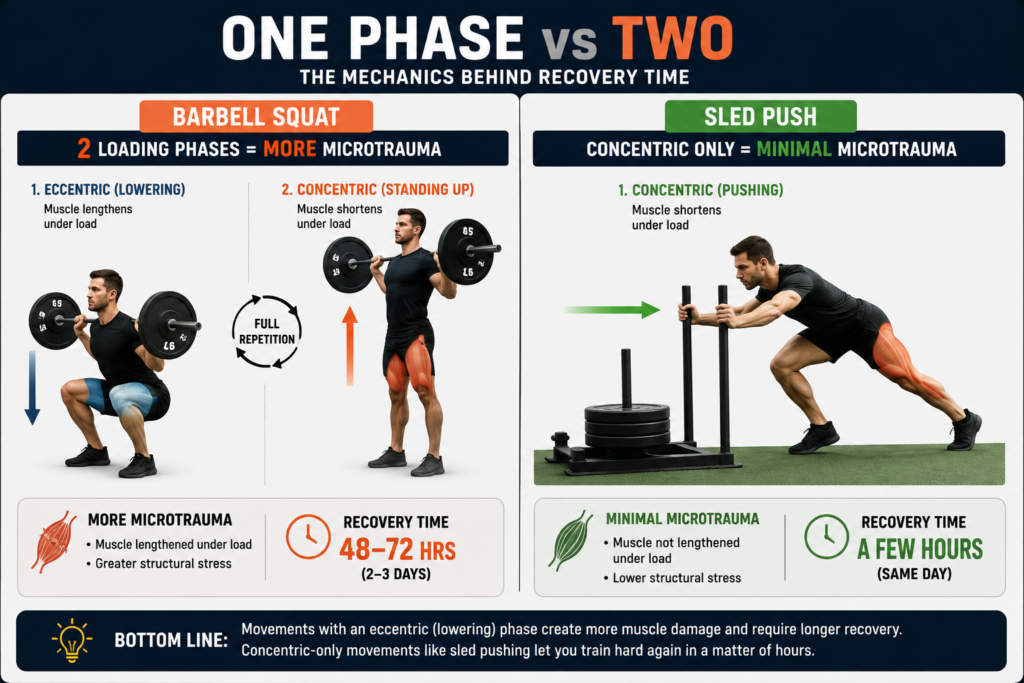
The defining difference between these two exercises isn’t which muscles get worked, since both heavily recruit the quads. It’s how they load those muscles. Squats combine two distinct phases, lowering and lifting, while sled pushes are functionally a single, repeated pushing motion. That mechanical difference is the single biggest factor separating how each exercise feels the next day.
Concentric vs Eccentric Loading, Explained Simply
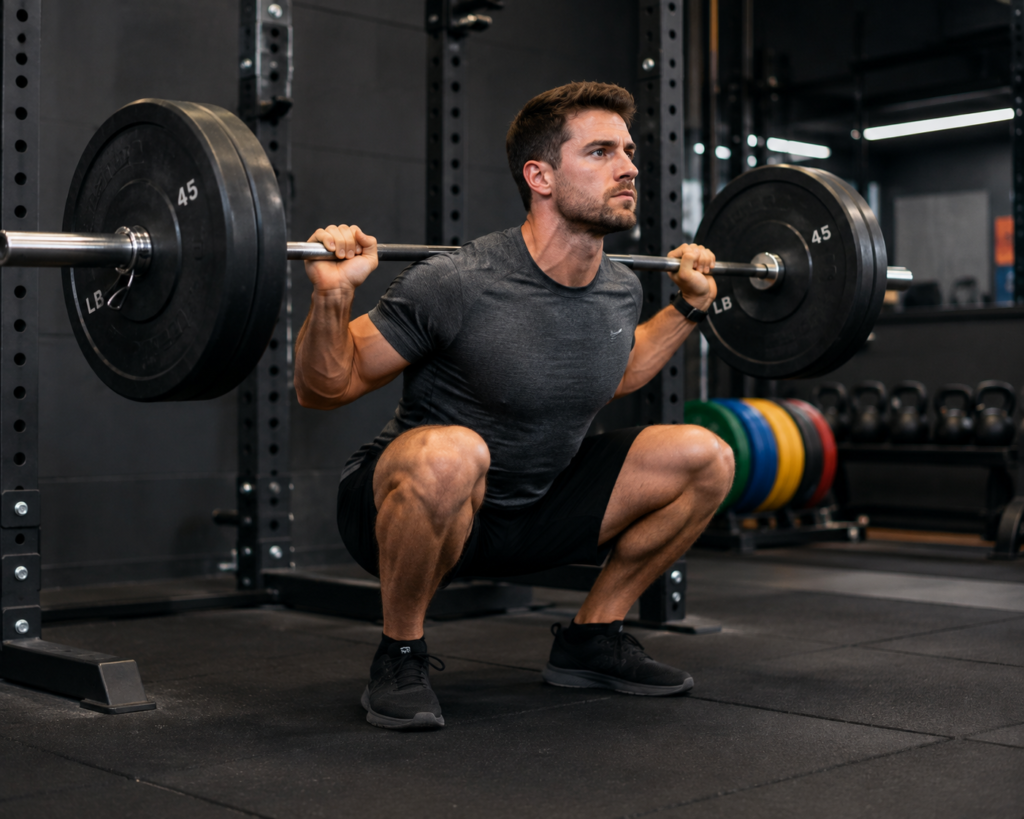
Every resistance exercise involves a muscle either shortening or lengthening under load. The shortening phase is called concentric, like standing up out of a squat or driving the sled forward. The lengthening phase is called eccentric, like lowering into the bottom of a squat under control. Eccentric loading causes considerably more microscopic muscle damage than concentric loading does, and that damage is a major driver of both long term strength adaptation and the soreness known as delayed onset muscle soreness. A sled push has almost no meaningful eccentric phase, since the leg simply lifts and resets between steps without fighting against resistance on the way back. That absence of an eccentric component, not something mystical about pushing weight along the floor, is the real reason sled work is so much easier to recover from.
What the EMG Research Actually Shows
The Maddigan study found something that surprises a lot of lifters. Quadriceps and hamstring activation were statistically comparable between the back squat and the sled push. The two significant differences the researchers did find ran in opposite directions: the sled push produced noticeably greater calf activation than the squat, while the squat produced noticeably greater lower back activation than the sled. In plain terms, the data pushes back hard against the idea that sled work is some kind of lesser, accessory only movement. For quad development specifically, it holds its own against one of the most respected exercises in strength training.
Why Squats Take Longer to Recover From
Heavy squatting puts the body through several things a sled push simply doesn’t:
- Eccentric loading during the lowering phase, which causes deeper muscle microtrauma than concentric only work
- A measurable rise in creatine kinase, a blood marker of muscle damage. One study measuring this response found trained lifters peaked around 1,349 IU after heavy squat work, while untrained lifters peaked around 3,272 IU, both well above typical resting levels, with soreness often peaking two to three days later rather than immediately
- The Valsalva maneuver, the breath hold and brace lifters use under heavy load, which temporarily raises intra abdominal pressure. This is a normal, widely used, and generally safe bracing technique, but it is a real physiological difference from a sled push where no bracing of that intensity is required
- Heavier spinal loading overall, which contributes to whole body fatigue rather than soreness confined to the legs
None of this makes squats a bad exercise. It makes them a higher cost, higher reward movement that needs real recovery time built around it, which is exactly the gap sled work is positioned to fill. Anyone building deeper squat mobility as part of that recovery process might find the breakdown in this deep squat mobility guide useful, and the resting squat position covered in this piece on Asian squat benefits is a great low load way to keep those hips moving between heavy sessions.
Sled Push vs Squats: Head to Head Comparison
Neither exercise wins outright. The right choice depends entirely on the specific training goal.
Muscle Growth
Squats still hold the edge for overall lower body size and maximal strength, largely because of that eccentric phase and the sheer volume of research behind mechanical tension as a growth driver. Sled pushes are a legitimate hypertrophy tool in their own right though, particularly for the calves, where activation actually exceeds the squat. Anyone curious how single leg loading patterns like the sled compared to more traditional bilateral training should look at this guide on unilateral training, since each step of a sled push briefly loads one leg at a time.
Recovery Time
Forty eight to 72 hours is a reasonable general guideline for full recovery from a heavy squat session, driven mainly by that eccentric muscle damage. Sled pushes, with minimal eccentric loading, allow most lifters to feel recovered within hours, which opens the door to training legs far more frequently than a squat only approach would allow. Lifters curious about pushing leg frequency even further can see how that plays out in practice in this piece on training squats every day.
Joint and Spinal Stress
Squats place real compressive, axial load on the spine, manageable with solid form but a genuine consideration for anyone with lower back sensitivity. Sled pushes apply force horizontally through the legs instead, which is why the spine carries comparatively little load and why sled work shows up so often in return to training and in season programming for athletes managing injury history.
Practical Application
Squats fit best in dedicated strength blocks or off season phases where adequate recovery time is available between sessions. Sled pushes fit best as in season maintenance, high frequency accessory volume, or a lower back friendly option for anyone working around an existing injury.
Sled Push vs Squats at a Glance
| Factor | Squats | Sled Push |
| Quad Activation | High | High, comparable to squats |
| Calf Activation | Moderate | Significantly higher |
| Lower Back Activation | Significantly higher | Minimal |
| Loading Type | Concentric and eccentric | Primarily concentric |
| Typical Recovery Time | 48 to 72 hours | A few hours to one day |
| Training Frequency | 1 to 2 times per week | Up to 3 to 4 times per week |
| Best For | Maximal strength, hypertrophy | High frequency volume, joint friendly conditioning |
How to Combine Sled Pushes and Squats in One Program
These two exercises aren’t competing for the same slot in a training week, they solve different problems and work well stacked together. A sensible structure looks like squats once or twice a week as the primary heavy lower body movement, with sled pushes layered in on additional days as lower stress volume that doesn’t eat into recovery for the next squat session.
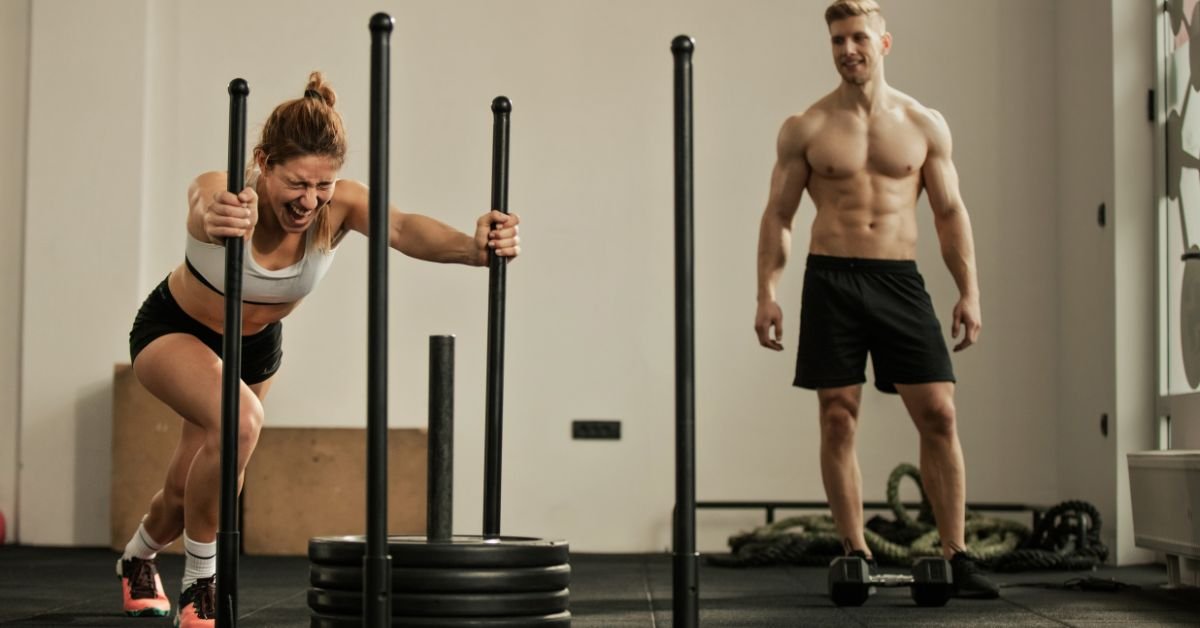
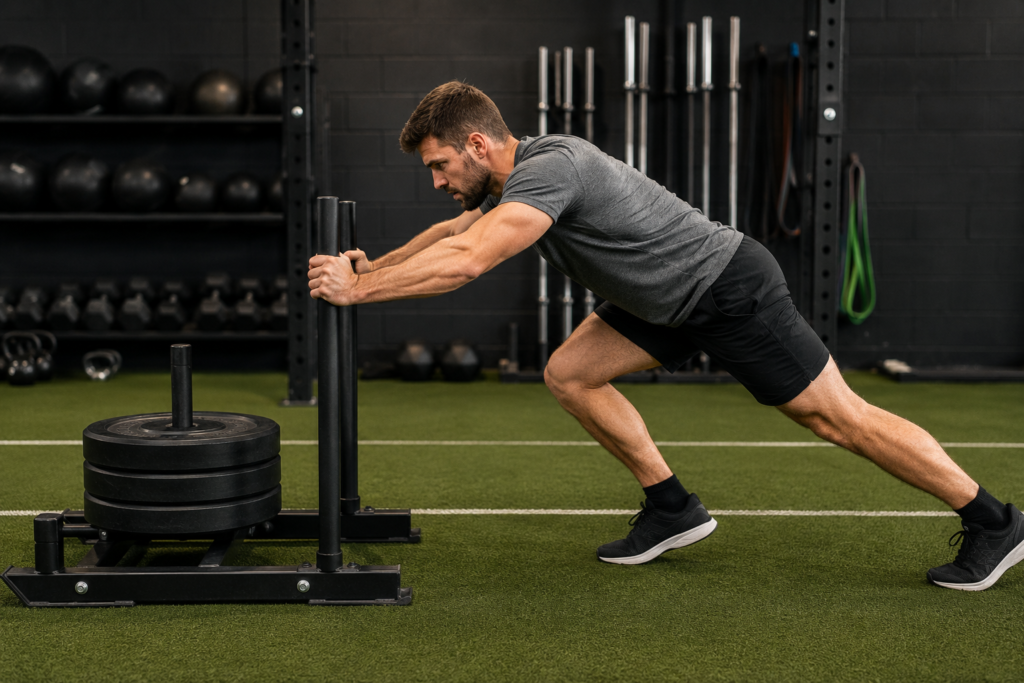
Technique matters here. A proper sled push starts with a forward lean of roughly 45 degrees, arms extended and driving the movement through the legs rather than the arms, core braced throughout the set. If the arms are burning by the end of a push, the technique needs adjusting, since the legs should be doing essentially all the work.
Recovery still comes down to the same fundamentals regardless of which exercise gets programmed: enough protein, enough sleep, and enough total recovery capacity across the week. The advantage of the sled is that its lower systemic cost means it can be added on top of an existing plan without quietly draining the recovery budget squats depend on. Readers looking to structure that loading progression properly over time should check the full breakdown in this guide on progressive overload. For a lower body equivalent to comparing pressing patterns on the upper body side, the tradeoffs discussed in chair dips versus push ups follow a similar logic of picking the right tool for the right recovery window.
The Bottom Line
Squats and sled pushes each have a valuable place in a well designed training program. Squats remain the gold standard for building maximal strength, muscle mass, and total body power through heavy eccentric loading. Sled pushes, on the other hand, deliver comparable quad activation with far less muscle damage, making them an excellent option for increasing training frequency while managing fatigue.
For most lifters, the smartest approach is to combine both. Build your routine around one heavy squat session each week, then add one or two sled push sessions to increase lower body volume without compromising recovery. Over time, this balanced strategy can improve strength, muscle growth, work capacity, and overall athletic performance.
Looking to build a stronger, smarter training program? Fitness Geekz offers evidence-based workout guides, exercise comparisons, and practical training advice to help you maximize muscle growth, improve performance, and train with confidence. Explore more expert resources on Fitness Geekz and take your fitness journey to the next level.
Frequently Asked Questions
For quad and calf development, EMG research shows sled pushes activate those muscles comparably to or even more than squats, though squats still edge ahead for overall strength and hypertrophy thanks to their eccentric loading.
Squats involve an eccentric lowering phase that causes deeper muscle microtrauma, while sled pushes are almost entirely concentric, resulting in far less muscle damage and a much shorter recovery window.
Not entirely. Sled pushes are a strong complement for volume and recovery friendly training, but squats remain more effective for building maximal strength.
Because sled pushes cause minimal muscle damage, most lifters can perform them multiple times per week, even on days surrounding heavier squat sessions.
Yes, sled pushes place significantly less compressive load on the spine than squats, making them a useful option for lifters managing lower back sensitivity.