
Quick Answer
Single-leg exercises build strength, balance, and hip stability that standard squats often miss, particularly in the glutes, hamstrings, and adductors. Research shows unilateral training improves single-leg power, sprint performance, and fall resistance more effectively than bilateral lifts alone, making it essential for strength and healthy aging after 50.
- Best single-leg exercises: Bulgarian split squat, step-up, single-leg RDL, Copenhagen plank, glute bridge march
- Muscles squats commonly under-train: gluteus medius, adductors, hamstrings
- Research finding: unilateral training improves single-leg jump, sprint, and unilateral force more than bilateral training
- Key benefit for aging adults: leg power declines earlier than leg strength, making unilateral training a priority
- Programming approach: layer single-leg work alongside, not instead of, heavy bilateral lifts
Introduction
Months of consistent squatting, sometimes years of it, and the legs still look the same. Still feel the same. Some people would even say worse. Here’s the part nobody quite says out loud: squats aren’t the problem. But after 50, they’re also not the full solution. A standard squat barely touches the hamstrings, the inner thighs, or the deep glute fibers that actually keep the body upright, mobile, and strong as the years add up. So while the reps keep piling up, the lower back quietly does more of the work than it should, and the muscles that matter most stay half asleep.
This isn’t a case against squats. It’s a case for adding what they leave out. Single-leg, or unilateral, training refers to exercises performed primarily on one leg at a time, such as Bulgarian split squats, step-ups, and single-leg deadlifts, which build strength, balance, and stability that bilateral movements like standard squats can’t fully replicate. This guide covers what the research actually says about why that gap matters, and six specific moves built to close it.
Want to see the technique explained in detail? Click here to watch the full exercise:
Why Squats Alone Aren’t Enough After 50
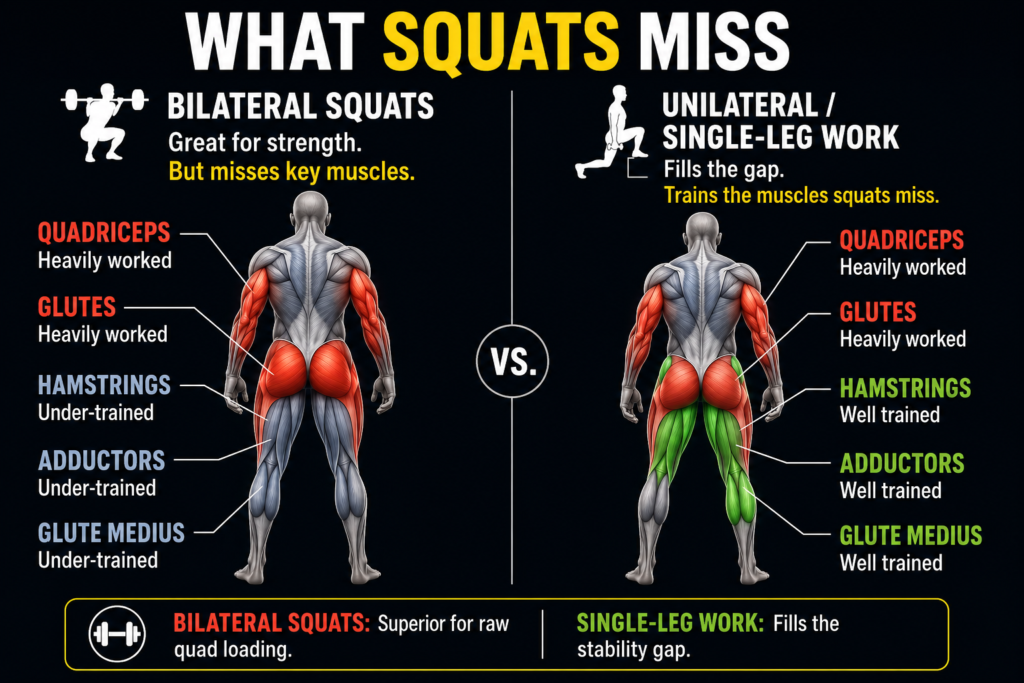
A standard squat under-trains the hamstrings, inner thighs, and deep glute fibers, the exact muscles responsible for staying upright, mobile, and strong with age.
When these muscles stay underused rep after rep, the lower back quietly starts picking up the slack. That pattern gets written off as normal aging more often than it should be. In reality, it’s usually a training gap, not an inevitability. The gluteus medius, a key hip stabilizer, is one of the most commonly under-recruited muscles in standard lower-body routines. When it weakens, the hip tends to drop and the knee twists inward during single-leg tasks like climbing stairs or standing up from a chair, a muscle that simply stopped getting recruited because nothing in the routine was asking anything of it. This is really just one example of a broader principle covered in more depth in this guide to unilateral training for single-leg and single-arm strength, which breaks down why training one side at a time closes gaps that bilateral lifts consistently leave open.
What the Research Actually Says About Leg Power and Aging
Leg power, not just leg strength, tends to decline earlier with age, and it’s a more sensitive predictor of functional decline and fall risk than strength alone.
A systematic review of studies on older adults found that conditions like osteoarthritis, diabetes, and peripheral vascular disease are consistently associated with lower leg power, with peripheral vascular disease specifically linked to roughly 19 to 20 percent lower leg power compared to people without the condition. Here’s the encouraging part: that same body of research found that structured training improves leg power similarly in older adults regardless of these chronic conditions. The decline isn’t fixed, and it isn’t untrainable. Leg power, the ability to generate force quickly, tends to decline before raw leg strength does, which is exactly why power-focused, functional training like single-leg work deserves a spot near the top of the priority list rather than an afterthought tacked onto leg day.
Single-Leg Training vs. Bilateral Squats: What Actually Changes
Single-leg training and bilateral squats serve different, complementary purposes, one doesn’t simply replace the other.
Here’s a detail that tends to surprise people: a peer-reviewed EMG comparison found no significant difference in glute activation between bilateral and unilateral barbell squats, and bilateral squats actually produced higher quadriceps activation. That directly challenges the common gym-floor claim that single-leg work always fires up the glutes more. Where unilateral training genuinely pulls ahead is elsewhere. A 2023 meta-analysis of 28 training studies found unilateral training specifically improved single-leg jump performance, unilateral maximal force, and linear sprint performance more effectively than bilateral training did. The practical takeaway lands somewhere in the middle: heavy bilateral lifts remain an excellent base for overall strength and bone loading, while single-leg work sharpens the balance, symmetry, and sport-specific power that bilateral training alone doesn’t fully cover, the kind of explosive, one-leg-at-a-time output that also underpins plyometric training for speed and agility.
6 Single-Leg Moves That Fix What Squats Miss
No machines, no barbells required, just the muscles standard routines tend to leave sleeping, finally doing their job.
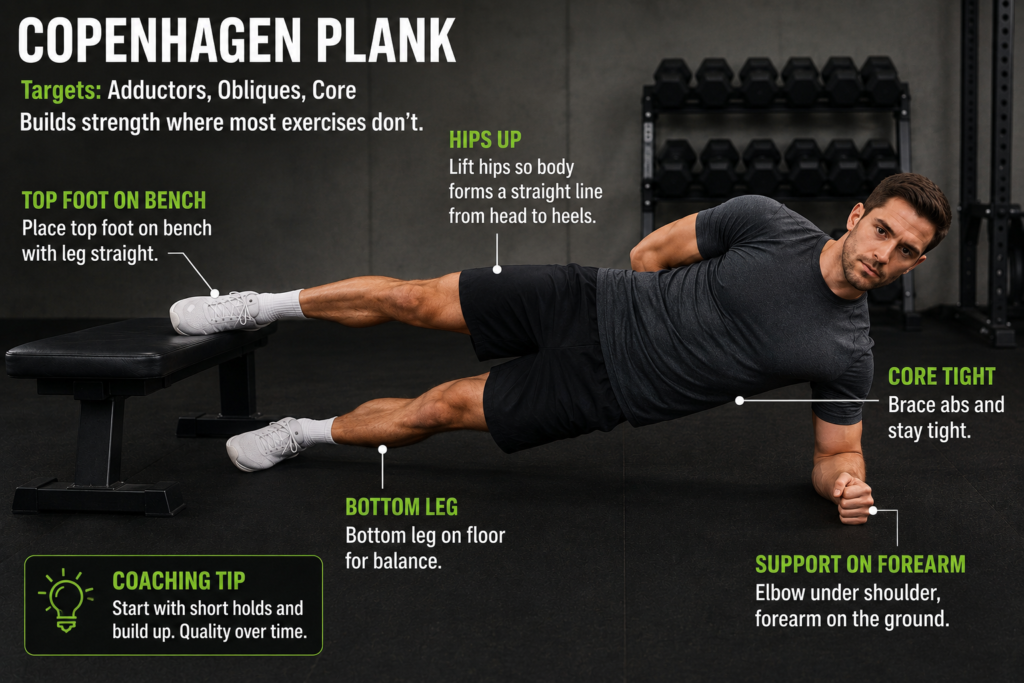
1. Copenhagen plank. Targets the gluteus medius and adductors at the same time, a rare combination for a single movement. Lying on one side with the top foot resting on a bench, the hips lift into a straight line from head to feet. Beginners can bend the top knee to reduce difficulty. Progression starts around 10-second holds for three sets per side, building toward 30 seconds with full form over a few weeks.
2. Step-up with knee drive. A step height between knee and hip level works best. The correction most people miss: keeping the trailing foot off the floor throughout forces the working leg to do all the work instead of quietly pushing off the bottom foot. Driving the opposite knee to chest height at the top adds a balance and hip flexor component on top of the strength work. A slow, three-second descent is where much of the actual adaptation happens.
3. Glute bridge march. A standard glute bridge becomes far more revealing the moment one foot lifts off the ground, exposing a side-to-side strength imbalance that bilateral bridges hide with ease. Keeping the hips level and locked in place while marching one knee toward the chest trains the exact stabilizers responsible for pelvic control.
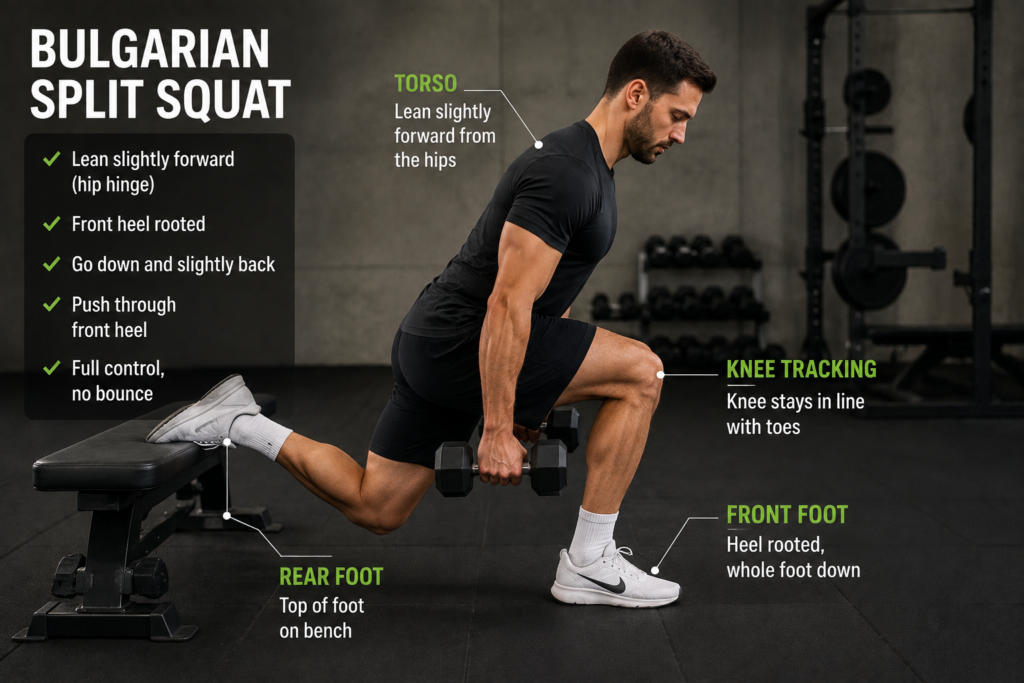
4. Bulgarian split squat. One of the most effective single-leg movements for the glutes, hamstrings, and quads through a full range of motion, but only when treated as a hip hinge rather than a straight-down squat. Leaning the torso slightly forward with the front heel rooted protects the front knee and shifts more of the work into the glutes. A simple setup trick removes most of the guesswork: sitting on a bench, extending the front leg, and marking exactly where the heel lands before standing up into position.
5. Single-leg calf raise. Often skipped entirely, despite the calves playing a direct role in circulating blood back up from the lower legs. Weak calves are linked to poor circulation, swollen ankles, and a higher fall risk. Full range of motion matters here, the heel should drop below the step at the bottom and fully extend at the top, performed one leg at a time so the stronger side can’t quietly cheat the rep.
6. Tibialis raise. Trains the tibialis anterior, the muscle running along the shin that controls how the foot lands with every step. When it’s weak, the toes tend to drag and the ankles roll more easily, which shifts extra impact absorption onto the knees. Standing with the back against a wall and pulling the toes up toward the shins, held briefly before lowering slowly, builds this frequently ignored muscle directly.
How to Progress Single-Leg Training Safely
Progression works best as a structured ladder, not a straight jump into advanced loaded variations.
A simple baseline check helps set the starting point: a 30-second single-leg stance test on each side, and 8 to 10 pain-free supported split squats. Train the weaker side first, and match reps to that side rather than letting the stronger leg quietly do more work than it should. From there, progression should move through basic balance and bodyweight positions, then added range and light resistance, then heavier single-leg loading, and eventually power-based movements like hops once control stays consistent. Staying at each stage for several weeks before advancing isn’t a lack of ambition, it’s exactly the kind of measured approach covered in this guide to progressive overload, which explains why rushing the process tends to backfire more often than it pays off.
Single-Leg Exercises by Muscle Focus, Benefit, and Starting Point
| Exercise | Primary Muscles | Key Benefit | Week 1 Starting Point |
| Copenhagen Plank | Glute medius, adductors | Hip stability, inner thigh strength | 3 sets, 10-second holds per side |
| Step-Up with Knee Drive | Glutes, hamstrings | Functional strength for stairs/hills | 3 sets of 8 reps per leg, bodyweight |
| Glute Bridge March | Glutes, core, hip stabilizers | Exposes and corrects side imbalance | 3 sets of 6 marches per side |
| Bulgarian Split Squat | Glutes, hamstrings, quads | Full range single-leg strength | 3 sets of 6 reps per leg, bodyweight |
| Single-Leg Calf Raise | Calves | Circulation, fall risk reduction | 3 sets of 8 slow reps per side |
| Tibialis Raise | Tibialis anterior (shin) | Ankle control, impact absorption | 3 sets of 15 reps |
Real-Life and Sport Carryover
Most real-world movement, walking, climbing stairs, running, is inherently single-leg in nature, which is exactly why unilateral training carries over more directly than bilateral lifts alone.
Running is essentially alternating single-leg stance at speed. Athletes plant, cut, and jump off one leg far more often than two in sports like soccer, basketball, and tennis. Even the mundane stuff, climbing a flight of stairs or stepping off a curb without thinking twice, relies on the same single-leg stability trained directly through these exercises.
Safety Considerations Before Starting
A cautious, guided approach makes sense for anyone with a history of falls, recent joint surgery, or existing joint pain.
Anyone with a history of frequent falls, or who feels unsteady simply standing on one leg, should start with supported variations and professional guidance rather than jumping straight into loaded movements. Recent hip, knee, ankle, or foot surgery warrants clearance from a physical therapist before progressing single-leg loading of any kind. Sharp, localized joint pain or a sensation of the knee giving way during single-leg work should get addressed before continuing, and for anyone managing knee discomfort more generally, this guide to bodyweight exercises for knee pain and posture offers a useful starting point for building strength without aggravating the joint further.
The Bottom Line
Squats aren’t the problem, but relying on them alone leaves real gaps in hip stability, hamstring strength, and balance, gaps that become more consequential with every passing year. Single-leg training fills that space directly, and the research backs it up: measurable improvements in power, sprint performance, and fall resistance that bilateral lifts alone don’t fully deliver. Layer one or two of the six moves above into an existing routine, progress gradually, and give the weaker side the attention it’s probably been missing for a while.
Ready to build stronger, more balanced legs? Explore more strength and mobility guides on Fitness Geekz for additional single-leg progressions and programming ideas.
Frequently Asked Questions
Single-leg exercises and squats serve different purposes. Unilateral training builds balance, hip stability, and single-leg power that squats often miss, while bilateral squats remain excellent for overall strength and loading capacity.
Single-leg exercises place greater demand on the gluteus medius, adductors, and hamstrings, muscles that a standard bilateral squat often under-trains.
The single-leg stance and supported split squat are effective starting points, building balance and basic strength before progressing to loaded variations like the Bulgarian split squat.
One to two sessions per week is generally enough to build meaningful strength and balance improvements when layered alongside existing lower-body training.
Yes. Research links stronger, more balanced leg power to reduced fall risk, and single-leg training directly targets the stabilizing muscles most responsible for maintaining balance during everyday movement.