
Quick answer: The clavicular head of the pec major responds best to a bench angle between 30 and 45 degrees combined with horizontal adduction, meaning the arms drive up and inward, not just upward. Incline dumbbell presses, low to high cable flies, and landmine presses consistently produce the strongest activation and the deepest mechanical stretch.
- Best overall exercise: Incline Dumbbell Press, bench set between 30 and 45 degrees
- Best isolation option: Low to High Cable Fly
- Best equipment free option: Decline Push Up
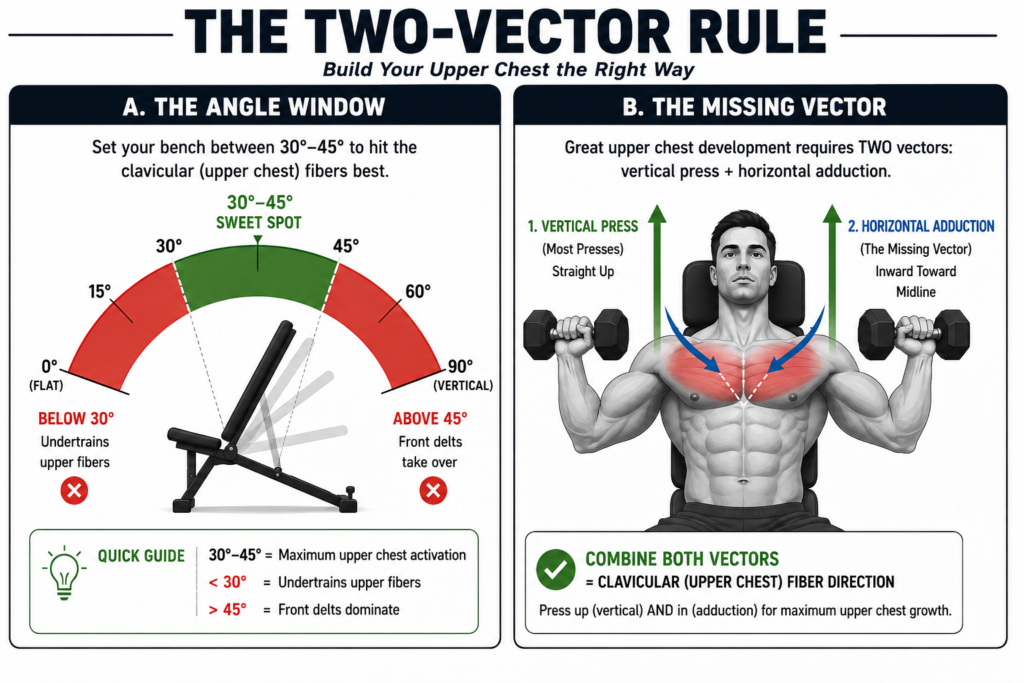
- Optimal incline range: 30 to 45 degrees. Below that range under trains the upper fibers, above it shifts the load to the front delts
- Key technique cue: horizontal adduction, elbows driving inward, not just vertical pressing
- Training frequency: one to two direct chest sessions per week, with upper chest work placed early in the session
Introduction
There’s a very specific kind of frustration that shows up around the two year mark of consistent training. The arms have filled out. The back has width. The lower chest looks full and round in a t- shirt. And then there’s that flat patch just below the collarbone that hasn’t moved in months, no matter how much incline pressing gets thrown at it.
Most people assume that patch is just genetics being unfair. It usually isn’t. A 2020 study published in the International Journal of Environmental Research and Public Health tested bench press EMG activity across five different incline angles, from flat to 60 degrees, and found that activation of the upper pectoral fibers peaked specifically at 30 degrees, not higher. That single detail explains a lot of stalled upper chest progress. Plenty of lifters are pressing at whatever angle the bench happens to be set at, without realizing that a few degrees in either direction changes which muscle actually does the work. This article breaks down what the evidence actually supports, ranks the exercises worth building a routine around, and explains the setup details that quietly determine whether any of it works at all.
Want to see the correct form before jumping in? Click here to watch the full exercise:
Why the Upper Chest Is Hard to Target in the First Place
The clavicular head of the pectoralis major is a separate, independently innervated section of the chest, with muscle fibers that run diagonally up toward the collarbone rather than straight across like the rest of the pec. That angled fiber direction is the whole reason this area behaves differently from the rest of the chest. It responds to a specific combination of two things happening at once: the arm lifting upward, and the arm drawing inward across the body. Most standard pressing movements only deliver the first part.
The Angle Debate, and What the Research Actually Shows
There’s some genuine disagreement in the research world about the exact ideal angle, and it’s worth being upfront about that rather than pretending there’s one magic number. The Rodríguez-Ridao study found peak clavicular activation at 30 degrees specifically. Other research examining a wider spread of angles, including work looking at 44 and 56 degree inclines, has found meaningful upper chest engagement at steeper settings too. What almost every study agrees on is the boundary at the top end: once the incline pushes past roughly 45 to 50 degrees, the movement starts to resemble a shoulder press more than a chest press, and the front deltoid takes over. The practical takeaway is to stay inside the 30 to 45 degree window. That range captures the benefit across the available research while staying clear of the point where the shoulders hijack the set.
The Missing Ingredient Most Lifters Skip
Getting the angle right solves half the problem. The other half is horizontal adduction, which is a technical way of describing the arm sweeping inward across the chest. A standard incline press moves the arms up and down in a straight line and never asks them to converge. That’s why two lifters using the same bench angle can get very different results depending on whether they’re simply pushing the weight up or actively driving the elbows toward each other as they press. The second version recruits far more of the clavicular fibers because it finally matches the direction those fibers actually run.
5 Reasons the Upper Chest Stops Growing
Even with the right exercises in a program, a handful of small habits quietly cap upper chest progress:
- Training at the wrong incline angle, either too flat or too steep
- Training the upper chest last, after fatigue has already taken the edge off strength and focus
- Letting the elbows flare out toward 90 degrees, which hands the set over to the front delts
- Focusing only on pushing the weight up instead of squeezing the arms inward
- Starting each set from a rounded shoulder, sunken chest position instead of a proper setup
That last point matters more than it gets credit for, especially for anyone who spends most of the day at a desk. Tight chest muscles and rounded shoulders put the clavicular fibers in a shortened position before the bar even leaves the rack, which limits how much tension they can generate through the full rep. A quick scapular retraction and chest lift before every set fixes this in seconds, and it’s one of the simplest changes on this list to actually apply.
Best Upper Chest Exercises, Ranked by Activation and Stretch
In order, the strongest options are the incline dumbbell press, the low to high cable fly, the incline barbell bench press, the landmine press, and the decline push up. Here’s why each one earns its spot.
1. Incline Dumbbell Press
This sits at the top of the list because it combines two things that rarely come together in one movement: enough load capacity to drive real strength gains, and a free arm path that lets each side stretch deeper at the bottom and converge naturally at the top.
How to do it:
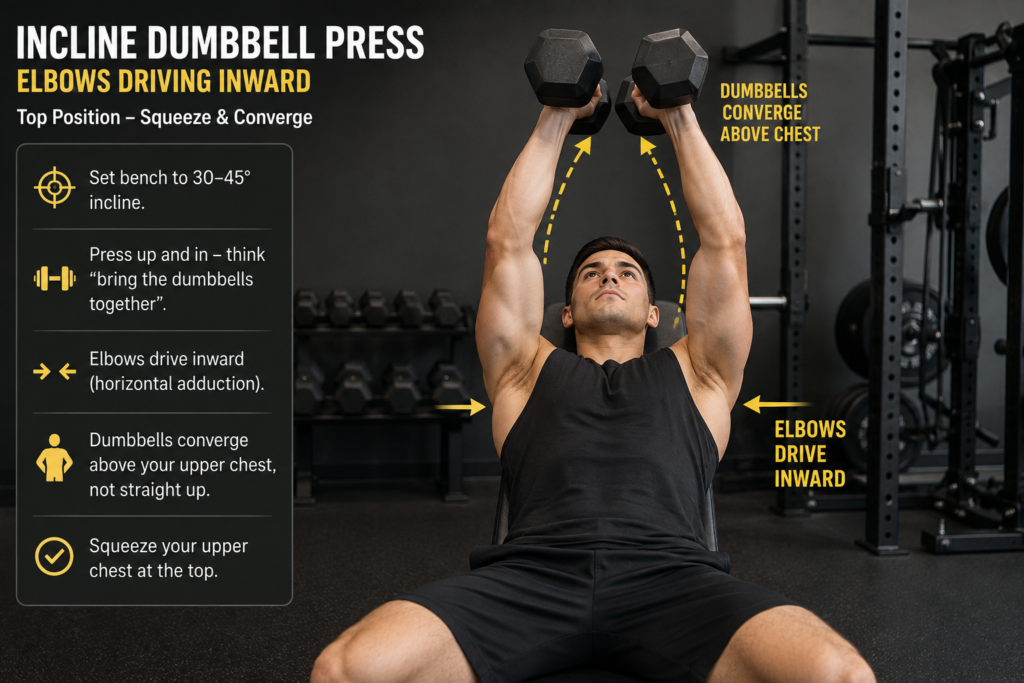
- Set the bench between 30 and 45 degrees.
- Hold the dumbbells with elbows angled around 45 degrees from the torso, not flared wide.
- Lower with control until a deep stretch is felt across the upper chest.
- Press upward while actively thinking about bringing the elbows together, not just pushing the weight away.
Prescription: 3 to 4 sets of 6 to 10 reps.
2. Low to High Cable Fly
Cables solve a problem that free weights can’t. Gravity only resists straight down, but a cable pulling from a low pulley resists the entire arc of the movement, including the inward finish that gives this exercise its edge for isolating the clavicular fibers.
How to do it:
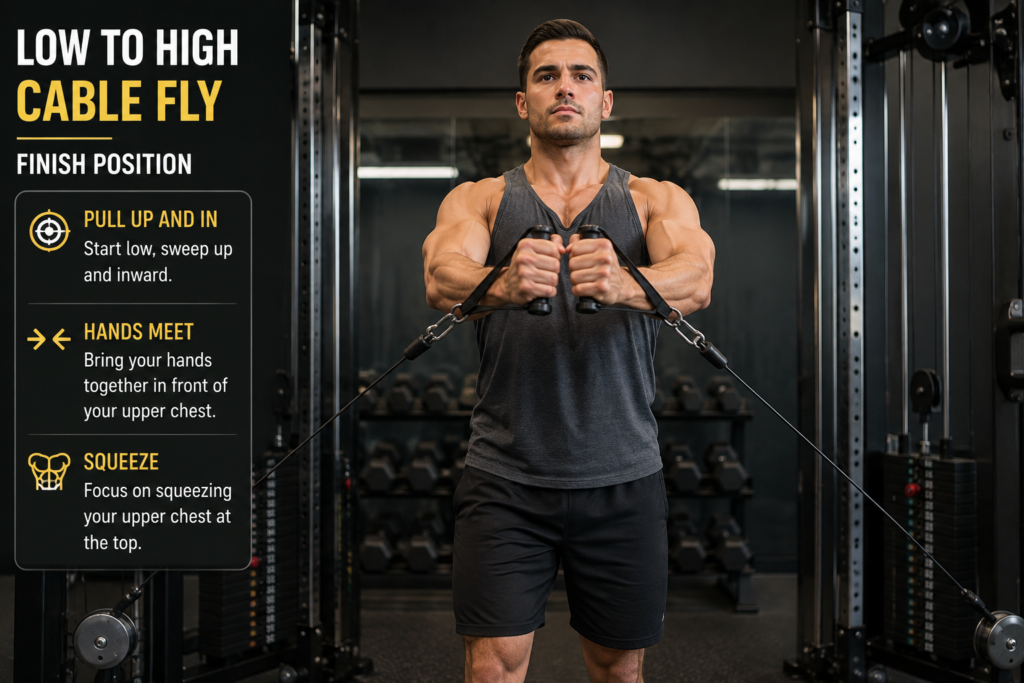
- Set the pulleys to the lowest position and grab a handle in each hand.
- Step forward slightly with a soft bend in the elbows.
- Pull the handles up and inward until the hands meet around chest height.
- Squeeze at the top before lowering back under control.
Prescription: 3 to 4 sets of 10 to 15 reps. For lifters who want to understand why controlling that lowering phase matters so much for results, the breakdown in this guide on exercise tempo is worth a look.
3. Incline Barbell Bench Press
This ranks third, not because it’s a weak movement, but because a fixed barbell path removes the adduction component almost entirely. What it offers instead is raw loading capacity. Nothing on this list allows for heavier weight on the bar, which makes it valuable for building the kind of baseline strength that everything else gets layered on top of.
Prescription: 3 to 4 sets of 6 to 8 reps, used as a strength anchor alongside the more isolation focused movements on this list. Anyone building a full pressing routine around barbell work should also look at the best barbell exercises for building muscle mass for how this fits into a broader plan.
4. Landmine Press
The landmine attachment creates a converging arc almost automatically, since the bar is pinned at a fixed point on the floor. That built in path lines up closely with the natural direction of the clavicular fibers, and the fixed pivot tends to feel noticeably easier on the shoulder joint than a barbell or overhead press.
Prescription: 3 sets of 8 to 12 reps per side. A strong option for anyone managing shoulder discomfort who still wants loaded pressing work in the program.
5. Decline Push Up
The most underrated entry on this list, mostly because it requires no equipment at all. Elevating the feet on a bench or box shifts a real percentage of bodyweight load toward the upper chest and front shoulders, closely mimicking the pressing path of an incline press.
How to do it:
- Place the feet on an elevated surface and hands slightly wider than shoulder width on the floor.
- Keep the chest lifted and elbows around 45 degrees from the torso.
- Lower until the chest nearly touches the floor, then press back up.
Prescription: 3 sets taken close to failure. Anyone curious how this stacks up against other bodyweight pressing options should check the comparison in chair dips versus push ups.
Upper Chest Exercise Comparison
| Exercise | Equipment | Primary Benefit | Best For | Rep Range |
| Incline Dumbbell Press | Dumbbells, bench | Load plus deep stretch | Overall upper chest builder | 6 to 10 |
| Low to High Cable Fly | Cable machine | Constant tension, true adduction | Isolation and mind muscle focus | 10 to 15 |
| Incline Barbell Bench Press | Barbell, bench | Maximum loading | Progressive overload and strength | 6 to 8 |
| Landmine Press | Landmine, barbell | Joint friendly pressing arc | Shoulder conscious lifters | 8 to 12 |
| Decline Push Up | None | Bodyweight upper chest work | Home training, finishers | Near failure |
How to Actually Program These Exercises
Two exercises, chosen well and done consistently, beat five exercises done half heartedly almost every time. A sensible split looks like one loaded compound movement, such as the incline dumbbell press, paired with one isolation or bodyweight finisher, such as the cable fly or decline push up.
Sequencing matters just as much as selection. Strength, focus, and coordination are all highest at the start of a workout, which is exactly why upper chest work should come first on chest day rather than getting tacked on after a round of flat bench press has already used up the best reps of the session.
Before every set, run through a short setup checklist: feet planted, upper back tight against the bench, shoulder blades pulled back and down, chest lifted toward the ceiling. This creates a pre-stretch in the clavicular fibers before the first rep even starts, which noticeably improves recruitment and takes pressure off the shoulder joint at the same time.
One to two direct chest sessions per week is enough for most lifters to see real progress, as long as intensity and form stay high across those sessions. For the loading side of that equation, understanding how to structure weight increases over time makes a real difference, and this guide on progressive overload covers exactly that.
The Bottom Line
Upper chest underdevelopment almost never comes down to bad genetics. It usually comes down to a stacked set of small, fixable habits: the wrong angle, the wrong exercise order, and a movement pattern that never asks the arms to converge. Fix the angle, prioritize the area early in the session, and add the inward squeeze that most pressing movements leave out, and the flat patch below the collarbone starts filling in.
Start with just two exercises from this list, the incline dumbbell press and the low to high cable fly, and build consistency there before adding anything else. For lifters who want to round out their pressing strength with more bodyweight and isometric options, the isometric training guide is a solid next stop.
Frequently Asked Questions
Research points to 30 degrees as the angle producing peak clavicular activation, with a practical working range of 30 to 45 degrees before the front delts start taking over.
It’s usually one of a few fixable habits: training at the wrong angle, training upper chest last when already fatigued, or letting the shoulders dominate the movement instead of the chest.
Cable flies offer more constant tension and true horizontal adduction, while presses allow heavier loading. The two work best together rather than as a substitute for one another.
Yes. Decline push ups, with the feet elevated and chest lifted, effectively target the upper chest using bodyweight alone.
Two well executed exercises, performed with correct setup and consistent progression, typically outperform rotating through several exercises without focus.