
Quick Answer
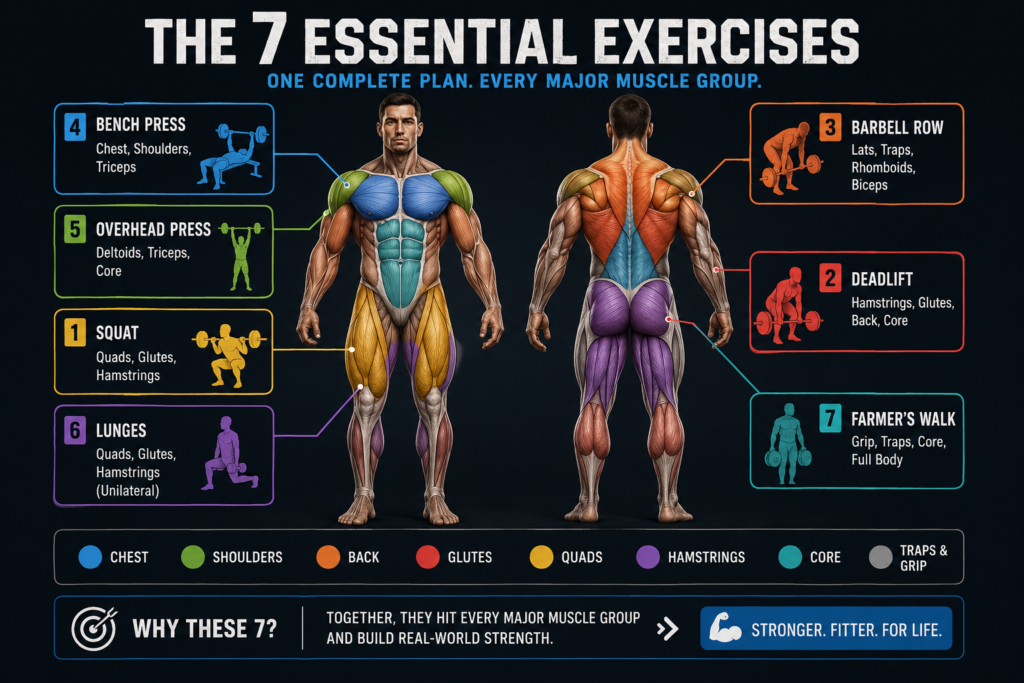
Building a strong physique doesn’t require an endless exercise list. Seven compound movements, the squat, deadlift, barbell row, bench press, overhead press, lunge, and farmer’s walk, train every major muscle group, build functional strength, and deliver consistent results with just three training sessions per week.
- The 7 essential exercises: barbell squat, deadlift, barbell row, bench press, overhead press, lunges, farmer’s walk
- Recommended frequency: 3 training sessions per week
- Typical rep ranges: 5 to 12 reps depending on the exercise and load
- Core principle: compound, multi-joint movements build more total muscle than isolation work alone
- Supporting factors: progressive overload, adequate protein intake, and consistent sleep
Introduction
A large share of lifters spend hours in the gym every week doing exercises that barely move the needle, chasing pump-focused isolation work while the movements that actually build a strong, capable physique sit untouched in the corner of the free weight section. Here’s the good news: the body doesn’t need an endless exercise list to get stronger. It needs seven.
Seven compound lifts, trained consistently and programmed with a little intention, cover every major muscle group and build the kind of strength that shows up outside the gym, not just in the mirror. This guide walks through all seven, the exact sets, reps, and frequency to run them at, and how to fit the whole thing into a realistic three-day week.
A strong physique is best built through compound exercises, multi-joint movements that recruit several muscle groups at once, rather than isolation exercises that train one muscle in a single plane of motion. That single distinction is the difference between a routine that builds real strength and one that just burns time.
Want a closer look at the movement? Click here to watch the full exercise:
What Makes an Exercise “Essential” for Building a Physique
An essential exercise is multi-joint, recruits multiple muscle groups at once, and builds strength that transfers directly to real-world movement, not just numbers on a machine readout.
A few traits separate the essential lifts from the filler:
- Multi-joint over single-joint. Compound movements beat isolation work for total muscle recruitment per session.
- Free weights over machines. Barbells and dumbbells demand coordination and stabilizer engagement that a fixed machine path removes entirely.
- Real-world transfer. These movements mimic what the body actually does outside the gym, lifting, carrying, pushing, pulling. This is the same principle behind functional strength training exercises, which prioritize movement patterns over isolated muscle targeting.
Isolation work still earns a spot in a well-rounded program, correcting muscle imbalances or supporting an injury recovery is exactly where it shines. It just shouldn’t be the foundation a routine is built on.
The 7 Essential Exercises for a Strong Physique
Here they are, all seven, each with the exact form cues, sets, and reps to make them count.
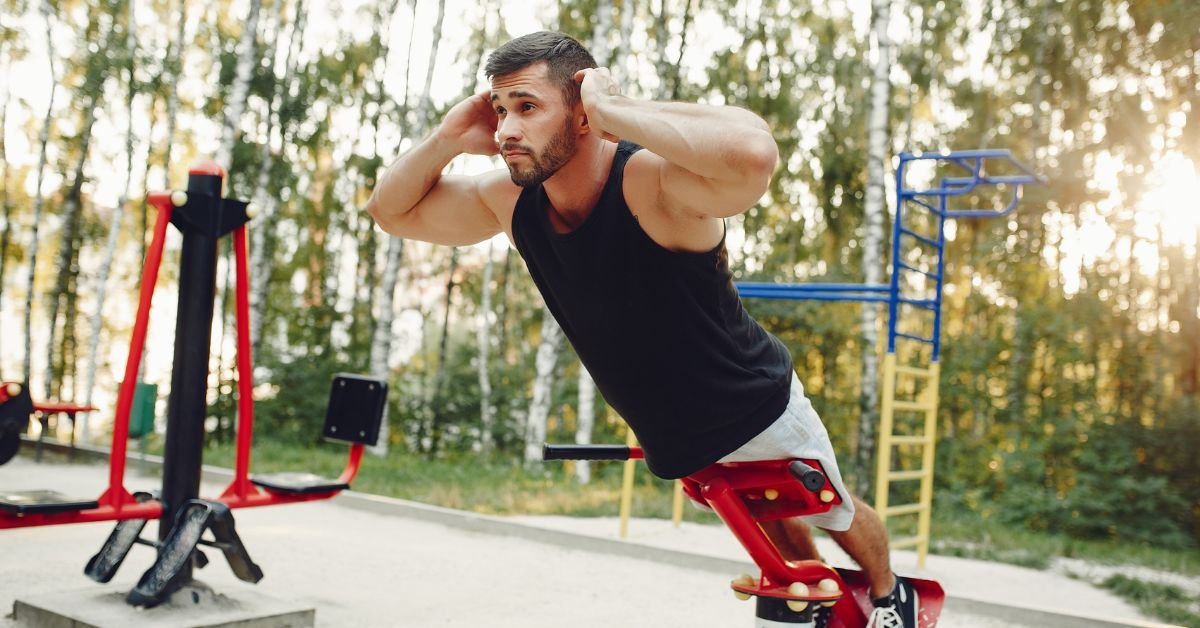
1. Barbell Squat
Ever notice how many guys have an impressive upper body but legs that tell a completely different story? The barbell squat is the fix. It’s not just another leg exercise, it’s one of the most powerful movements for triggering total-body growth, with research suggesting squats stimulate a meaningful hormonal response that supports strength and muscle development.
How to do it:
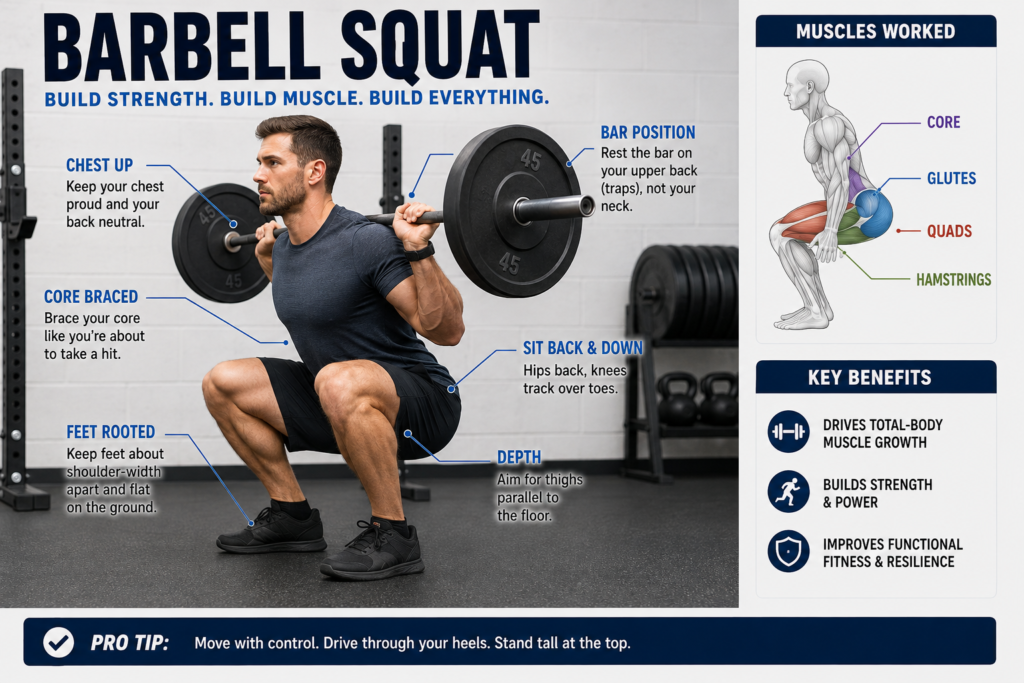
- Stand with feet shoulder-width apart.
- Place the barbell across the upper back.
- Keep the chest up and core tight.
- Squat until the thighs are parallel to the floor.
- Push through the heels to return to standing.
Recommended training: 3 sets of 5 to 8 reps (heavy) or 3 sets of 8 to 12 reps (moderate weight), twice per week.
2. Deadlift
The deadlift isn’t just another exercise, it’s one of the ultimate tests of total-body strength. The hamstrings, glutes, back, and core all work together to generate force, and research shows properly performed deadlifts can strengthen the muscles supporting the spine while improving functional strength.
How to do it:
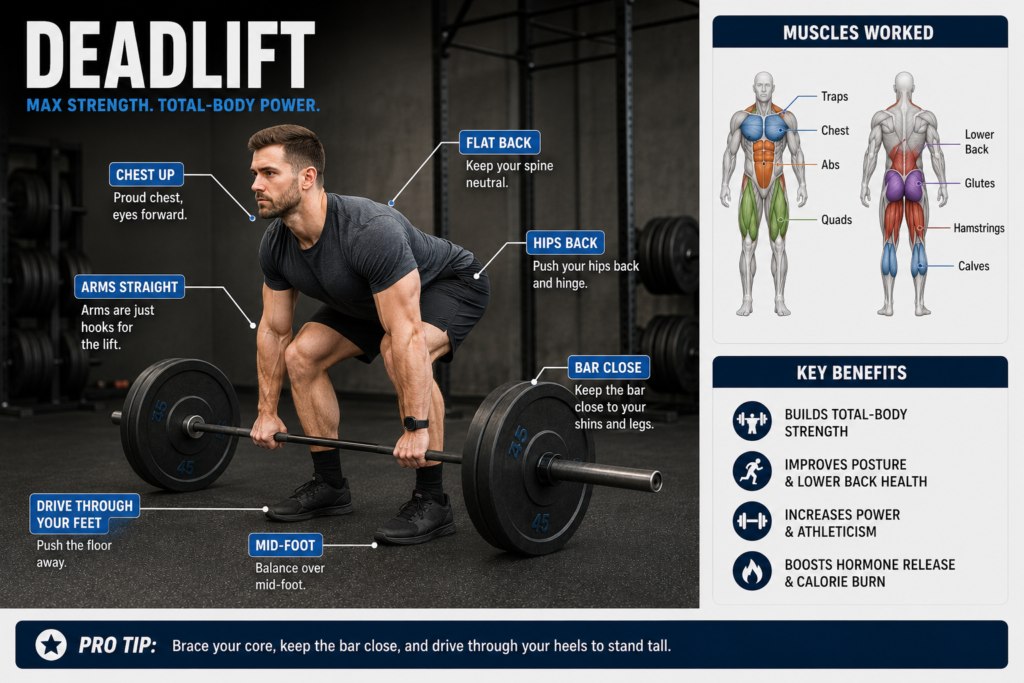
- Position the bar over the midfoot.
- Hinge at the hips and knees.
- Keep the back flat and chest up.
- Drive through the heels.
- Keep the bar close to the body throughout the movement.
Recommended training: 3 sets of 3 to 8 reps, once per week.
3. Barbell Row
The barbell row is the foundation of upper-body thickness and pulling strength. It targets the lats, traps, and rhomboids, building a stronger back while improving posture in the process.
How to do it:
- Hinge forward about 45 degrees.
- Keep the back straight and core engaged.
- Pull the bar toward the lower chest.
- Squeeze the shoulder blades together at the top.
- Lower under control.
Recommended training: 3 sets of 6 to 10 reps, 1 to 2 times per week.
4. Bench Press
Without proper strength training, the average man gradually loses upper-body strength with age. The bench press develops the chest, shoulders, and triceps while teaching them to work together efficiently, one of the reasons it’s stuck around as a strength staple for decades.
How to do it:
- Keep the feet flat on the floor.
- Grip the bar slightly wider than shoulder-width.
- Lower the bar under control to the mid-chest.
- Press it back up in a slight arc.
Recommended training: 3 sets of 5 to 10 reps, 1 to 3 sessions per week.
5. Overhead Press
The overhead press is one of the most effective exercises for shoulder strength and overall upper-body development. It strengthens the deltoids, triceps, and core while improving posture and overhead stability, a movement pattern that shows up constantly in daily life, from reaching a top shelf to loading a suitcase overhead.
How to do it:
- Start with the bar at collarbone height.
- Brace the core.
- Press the bar straight overhead until the arms are fully extended.
- Lower slowly and under control.
Recommended training: 3 sets of 5 to 6 reps (heavy) or 8 to 12 reps (moderate weight), twice per week.
6. Lunges
While squats build overall strength, lunges improve single-leg stability, balance, and muscular symmetry. They reduce the imbalances that tend to build up between the dominant and non-dominant side, while still hitting the quads and glutes hard.
How to do it:
- Step forward about 2 to 3 feet.
- Lower both knees until they reach approximately 90 degrees.
- Keep the front knee aligned over the foot.
- Push through the front heel to return.
Recommended training: 3 sets of 8 to 12 reps per leg, 1 to 2 times per week.
7. Farmer’s Walk
Real strength isn’t just about lifting, it’s also about carrying. The farmer’s walk develops grip strength, core stability, posture, and full-body endurance, and grip strength itself has been linked to overall health and long-term physical function. Anyone building this movement into a home routine can pull additional dumbbell-based pairings from this guide to dumbbell exercises for muscle mass at home, which covers several full-body combinations worth mixing in.
How to do it:
- Pick up two heavy dumbbells or kettlebells.
- Stand tall with shoulders back.
- Keep the core tight.
- Walk forward with slow, controlled steps.
Recommended training: 3 to 4 sets, 25 to 50 yards per set, 1 to 2 times per week.
Why Compound Movements Outperform Isolation-Only Training
Compound lifts stimulate more total muscle mass per session and build strength that carries over to daily life, something isolation training alone simply can’t replicate.
The mechanism behind this comes down to hypertrophy itself: resistance training stresses muscle tissue, prompting the body to rebuild it bigger and stronger over time. That process responds best to movements that recruit the most muscle fibers at once, which is exactly what compound lifts are built for. Isolation exercises like barbell curls or leg extensions still have their place for correcting imbalances or easing back from an injury, but they were never designed to carry a routine on their own. For a deeper dive into what actually accelerates this process, this breakdown of proven tips to build muscle faster naturally covers the training and lifestyle levers that matter most.
How to Program This Routine Into a Realistic Week
1. Train three times per week. Complete all seven movements across three weekly sessions for steady strength and muscle gains without excessive training volume.
2. Rest at least one day between workouts. This gives your muscles adequate time to recover and adapt, especially if you’re a beginner.
3. Master technique before increasing the load. Focus on proper form first, then apply progressive overload by adding repetitions before increasing weight, particularly for farmer’s walks and lunges where technique can break down under heavy loads.
4. Follow an effective weekly split. Alternate between:
- Lower body days: Squats, deadlifts, and lunges.
- Upper body days: Bench press, rows, and overhead press.
- Farmer’s walks: Add them at the end of any session or on the day that best fits your schedule.
5. Adjust training volume as you progress. Once the routine feels manageable, gradually increase sets or weekly frequency based on your recovery and goals rather than making large jumps in weight. How much of this to actually do each week matters just as much as the exercises themselves, and this guide to training volume for muscle growth is a solid companion for dialing in sets and frequency beyond the base recommendations here.
The 7 Essential Exercises by Muscle Group, Sets/Reps, and Frequency
| Exercise | Primary Muscles | Sets × Reps | Recommended Frequency |
| Barbell Squat | Quads, hamstrings, glutes, core | 3 × 5 to 8 (heavy) or 3 × 8 to 12 (moderate) | 2 times per week |
| Deadlift | Hamstrings, glutes, back, core | 3 × 3 to 8 | 1 time per week |
| Barbell Row | Lats, traps, rhomboids | 3 × 6 to 10 | 1 to 2 times per week |
| Bench Press | Chest, shoulders, triceps | 3 × 5 to 10 | 1 to 3 times per week |
| Overhead Press | Deltoids, triceps, core | 3 × 5 to 6 (heavy) or 3 × 8 to 12 (moderate) | 2 times per week |
| Lunges | Quads, glutes, hamstrings, core | 3 × 8 to 12 per leg | 1 to 2 times per week |
| Farmer’s Walk | Grip, core, traps, full body | 3 to 4 sets, 25 to 50 yards | 1 to 2 times per week |
Common Mistakes That Slow Down Physique Results
The single biggest mistake is chasing isolation-heavy routines while neglecting these seven foundational lifts entirely; no amount of curls or cable work replaces what a squat or deadlift does for total-body development.
A few other habits tend to stall progress just as effectively:
- Overloading weight before mastering form, particularly on squats and deadlifts
- Skipping recovery days and training the same movement patterns back-to-back
- Neglecting protein intake and sleep, both of which limit hypertrophy no matter how well the training itself is dialed in. Whole-food sources matter here too, and this list of surprising foods that build muscle faster than protein supplements is worth a look for anyone trying to close that gap without relying on shakes alone
- Avoiding heavier compound lifts out of intimidation, when beginner-friendly regressions exist for nearly every movement on this list, including simple bodyweight starting points covered in this isometric workout for beginners
The Bottom Line
A strong, capable physique doesn’t require an endless list of exercises or hours of daily training. Three well-planned sessions per week built around these seven movements, squat, deadlift, row, bench press, overhead press, lunge, and farmer’s walk, cover every major muscle group and build strength that carries over into daily life. Start with moderate weight, prioritize form over ego, and apply progressive overload consistently over the coming weeks. The results tend to show up faster than expected once the guesswork is removed.
Ready to put these seven exercises into a structured weekly plan? Explore more strength training guides on Fitness Geekz for a complete, step-by-step routine built around exactly this framework.
Frequently Asked Questions
The barbell squat, deadlift, barbell row, bench press, overhead press, lunges, and farmer’s walk.
Three training sessions per week is sufficient when the seven movements are spread across upper-body, lower-body, and full-body focused days.
Yes, with lighter loads and proper form as the priority, along with beginner-friendly regressions like supported squats or a reduced range of motion on lunges while technique develops.
For overall physique development, yes. Compound exercises recruit more total muscle mass per session, though isolation work still has a place for correcting imbalances or supporting recovery.
Most of these lifts perform well in the 5 to 12 rep range, with heavier, lower-rep work suited to squats, deadlifts, and presses, and moderate reps for accessory movements like lunges.