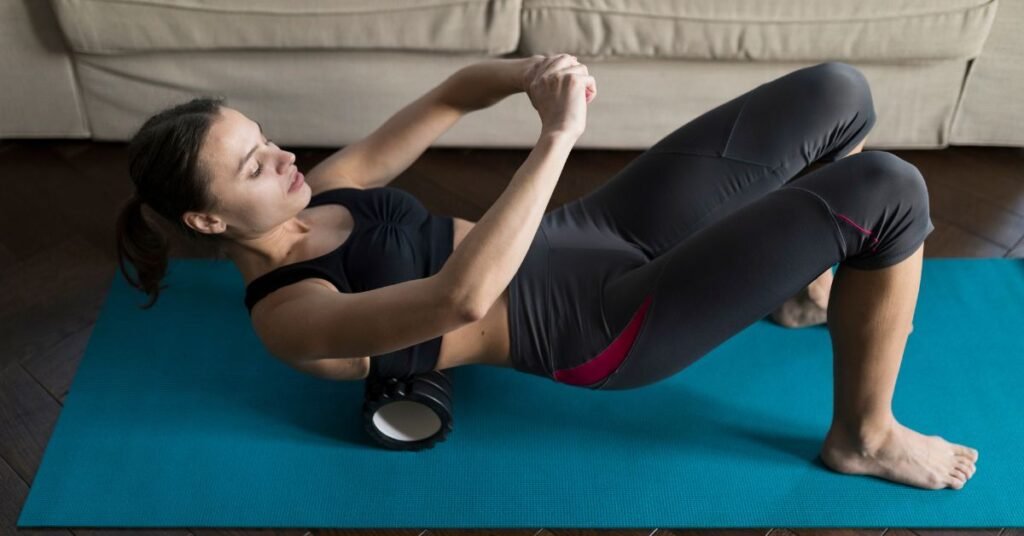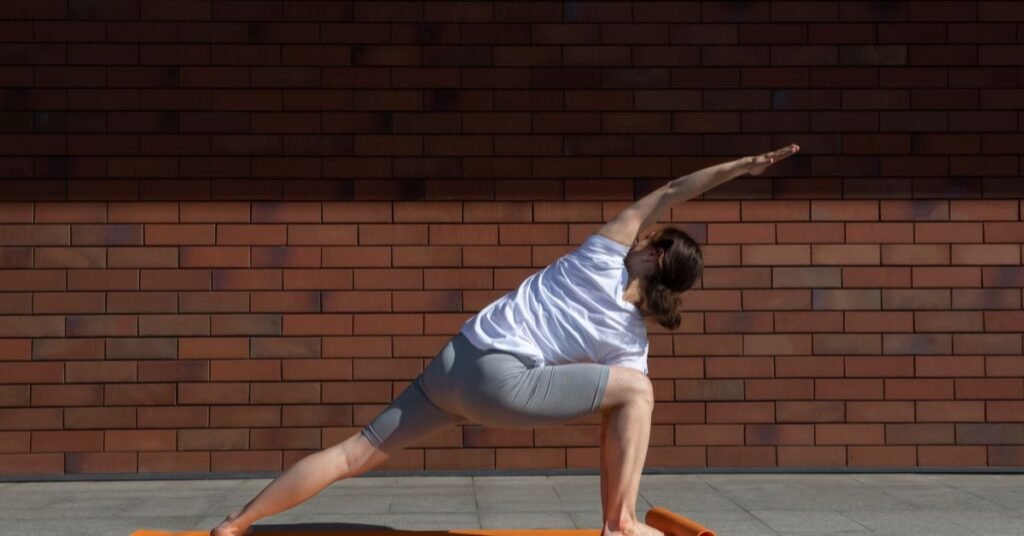
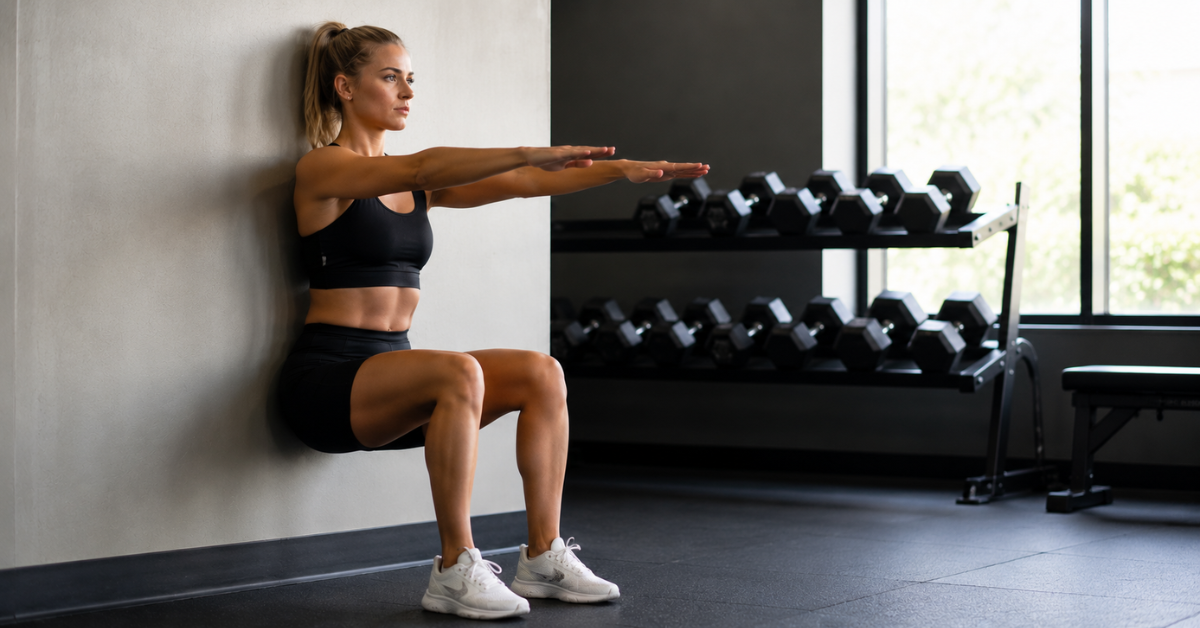

Quick Answer: Yes, isometric training can make you stronger, without movement. By holding a position under tension (like a plank or wall sit), your nervous system recruits more motor units, increasing force production and strength even without lifting heavier weights. Isometrics also strengthen tendons, support joint health, target sticking points in lifts, and improve muscular endurance and stability. They contribute moderately to muscle growth, but full-range dynamic training still builds more mass. The smartest approach combines both, using isometrics to complement traditional training for strength, stability, and injury prevention.

What if building more strength didn’t always require lifting heavier weights or performing endless repetitions?
That idea might sound surprising, but your muscles can become stronger even when your body isn’t moving. This training method, known as isometric training, relies on creating maximum tension by holding a position instead of moving through a full range of motion. It’s a technique trusted by elite athletes, rehabilitation specialists, physical therapists, and strength coaches to improve force production, joint stability, and muscular endurance.
Whether you’re holding a plank, sitting against a wall, or pausing at the bottom of a push-up, your muscles are working hard behind the scenes. Research suggests that these static contractions can recruit a high number of motor units, strengthen tendons, improve stability, and help overcome weak points in traditional lifts while placing less stress on the joints.
If you’re looking for a smarter way to build strength without weights, reduce injury risk, or add variety to your workouts, understanding the benefits of isometric training could completely change the way you train. For a deeper dive into how to structure this kind of training, the complete isometric training guide covers the full approach in more detail.
See the full process from start to finish, watch the video here:
What Is Isometric Training?
Isometric training involves contracting a muscle without creating visible movement at the joint. Unlike traditional exercises where muscles shorten or lengthen as you move through a range of motion, isometric exercises require you to hold a position while maintaining tension.
To understand this better, it helps to look at the three main types of muscle contractions:
- Concentric contractions occur when a muscle shortens while producing force, such as lifting a dumbbell during a bicep curl.
- Eccentric contractions occur when a muscle lengthens while resisting force, such as lowering the dumbbell back down.
- Isometric contractions occur when force is produced without noticeable movement, such as holding a plank or wall sit.
Although the body appears motionless during an isometric exercise, significant muscular activity is taking place beneath the surface. The muscles are working continuously to maintain position and resist external forces.
Types of Isometric Exercises
There are two primary forms of isometric training.
- Yielding Isometrics
These involve holding a position against resistance. Examples include planks, wall sits, static lunges, and glute bridge holds.
- Overcoming Isometrics
These involve pushing or pulling against an immovable object with maximum effort. Examples include pressing a barbell into safety pins or pulling against a fixed strap.
Both methods can be highly effective, but they serve slightly different purposes. Yielding isometrics are excellent for endurance, stability, and joint health, while overcoming isometrics are particularly useful for maximal strength development and neural adaptations.
The Science Behind Isometric Training Benefits
One of the biggest reasons isometric training works is its effect on the nervous system.
Strength is not simply about muscle size. It is also about how efficiently the brain communicates with the muscles. During high-intensity isometric contractions, the body recruits a large number of motor units, which are groups of muscle fibers controlled by a single nerve.
The more motor units your body can activate, the greater your force production potential.
This increased neural drive helps explain why isometric training can improve strength even without traditional movement.
Additionally, isometric exercises place muscles under continuous tension, which creates a strong training stimulus for both muscles and connective tissues.
Top Isometric Training Benefits
For a closer look at how each of these advantages plays out in practice, the benefits of isometric exercises breaks down the evidence behind each one in more depth.
1. Builds Strength and Force Production
One of the most significant isometric training benefits is increased strength.
Research suggests that high-intensity isometric contractions can improve maximum force production by teaching the nervous system to recruit more muscle fibers efficiently.
This is particularly useful for athletes and lifters who want to improve performance in exercises like squats, deadlifts, pull-ups, and bench presses.
2. Helps Overcome Sticking Points
Almost everyone who strength trains encounters sticking points.
Maybe you struggle at the midpoint of a squat or fail halfway through a pull-up. Isometric training allows you to target these exact positions by holding or pushing against resistance at the specific joint angle where weakness occurs.
Over time, this can improve force production and confidence in difficult positions.
3. Improves Muscular Endurance
Because static hold exercises require sustained tension, they challenge the muscles in a unique way.
Exercises such as planks, wall sits, and static lunges force muscles to remain active for extended periods, helping develop muscular endurance that carries over into sports, training, and daily activities.
4. Strengthens Tendons and Connective Tissue
Muscles often get all the attention, but tendons are equally important for strength and athletic performance.
Strong tendons improve force transfer, support joint integrity, and reduce injury risk.
Research has shown that isometric contractions can increase tendon stiffness and improve tendon health, making them particularly useful for injury prevention and long-term performance. For a more focused look at this area, dedicated tendon strengthening exercises build on this same principle.
5. Supports Joint Health
Many traditional exercises involve repetitive joint movement, which can sometimes aggravate injuries or existing joint issues.
Because isometric exercises involve little or no movement, they allow muscles to be loaded while minimizing stress on the joints.
This is one reason physical therapists frequently use isometric exercises during rehabilitation programs.
6. May Contribute to Muscle Growth
Although dynamic resistance training remains the most effective method for maximizing muscle growth, isometric training can still contribute to hypertrophy.
High levels of muscular tension and increased time under tension stimulate muscle fibers and can support muscle development when combined with progressive overload.
7. Enhances Stability and Body Control
Many people focus exclusively on movement but overlook the importance of stability.
Your body relies on isometric contractions every day to maintain posture, protect joints, and control movement.
Improving these qualities can enhance athletic performance while reducing injury risk.
Isometric Training vs Traditional Weight Training
Both training methods offer unique advantages.
| Training Factor | Isometric Training | Traditional Weight Training |
| Joint Movement | Minimal or no joint movement | Full range of motion |
| Strength Development | Primarily angle specific | Develops strength through the full range of motion |
| Tendon Strength | Excellent | Good |
| Muscle Growth | Moderate to high | High |
| Joint Stress | Lower | Moderate |
| Rehabilitation Use | Excellent, especially during early recovery | Limited during the initial stages of rehabilitation |
| Athletic Transfer | Moderate | High |
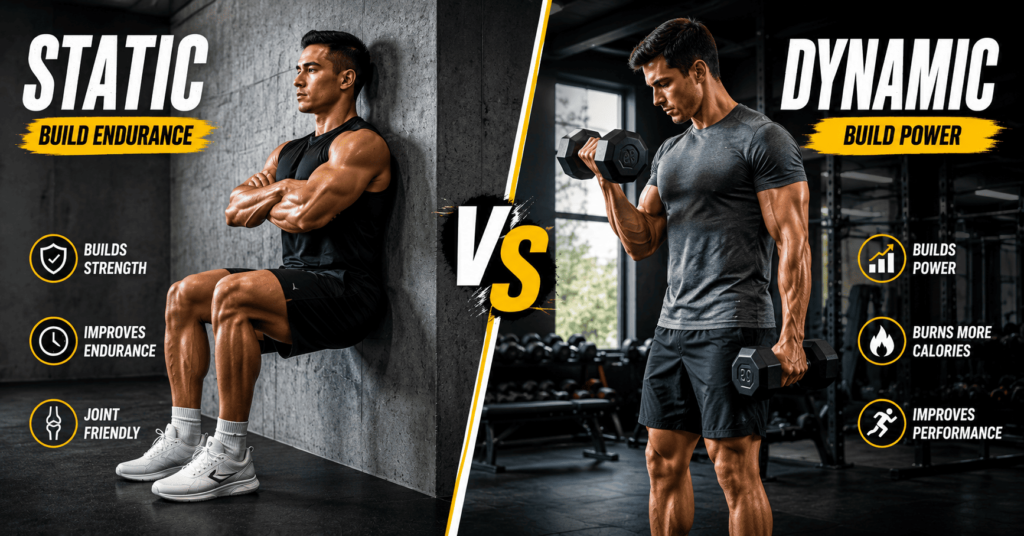
The most effective strategy is not choosing one over the other.
Instead, combine both methods to develop strength, muscle mass, stability, mobility, and athletic performance.
9 Effective Isometric Exercises to Add to Your Routine
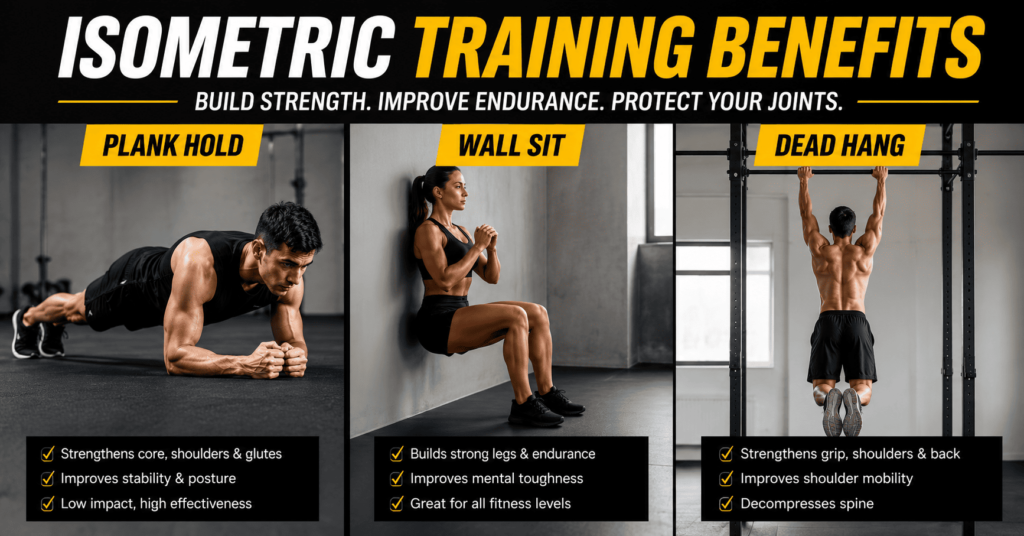
1. Plank
The plank is one of the most effective isometric exercises for developing core strength and stability.
Holding a plank challenges the abdominals, obliques, shoulders, glutes, and lower back simultaneously while promoting better posture and spinal alignment.
2. Wall Sit
The wall sit targets the quadriceps, hamstrings, and glutes.
This simple exercise develops lower-body endurance, improves stability, and can challenge even advanced trainees when held for longer durations.
3. Bicep Curl Hold
Instead of repeatedly curling a weight, hold the dumbbell at approximately ninety degrees.
This creates significant tension in the biceps and improves muscular endurance while increasing time under tension.
4. Dead Hang
Dead hangs are excellent for grip strength, shoulder stability, and spinal decompression.
They are particularly valuable for people who spend long hours sitting at a desk.
5. Static Lunge Hold
Holding a lunge position strengthens the quadriceps, hamstrings, and glutes while improving balance and coordination.
The exercise also enhances proprioception, which is your body’s awareness of its position in space.
6. Glute Bridge Hold
This exercise strengthens the glutes, hamstrings, and lower back while improving hip stability and reducing stress on the lumbar spine.
7. Superman Hold
The superman hold targets the posterior chain, including the lower back, glutes, shoulders, and upper back.
It is particularly useful for counteracting the effects of prolonged sitting.
8. Isometric Push-Up Hold
Holding the bottom position of a push-up dramatically increases tension in the chest, shoulders, and triceps.
It is a highly effective way to improve upper-body strength and muscular endurance.
9. Isometric Neck Exercise
Neck strength is often overlooked but plays an important role in posture, injury prevention, and athletic performance.
Controlled neck holds can improve alignment and support overall movement quality.
Sample Isometric Workout Plan
Perform this routine three times per week, ideally on non-consecutive days to allow proper recovery.
Day 1: Upper Body and Core
Plank: 3 sets of 30 to 45 seconds
Isometric Push-Up Hold: 3 sets of 15 to 30 seconds
Bicep Curl Hold: 3 sets of 20 to 30 seconds
Dead Hang: 3 sets of 20 to 45 seconds
Day 2: Lower Body and Stability
Wall Sit: 3 sets of 30 to 60 seconds
Static Lunge Hold: 3 sets per leg
Glute Bridge Hold: 3 sets of 20 to 30 seconds
Isometric Neck Holds: 3 sets per direction
Day 3: Full Body Conditioning
Superman Hold: 3 sets of 30 seconds
Plank: 3 sets of 45 seconds
Dead Hang: 3 sets of 30 seconds
Wall Sit: 3 sets of 45 seconds
How to Progress Your Isometric Workout
Like any training method, results depend on progressive overload.
You can progress by:
- Increasing hold duration
- Increasing contraction intensity
- Adding external resistance
- Training multiple joint angles
- Reducing rest periods
For maximum strength development, research suggests using contractions lasting approximately 1 to 5 seconds at 80 to 100 percent of maximum voluntary effort.
For muscle growth and muscular endurance, slightly longer holds at moderate intensity can be effective.
Recovery and Nutrition Considerations
Like any form of strength training, recovery plays a major role in results. Aim for adequate sleep, proper hydration, and sufficient protein intake to support muscle repair and adaptation.
Isometric training can place significant demands on the nervous system, especially during high intensity holds. While muscle soreness may be minimal, recovery is still essential for long term progress.
Final Thoughts
The benefits of isometric training extend far beyond simply holding a position.
From improving motor unit recruitment and increasing strength to enhancing muscular endurance, supporting tendon health, and protecting the joints, isometric exercises provide a powerful training stimulus with minimal equipment requirements.
They are not a complete replacement for traditional resistance training, but they are an incredibly valuable tool that can complement almost any fitness program.
Whether you want to build strength without weights, overcome training plateaus, improve posture, recover from injury, or simply become more resilient, incorporating static hold exercises into your routine can help you achieve those goals.
Start with a few simple holds, focus on quality effort, and stay consistent. Sometimes the path to becoming stronger involves moving less, not more.
If you’re ready to take your fitness to the next level, explore more expert backed workout guides, strength training tips, and science based nutrition advice on Fitness Geekz. Whether you’re training at home or in the gym, you’ll find practical strategies to help you build muscle, improve performance, and stay healthy for the long run.
Frequently Asked Questions
Yes. Isometric exercises can stimulate muscle growth through sustained tension and increased motor unit recruitment. However, traditional resistance training generally produces greater hypertrophy when performed through a full range of motion.
Most people can benefit from performing isometric training two to four times per week, depending on their overall training volume and recovery capacity.
Yes. Isometric training can improve force production, stability, tendon health, and strength at specific joint angles. It is most effective when combined with dynamic strength and power training.
Absolutely. Exercises such as planks, wall sits, glute bridge holds, and dead hangs are beginner-friendly and require little to no equipment.
Yes. Bodyweight isometric exercises can effectively improve strength, endurance, stability, and body control. As fitness levels improve, additional resistance can be added to continue progressing.