
Over 15 million adults in the United States report severe joint pain every single year. Millions more wake up with a stiff lower back, rounded shoulders, and the kind of deep hip tightness that makes getting out of a chair feel like a project. Most of them are searching for complicated solutions when the answer is surprisingly simple, and surprisingly still.
What if the exercises that feel the most boring are actually the ones the body needs the most? Holding a position, contracting hard, and refusing to move is not a beginner shortcut or a recovery-day throwaway. It is one of the most effective and most underused training methods in fitness, and the science behind it is genuinely impressive.
This guide breaks down what isometric training actually is, why it works at a physiological level, which movements deliver the best results, and how to build a straightforward isometric workout routine that produces real change without a single piece of equipment or a gym membership.
Whether the goal is to build stability and strength, manage chronic joint pain, correct posture, or bring blood pressure down, isometric exercises offer a practical path forward for almost anyone starting from almost anywhere.
Want to master the right technique? Watch the full practical exercise demo here: Watch Exercise
What Are Isometric Exercises and Why Do They Actually Work?
Most people think building strength requires movement. Squats, curls, deadlifts, all of these involve the muscle shortening and lengthening through a range of motion. Isometric training works differently. The muscle contracts and generates force, but neither the muscle length nor the joint position changes. The body works hard while staying completely still.
What makes this so effective is a process called neural recruitment. Isometric contractions demand that the body engage specialised neurons in the brain and spinal cord to maintain the hold. The longer and harder the contraction, the more muscle fibres get recruited, and the more force gets produced. Over time, this translates into genuine strength and endurance gains.
One important thing worth being honest about: isometric training builds strength specifically at the angle being trained. It does not improve speed, power, or athletic performance across a full movement pattern. Where it genuinely excels is in joint stability, tendon health, rehabilitation, and cardiovascular improvement. Think of it as the foundation that makes everything else in fitness work better and last longer.
The Real Benefits of Isometric Exercises
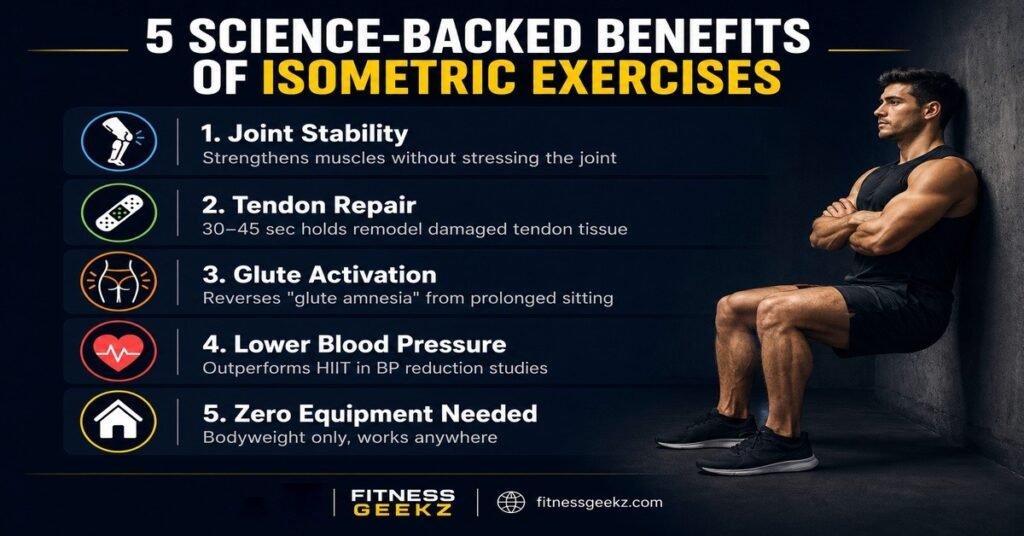
1. Joint Stability and Pain Relief
Because isometric training involves no joint movement, it places far less strain on the body than dynamic or heavy lifting. For anyone dealing with knee pain, hip discomfort, or a recovering shoulder, these joint stability exercises allow the muscles surrounding the injury to strengthen without aggravating it. This is exactly why isometric holds are a cornerstone of physical therapy programmes worldwide.
2. Tendon Health and Repair
Tendons respond exceptionally well to sustained tension. Holding a position for 30 to 45 seconds helps remodel damaged tendon tissue into something stronger and more resilient over time. This is why isometric holds are so commonly prescribed for conditions like patellar tendinopathy and Achilles tendon problems, where movement through range causes pain but static tension promotes healing.
3. Glute Activation and Posture Correction
Years of sitting create a condition commonly called glute amnesia. The hip flexors shorten and tighten while the glutes stretch out and gradually stop firing properly. The lower back and hamstrings then take over movements the glutes were designed to handle, which is one of the primary drivers of chronic lower back pain and forward-leaning posture. Isometric holds like the glute bridge force the glutes to reactivate and stay engaged long enough to retrain the pattern.
4. Blood Pressure Reduction
This benefit surprises most people. During an isometric hold, the contracting muscle compresses the blood vessels supplying it, which temporarily raises arterial pressure. The moment the hold is released, blood surges back into those vessels carrying nitric oxide, a compound that causes the vessel walls to widen and blood pressure to drop. Repeated consistently over weeks, this process reduces arterial stiffness and brings resting blood pressure down significantly. Research comparing isometric training directly against high intensity interval training found that isometrics produced greater reductions in resting blood pressure over a period of two to twelve weeks. That is not a small finding.
5. Functional Fitness at Home With Zero Equipment
The entire isometric workout routine covered in this article requires nothing but bodyweight and floor space. Wall sits, planks, glute bridge holds, and split squat iso holds are all genuinely effective movements that support functional fitness at home for anyone, regardless of fitness level or starting point.
The 4 Isometric Exercises That Actually Deliver Results
1. Glute Bridge Isometric Hold- For Glute Activation and Lower Back Relief
Lie on the back with knees bent and feet flat on the floor about hip-width apart. Press through the heels and lift the hips until the body forms a straight line from the knees to the shoulders. Then hold.
Most people think they are squeezing their glutes in this position but are actually relying on the hamstrings or lower back. A simple check: place both hands on the glutes during the hold. They should feel firm and fully engaged. If they feel soft, think about pulling the heels toward the body without actually moving them. That single cue changes everything about how the exercise feels.
Hold for 30 to 45 seconds and perform 3 sets with about 60 seconds of rest between each one.
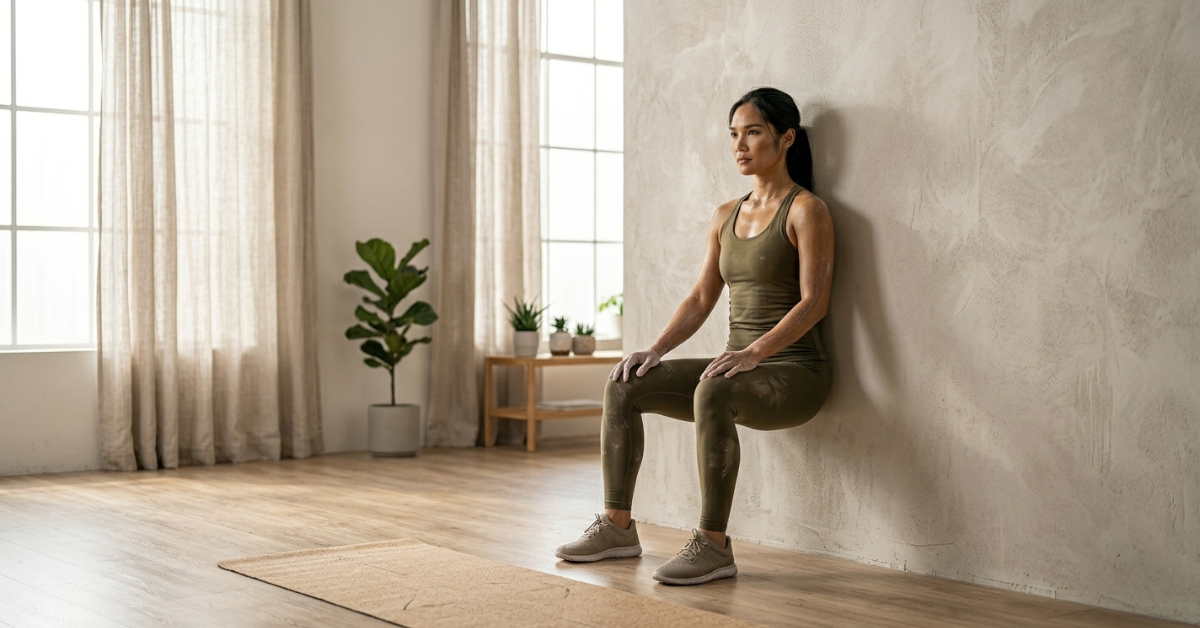
2. Wall Sit- For Quad Endurance, Knee Stability and Blood Pressure
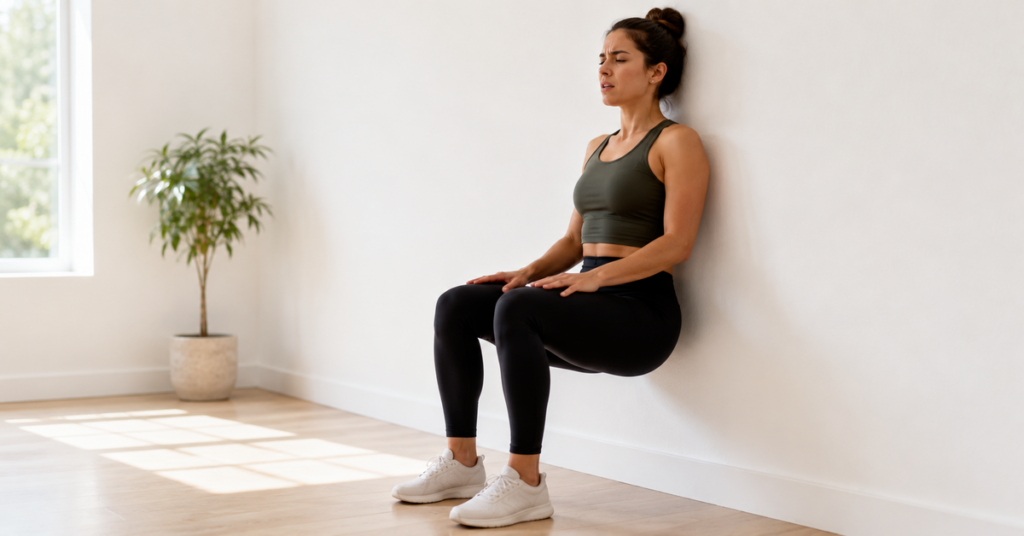
Lean the back flat against a wall and slide down until the thighs are parallel to the ground, with the knees at roughly 90 degrees and positioned directly above the ankles. Then hold.
Around 20 seconds in, the quads start to burn. By 40 seconds it becomes genuinely intense. Past 60 seconds it turns into more of a mental challenge than a physical one, and that is exactly the point. The wall sit builds muscular endurance by keeping the muscles under constant tension with no breaks.
The most important cue here is to resist the urge to let the hips rise up the wall when it gets hard. The moment that happens, the muscles get a break and the benefit disappears. Stay in depth.
Build from 30 seconds up to 60 to 90 seconds per hold and perform 3 sets with 90 seconds of rest.
3. Split Squat Iso Hold- For Single Leg Stability and Hip Balance
Step into a split stance with one foot forward and the other behind, like the bottom position of a lunge. Lower down until the front thigh is roughly parallel to the ground and the back knee hovers just above the floor. Hold that position without leaning the chest forward.
Every time a person walks, climbs stairs, or steps off a curb, the body has to stabilize on a single leg. When that capacity is undertrained, the hip wobbles, the knee collapses inward, and the lower back compensates to fill the gap. The split squat iso hold directly trains the stability that prevents all of that.
The slight shaking felt during this hold is completely normal. That is the stabilising muscles learning to do their job properly.
Hold for 30 to 45 seconds per leg and perform 3 sets per side with the chest tall throughout.
4. Plank- For Core Strength and Spinal Alignment
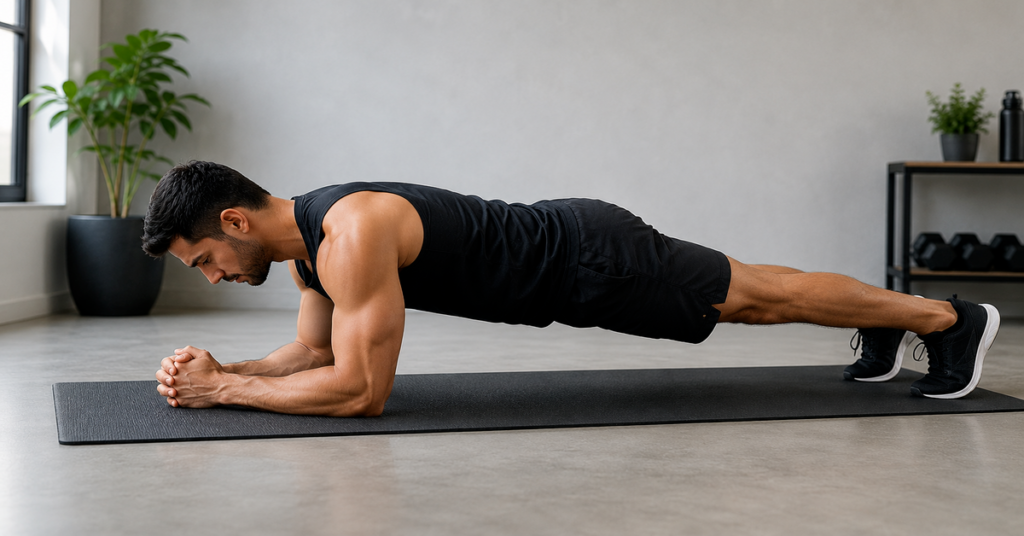
Forearms or hands on the floor, body in a straight line from head to heels. Brace the core, squeeze the glutes, and hold without letting the hips sag toward the floor or rise toward the ceiling.
The plank targets the deep stabilising muscles of the spine and core that keep the body upright and aligned throughout daily movement. It is one of the most well-studied and widely recommended joint stability exercises in both fitness and rehabilitation settings for good reason.
Build from 20 to 30 seconds up to 60 seconds and perform 3 sets.
Bonus- Thoracic Spine Foam Rolling
This is not an exercise but it is the piece most people skip that makes the whole routine work better. If hours are spent hunched over a desk or looking down at a phone, the mid-back becomes stuck in a rounded position that limits shoulder mobility, compresses the rib cage, and makes deep breathing harder than it should be.
Place a foam roller across the mid-back at shoulder blade level, cross the arms over the chest, and gently arch the upper back over the roller. Hold the extension for a few seconds, relax, move the roller slightly, and repeat. Spend 2 to 3 minutes working through the mid-back at the start or end of each session.
How to Build a Simple Isometric Workout Routine
The research recommends starting with any isometric contraction held for two minutes at roughly 30 to 50 percent of maximum effort. That level of intensity is enough to trigger the physiological changes in blood pressure and muscle function that make this training style so effective.
Perform the routine three to five times per week. Start with the same four exercises each session to build consistency and develop the neural connection that makes each hold more effective over time. As the body adapts across the first few weeks, increase hold durations, add variety, or introduce a second isometric exercise per muscle group.
Measurable improvements in blood pressure and joint stability typically begin to show between four and ten weeks in, depending on baseline fitness and how consistently the routine is followed.
One safety note that matters: anyone with high blood pressure or a diagnosed heart condition should speak with a healthcare provider before starting. The most important technical rule across every single isometric hold is to keep breathing steadily throughout. Holding the breath during a static contraction causes dangerous spikes in blood pressure and removes much of the cardiovascular benefit the training is designed to create.
For anyone managing arthritis, isometric training is one of the safest and most recommended entry points. As strength builds around the affected joints, a gradual progression toward light dynamic strength training becomes possible, ideally with guidance from a physiotherapist.
Conclusion
The benefits of isometric exercises go well beyond holding a plank and waiting for the clock to run out. This style of training addresses glute inactivity, joint instability, postural collapse, tendon weakness, and cardiovascular health at the same time, without equipment, without high impact, and without needing an hour at the gym.
The results will not be dramatic after the first session. But after four to six weeks of showing up consistently, the joints feel more stable, the lower back quiets down, posture improves noticeably, and daily movement becomes easier in ways that are hard to fully explain until they are experienced.
Start with two rounds of the four exercises above. Stay consistent three to four times per week. Let the body catch up to what it has been missing.
For more practical, science-informed training guides built around real movement and long-term health, explore the full resource library at Fitness Geekz.
Frequently Asked Questions
Isometric exercises help improve joint stability, strengthen tendons, reactivate weak muscles caused by prolonged sitting, and reduce stress on painful joints. They are also highly accessible because most routines require only bodyweight and minimal space.
Yes. Research shows that regular isometric training can significantly reduce resting blood pressure. Sustained muscle contractions improve vascular function and circulation over time.
In most cases, yes. Because there is little to no joint movement during the exercise, isometrics are often recommended as a low-impact starting point for people with joint pain or arthritis.
For stability and tendon strength, holds of 30 to 45 seconds are commonly recommended. Exercises like wall sits may gradually build up to 60 to 90 seconds for better muscular endurance.
Not completely. Isometrics are excellent for stability, posture, and foundational strength, but they do not fully develop speed, power, or full-range movement. They work best alongside dynamic strength and mobility training.