


Quick Answer: Training volume for muscle growth is best measured in hard sets per muscle group per week, generally 10–20, performed within a broad 6–20 rep range and taken close to muscular failure. Effort and consistency matter more than chasing one “perfect” rep number.
- 10–20 hard sets per muscle group per week is a reliable hypertrophy target for most lifters
- Rep ranges from 6 to 20+ build similar muscle when sets are taken close to failure
- Proximity to failure (1–4 reps in reserve) matters more than the specific number of reps
- Beginners should start near 10 sets per week; experienced lifters can progress toward 15–20
- Bodyweight exercises like push-ups follow the same volume logic, total reps matter more than a fixed daily number

Introduction
A recent meta-analysis comparing high-load and low-load resistance training found virtually no difference in muscle growth between the two, provided sets were pushed close to failure. That single finding quietly overturns one of fitness’s most repeated rules: the idea that a specific rep range, usually “8 to 12”, is the secret code for building muscle. It isn’t.
What actually predicts results is training volume: how much hard, well-recovered work gets done for a muscle group across a week. Get that number right, and the exact rep count becomes far less important than most workout plans suggest. This guide breaks down what training volume really means, how many sets and reps to use, how the same principles apply to bodyweight training like push-ups, and how to increase volume without wrecking recovery in the process.
Want to nail the technique? Click here to watch the full exercise:
What Is the Training Volume in Strength Training?
Training volume is the total amount of hard work performed for a given muscle group, most commonly measured as the number of sets taken close to muscular failure within a week. It’s a simple metric with an outsized influence on results.
Training volume is often confused with volume load, which multiplies sets by reps by weight lifted. Volume load has its uses, but most current research favors counting hard sets as the more practical, easier-to-apply metric, largely because it’s simpler to track and doesn’t require constant math between workouts.
Sets vs. Reps: What’s the Difference?
A rep is one complete repetition of a movement, and a set is a group of reps performed back-to-back without rest. Both numbers matter, but weekly set count, not the rep number inside each set, is the primary driver of muscle growth. Reps are simply the vehicle that gets a set close enough to failure to count.
How Many Sets Per Muscle Group for Muscle Growth?
Most research supports roughly 10 to 20 hard sets per muscle group per week for hypertrophy, ideally spread across two to three sessions rather than crammed into a single exhausting workout.
There’s a counting nuance worth knowing here, because it explains why the numbers in scientific studies can look intimidating. Many muscles overlap between exercises, the triceps, for example, work hard during bench pressing even though the “official” exercise targets the chest. Some research counts that as partial triceps volume, which inflates the weekly set totals compared to what someone tracking their own workout log would count. In practice, this means most lifters can build muscle successfully with fewer dedicated sets than the raw research numbers imply.
What’s the Best Rep Range for Hypertrophy?
There is no single best rep range for muscle growth. Research shows remarkably similar hypertrophy across reps as low as 6 and as high as 20 or more, as long as each set is taken close to failure.
The 8-to-12 rep range remains popular for good reason, it balances mechanical tension and metabolic fatigue without excessive strain on the nervous system, and it’s simply efficient to program. But “popular” isn’t the same as “superior.” What actually separates a productive set from a wasted one is proximity to failure: leaving roughly 1 to 4 reps in reserve, rather than the specific rep count used to get there.
How Training Volume Applies to Bodyweight Exercises Like Push-Ups
Push-ups follow the exact same volume principles as barbell training, muscle growth depends on accumulating enough hard reps relative to a person’s current strength level, not hitting some arbitrary daily number pulled from a fitness challenge.
The underlying mechanism is identical whether the resistance comes from a loaded bar or body weight alone. Training stress creates microscopic damage in muscle fibers. That damage isn’t a setback, it’s the trigger. During recovery, the body repairs that tissue back thicker and stronger than before, which is the entire basis of hypertrophy. A push-up session and a bench press session are, mechanically, working toward the same outcome.
Because push-ups scale with bodyweight rather than an external load, volume needs are best set relative to individual strength rather than a flat number for everyone. A practical way to calibrate that:
- Max out under 25 push-ups in a row → aim for roughly 50–75 total push-ups across a session
- Max out between 25 and 50 push-ups → aim for roughly 50–150 total push-ups across a session
- Max out above 50 push-ups → aim for roughly 150–250 total push-ups across a session, maintaining strict form throughout
These totals can be split across two to four sets to manage fatigue and preserve technique, a far more sustainable approach than grinding through one massive, sloppy set. For a broader look at building strength without a gym setup, see this guide to no-equipment exercises that can transform the body in four weeks.
Push-Up Variations for Progressive Overload
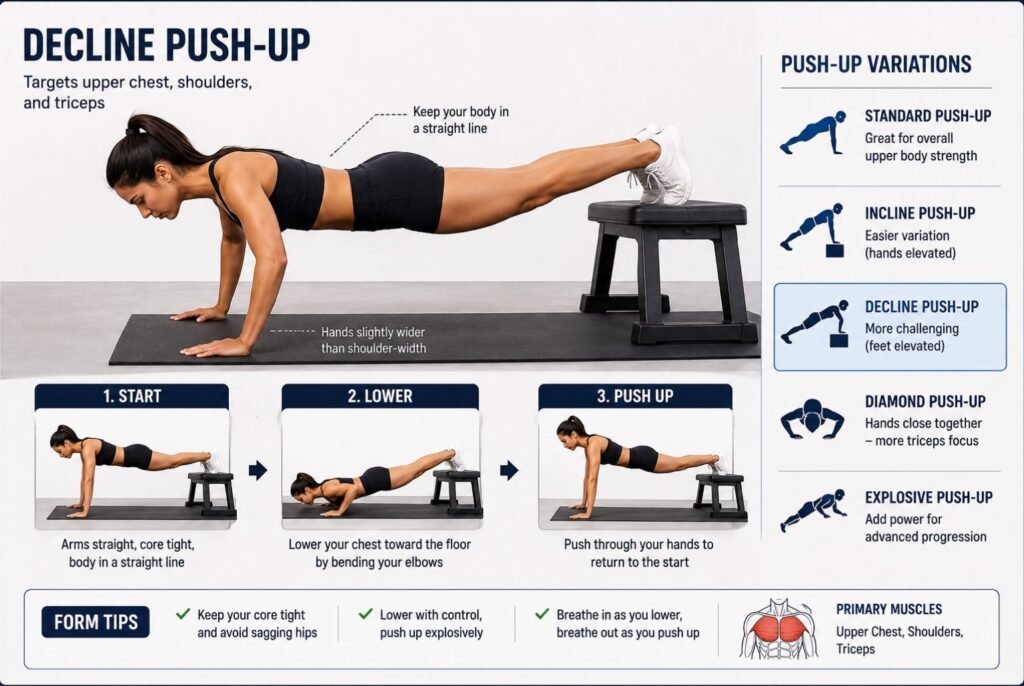
Once a rep range starts feeling manageable, progressive overload doesn’t have to mean adding external weight. Variation is a legitimate, and often underused, way to keep pushing adaptation:
- Incline push-ups (hands elevated on a bench): a gentler entry point for beginners
- T push-ups (rotating into a side plank): adds core and rotational demand
- Plank-to-push-up transitions: builds shoulder stability
- Diamond push-ups: shifts emphasis heavily onto the triceps
- Decline push-ups (feet elevated): increases difficulty by shifting more bodyweight onto the upper body
- Plyometric push-ups: explosive variations that build power on top of strength
Anyone dealing with joint sensitivity should scale these carefully, this guide to bodyweight exercises for knee pain and posture covers how to modify common movements without losing training effect.
How Much Recovery Time Does Muscle Growth Require?
Muscle growth happens during rest, not during the workout itself, and most muscle groups need approximately 48 to 72 hours before being trained intensely again.
Persistent soreness, unusual fatigue, or a noticeable drop in strength during a session are all signals that more recovery time is needed rather than more volume. This is where training volume and recovery intersect directly: pushing weekly sets higher without matching rest capacity doesn’t accelerate results, it undermines the very adaptation the volume was meant to trigger. Recovery also depends heavily on what happens outside the gym; nutrition plays a bigger role here than most lifters assume, and this breakdown of foods that build muscle faster than protein supplements is worth a look for anyone optimizing that side of the equation.
Training Volume Guidelines at a Glance
| Goal | Weekly Sets per Muscle Group | Recommended Rep Range | Proximity to Failure | Rest Between Sets |
| Muscle Growth (Hypertrophy) | 10–20 sets | 6–20 reps | 1–4 reps in reserve (RIR) | 2–3 minutes |
| Strength | 10–15 sets | 1–6 reps | 0–2 reps in reserve (RIR) | 2–4 minutes |
| Muscular Endurance | 8–12 sets | 15–25+ reps | 2–5 reps in reserve (RIR) | 30–60 seconds |
| Beginner Starting Point | 8–10 sets | 8–15 reps | 2–4 reps in reserve (RIR) | Around 2 minutes |
How to Increase Training Volume Safely
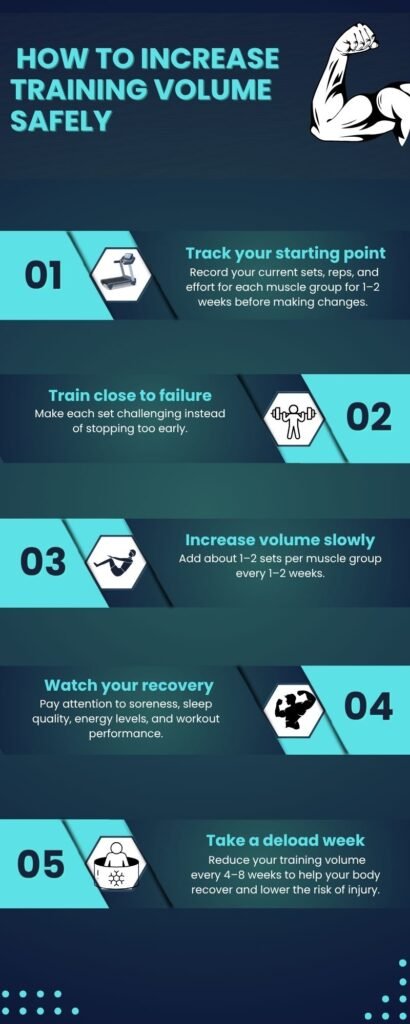
Adding volume works best as a gradual, tracked process rather than a sudden jump:
- Establish a baseline, log current sets, reps, and effort level per muscle group for one to two weeks before changing anything
- Prioritize proximity to failure before adding more sets, a set that stops too early doesn’t count the same as one taken close to failure
- Increase weekly volume gradually, roughly 1–2 sets per muscle group every one to two weeks
- Monitor recovery signals, soreness, sleep quality, and performance trends, before adding further volume
- Deload periodically, reducing volume every 4–8 weeks to allow full recovery and lower injury risk
Even low-impact training days play a role in this cycle, for lifters looking to stay active on lighter recovery days, an isometric workout for beginners or a simple daily movement habit like the one outlined in the benefits of squats every day can support consistency without adding excessive fatigue.
Moving Forward With Smarter Training Volume
Building muscle was never about finding one magic rep number. It comes down to accumulating enough hard, well-recovered sets over time, whether that work is done with a barbell, dumbbells, or nothing more than bodyweight push-ups performed with strict form. The table above provides a realistic starting point; the real progress comes from tracking current volume honestly and nudging it upward in small, sustainable steps.
Ready to put a real number on this week’s training? Compare current weekly sets per muscle group against the guidelines above, and explore more structured, no-equipment training options on Fitness Geekz to start applying this immediately.
FAQs
Most research points to roughly 10 to 20 hard sets per muscle group per week for muscle growth, with beginners starting closer to 10 and experienced lifters progressing toward 15–20 over time.
Neither range is inherently superior. Studies show similar muscle growth across reps as low as 6 and as high as 20 or more, as long as sets are taken close to muscular failure.
The right number depends on current strength level. Someone who maxes out under 25 push-ups should aim for about 50–75 total daily reps, while someone who exceeds 50 push-ups may need 150–250 total reps, divided across two to four sets.
Most muscle groups need approximately 48 to 72 hours of recovery between intense training sessions to repair and grow stronger.
Yes. Excessive volume without adequate recovery can lead to fatigue, reduced performance, and a higher risk of injury, which is why gradual volume increases and periodic deload weeks are recommended.