
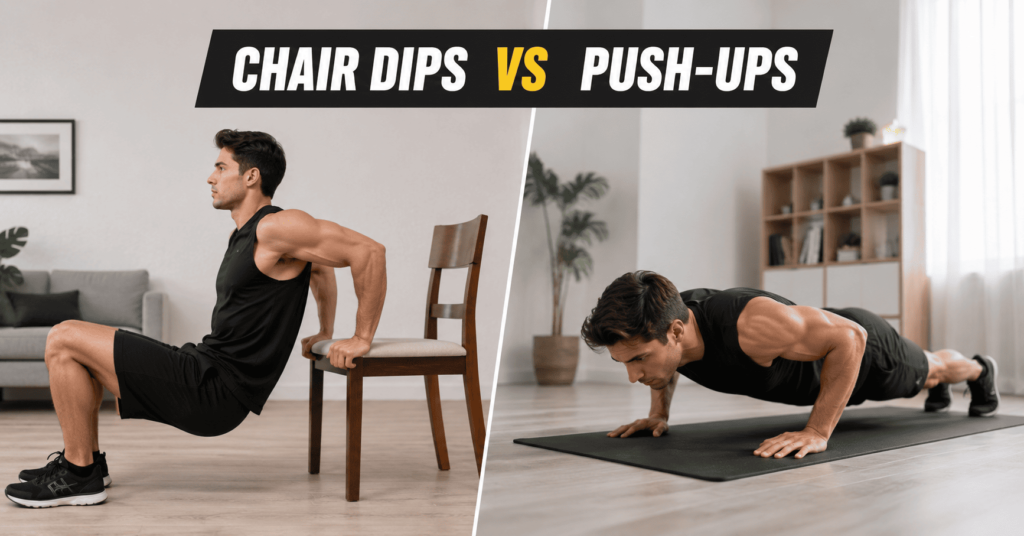
Quick Answer: Chair dips build more raw tricep strength and lower chest mass, loading 70–90% of bodyweight through a vertical press. Push-ups build more complete upper-body strength, engaging the chest, shoulders, core, and serratus anterior at 60–65% bodyweight load. Push-ups are safer, more beginner-friendly, and offer far more progression variations. Chair dips carry higher shoulder injury risk if lowered too deep. For most people, push-ups should be the primary pressing exercise, with chair dips used as a targeted tricep finisher, combining both covers complete upper-body development without any equipment.
Studies show that push-ups performed with progressive overload are as effective as the bench press for building upper body strength. Meanwhile, chair dips require lifting 70 to 90 percent of total bodyweight, making them one of the most demanding tricep exercises without weights available to anyone training at home. Two powerful movements. Both require zero gym equipment. But they are not interchangeable, and choosing the wrong one for the wrong goal is one of the most common mistakes in home-based training.
Here is the direct answer before anything else. Chair dips build more raw pushing strength and tricep mass due to the higher bodyweight load. Push-ups build more well-rounded upper body development by engaging the full chest, shoulders, core, and serratus anterior simultaneously. For most people, push-ups are the better primary exercise and chair dips are the more powerful accessory finisher.
Both movements are cornerstones of bodyweight strength training. Both target the same primary muscle groups through different pressing planes. And both are completely accessible for anyone who wants an effective chest workout at home without barbells, dumbbells, or machines. Understanding the real differences between them allows anyone to programme smarter, train safer, and build more complete upper body strength regardless of starting point.
Ready to level up your fitness? Follow along with the full workout here: Watch Now
What Muscles Do Chair Dips and Push-Ups Actually Work?
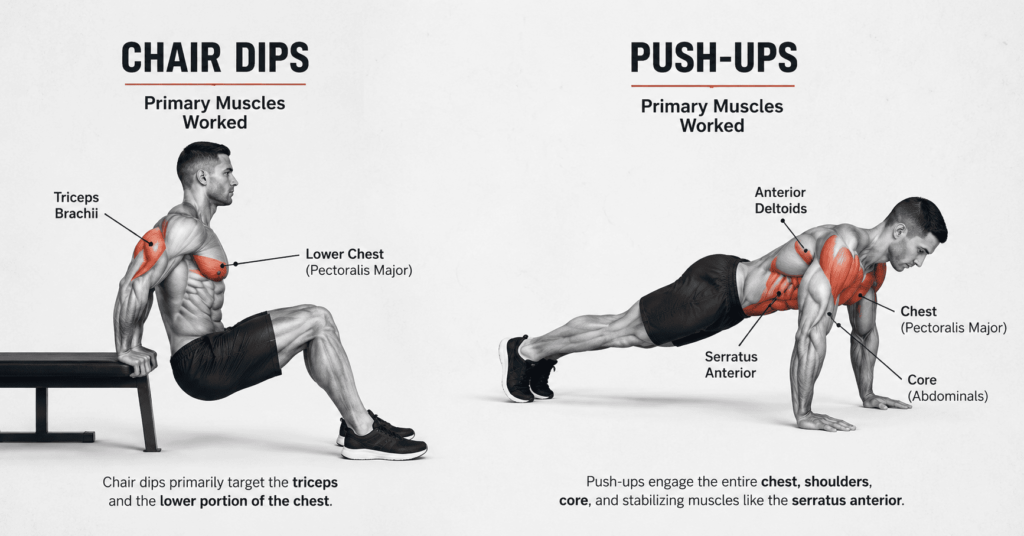
Both exercises target the chest, anterior deltoids, and triceps. The critical difference is which portion of the chest receives the primary stimulus and how many secondary muscles are recruited alongside it.
Push-ups use a horizontal pressing motion that targets the entire pectoralis major with strong activation across both the upper and middle chest fibres. They also heavily recruit the serratus anterior, the muscles underneath the armpits that are essential for healthy shoulder mechanics, and the entire core to maintain a rigid plank position throughout every rep. This makes push-ups a genuinely full-body movement rather than a simple upper body exercise.
Chair dips use a vertical pressing motion that shifts emphasis to the lower chest fibres and isolates the triceps under significantly higher load. Because the hands are positioned behind the body and the legs provide floor support, core stability demands are almost entirely removed. The rhomboids and trapezius engage as stabilisers but the serratus anterior contribution is minimal compared to what push-ups produce.
The practical implication is straightforward. If building a thick lower chest and powerful triceps is the primary goal, chair dips deliver a more targeted stimulus. If building complete upper body strength with core integration and shoulder resilience is the goal, push-ups are the superior choice for the same time investment. Both, however, are pressing movements, and a programme built only around pushing eventually creates imbalance. Pulling exercises matter just as much, which is why understanding why inverted rows are better than lat pulldowns for posture and upper back strength is worth exploring alongside this comparison.
Why the Pressing Angle Changes Everything
The horizontal pressing plane of push-ups distributes tension more evenly across the entire pectoralis major, making them one of the most complete chest workout at home options available without any equipment. The vertical pressing plane of chair dips creates a deeper stretch at the bottom of the movement, which enhances lower chest and triceps activation but simultaneously places higher shear stress on the anterior shoulder joint.
This is not a minor technical distinction. It directly determines which exercise is appropriate for someone with existing shoulder discomfort and which exercise produces the specific muscle development being targeted in any given training phase.
Load, Intensity, and Progressive Overload Compared
Standard push-ups require lifting approximately 60 to 65 percent of total bodyweight. The toes remain on the floor throughout the movement, which reduces the total load on the pressing muscles but allows for higher training volume, more reps per set, and better endurance development over time.
Chair dips require lifting 70 to 90 percent of total bodyweight depending on leg position and foot placement. The higher load means greater mechanical tension per rep, which is the primary driver of strength and triceps hypertrophy. This load difference directly explains why chair dips are significantly harder than push-ups and why they produce greater raw pushing power when performed consistently.
Research context worth knowing: studies show push-ups performed with progressive overload produce comparable strength and hypertrophy outcomes to the bench press. This means the limiting factor for push-up effectiveness is not the exercise itself but whether progressive overload is actually being applied consistently over time.
How to Progress Each Exercise Without Equipment
Chair dips offer two primary progressions. Elevating the feet on a second chair increases the percentage of body weight being lifted. Placing a weight plate or dumbbell on the lap adds direct resistance beyond bodyweight. These progressions are effective but limited in variety.
Push-ups offer an almost unlimited progression pathway. Decline push-ups with feet elevated shift more load to the upper chest and shoulders. Diamond push-ups with hands close together dramatically increase tricep isolation and inner chest activation. Wide grip push-ups increase pec activation across the outer chest. Deficit push-ups using yoga blocks or stacked books increase the range of motion beyond what the floor allows. Weighted push-ups with a plate on the back add direct resistance. One-arm push-ups represent the ultimate test of bodyweight pressing strength.
The progression advantage strongly favours push-ups. The variety of upper body exercises at home available through push-up variations means the movement serves an advanced athlete just as effectively as it serves a complete beginner, something no chair dip variation can fully replicate.
Shoulder Safety and Injury Risk
Push-ups are genuinely more shoulder-friendly for most people. The horizontal pressing plane allows the shoulder blades to move naturally through protraction and retraction during each rep, which is how the shoulder joint was designed to function under load. The floor-limited range of motion prevents the kind of deep shoulder extension that accumulates injury risk over repeated training sessions. For anyone with a history of shoulder discomfort, push-ups can typically be performed safely with appropriate hand placement adjustments.
Chair dips carry meaningfully higher shoulder injury risk for two specific reasons. First, the hands positioned behind the body places the shoulder in an internally rotated position that generates anterior joint stress on every single rep. Second, lowering too deeply specifically past the point where the shoulders drop below the elbows creates significant shear force on the anterior shoulder capsule that exceeds what most people’s connective tissue can handle safely over time.
The most important safety rule for chair dips is this: never lower the hips to the point where the shoulders drop below the elbows. That depth threshold is the defining boundary between a productive set and a shoulder injury that sidelines training for weeks.
For anyone with existing shoulder problems, incline push-ups with the hands elevated on a bench or counter dramatically reduce shoulder stress while maintaining the full training benefit of the horizontal pressing pattern. The same logic applies more broadly too. Choosing the right bodyweight exercises when dealing with knee pain or posture issues follows the same principle of adjusting movement patterns to protect vulnerable joints while still training effectively.
Chair Dips vs Push-Ups at a Glance
| Feature | Chair Dips | Push-Ups |
| Pressing Plane | Vertical | Horizontal |
| Primary Muscle Emphasis | Triceps, lower chest | Chest, shoulders, triceps, core |
| Bodyweight Loaded | Approximately 70 to 90% of bodyweight | Approximately 60 to 65% of bodyweight |
| Core Activation | Minimal | High |
| Shoulder Safety | Moderate to low | High |
| Progression Options | Limited | Extensive |
| Best For | Tricep mass and pushing strength | Complete upper-body development |
| Equipment Needed | Sturdy chair or bench | None |
| Difficulty Level | Intermediate | Beginner to advanced |
Which One Should You Choose Based on Your Goal?
1. For maximum tricep mass and raw pushing strength: Chair dips are the better choice. The vertical pressing path with near full bodyweight load places greater mechanical tension on the triceps than push-ups in any standard variation. For anyone whose primary focus is building thick, powerful triceps and raw upper body pressing strength, chair dips as the primary movement provide a clear advantage.
2. For complete chest development and core strength: Push-ups are the superior choice. The horizontal pressing path activates the full pectoralis major across both upper and middle fibres, recruits the serratus anterior for shoulder health, and demands full-body core stabilisation throughout every rep. No chair dip variation replicates this combination of benefits in a single movement.
3. For beginners starting bodyweight strength training: Push-ups are the clear starting point. They require zero equipment, scale immediately through knee push-ups or incline variations, and develop the foundational pressing strength and shoulder stability needed before chair dips become safe and effective to perform.
4. The smartest strategy for most people: Use push-ups as the primary pressing exercise and chair dips as a targeted finisher. Begin each upper body session with 3 to 5 sets of push-up variations at the appropriate difficulty level. Finish with 2 to 3 sets of chair dips to exhaust the triceps and lower chest under higher load. This combination covers both pressing planes, develops the full spectrum of upper body muscle groups, and provides a natural progression pathway from beginner to advanced levels of bodyweight strength training.
How to Perform Both Exercises With Perfect Form
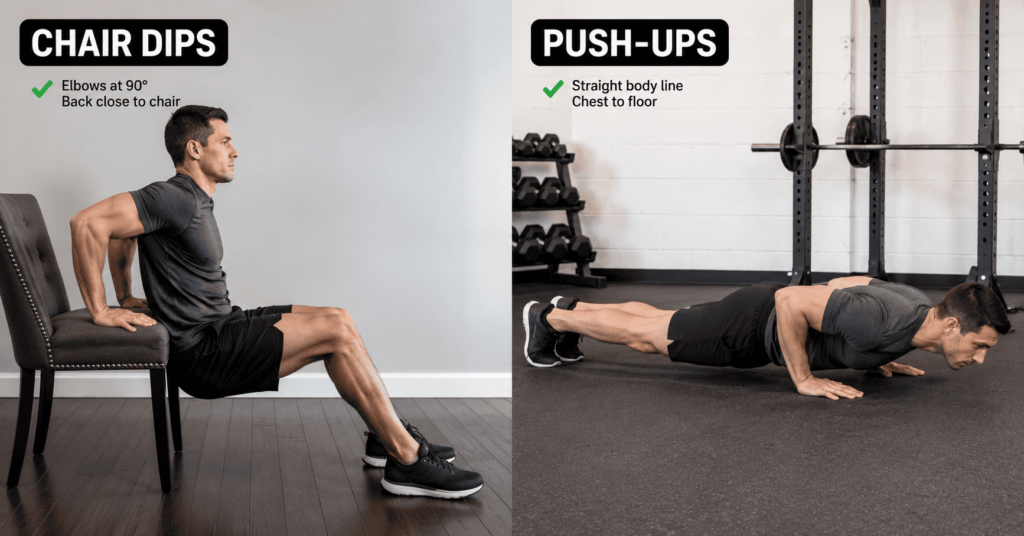
Chair Dips: Step-by-Step
Sit on the edge of a sturdy chair with hands shoulder-width apart and fingers pointing forward. Slide the hips off the chair and extend the legs forward. Lower the body by bending the elbows until they reach a 90-degree angle. Press back up to the starting position without locking the elbows fully at the top.
Never lower below the point where the shoulders drop beneath the elbows. Keep the back close to the chair throughout. Avoid using momentum or swinging to assist the press. Engage the core lightly to protect the lower back throughout every rep.
To make it harder, elevate the feet on a second chair or place a weight plate on the thighs.
Push-Ups: Step-by-Step
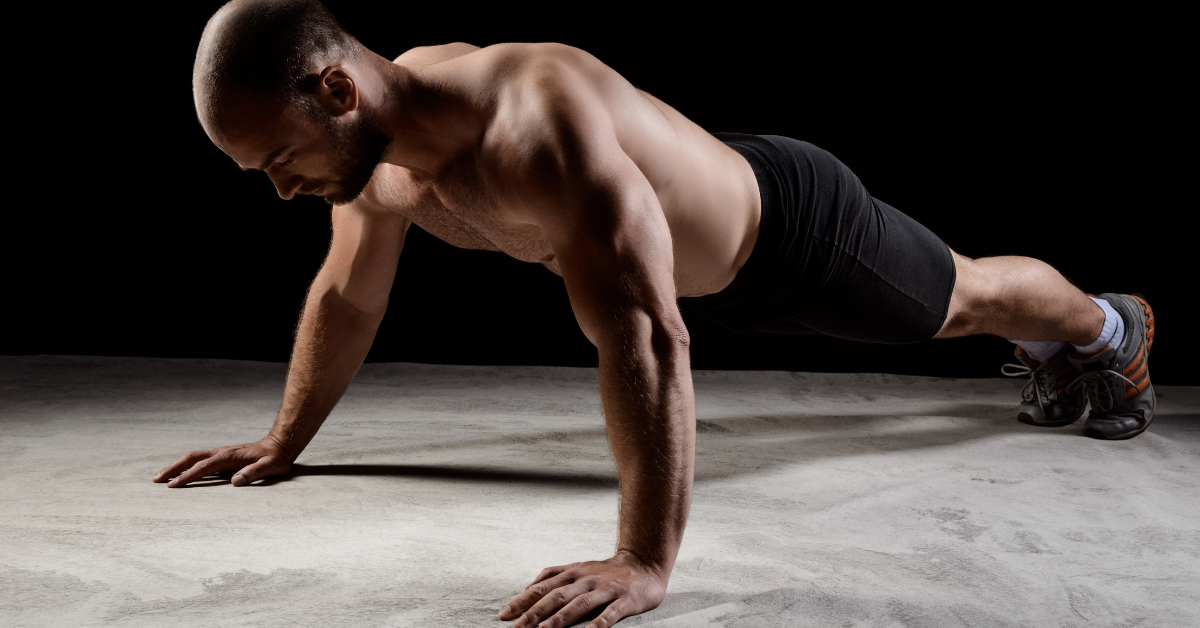
Get into a high plank position with hands placed slightly wider than shoulder width. Keep the body in a perfectly straight line from head to heels with the core braced throughout. Lower the chest toward the floor with the elbows at a 45-degree angle relative to the torso. Stop just before the chest touches the floor, pause briefly, then press back up to the starting position.
Never flare the elbows excessively outward as this generates unnecessary shoulder joint stress. Keep the hips from sagging or rising throughout every rep. Breathe in on the way down and out on the way up. Use a full range of motion on every single repetition without shortcutting the descent.
Progression pathway: incline push-ups, then standard push-ups, then decline push-ups, then diamond push-ups, then weighted push-ups, then one-arm push-ups.
Recovery and Nutrition
- Allow at least 48 hours of recovery between workouts that heavily target the chest, shoulders, and triceps.
- Avoid training the same pressing muscles on consecutive days. Insufficient recovery can reduce performance and slow long-term progress.
- Remember that adaptation happens during recovery. Muscles grow and strengthen after training, not during the workout itself.
- Use active recovery on rest days to support movement quality and joint health. Low-impact, joint-friendly movements such as wall sits, planks, and the horse stance also offer anti-aging benefits and can be a useful addition to a rest-day routine focused on building strength and resilience over time.
- Light mobility work, shoulder circles, and gentle stretching can help maintain flexibility and range of motion without interfering with recovery.
- Prioritize shoulder health. Both chair dips and push-ups place repeated stress on the shoulder joint, making recovery and mobility work especially important.
- Consume enough daily protein to support muscle repair and growth after training.
- A practical target is 0.7 to 1 gram of protein per pound of bodyweight per day.
- Stay adequately hydrated throughout the day. Proper hydration supports recovery, performance, and overall joint function.
- Good hydration also helps maintain joint lubrication, which is particularly important for the shoulders during frequent pressing exercises.
- The combination of training, recovery, nutrition, and hydration produces better long-term results than simply adding more workout volume.
Conclusion
The chair dips vs push-ups debate does not have a single universal winner because both exercises serve different and genuinely complementary purposes. Chair dips build more raw tricep strength and lower chest mass through higher bodyweight loading. Push-ups build more complete upper body development, core integration, and shoulder resilience through a safer and more versatile pressing pattern.
The practical recommendation is simple. Programme push-ups as the foundation of any chest workout at home and use chair dips as a targeted tricep finisher at the end of upper body sessions. That combination covers both pressing planes, develops the full spectrum of upper body muscle groups, and creates a natural progression pathway that serves every fitness level without requiring a single piece of gym equipment.
For more practical, science-informed training guides covering bodyweight training, barbell programming, and everything in between, explore the full resource library at Fitness Geekz.
Frequently Asked Questions
It depends on the goal. Chair dips are better for developing tricep strength and lower chest mass because they involve lifting a larger percentage of bodyweight through a vertical pressing pattern. Push-ups are better for overall upper-body strength, engaging the chest, shoulders, core, and serratus anterior. For most people, combining both exercises delivers the best results.
No. Chair dips and push-ups use different movement patterns and train the upper body differently. Chair dips emphasize the triceps and lower chest, while push-ups develop the chest, shoulders, and core together. Relying on only one movement can leave gaps in overall upper-body development.
Push-ups are the better starting point for most beginners. They require no equipment, can be easily modified with incline or knee variations, and help build the shoulder stability and pressing strength needed before progressing to chair dips.
For chair dips, elevating the feet on a second chair increases the amount of bodyweight being lifted. For push-ups, progress to decline push-ups, diamond push-ups, deficit push-ups, or eventually one-arm push-up variations. These progressions provide a significant challenge without requiring additional equipment.
Chair dips are not inherently bad for the shoulders, but they do place more stress on the front of the shoulder joint than push-ups. The key safety rule is to avoid lowering so deeply that the shoulders drop below the elbows. If you have shoulder pain or limited mobility, push-up variations are generally a safer alternative until shoulder health and stability improve.