

Aim for roughly 10 to 20 hard sets per muscle group each week, spread over two or three sessions. Reps anywhere from about 5 to 30 can build muscle if sets finish close to failure, though 6 to 15 reps is a sensible, practical default.
The short version
- Count hard sets per muscle each week, not how many exercises are in the workout.
- More sets help up to a point, and the gains flatten out somewhere around 12 to 20.
- Light and heavy weights can build similar muscle when the sets are tough.
- Going to complete failure is not required.
- Two sessions per muscle per week is enough for most people.
- After 40, start low and build up slowly.
- Check with a doctor first if there is heart disease, high blood pressure that is not controlled, joint pain or a recent injury.
Why the advice feels so confusing
Open ten programs and the numbers rarely match. One says 3 sets of 10, another says 20 sets per muscle, and almost all of it was tested on people in their twenties. For anyone around 40 or older, the real question is simpler: how much training is enough, and how fast should it grow? The research is clearer than the internet makes it sound. Enough hard sets each week, a flexible rep range and steady progress do most of the work. Here is how that plays out, what changes after 40, and a dumbbell plan to put it to use.
Ready to get moving? Watch the complete exercise video by clicking the link below!
How many sets do you actually need?

Muscle growth rises with weekly sets, but not in a neat straight line. A 2017 meta regression of 15 studies found that each extra weekly set went with a bit more growth, about 0.37% per set. When the researchers sorted lifters into groups of under 5, 5 to 9 and 10 or more sets, the pattern showed up only as a trend, so there is no magic cutoff.
A 2022 review of young, trained men landed on 12 to 20 weekly sets per muscle as a solid target. Going above 20 did not clearly help the quads or biceps, though triceps did better with more.
One detail matters here: sets count when they are hard. A 2021 review found that counting sets taken to failure, or close to it, works well as a measure of volume when reps fall between 6 and 20 or more. Easy warm up sets do not count.
Most of this research used adults aged 18 to 35. After 40, treat 10 to 20 sets as something to grow into, not a day one target.
Does the rep range matter?
Less than most people think. A meta analysis of 21 studies compared light and heavy training with every set taken to failure, and muscle growth came out similar. A second analysis that matched total work reached the same result. Heavier loads did win for maximum strength.
So pick the range that feels good. Sets of 6 to 15 are a practical default because they balance effort and joint stress. Lighter sets of 15 to 30 can be kinder to sore shoulders or knees, and heavier sets suit anyone who also wants to get stronger. That part is coaching advice, not a research rule.
Do you have to train to failure?
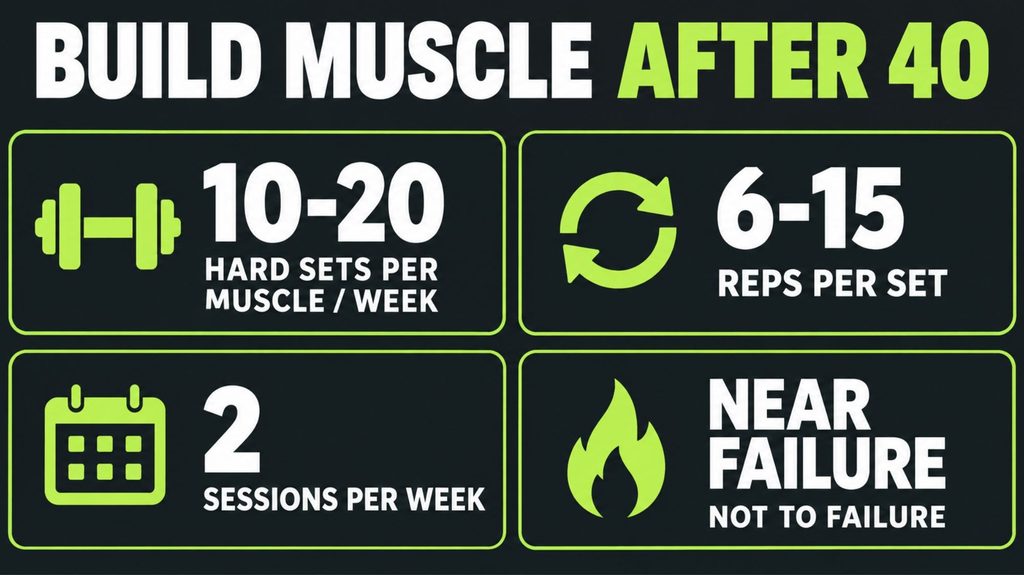
No. A 2023 meta analysis of 15 studies found no evidence that going to complete failure beats stopping a little short. It did find a tiny edge for training to set failure of some kind, so hard effort still matters.
A simple approach: finish most sets with a few reps left, and let the last set of an exercise go closer. The “few reps left” idea is a coaching habit, not a scientific threshold.
What changes after 40?
The principles stay the same. The pace changes.
The WHO guidelines say adults should do muscle strengthening on at least two days a week, covering all major muscle groups. Frequency beyond that seems to matter less than most people expect. A meta analysis found no real difference between higher and lower training frequency when total volume is equal, and a review of adults over 60 found more than two weekly sessions was unlikely to add benefit for muscle size.
Volume is where the research gets mixed. A 2024 analysis of 151 trials found that low volume training substantially improved function, lean mass and muscle size in healthy older adults, while higher volume seemed needed for bigger strength gains. An older review of adults 50 and over found higher volume programs added more lean mass, and older participants gained a bit less.
The practical takeaway: start with 2 sets per exercise, add a third if recovery feels good, and leave a rest day between sessions for the same muscles. Good food supports all of this, and the guide to nutrient dense foods for strength is a useful next read.
A simple dumbbell plan
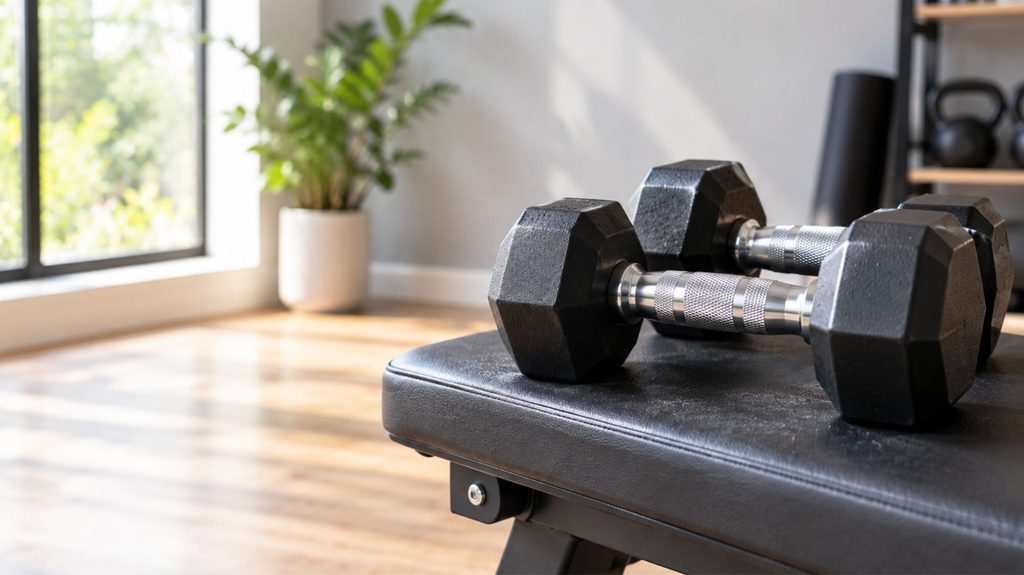
Dumbbells are enough to follow everything above. They are a capable tool. They are not a proven upgrade over barbells.
That is worth saying because the claim gets repeated a lot. In a 2011 study of 12 trained men, chest and front shoulder muscle activity matched across barbell, dumbbell and Smith machine presses, and the dumbbell weight was 17% lighter. A 10 week trial also found no difference in muscle activity between dumbbell and other chest press groups. Muscle activity readings do not prove growth either way.
Here is a full upper body session, roughly 35 to 45 minutes, done two or three times a week:
| Exercise | Sets x reps | Works | Good to know |
| Dumbbell press | 3 x 6 to 10 | Chest, front shoulders, triceps | Neutral grip if shoulders complain |
| Dumbbell row | 3 x 8 to 12 | Lats, upper back, biceps | Rest a hand and knee on a bench |
| Lateral raise | 3 x 12 to 15 | Side shoulders | Side shoulders worked about as hard as in a shoulder press in one study of 13 trained men |
| Dumbbell pullover | 3 x 10 to 12 | Lats, chest, triceps | Optional, skip if shoulders hurt |
| Curl | 2 x 10 to 12 | Biceps | Keep the elbows still |
| Overhead triceps extension | 2 x 10 to 12 | Triceps | In a 12 week trial the long head grew 28.5% vs 19.6% with pushdowns (cables, young beginners) |
Two sessions a week give about 6 direct sets each for chest, back and side shoulders, and 4 for each arm. Three sessions raise that to 9 and 6. That sits under the 10 to 20 range, which is a fair place to start after 40, and presses and rows add some indirect work too.
This plan covers the upper body only. Legs need their own sessions to meet the WHO guideline of working all major muscle groups. The guide to the best dumbbell exercises for muscle mass at home can fill that gap.
For progress, add reps until the top of the range, then add weight. The progressive overload guide breaks that down step by step.
Mistakes that waste effort
- Counting easy sets. Only hard sets move the weekly total.
- Copying young lifters. Most volume studies used 18 to 35 year olds.
- Trusting muscle activity headlines. More activity in one exercise does not prove more growth.
- Adding exercises instead of progressing. Extra variety does not replace extra reps or weight.
- Skipping legs. An upper body plan is only half the job.
The bottom line
Roughly 10 to 20 hard sets per muscle each week, reps mostly between 6 and 15, and sets that feel challenging without grinding to failure: that is what the research supports. After 40, start lower, add one set at a time and let recovery set the pace. Dumbbells can do the job, though they are no magic shortcut, and results vary from person to person with no guaranteed timeline.
For more, explore the Fitness Geekz guides on ancestral fitness training.
FAQs
6 to 15 is a practical default. Research shows similar growth across a wide range of loads when sets are hard.
It is a solid start for one exercise. What matters most is the weekly total of hard sets per muscle.
Two sessions a week is enough for most people, since frequency made little difference when volume was equal.
Yes, as long as the weight or reps keep creeping up. Questions about exercising with a health condition belong with a doctor.
Disclosure statement
This article is for education and is not medical advice. It does not diagnose any condition or recommend starting, stopping or changing medication. Speak with a doctor before starting if there is heart disease, uncontrolled high blood pressure, chest pain, dizziness, joint pain, a recent injury or surgery, or any chronic condition.