

Quick answer: Belly fat cannot be spot-reduced. Crunches strengthen abdominal muscles but do not burn the fat above them. Fat comes off across the whole body through a modest calorie deficit, strength training, aerobic activity, walking and enough sleep. Waist measurement shows progress better than the scale.
- No exercise removes fat from one area, and abdominal exercise alone did not reduce abdominal fat in a controlled trial
- Waist circumference is a practical way to track belly fat over time
- Visceral fat, the deep fat around organs, responds to regular exercise
- A modest calorie deficit, lifting, aerobic work and daily walking all contribute
- Short sleep is linked to more abdominal fat in experimental research
- Persistent bloating, swelling or pain is a reason to see a doctor, not a reason to train harder
Short Answer: Belly Fat Cannot Be Spot-Reduced
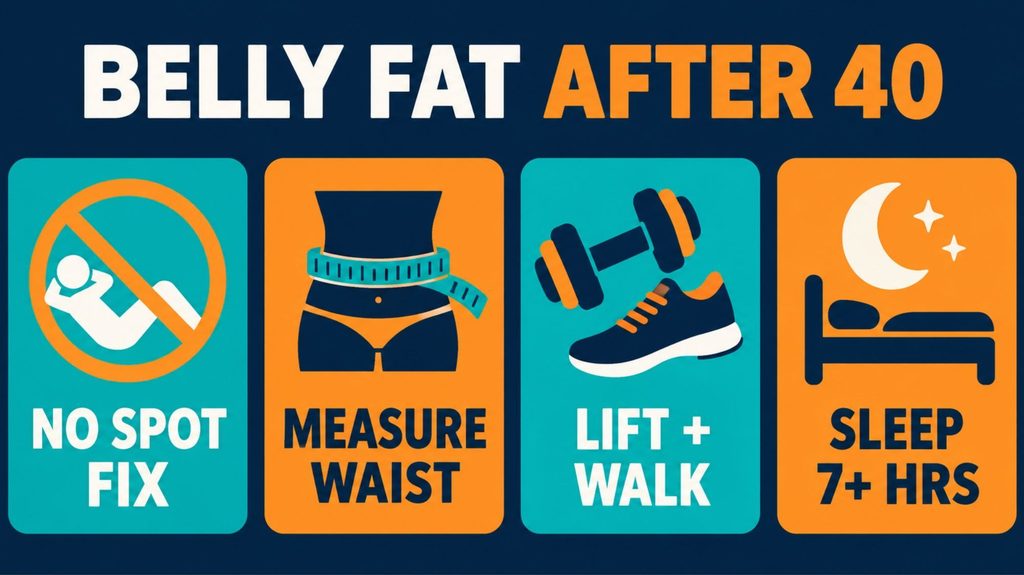
Can the right exercise target belly fat? No. Evidence shows that abdominal exercise alone does not shrink the fat above the muscle. A randomised trial of 24 healthy adults, published in the Journal of Strength and Conditioning Research, had one group do seven abdominal exercises five days a week for six weeks. Food intake was held steady. Abdominal endurance improved, but body fat, abdominal circumference and skinfold measures did not change significantly.
Practical guidance: core exercises still earn a place for strength, posture and back support. They simply do not act as a fat-loss tool for the midsection. Fat leaves the body according to overall energy balance and individual patterns, not according to which muscle was just trained.
Myths and Facts
| Myth | Fact |
| Crunches and planks burn belly fat | They build abdominal muscle and endurance, not local fat loss |
| Belly fat after 40 is all hormones | Menopause shifts fat and lean mass, but it does not make change impossible |
| Sweating more means losing more fat | Sweat is water, not fat |
| Detox teas or “melt belly fat” products work | No such product has reliable evidence behind it |
| Catching up on sleep at weekends fixes it | Short-term catch-up sleep did not reverse visceral fat gain in one experiment |
Evidence shows that the menopause transition changes where weight sits. The SWAN cohort study, published in JCI Insight, found that at the start of the transition the rate of fat gain doubled and lean mass declined, while overall weight gain did not accelerate. A flat scale can therefore hide a changing waistline.
Coach to add the myths most often heard from real trainees over 40, based on direct experience. [FIRST-HAND NOTE]
Waist Measurement: How to Track It
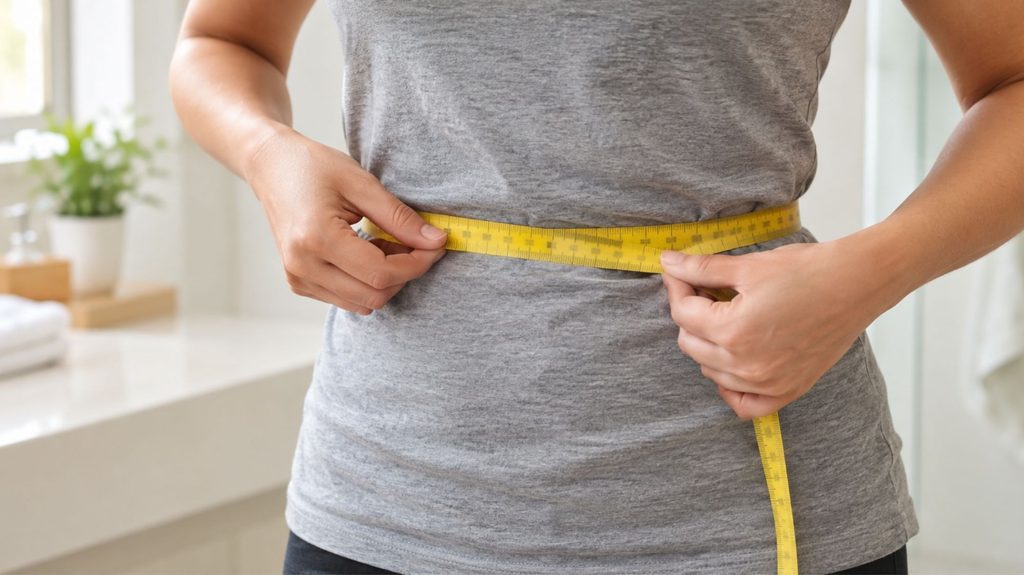
Why measure the waist? Because it reflects abdominal fat in a way body weight does not. The Heart Foundation describes waist measurement as an indicator of the fat deposits around internal organs, and notes it is less accurate in pregnancy, in conditions that distend the abdomen, and for some ethnic groups.
How to measure: find the bottom of the ribs and the top of the hip bone, place a tape midway between them in line with the belly button, breathe out normally, and keep the tape snug but not pinching. Measure at the same time of day, every two weeks.
Reference points: the WHO expert consultation on waist circumference is the standard source for action levels. Commonly cited cut-offs are 80 cm (women) and 94 cm (men) for increased risk, and 88 cm (women) and 102 cm (men) for substantially increased risk. These can differ by ethnic background, and the figures should be verified against the WHO report before publication.
Practical guidance: a falling waist with rising strength is a better result than a lower scale weight. A waist above the reference range is a prompt to talk to a doctor, not a diagnosis.
[MEDIA: real photo or video of the coach demonstrating correct tape placement.]
Visceral Fat Basics (Without Alarm)
Two kinds of fat sit in the abdomen. Subcutaneous fat lies under the skin and can be pinched. Visceral fat lies deeper, around organs, and cannot be seen or pinched. It is usually measured with CT or MRI, which is why waist circumference is used as an everyday stand-in.
Evidence shows that exercise reduces visceral fat. A systematic review and meta-analysis in the British Journal of Sports Medicine, Recchia and colleagues, 2023, found that both exercise and calorie restriction reduced visceral fat compared with controls in adults with overweight or obesity, and that exercise showed a dose-dependent effect. Another meta-analysis found that aerobic exercise without a calorie-restricted diet reduced visceral fat in overweight adults, with effects seen in studies as short as 12 weeks.
Practical guidance: visceral fat is not a cause for alarm in itself. It is a reason to keep regular movement, sleep and food habits steady, and to have blood pressure and blood sugar checked routinely.
What Works: Deficit, Strength, Steps, Sleep and Stress

Which approach reduces belly fat best? A combination. A network meta-analysis of 84 trials in Obesity Reviews found that aerobic exercise, resistance training, combined training and interval training all reduced visceral fat and waist circumference in people with overweight or obesity. Vigorous aerobic exercise and interval training ranked best. Resistance training ranked lowest for visceral fat, and in the subgroup analysis it did not significantly reduce visceral fat in females or in people with higher body fat. The trials involved people with overweight or obesity, so results may not transfer fully to everyone.
| Approach | Evidence on Visceral Fat or Waist | Practical Role |
| Moderate calorie deficit | Reduces visceral fat (Recchia) | Foundation; pace covered in How to Lose Weight After 40 [INTERNAL LINK: #11] |
| Aerobic exercise, including brisk walking | Reduces visceral fat; vigorous ranks highest | Regular base, most days |
| Interval training | Ranked among the best | Optional, after a base is built, with doctor clearance where needed |
| Strength training | Improves waist and muscle; weaker visceral effect | Protects muscle during fat loss; see Weight Loss for Women Over 40 [INTERNAL LINK: #12] |
| Sleep and stress management | Supports the above | Recovery and appetite |
Sleep. Evidence shows that experimental sleep restriction raised abdominal fat. In a small randomised crossover study in the Journal of the American College of Cardiology, Covassin and colleagues restricted 12 healthy, non-obese, younger adults to four hours of sleep a night for 14 days, and visceral fat rose by about 11 percent compared with control sleep. The design was extreme and the sample small, so it shows direction, not a typical effect. The AASM recommends seven or more hours for adults.
Stress. Practical guidance, not strong evidence: high-stress weeks tend to disrupt sleep, eating patterns and training consistency. Protecting a minimum routine, such as two short lifting sessions and daily walks, holds up better than stopping altogether.
A Realistic Timeline
Practical guidance, not a promise: no study guarantees a particular result in a particular time.
- Weeks 1 to 4: habits and technique settle. Scale and waist may barely move. Strength and energy often change first.
- Weeks 4 to 8: early waist changes become possible if sessions, sleep and food stay consistent.
- Week 12: a fair first checkpoint. Trials in the visceral-fat literature commonly run about 12 weeks. Waist, strength and photos are compared with week one.
- Beyond: progress usually continues over months, not weeks, and is not linear.
Coach to add how timelines are framed with real trainees, without inventing client stories. [FIRST-HAND NOTE]
A Belly Fat Workout Over 40: A Sample Week
Practical guidance for general adults, pending coach sign-off. [REVIEWER NAME, CREDENTIAL, REVIEW DATE] Exercise details for the lifting sessions appear in the 4-week schedule in Weight Loss for Women Over 40. [INTERNAL LINK: #12]
| Day | Session |
| Monday | Full-body lifting A |
| Tuesday | Brisk walk, 30 to 40 minutes |
| Wednesday | Full-body lifting B |
| Thursday | Easy walk, dead bug and side plank for core strength |
| Friday | Full-body lifting A |
| Saturday | Longer brisk walk or bike ride; optional short intervals once a base exists |
| Sunday | Rest or gentle mobility |
The core work on Thursday is for strength and spine support, not fat loss. Intervals should be added gradually, and not at all without medical clearance for anyone with heart, blood pressure or joint concerns.
[MEDIA: real photo or video of the coach demonstrating dead bugs and side planks.]
Red Flags to Raise With a Doctor
Not all abdominal swelling is fat. A doctor should be consulted when:
- A swollen tummy or bloating happens frequently, or comes with pelvic or tummy pain. The NHS ovarian cancer symptoms page lists these as symptoms that occur roughly 12 or more times a month, and notes that they are common and have many possible causes. The NHS advises seeing a GP rather than self-assessing.
- The abdomen grows quickly without changes in eating or activity
- Weight is lost without trying
- Weight gain comes with unusual tiredness, feeling cold or hair thinning
- The waist is above the reference range and blood pressure or blood sugar have never been checked
Medications can affect weight and appetite. Anyone concerned should raise it with the prescribing doctor. This article does not advise starting, stopping or changing any medication.
Common Mistakes
Doing hundreds of crunches. The fat above the muscle does not change. Time is better spent on full-body lifting and walking.
Judging by the scale alone. Fat and lean mass can move in opposite directions. Waist, strength and photos give context.
Cutting food sharply. Large deficits make recovery and muscle retention harder. A modest deficit holds up better.
Chasing detox products. No supplement or tea reduces belly fat. Money and attention are better spent on sleep and consistency.
Ignoring persistent bloating. Training harder will not explain swelling or pain. A doctor visit is the correct next step.
Information Gain: What Sets This Apart
- A direct statement of what the research says about resistance training versus aerobic work for visceral fat, rather than a one-size-fits-all lifting message
- A waist-tracking method with reference points and the caveats attached
- A red-flags section that separates fat from symptoms needing medical attention
- A realistic timeline with a week-12 checkpoint instead of fast-result promises
Conclusion
Belly fat responds to the same things overall fat does: a modest deficit, regular lifting, aerobic activity and walking, adequate sleep and steady habits. No exercise or product targets the midsection. A waist measurement every two weeks shows progress more reliably than the scale.
Persistent bloating, swelling or pain is worth a conversation with a doctor before any plan.
For the full picture, read Fitness Geekz’s guides on How to Lose Weight After 40 [INTERNAL LINK: #11] and Weight Loss for Women Over 40 [INTERNAL LINK: #12], or browse the Fitness After 40 hub. [INTERNAL LINK: #20, suggested]
Frequently Asked Questions
Possibly. Fat and lean mass can change in opposite directions, so the waist can shrink while the scale holds. Waist, strength and photos are more useful than weight alone.
No. A randomised trial found six weeks of abdominal exercise did not reduce abdominal fat, though it improved abdominal endurance.
Walking contributes. Aerobic activity reduced visceral fat in trials, and pairing it with strength work and a modest calorie deficit covers more ground.
Fat and lean mass shift during the menopause transition, and sleep and stress can add to it. Persistent concerns belong with a doctor.
Frequent bloating or a swollen tummy, especially with pelvic or tummy pain, should be raised with a doctor, since many conditions can cause it.