
Quick Answer
Low-impact exercise protects joints, builds core strength, and lowers stress hormones while remaining easy to sustain long-term. Walking, swimming, yoga, Pilates, and cycling deliver comparable cardiovascular and metabolic benefits to higher-intensity training when total daily movement is considered, without the burnout or injury risk.
- Top benefits: joint protection, better workout consistency, core and balance strength, lower cortisol and stress
- Popular low-impact activities: walking, swimming, yoga, Pilates, cycling, tai chi, barre, resistance band training
- Recommended frequency: 150 minutes of moderate activity weekly, or shorter daily sessions built gradually
- Best for: beginners, older adults, injury recovery, and anyone managing joint pain
- Core principle: consistent gentle movement often outperforms sporadic high-intensity effort over time

Introduction
There’s a stubborn belief floating around every gym, every fitness app, every well-meaning friend’s advice: if a workout doesn’t leave someone drenched in sweat and gasping for air, it doesn’t count. That belief is wrong, and it’s costing people consistency they’d otherwise have.
Gentler forms of movement, walking, swimming, yoga, Pilates, and plenty more, deliver real, measurable benefits for strength, endurance, balance, and overall fitness. Not a watered-down substitute for “real” training. A legitimate approach that a growing body of research actually supports. This guide covers the science behind why gentle movement works, the most accessible low-impact activities worth trying, and one genuinely simple way to start today, no equipment, no plan, no motivation required.
Low-impact exercise refers to movement that elevates heart rate and builds strength, stability, and endurance while placing minimal stress on the joints, making it sustainable for daily practice without the burnout risk associated with constant high-intensity training.
Want to watch how each rep should look? Click here to watch the full exercise:
Rethinking What Effective Exercise Looks Like
Intensity is not the only measure of an effective workout. Research comparing gentle activity with rigorous exercise shows comparable benefits for weight management, cardiovascular health, and metabolic markers once total daily movement gets factored into the picture.
For decades, exercise effectiveness got judged almost entirely by exertion level and sweat output. That framework is starting to crack under closer scientific scrutiny. Exercise behaves more like a spectrum than a binary of “hard enough” versus “not enough,” and the body responds meaningfully to effort accumulated consistently over time, not just effort crammed into short, brutal bursts. A slow, controlled Pilates session and a sprint interval workout are training different systems, but neither one is inherently more “real” than the other.
The Real Benefits of Low-Impact Exercise
Five benefit categories show up again and again across the research, and each one solves a real problem that keeps people from staying active long-term.
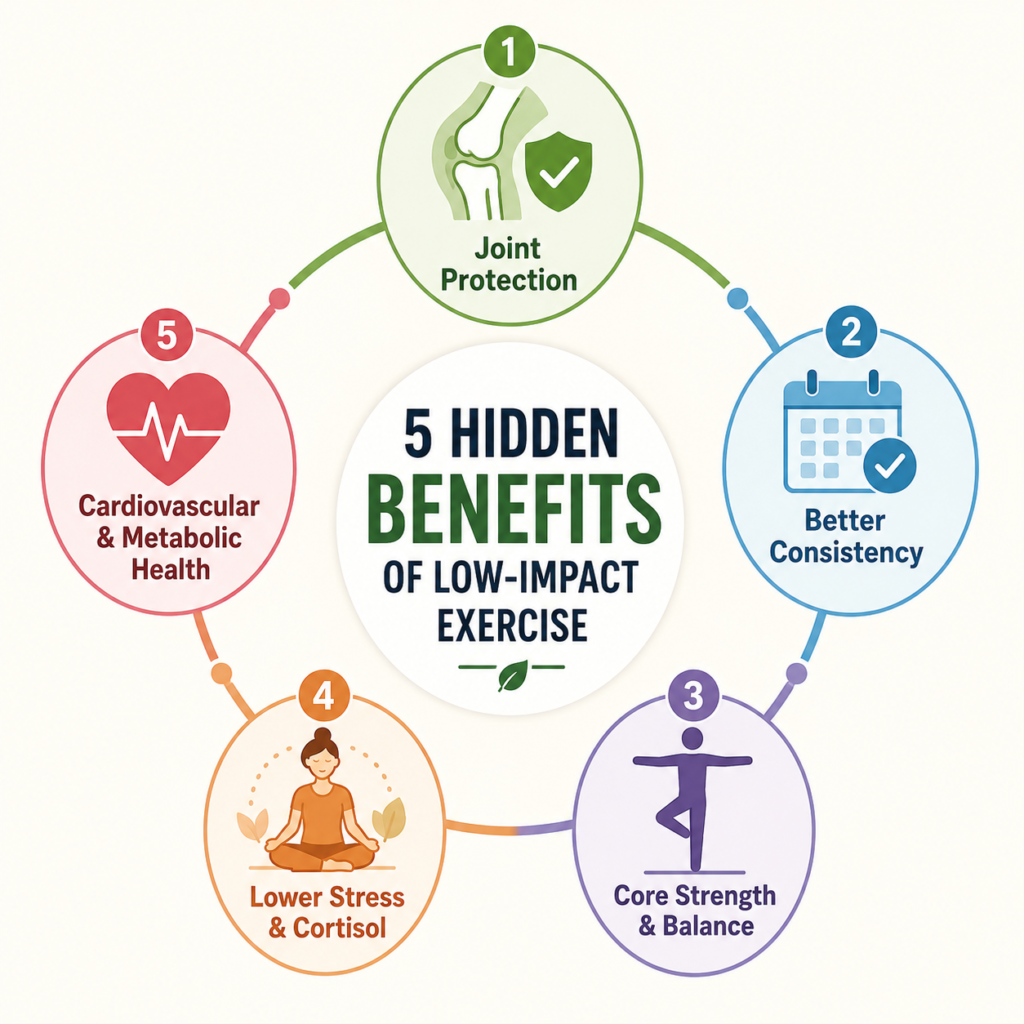
1. Joint protection. Low-impact movement keeps stress off the knees, ankles, and hips, which matters enormously for anyone managing arthritis, an old injury, or simple wear and tear from decades of higher-impact training.
2. Better consistency. Lower injury and fatigue risk makes daily movement genuinely realistic instead of something that demands a recovery day for every hard session.
3. Core strength and balance. Controlled movements found in Pilates, barre, and yoga build real deep stability through slow, deliberate control rather than momentum, and the tempo of a movement matters here just as much as the movement itself. This is where the science behind exercise tempo becomes relevant, since slowing a rep down changes how much the muscle actually has to work to stabilize it.
4. Lower stress and better mood. Regular low-impact activity reduces the stress hormone cortisol while improving sleep quality and emotional regulation, largely through the nervous system’s response to steady, rhythmic movement.
5. Cardiovascular and metabolic health. Regular participation improves heart health and blood pressure, even without ever pushing heart rate anywhere near its maximum.
Popular Low-Impact Activities Worth Trying
A handful of entry points make this easy to start today, no gym membership or specialized gear required for most of them.
- Walking or hiking. The simplest starting point there is, doable anywhere, at any pace, with zero learning curve.
- Swimming and water aerobics. Full-body, zero joint impact, genuinely ideal for arthritis or mobility limitations.
- Cycling. Stationary or outdoor, strengthens the lower body while staying gentle on the joints.
- Yoga and Tai Chi. Blend movement with breathwork and mindfulness, building flexibility and balance at the same time.
- Pilates. Core-focused and controlled, done on a mat or a reformer machine.
- Barre. Combines Pilates, yoga, and ballet-inspired movement, high reps, light or no weight.
- Functional strength training. Slow, controlled resistance work that mimics real-life movement patterns, the kind covered in depth in this guide to functional strength training exercises, which breaks down how these movements translate directly to everyday tasks like lifting and carrying.
- Resistance band training. Portable, joint-friendly strength work that needs nothing but a band and a bit of floor space.
- Stair climbing. About as accessible as exercise gets, and it builds leg strength and cardiovascular fitness without a single piece of equipment.
The Simplest Way to Start: Try Bouncing
No equipment, no workout plan, no motivation required. Just standing with feet rooted into the floor, knees soft, letting a gentle bounce move through the body.
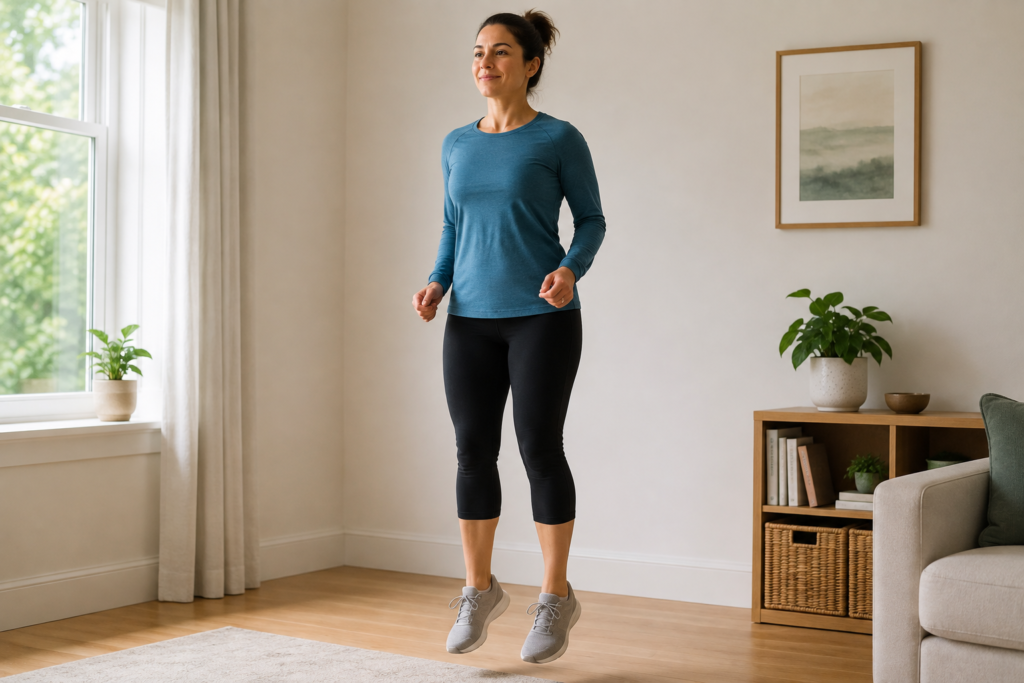
That probably sounds too simple to matter. It isn’t. The body responds in real, measurable ways: blood circulation increases, the joints decompress, muscles contract and relax rhythmically, and the lymphatic system starts moving, which supports immune function along the way. There’s a physiological reason this reaches beyond the physical, too. Repetitive, rhythmic movement sends signals of safety through the nervous system. Breathing slows, tension softens, and physical self-awareness improves, all without a shred of intensity involved.
Here’s the deeper point buried in something this small. A culture that equates “harder” with “better” tends to leave people bouncing between two extremes, either giving up on movement entirely because everything feels exhausting, or chasing intensity until the body eventually forces a stop. Gentle, easy movement like this isn’t a lesser form of exercise. It’s a direct rejection of the idea that effort only counts when it hurts, and for a lot of people, it’s the exact entry point that finally makes consistency possible. There’s something almost isometric about the stillness underneath the movement, the same quiet control covered in this guide to isometric training for beginners, where holding steady turns out to build just as much as moving does.
Mental and Nervous System Benefits of Gentle Movement
Gentle movement supports emotional steadiness by lowering stress hormones and encouraging calm, controlled breathing patterns, and that effect shows up in more places than just mood.
Activities like walking, yoga, and tai chi stimulate endorphin release, improving mood and reducing anxiety in the process. Rhythmic, repetitive movement supports better sleep quality and sharper daytime focus, benefits that compound the more consistently they’re practiced. Regular gentle movement also builds a genuine sense of accomplishment, something especially valuable for beginners or anyone returning from injury who needs a low-stakes way back into training. Physical resilience grows through steady, sustainable engagement rather than sporadic high-effort sessions that burn out as fast as they start.
How Much Low-Impact Exercise Is Actually Enough
Roughly 150 minutes of moderate-intensity activity per week is the general benchmark most health organizations point to, and it’s meant to be built gradually rather than tackled all at once.
Standard guidelines recommend 150 minutes of moderate activity or 75 minutes of vigorous activity weekly, alongside muscle-strengthening work on at least two days. For low-impact training specifically, shorter sessions work well as a starting point, one popular fitness platform found that just 20 to 30 minutes, three times a week, produced genuinely effective results for people easing into a routine. And movement doesn’t need to happen in one long structured block to count. Short “workout snacks” spread throughout the day, a walk after a meal, a stretch between meetings, add up meaningfully over time. This works especially well when it gets built into an existing daily rhythm, the same logic behind a solid morning workout routine, which front-loads movement before the day gets a chance to crowd it out. Consistency matters more than duration when the goal is long-term, sustainable fitness, and the same principle around building up gradually applies to strength work too, covered in more depth in this guide to training volume for muscle growth.
Low-Impact Activities by Primary Benefit, Equipment, and Best For
| Activity | Primary Benefit | Equipment Needed | Best For |
| Walking | Cardiovascular health, mental clarity | None | Everyone, all fitness levels |
| Swimming/Water Aerobics | Full-body strength, zero joint impact | Pool access | Arthritis, joint pain, injury recovery |
| Cycling | Lower-body strength, cardio | Bike (stationary or outdoor) | Cardiovascular fitness, low joint stress |
| Yoga | Flexibility, core strength, stress relief | Mat | Beginners, stress reduction, mobility |
| Tai Chi | Balance, coordination, relaxation | None | Older adults, fall prevention |
| Pilates | Core strength, posture, stability | Mat or reformer | Core-focused training, posture correction |
| Barre | Flexibility, muscle tone, posture | Light weights or none | Toning, flexibility-focused training |
| Resistance Bands | Functional strength, mobility | Resistance band | Travel, home workouts, joint-friendly strength |
| Stair Climbing | Leg strength, cardiovascular fitness | Stairs | Accessible daily movement |
Common Misconceptions About Low-Impact Exercise
The biggest misconception, by far, is that gentle movement doesn’t count as “real” exercise.
Low-impact does not mean low-effort. Movements like Pilates and barre demand real control and mind-muscle connection, arguably more than swinging heavy weights around with momentum ever will. Gentle exercise isn’t reserved for beginners or older adults either, plenty of advanced exercisers use it deliberately to complement higher-intensity training and support recovery between harder sessions. Skipping gentle movement in favor of constant high intensity tends to backfire, often leading to burnout or injury that undermines the very consistency someone was chasing in the first place. Progress doesn’t require suffering. Steady, sustainable effort produces real, measurable results over time, just on a timeline that respects the body instead of fighting it.
The Bottom Line
Low-impact exercise isn’t a compromise. It’s a legitimate, evidence-backed path to strength, balance, cardiovascular health, and mental well-being, one that happens to be a lot easier to stick with than the alternative. Pick one or two activities from the list above, start with short, manageable sessions, and build consistency before worrying about intensity at all. Movement that feels sustainable is movement that actually gets repeated, and repetition is where every real result eventually comes from.
Ready to build a gentler, more sustainable fitness routine? Explore more low-impact and joint-friendly workout guides on Fitness Geekz to find the right starting point.
Frequently Asked Questions
Low-impact exercise protects the joints, builds core strength and balance, reduces stress hormones, and supports cardiovascular health, all while remaining sustainable enough for daily practice.
For many health markers, including weight management, cardiovascular health, and metabolic function, low-impact exercise delivers comparable benefits to high-intensity training when total movement across the day is considered.
Walking, swimming, cycling, yoga, tai chi, Pilates, barre, and resistance band training are all considered low-impact activities.
Aiming for about 150 minutes of moderate activity per week is a solid general benchmark, though starting with shorter 20 to 30 minute sessions a few times weekly is an effective way to begin.
Yes. Its gentle, adaptable nature makes it one of the safest and most sustainable starting points for anyone new to exercise, recovering from injury, or managing joint pain.