
Quick Answer
Core stability exercises for adults over 50 strengthen the deep stabilizer muscles that protect the spine, support balance, and reduce fall risk. None of these ten movements require a traditional plank, making them accessible for people managing wrist, shoulder, or lower back discomfort while still building real core strength.
- Best core stability exercises for over 50: dead bug, wall mountain climbers, lying march, glute bridge, standing knee raise, bird-dog, side leg raise, sit-to-stand, heel-to-toe walk, butterfly crunch
- Recommended frequency: most days per week, since core muscles recover faster than other muscle groups
- Ideal rep range: 10 to 20 reps per set, 1 to 3 sets per exercise
- Key benefit: reduced fall risk through improved balance, posture, and spinal support
- Medical clearance: recommended before starting, especially with existing joint or cardiovascular conditions
Introduction
Anyone over 50 who wants a stronger core, better balance, less back pain, and more confidence in everyday movement is in the right place. Research backs up why this matters more than most people realize: adults over 50 with weak core muscles are far more likely to experience mobility problems as the years go on. This isn’t just about fitness for its own sake, it’s about staying independent, protecting the body, and staying active for years to come.
Here’s the part that trips a lot of people up before they even start. Mention core training, and the first image that comes to mind is a plank. And honestly, planks aren’t for everyone. They put real pressure on the wrists, the shoulders, and the lower back, and plenty of people quietly avoid core training altogether just to sidestep that discomfort. The good news is that none of that is necessary. Ten exercises below build genuine core stability without a single plank in the mix.
Core stability exercises for adults over 50 train the deep muscles supporting the spine and pelvis, the transverse abdominis, multifidus, and pelvic floor, improving balance, posture, and resistance to falls without requiring high-impact or joint-stressing movements.
Want to see it demonstrated the right way? Click here to watch the full exercise:
Why Core Strength Matters So Much After 50
A weak core places more stress directly on the spine, worsens balance, and speeds up the postural changes that tend to creep in with age.
- Spine protection. The muscles of the core support the lower back and help distribute force during everyday movements, reaching, bending, lifting a grocery bag. When these muscles are weak, that stress gets rerouted onto the joints and discs of the spine, and pain and stiffness tend to follow.
- Balance. Many falls happen because the body simply can’t react fast enough to a sudden loss of stability. A stronger core shortens that reaction gap.
- Posture. As the years add up, many people develop rounded shoulders and a forward head position, both closely tied to weakened core and postural muscles. Understanding why strength declines with age after 50 helps explain why this isn’t a personal failing, it’s a physiological pattern, and one that responds well to targeted training.
The research backs all of this up directly. Skeletal muscle is lost at a rate of roughly 3 to 8 percent per decade after age 30, and the core is not exempt from that decline. A randomized controlled trial by Granacher and colleagues found that a structured core training program significantly improved trunk strength, spinal mobility, and balance in a group of older adults. Separately, research by Ko and colleagues found that core training in elderly women reduced fear of falling and meaningfully improved psychological well-being, not just physical markers.
What Is Core Stability, Beyond the Six-Pack?
The core is the deep stabilizing system beneath the visible abs, not a single muscle but a coordinated group that supports the spine and pelvis together.
- Local stabilizers. The transverse abdominis, multifidus, pelvic floor, and diaphragm, small, deep muscles that keep the spinal column stable and absorb shock before it reaches the vertebrae.
- Global stabilizers. The glutes, obliques, and quadratus lumborum, connecting the pelvis to the spine and allowing controlled movement without excess wobble.
- Movement system. The hamstrings, hip flexors, and lat muscles that connect the spine and pelvis to the arms and legs, translating core stability into actual dynamic movement, walking, climbing stairs, reaching overhead.
The 10 Best Core Stability Exercises for Adults Over 50
All ten below, and not a single plank among them.
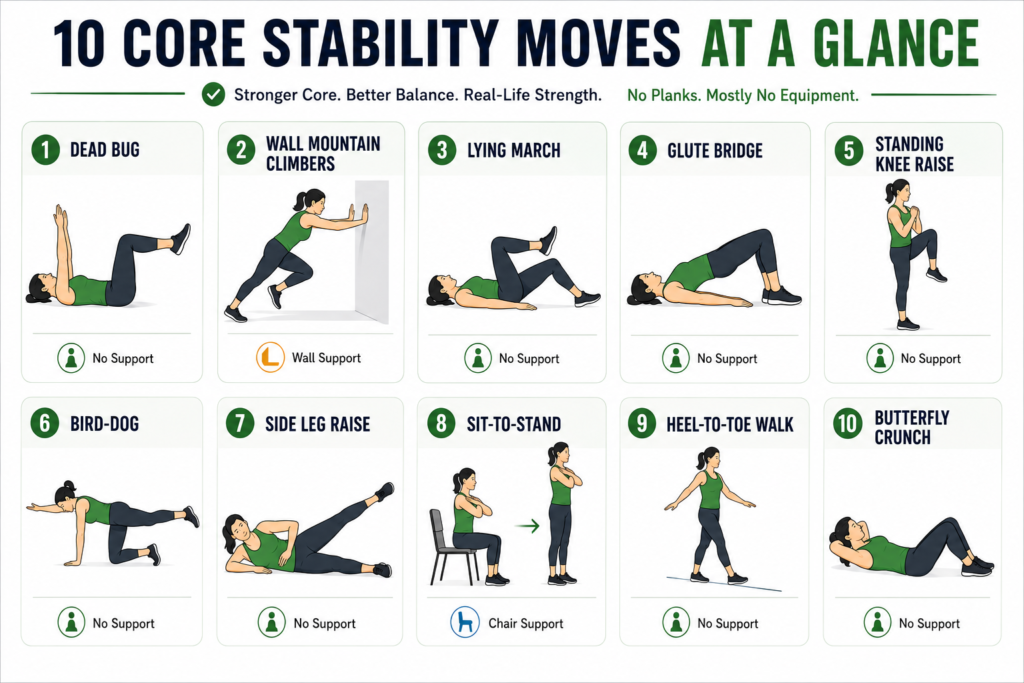
1. Dead Bug
Lie on the back with arms reaching toward the ceiling and knees bent to 90 degrees. Slowly extend the right leg while reaching the left arm overhead, keeping the lower back pressed gently into the floor throughout. Return to start and repeat on the opposite side. If the lower back starts lifting off the floor, shorten the range of motion until form holds steady.
Sets/reps: 3 sets of 10 to 16 reps per side.
2. Wall Mountain Climbers
Stand facing a wall with both hands pressed against it, feet walked back slightly so the body sits at a comfortable angle. Lift one knee at a time in a controlled marching motion, keeping the core engaged the entire time rather than relaxing between reps.
Sets/reps: 3 sets of 16 to 20 reps.
3. Lying March
Lie on the back, knees bent, feet flat on the floor. Tighten the abdominal muscles and lift one foot a few inches off the floor, keeping the pelvis still and stable, then lower and repeat with the other leg. The movement looks small, but it teaches the deep stabilizing muscles exactly the job they’re supposed to do.
Sets/reps: 3 sets of 16 to 20 reps.
4. Glute Bridge
Lie on the back with knees bent and feet flat, hip-width apart. Squeeze the glutes to lift the hips until the body forms a straight line from shoulders to knees, hold for a second or two, then lower slowly. Focus on squeezing the glutes rather than pushing the hips excessively high, which tends to overarch the lower back.
Sets/reps: 3 sets of 12 to 15 reps.
5. Standing Knee Raise
Stand tall near a wall or chair for support. Slowly lift one knee to about hip height, pause briefly, then lower with control. Repeat on the other side. As balance improves over time, rely on less hand support from the wall or chair.
Sets/reps: 3 sets of 12 reps per side.
6. Bird-Dog
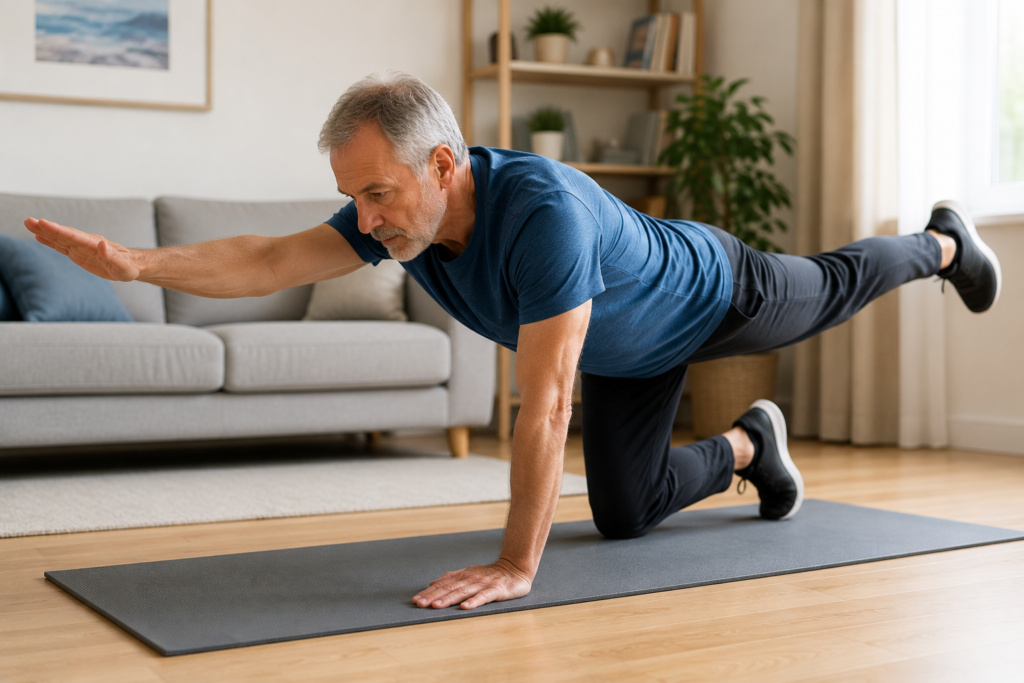
From an all-fours position, extend one arm forward and the opposite leg back at the same time, keeping the hips level without twisting. Hold briefly, then return to start and switch sides. This one’s a favorite for a reason, it trains anti-rotation strength that carries directly into everyday stability.
Sets/reps: 3 sets of 10 reps per side.
7. Side Leg Raise
Stand next to a sturdy chair or countertop, holding on for balance. Lift one leg out to the side, keeping the knee straight, then lower with control. This one targets the outer hip muscles that help prevent sideways falls specifically.
Sets/reps: 3 sets of 10 to 12 reps per side.
8. Sit-to-Stand
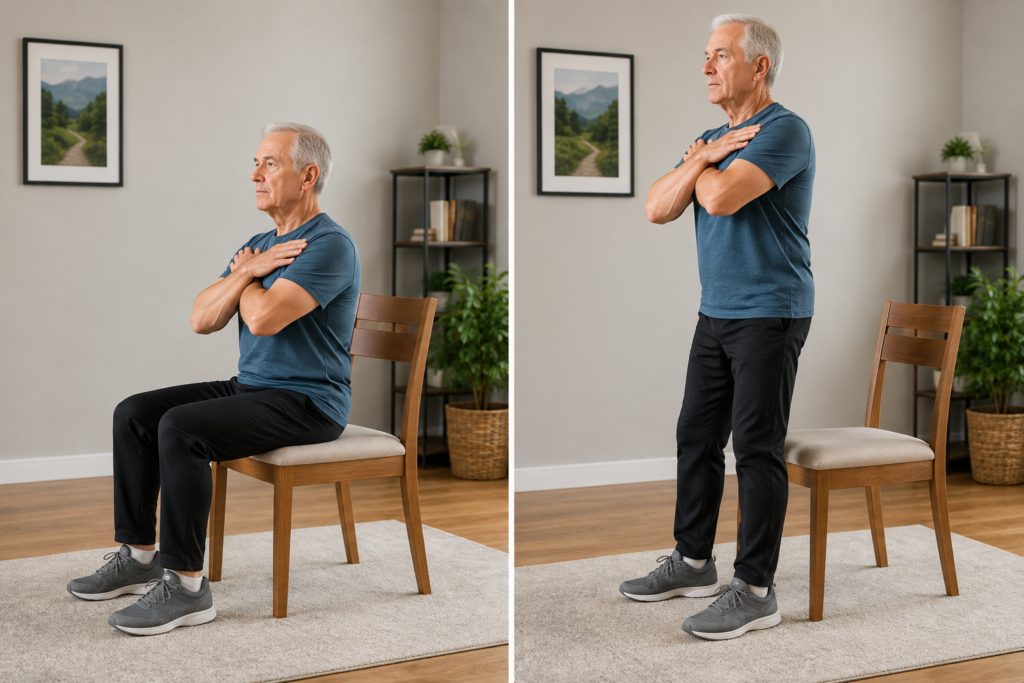
Sit in a chair with feet flat on the floor, hands held together at the chest. Push through the feet to stand up without using the hands for assistance, then sit back down with control. Few exercises translate as directly to daily life, this is quite literally the motion of getting out of a chair, done with intention.
Sets/reps: 3 sets of 8 to 12 reps.
9. Heel-to-Toe (Tandem) Walk
Walk in a straight line, placing the heel of one foot directly in front of the toes of the other. Keep the gaze forward rather than looking down at the feet, which actually helps maintain balance rather than hurting it.
Sets/reps: 3 sets of 15 steps.
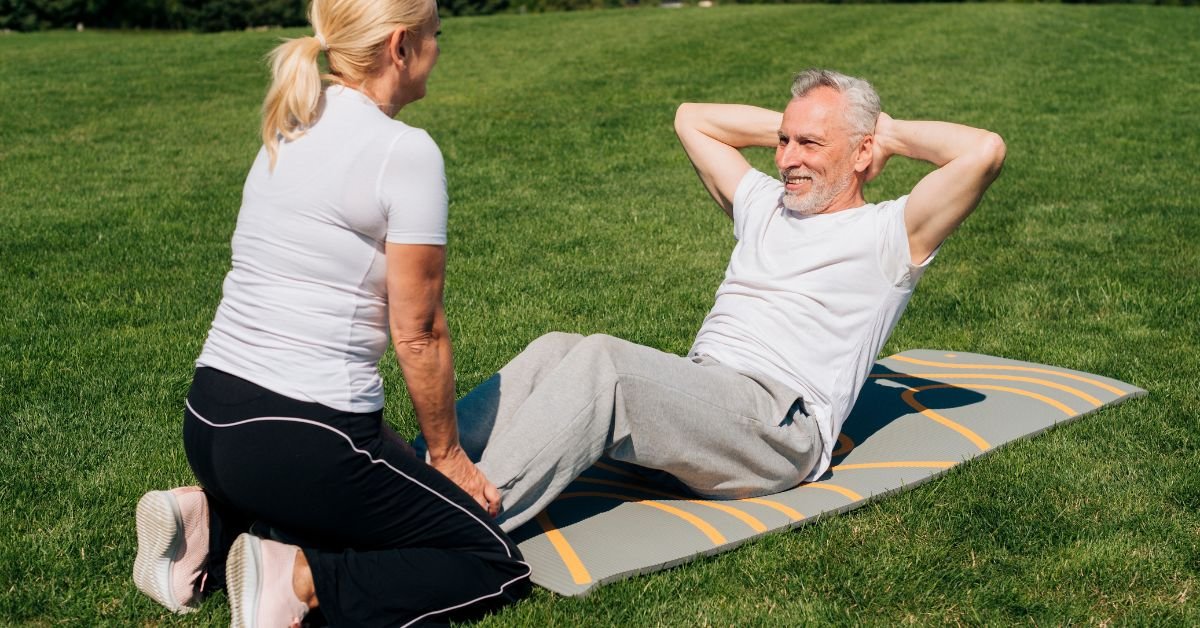
10. Butterfly Crunch (Bonus Favorite)
Lie on the back with the soles of the feet together, letting the knees fall naturally to the sides. Rest the hands lightly behind the head, then lift the shoulders a few inches off the floor and slowly return. Let the abs do the work rather than pulling on the neck with the hands.
Sets/reps: 3 sets of 12 to 15 reps.
Why These Exercises Skip the Traditional Plank
Planks place real pressure on the wrists, shoulders, and lower back, and that’s exactly why so many people quietly avoid core training altogether rather than pushing through the discomfort.
Every exercise above can be performed on the floor, standing, or against a wall, with no weight-bearing pressure on the wrists or shoulders required. Nearly every movement has a built-in modification, a reduced range of motion, added chair or wall support, that protects the lower back while form is still being learned. Building genuine core strength doesn’t require gritting through discomfort. Consistency with joint-friendly movements produces the same stabilization benefits over time, a principle covered in more depth in this guide to bodyweight exercises for knee pain and posture, which applies the same logic across the lower body.
How to Program Core Training for Adults Over 50
Most days per week works well here, since core muscles recover faster than larger muscle groups and don’t require the same extended rest windows.
A few practical guidelines make this easier to apply: aim for 10 to 20 reps per set, and 1 to 3 sets per movement, staying at a low to moderate intensity throughout. For balance specifically, dedicated balance-focused training at least three times per week is worth building in on top of general core work, since balance and core stability reinforce each other directly. A few minutes of marching in place or gentle arm circles before starting serves as a solid warm-up. As for progression, start with supported variations, using a wall or chair, and gradually reduce that support as strength and confidence build. For a broader look at how this fits into a full weekly plan, this guide to simple exercises to build strength after 60 rounds out core work with complementary strength movements for the rest of the body. Isometric holds also pair well here, and this breakdown of isometric training benefits explains why holding a position with control, like the standing knee raise above, builds real strength without any joint strain.
Core Stability Exercises by Muscle Group, Sets/Reps, and Support Needed
| Exercise | Primary Muscles Targeted | Sets × Reps | Support Needed |
| Dead Bug | Transverse abdominis | 3 × 10 to 16 per side | None |
| Wall Mountain Climbers | Core, hip flexors | 3 × 16 to 20 | Wall |
| Lying March | Deep core stabilizers | 3 × 16 to 20 | None |
| Glute Bridge | Glutes, lower core | 3 × 12 to 15 | None |
| Standing Knee Raise | Core, hip stabilizers | 3 × 12 per side | Wall or chair |
| Bird Dog | Transverse abdominis, back, glutes | 3 × 10 per side | None |
| Side Leg Raise | Outer hips, core | 3 × 10 to 12 per side | Chair or counter |
| Sit to Stand | Legs, core | 3 × 8 to 12 | Chair |
| Heel to Toe Walk | Core, balance stabilizers | 3 × 15 steps | None (wall nearby recommended) |
| Butterfly Crunch | Rectus abdominis | 3 × 12 to 15 | None |
Safety Considerations Before Starting a Core Routine
Medical clearance is worth getting before starting, particularly for anyone managing existing joint, cardiovascular, or balance-related conditions.
Conditions like arthritis, osteoporosis, and balance or coordination deficits may call for modified positioning or a bit of supervision at first. Anyone experiencing dizziness or persistent unsteadiness should talk to a doctor before starting a new routine, rather than pushing through it. A physical therapist or certified trainer can also help assess movement patterns and pinpoint the safest starting point for individual needs, which matters more here than in almost any other area of fitness.
Common Mistakes to Avoid
The single biggest mistake is rushing through reps instead of moving slowly and with control, speed adds very little here and takes away almost everything that makes these exercises effective.
A few other habits are worth watching for:
- Holding the breath instead of breathing steadily throughout each movement
- Letting the lower back arch excessively during bridges or leg-lowering exercises
- Dropping the wall or chair support too early, before balance and control are actually ready for it
- Avoiding core training altogether because of past discomfort with planks, instead of trying the joint-friendly alternatives above
The Bottom Line
Building a strong, stable core after 50 doesn’t require painful planks or a single piece of equipment. Ten accessible exercises, dead bug, wall mountain climbers, lying march, glute bridge, standing knee raise, bird-dog, side leg raise, sit-to-stand, heel-to-toe walk, and the butterfly crunch, cover everything needed to protect the spine, improve balance, and meaningfully reduce fall risk. Start with whichever exercises feel most comfortable, prioritize form over speed, and stay consistent several times a week. For a broader look at building this into a lasting routine, this guide to staying strong after 50 is a solid next stop.
Ready to build a stronger, more stable core at any age? Explore more senior fitness guides on Fitness Geekz for joint-friendly routines designed to keep the body moving confidently for years to come.
Frequently Asked Questions
Dead bug, wall mountain climbers, lying march, glute bridge, standing knee raise, bird-dog, side leg raise, sit-to-stand, heel-to-toe walk, and butterfly crunch are among the most effective and joint-friendly options.
No. Plank-free alternatives like the dead bug and glute bridge build the same deep core stability without placing pressure on the wrists, shoulders, or lower back.
Most days per week are safe and effective, since core muscles recover faster than larger muscle groups and generally don’t require extended rest between sessions.
Yes. A stronger core improves the body’s ability to react to sudden shifts in balance, which is one of the most common causes of falls in older adults.
Obtain medical clearance, especially with existing joint or cardiovascular conditions, and consider a movement assessment from a physical therapist or certified trainer to identify the safest starting exercises.