


Quick Answer: Sprint interval training (SIT) burns significantly more body fat than traditional cardio in far less time, driven by intense post-exercise calorie burn, favorable hormonal shifts, and improved fat metabolism. Research shows SIT can outperform steady-state cardio in fat loss while requiring a fraction of the weekly training time.
- Sprint interval training involves short, all-out effort bursts (20–30 seconds) followed by longer rest periods
- Research shows SIT can produce meaningfully greater body fat reduction than continuous moderate-intensity cardio, in significantly less total exercise time
- The “afterburn effect” (EPOC) keeps metabolism elevated for hours after a sprint session ends
- SIT tends to preserve lean muscle mass better than long-duration steady-state cardio
- A typical beginner protocol: 4–6 sprints of 10–30 seconds, with 60–90 seconds of rest, 2–3 times per week

Introduction
A meta-analysis pooling more than 70 studies on cardio training found that sprint interval training produced nearly a 40% greater reduction in body fat percentage than high-intensity interval training, and closer to 92% greater fat loss than continuous moderate-intensity cardio, all while requiring roughly 60% less total exercise time. That’s not a marginal edge. That’s an entirely different value proposition for anyone whose biggest obstacle to consistent training is time.
The instinct to run longer or bike further to burn more fat makes intuitive sense, but it isn’t what the research actually supports. What predicts fat loss more reliably than duration is intensity, specifically, how hard the body is pushed during short, maximal bursts of effort. This guide breaks down exactly why sprint interval training outperforms long cardio, what’s happening physiologically during those brief all-out efforts, and how to build a sprint protocol that actually fits into a real week.
Want to see exactly how it’s performed? Click here to watch the full exercise:
What Is Sprint Interval Training?
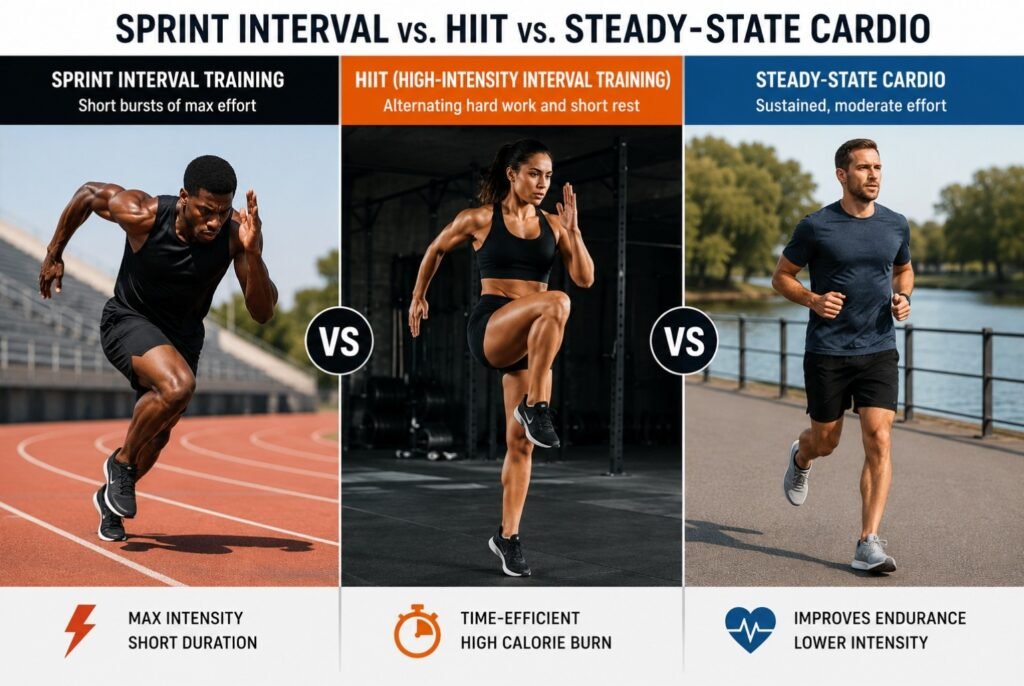
Sprint interval training is a form of high-intensity interval training built around short, maximal-effort bursts, typically 10 to 30 seconds, followed by longer recovery periods. It’s distinct from both steady-state cardio and standard HIIT in one key way: true maximal effort, not just “hard.”
The distinguishing feature between SIT and conventional HIIT comes down to intensity and ratio. HIIT intervals tend to run longer (often two to four minutes) at a high but sub-maximal effort. SIT intervals are shorter and performed at genuine 100% exertion, paired with a much longer rest period relative to the work, which is exactly what allows the next sprint to also be maximal, rather than a slowly fading imitation of one.
Sprint Interval Training vs. Traditional Cardio: What’s the Difference?
Traditional continuous cardio, jogging, cycling, or rowing at a steady, moderate pace, maintains one consistent effort level for an extended stretch of time. Sprint interval training instead alternates between brief maximal exertion and full recovery, creating a completely different metabolic demand in a fraction of the total workout time.
Why Does Sprint Interval Training Burn More Fat Than Steady-State Cardio?
Sprint interval training’s fat-loss advantage comes down to three physiological mechanisms working together: elevated post-exercise calorie burn, a more favorable hormonal environment, and improved cellular fat-burning capacity.
1. The Afterburn Effect (EPOC)
When the body sprints at maximal effort, it relies on the ATP-PC and anaerobic glycolytic energy systems, fast-access fuel sources that get depleted rapidly. That depletion creates an oxygen deficit, and the body has to work overtime afterward to restore oxygen levels, replenish energy stores, and repair muscle tissue. This process, known as Excess Post-Exercise Oxygen Consumption (EPOC), keeps metabolism running elevated for hours after the workout technically ends. Steady-state cardio produces a version of this effect too, but nowhere near the same magnitude.
2. Hormonal Response and Muscle Preservation
Long, continuous cardio sessions can elevate cortisol, a stress hormone associated with muscle tissue breakdown when chronically elevated. Short, maximal-effort sprints tend to support a different hormonal environment, one more favorable to mobilizing stored fat while preserving lean muscle tissue. It’s worth noting this is a general physiological tendency observed across research, not a guaranteed outcome for every individual, since hormonal responses vary based on training history, diet, and recovery.
3. Cellular and Metabolic Adaptations
Sprinting drives measurable changes at the cellular level, including increased mitochondrial density and improved GLUT4 transport protein activity, both of which support how efficiently muscle cells process fat and carbohydrate for fuel. A peer-reviewed study on short-term sprint training found a genuinely important nuance here: the improvement in fat oxidation during exercise was significant specifically in participants who also lost weight over the training period, not universally across everyone who simply performed the sprints. In other words, sprinting sets the stage for better fat metabolism, but the metabolic upgrade appears most reliably in people who see the training through consistently enough to also see the scale move.
Sprint Interval Training vs. HIIT vs. Steady-State Cardio
| Training Type | Typical Effort Level | Work Interval | Rest Interval | Typical Weekly Time Commitment |
| Sprint Interval Training (SIT) | Maximal (all-out effort) | 10 to 30 seconds | 60 seconds to 4 minutes | 15 to 30 minutes, 2 to 3 sessions per week |
| High-Intensity Interval Training (HIIT) | High intensity (not maximal) | 2 to 4 minutes | 1 to 3 minutes | 30 to 40 minutes, 3 to 4 sessions per week |
| Moderate-Intensity Continuous Training (Steady-State Cardio) | Moderate, sustainable pace | Continuous effort | No planned rest intervals | 30 to 60 minutes, 3 to 5 sessions per week |
How to Do Sprint Interval Training for Fat Loss
Getting started with sprint intervals follows a clear, repeatable structure:
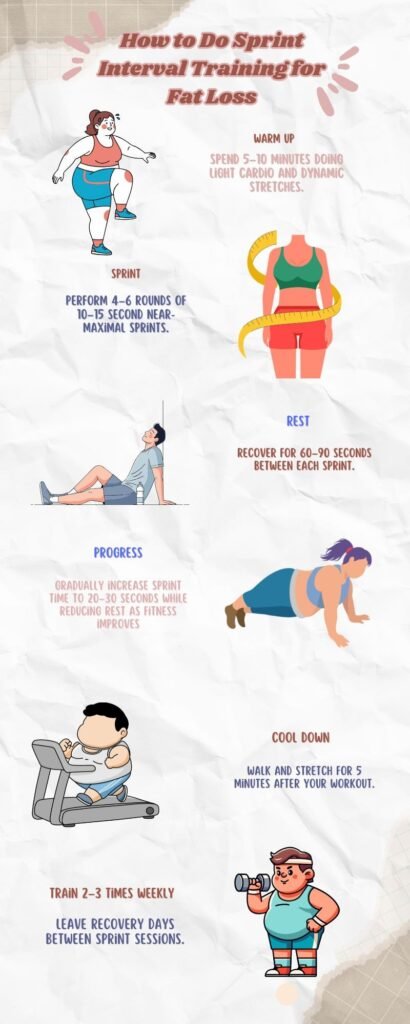
- Warm up for 5–10 minutes with light cardio and dynamic movement to prepare joints and muscles for maximal effort
- Perform 4–6 rounds of near-maximal effort sprints, starting around 10–15 seconds for beginners
- Rest 60–90 seconds between sprints, using a slow walk or complete rest to allow the next sprint to also be maximal
- Progress gradually over several weeks toward longer sprint durations (20–30 seconds) and shorter rest periods as conditioning improves
- Cool down for 5 minutes with light walking and stretching
- Limit sessions to 2–3 times per week, allowing recovery days between sprint workouts
Sample Beginner Sprint Interval Workout
Warm up for 5–10 minutes, then complete 4 to 6 sprints of 10–15 seconds at high effort, resting 60–90 seconds between each. Finish with a 5-minute cool-down. This structure works whether sprinting outdoors, on a bike, or even in place indoors, for anyone without access to a track, the same all-out-effort-then-rest principle applies to a three-week home workout plan built without equipment.
How to Fit Sprint Interval Training Into a Balanced Routine
Sprint interval training works best as a complement to resistance training, not a replacement for it. Strength work builds and maintains the lean muscle mass that keeps resting metabolism elevated day to day, while sprinting provides the sharp, short-duration metabolic stimulus that steady-state cardio can’t replicate in the same timeframe.
Because SIT is genuinely high-intensity, it shouldn’t be performed daily. Alternating sprint days with strength sessions or lower-impact recovery work supports better long-term adherence and lowers injury risk, burning out on maximal effort five days a week tends to backfire faster than it pays off. On lighter recovery days, low-impact options like an isometric workout for beginners can keep the body moving without adding to overall fatigue.
Other short, high-intensity movements, kettlebell swings, jump rope intervals, loaded carries, or bodyweight circuits, apply similar short-burst, high-effort principles and can add welcome variety to a routine. Readers building upper-body strength alongside their cardio work might also compare two accessible options in this breakdown of chair dips versus push-ups for upper body strength. Precise calorie counts or muscle-preservation percentages attached to any single exercise should be treated with some skepticism unless they trace back to a controlled study; plenty of fitness content repeats numbers that sound impressively specific without a verifiable source behind them.
Recovery isn’t only about rest days, either. What happens on the nutrition side has a real influence on how well the body responds to intense training, and this look at foods that build muscle faster than protein supplements is a useful next stop for anyone dialing in the other half of the equation.
Moving Forward With Sprint Interval Training
Sprint interval training isn’t about grinding through longer workouts, it’s about applying genuine maximal effort in short, well-structured bursts, and the research consistently shows that approach can outperform traditional cardio for fat loss in a fraction of the time. The physiology is clear: EPOC keeps the metabolic engine running after the session ends, the hormonal environment favors fat loss over muscle breakdown, and the cellular adaptations compound with consistency.
The next step is simple: start with the beginner protocol above, two to three times a week, and progress sprint duration and rest periods gradually as conditioning builds. Explore more structured, equipment-free training options on Fitness Geekz to build a complete, sustainable routine around this kind of time-efficient training.
FAQs
Research suggests sprint interval training can produce greater fat loss than steady-state cardio like jogging, in significantly less total training time, largely due to its stronger post-exercise calorie burn and metabolic effects.
Most guidelines recommend 2 to 3 sprint interval sessions per week, with rest or lower-intensity days in between to allow full recovery from the high-intensity effort.
Sprint interval training supports overall body fat reduction, and research has shown reductions in visceral (abdominal) fat specifically, though spot-reduction of fat from one area alone isn’t supported by exercise science.
A complete SIT session, including warm-up and cool-down, typically takes 15 to 30 minutes, with the actual sprinting portion often totaling just a few minutes of true maximal effort.
Yes, when approached gradually. Beginners should start with shorter sprint durations and longer rest periods, focus on proper form, and progress intensity over several weeks rather than starting with advanced protocols.