
Quick Answer: Power athlete training combines maximum-strength foundational lifting with high-velocity movements to maximize Force × Velocity output. Building a strength base first, then layering in Olympic lifts, plyometrics, and ballistic exercises, develops the explosive power needed for sprinting, jumping, and rapid direction changes across nearly every sport.
- Power is the product of force and velocity, training for it requires both strength work and high-speed movement
- A strength foundation (squats, deadlifts, presses) should generally be built before layering in dedicated power training
- Olympic lift variations like the power clean develop full-body force transfer through triple extension of the ankles, knees, and hips
- Plyometrics, like box jumps and plyo push-ups, train the neuromuscular system to produce force rapidly
- Specificity matters: training should match the actual movement pattern an athlete wants to improve, not just any explosive exercise
Introduction
Most people assume that if they keep getting stronger, they’ll automatically become faster, jump higher, and move more explosively. It sounds logical, but that’s not how the body works.
You can add 100 pounds to your squat, deadlift, or bench press and still struggle to sprint faster, jump higher, or generate real explosive power. That’s because strength is only part of the equation. To move with speed and force, your body also needs to learn how to apply that strength quickly.
Research backs this up. A 2017 meta-analysis on youth athletes found that plyometric power training produced greater improvements in jump height, while traditional strength training was more effective for improving sprint speed. Neither approach was superior overall, each developed a different aspect of athletic performance.
That distinction explains why so many lifters spend years chasing heavier weights without becoming noticeably more explosive on the field, court, or in everyday movement.
This guide breaks down what power athlete training actually involves, the foundational strength exercises that create the base for explosive performance, the movements that turn raw strength into speed and power, and how to combine everything into a training plan that fits a realistic weekly schedule.
Still curious how it looks in practice? Click here to watch the full exercise:
What Does It Mean to Train Like a Power Athlete?
Training like a power athlete means teaching your body to produce as much force as possible in as little time as possible. In simple terms, Power = Force × Velocity. It’s not just about lifting the heaviest weight you can, and it’s not about moving quickly with light weights. Real power comes from combining strength with speed.
Think of a sprinter exploding out of the blocks, a basketball player launching for a rebound, or a martial artist delivering a fast, powerful strike. They aren’t just strong, they can apply that strength instantly.
It’s also worth clearing up a common misconception. Explosive training can certainly help you build muscle, but it’s not the most effective way to maximize muscle size. Muscle growth (hypertrophy) is driven primarily by higher training volume, moderate rep ranges, and sufficient time under tension. Power training prioritizes speed, force, and nervous system adaptations instead. The result is a different kind of athlete: one built to move explosively rather than simply look bigger. Different goals require different training methods.
Why Power Matters Beyond Sports
Explosive power isn’t reserved for elite athletes chasing a personal record on the track. The same fast-force capacity that lets a sprinter accelerate out of the blocks is the exact quality that lets anyone react quickly, catching a falling object, steadying themselves after a stumble, or moving fast enough to prevent a fall from turning into an injury.
The Strength Foundation Every Power Athlete Needs
Before you focus on moving faster, you first need to get stronger. Research consistently shows that athletes who build a solid base of maximum strength before emphasizing explosive training tend to see better improvements in power than those who jump straight into plyometrics or speed work.
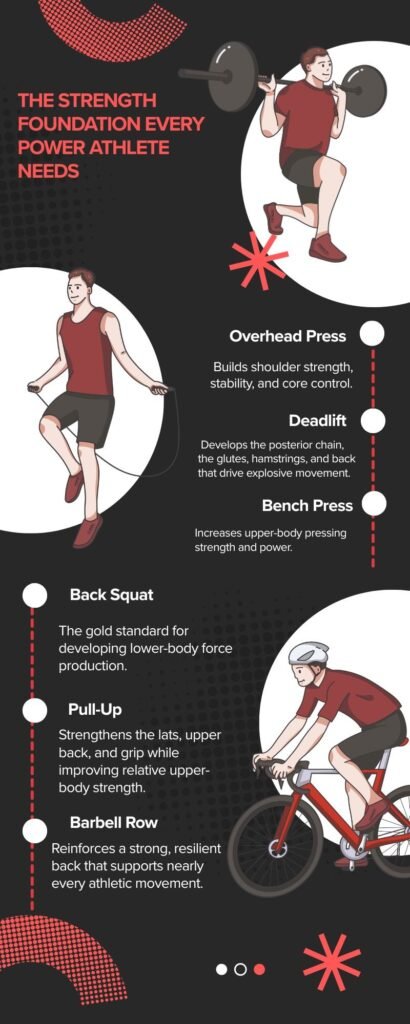
That foundation doesn’t require dozens of exercises. A handful of compound lifts do most of the heavy lifting:
- Overhead Press: Builds shoulder strength, stability, and core control.
- Deadlift: Develops the posterior chain, the glutes, hamstrings, and back that drive explosive movement.
- Bench Press: Increases upper-body pressing strength and power.
- Back Squat: The gold standard for developing lower-body force production.
- Pull-Up: Strengthens the lats, upper back, and grip while improving relative upper-body strength.
- Barbell Row: Reinforces a strong, resilient back that supports nearly every athletic movement.
These exercises aren’t flashy, and they don’t need to be. What matters is performing them with good technique and gradually increasing the challenge over time. Progressive overload, not constant exercise variation, is what builds the strength base that explosive training depends on.
Skipping this stage is like trying to build a house without laying the foundation first. Someone doing advanced box jumps before they’ve learned to squat well is simply increasing their injury risk without maximizing their performance potential.
If you don’t have access to a gym, you can still build this foundation. A structured bodyweight program that uses progressively harder movements can develop the strength needed before transitioning into more explosive training.
Best Explosive Exercises to Build Athletic Power
Once that strength base exists, a different set of exercises teaches the nervous system to express it fast, instead of slowly and under control the way a max-effort squat or deadlift usually does.
1. Power Clean and Olympic Lift Variations
The power clean trains full-body force transfer through triple extension, the simultaneous extension of the ankles, knees, and hips, which is one of the most transferable patterns available for sprinting, jumping, and change-of-direction sports. Starting from a dead stop at the hang or floor, the lifter drives explosively through full extension before receiving the bar in a quarter or full squat. Every rep trains both the physical output and the neuromuscular timing required to be genuinely explosive, which is exactly why this lift shows up in nearly every serious power program.
2. Trap Bar Deadlift (Dynamic Variation)
Swapping a heavy trap bar deadlift for a lighter load and focusing entirely on speed off the floor trains the same hip-and-quad drive pattern used in sprinting and jumping, just without the technical demands of an Olympic lift. The goal shifts from maximal weight to maximal speed, the bar (and sometimes the lifter) should almost leave the ground.
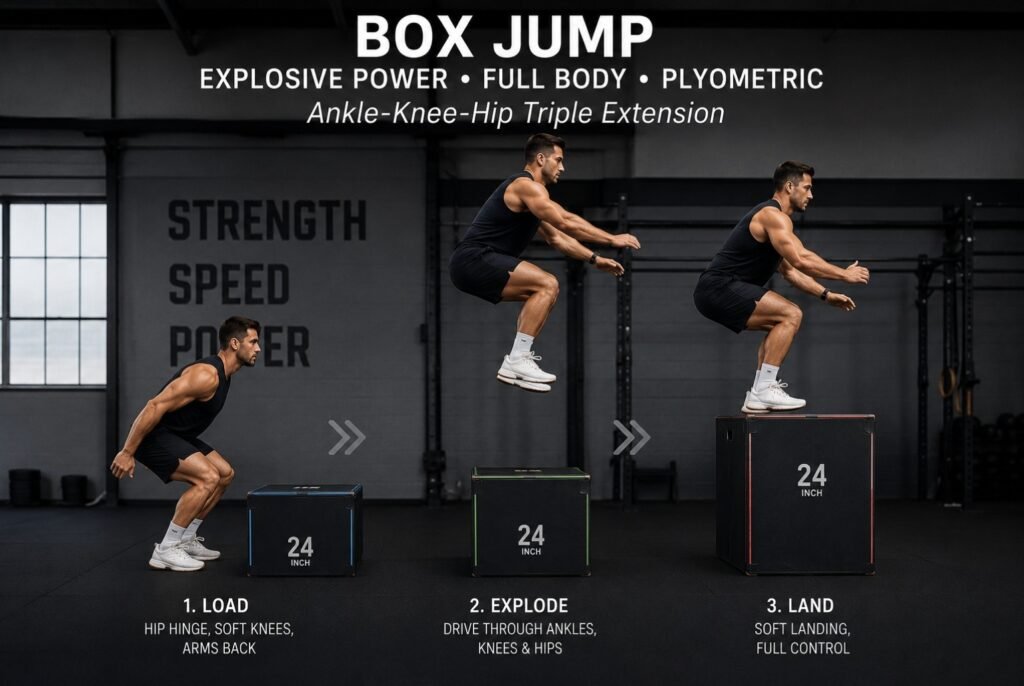
3. Box Jumps and Plyometrics
Plyometric exercises like box jumps and plyometric push-ups train the neuromuscular system to produce force rapidly, relying on the stretch-shortening cycle, the way muscles and tendons store and then release elastic energy during a quick countermovement. Take that countermovement away, though, and things change. A seated box jump removes the stretch-shortening cycle entirely, isolating raw concentric power from a dead stop, which makes it a genuinely different stimulus than a standing box jump, not just a harder version of the same one. This deeper connection between plyometrics, speed, and agility training is worth understanding fully before building it into a program, since the two qualities don’t always develop at the same rate.
4. Kettlebell Swings and Medicine Ball Slams
Ballistic exercises like kettlebell swings and medicine ball slams build explosive hip extension and upper-body power without the technical demands of catching a loaded barbell overhead. That makes them a solid entry point for anyone without Olympic lifting experience. One cue matters more than any other here: the power in a kettlebell swing comes from hip extension, not the arms. Get that wrong and it stops being a hip-power builder, it just becomes a glorified front raise with extra steps.
5. Sprinting and Sled Work
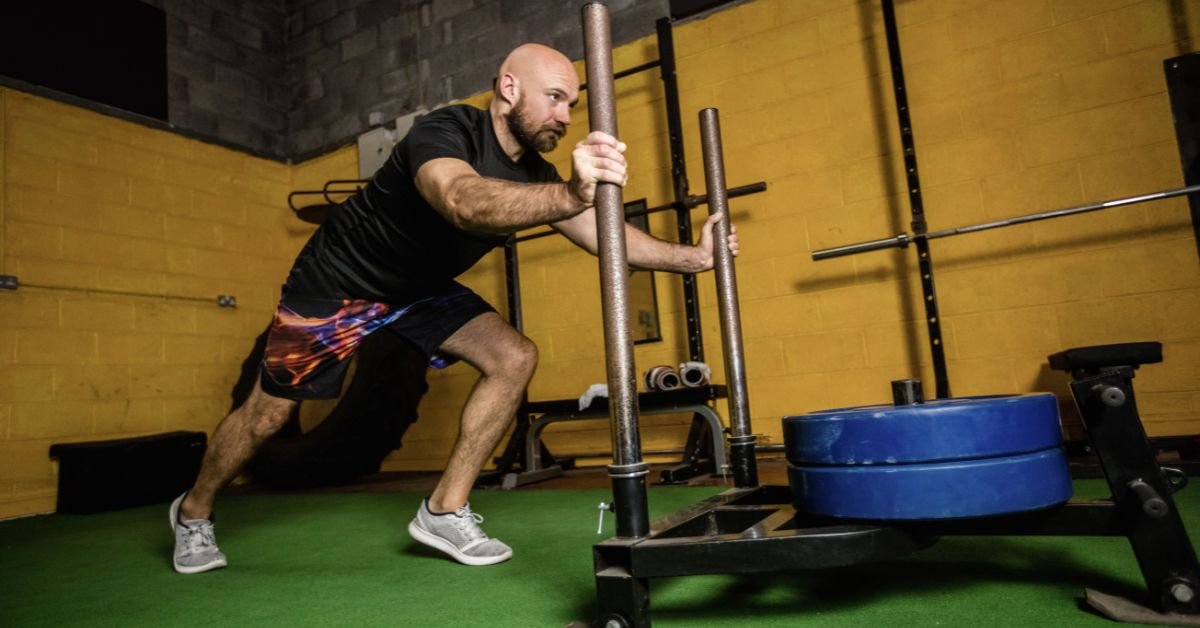
Sprinting demands maximum force output in minimal time. It directly trains acceleration, which makes it one of the most sport-specific ways to build usable power; there is no substitute that really replicates it. Sled pushes and pulls back this up with real data, showing meaningful gains in both acceleration and top-end speed. Interestingly, total training volume seems to matter more than how much weight sits on the sled, so loading it up like a strongman event isn’t the point. Athletes wanting to combine this kind of sprint and carry work into one complete conditioning session might recognize the format from a Spartan-style workout routine, which blends exactly this mix of sprinting, load carries, and functional strength.
Explosive Power Exercises at a Glance
| Exercise | Primary Quality Trained | Muscles Involved | Best For |
| Power Clean | Full body force transfer and explosive power | Hips, legs, shoulders, and back | Developing general athletic power and explosiveness |
| Trap Bar Deadlift (Dynamic) | Hip and leg drive speed | Glutes, quadriceps, and hamstrings | Improving sprinting speed and jumping performance |
| Box Jump | Reactive lower body power | Quadriceps, hamstrings, and glutes | Increasing vertical jump height and acceleration |
| Kettlebell Swing | Explosive hip extension | Glutes, hamstrings, and core | Building accessible ballistic power and posterior chain explosiveness |
| Medicine Ball Slam | Full body rotational and overhead power | Shoulders, core, and legs | Enhancing throwing ability and rotational sports performance |
| Sprinting | Maximum force production in minimal time | Hips, glutes, quadriceps, and hamstrings | Developing sport specific acceleration, speed, and power |
How to Structure a Power Athlete Training Program
Turning these exercises into an actual program comes down to a few rules that aren’t really optional:
- Warm up thoroughly with dynamic movement, since explosive work demands more tissue readiness than standard strength training
- Perform strength or power exercises in low-rep ranges, generally 3 to 5 reps, prioritizing movement quality and speed over accumulated fatigue
- Rest 2 to 3 minutes between sets to allow full recovery, since power training depends on peak output on every rep, not total volume
- Train explosive movements 2 to 3 times per week on non-consecutive days, giving the nervous system time to recover between sessions
- Apply specificity, prioritize exercises and movement patterns closest to the actual sport or goal, since research has shown that unrelated training, like high-intensity cycling intervals, doesn’t reliably transfer to sport-specific sprint speed
A program built around maximal output can’t skip recovery and expect to hold together. On the days between explosive sessions, something lower-intensity is worth doing rather than nothing, an isometric workout for beginners keeps joints stable and tissue resilient without adding to the fatigue a power session already creates. The same goes for grip and carrying strength, which tends to get ignored entirely in explosive-focused programs. A farmer’s walk fits well here too, hard enough to matter, but nowhere near taxing enough to eat into recovery from the real power work.
Moving Forward With Power Athlete Training
Real explosive power doesn’t come from picking a lane, strength or speed, and staying there. It comes from training both at once, deliberately, in patterns that actually resemble the movement being trained for. Fatigue-based workouts that leave someone gasping don’t build this quality no matter how hard they feel; the exercises above work precisely because they train force and velocity together rather than one at the expense of the other.
Start with an honest look at the current strength foundation with Fitness Geekz. If it’s solid, two to three power-focused sessions a week, structured the way this guide lays out, is where the real gains start showing up.
FAQs
The power clean is widely considered one of the most effective exercises for explosive power, since it trains full-body force transfer through triple extension of the ankles, knees, and hips, a pattern that carries over to sprinting, jumping, and many sport-specific movements.
Yes, most research and coaching guidance supports building a baseline of maximum strength before prioritizing power-specific training, since a stronger foundation allows the body to express more force during fast, explosive movements.
Power training typically uses low repetitions, generally 3 to 5 per set, with generous rest periods of 2 to 3 minutes, since the goal is peak velocity on every rep rather than accumulating fatigue.
Explosive power training can build some muscle as a byproduct, but it is not the most effective method for maximizing muscle size, since hypertrophy training generally requires higher training volume and different rep ranges than power-focused work.
Most programs recommend 2 to 3 power training sessions per week on non-consecutive days, allowing adequate recovery for the nervous system between high-intensity, explosive sessions.