

Quick Answer: Exercise tempo controls how fast each phase of a lift happens, directly setting time under tension and shaping strength, muscle growth, and injury risk. A four-number code, eccentric, bottom pause, concentric, top pause, lets lifters manipulate this variable with precision instead of guessing at speed.
- Tempo is written as four numbers (e.g., 3-1-2-0): lowering, bottom pause, lifting, top pause, each in seconds
- Slower eccentric (lowering) phases increase time under tension and are linked to greater muscle growth signaling in trained lifters
- “X” in a tempo code means explosive, as-fast-as-possible movement
- A total time under tension of roughly 10–30 seconds per set is a useful target range
- Tempo training does not always mean slow, it means controlled and intentional, at any speed
Most lifters obsess over how much weight is on the bar. Far fewer pay attention to how that weight actually moves, and research on time under tension suggests that’s a mistake. A 2012 study published in the Journal of Physiology found that muscle protein synthesis responds directly to how long muscle fibers stay under load, not just how heavy that load is. In other words, speed is a variable worth programming, not an accident of how a set happens to feel that day.
That variable has a name: exercise tempo. It’s the missing layer between “lift the weight” and “lift the weight well,” and once it’s understood, it becomes one of the simplest ways to break a plateau, sharpen technique, and train with far more control. This guide breaks down how tempo works, why it matters, and how to start using it in an actual workout.

What Is Exercise Tempo?
Exercise tempo is the controlled speed at which each phase of a repetition is performed, typically written as a four-number sequence that governs how long the lowering phase, the pauses, and the lifting phase each take. Rather than leaving rep speed to instinct, a tempo assigns exact timing to every part of the movement.
A common misconception is that tempo training simply means lifting slowly. It doesn’t. Tempo training means lifting with intention, and that intention can be fast, slow, or a deliberate mix of both, depending on the goal.
Want to see the correct form for this one? Click here to watch the full exercise:
How to Read a Tempo Number (e.g., 3-1-2-0)
A tempo code always follows the same four-part order:
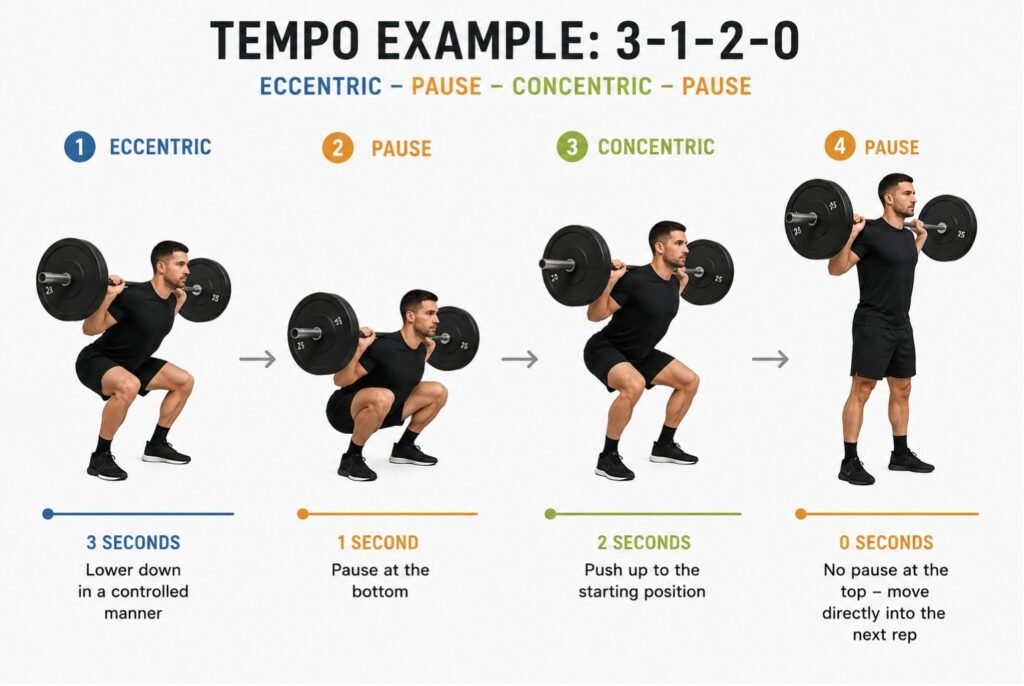
- First number- Eccentric: the lowering phase, where the muscle lengthens under load
- Second number- Isometric pause (bottom): a held position at the bottom of the movement
- Third number- Concentric: the lifting phase, where the muscle shortens (an “X” here means explosive, as fast as possible)
- Fourth number- Isometric pause (top): a held position at the top before the next rep begins
Applied to a back squat at 3-1-2-0: three seconds descending, a one-second pause at the bottom, two seconds standing back up, then straight into the next rep with no pause at the top.
Why Does Exercise Tempo Matter for Muscle Growth?
Tempo matters because it directly governs time under tension, the total duration a muscle spends working during a set, and time under tension is one of the primary mechanisms behind mechanical tension and metabolic stress, the two drivers most closely tied to muscle growth.
The research here deserves an honest read rather than a blanket claim. A study out of the University at Buffalo compared a slow 6-0-6-1 tempo against a fast 1-0-1-1 tempo in experienced lifters and found the slower tempo produced a greater acute rise in mitochondrial and sarcoplasmic protein synthesis, markers tied to muscle growth. But the effect isn’t universal: less experienced lifters tend to see far smaller differences between fast and slow tempos, since almost any structured resistance training drives adaptation at that stage. Extended tempos appear to pay off more clearly as training experience increases.
A practical target worth keeping in mind: roughly 10 to 30 seconds of time under tension per set is a reasonable range for most hypertrophy-focused work, whether that’s achieved through slower tempos and fewer reps or faster tempos and more of them.
Eccentric Training and Injury Prevention
Controlled eccentrics do more than build muscle, they build durability. Slowing the lowering phase improves joint stability, strengthens connective tissue, and removes the temptation to “cheat” a rep, whether that’s bouncing a bar off the chest during a press or swinging momentum into a curl. That control is also where sticking points in heavy compound lifts tend to get exposed and corrected.
There’s a tradeoff worth naming honestly: longer eccentric phases and novel tempo work tend to produce more delayed onset muscle soreness. That’s not a reason to avoid them, it’s a reason to program them deliberately, rather than stacking heavy eccentric work into a week that’s already demanding.
Common Workout Tempo Types Compared
| Tempo Type | Example Tempo Ratio | Primary Goal | Best For |
| Slow / Controlled | 4-2-4-0 | Maximizes time under tension, improves muscle control, and enhances the mind-muscle connection | Hypertrophy, technique refinement, rehabilitation |
| Explosive | 1-0-X-0 (X = lift as fast as possible) | Develops power, rate of force development, and movement speed | Athletic performance, powerlifting, Olympic lifting, strength-speed training |
| Pause Tempo | 2-2-1-1 | Eliminates momentum, increases positional strength, and improves stability | Breaking through sticking points, improving weak ranges, technique correction |
| Standard Tempo | 2-0-2-0 | Provides balanced control throughout the full range of motion while maintaining efficient training volume | General strength training, beginners, most resistance training programs |
How to Add Tempo to a Workout
Applying tempo training follows a straightforward process:
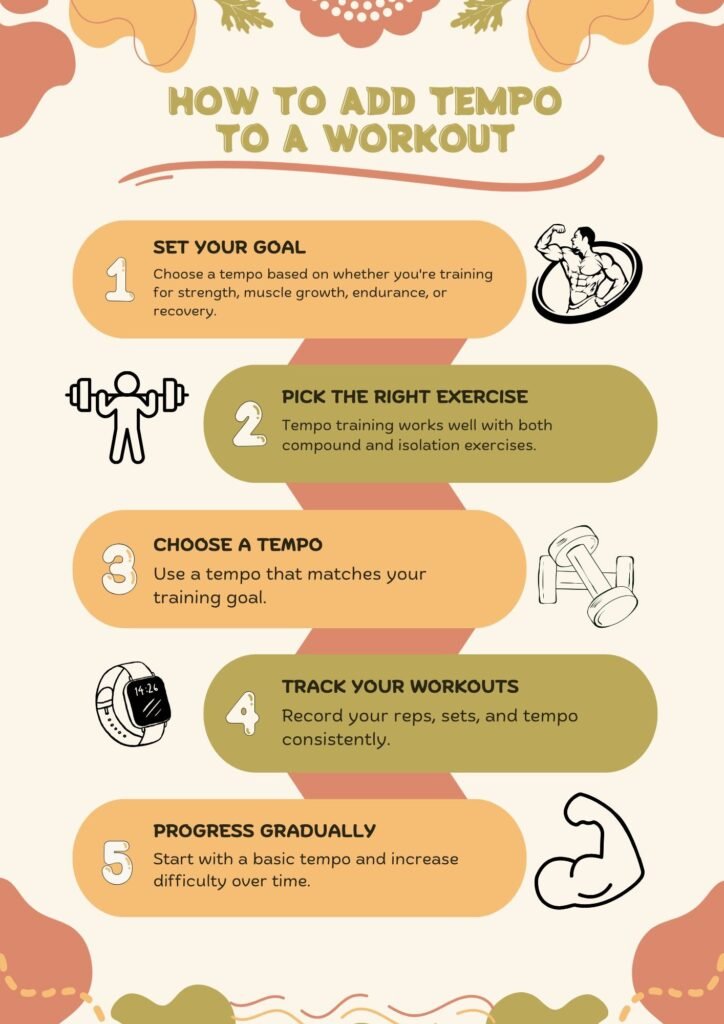
- Identify the training goal, strength, hypertrophy, endurance, or injury rehabilitation each call for different tempo emphasis.
- Choose suitable exercises, compound lifts like squats, presses, and rows respond especially well to tempo work, though isolation moves like curls benefit too.
- Assign a tempo ratio that matches the goal, using the comparison table above as a starting reference.
- Track reps and sets to stay within an appropriate time-under-tension range rather than guessing.
- Progressing gradually, beginners generally do best starting with a standard tempo before layering in extended eccentrics or explosive work.
Sample Tempo-Based Exercises
A back squat at 4-1-2-1 forces a slow, controlled descent and rewards a strong bottom position before standing back up, ideal for reinforcing form under load. A push-up at 2-0-2-0 turns a familiar bodyweight movement into a genuine strength and control challenge simply by removing momentum from the equation. A dumbbell curl performed with a slow four-second eccentric develops far more control than the same movement rushed through at full speed.
Tempo Training Mistakes to Avoid
- Rushing repetitions: fast, uncontrolled reps lean on momentum instead of muscle tension, undercutting the entire point of the set.
- Applying extended eccentrics without context: heavy, slow eccentric work adds real fatigue and soreness, and needs to be matched to training age and recovery capacity rather than applied indiscriminately.
- Ignoring recovery and nutrition demands: tempo work increases mechanical and metabolic stress on the muscle, which raises the importance of adequate sleep, protein intake, and recovery between sessions.
Moving Forward With Tempo Training
Exercise tempo isn’t a gimmick or a slow-lifting trend, it’s a training variable that sits right alongside load, volume, and rest periods, and it’s one of the easiest to start applying immediately. Picking a single lift this week and assigning it a tempo from the comparison table above is enough to start feeling the difference between moving weight and truly controlling it.
Ready to put tempo into practice? Explore a full tempo-based strength program on Fitness Geekz to start applying these principles in a structured, goal-specific plan.
FAQs
Tempo refers to the speed of each phase of an exercise rep, usually written as a four-number sequence like 3-1-2-0, covering the lowering, pause, lifting, and top-pause phases.
Slower tempos increase time under tension, which can support muscle growth, especially in experienced lifters, but they aren’t universally better, faster, explosive tempos build power and serve different training goals.
The “X” means the concentric, or lifting, phase should be performed as explosively and quickly as possible while maintaining proper form.
A commonly referenced target is roughly 10 to 30 seconds of time under tension per set, though the ideal range varies by training goal and experience level.
Yes. Controlled tempo reduces reliance on momentum, improves joint stability, and reinforces proper technique, all of which lower injury risk during compound lifts.