


Look at your wrists right now. Bony. Skinny. Unchanged, even after years of lifting heavier and pushing harder. Most people are told it’s genetics and quietly give up.
But here’s the honest, science-backed truth: your wrist bones won’t grow, yet the muscle, tendon, and connective tissue wrapped around them absolutely can.
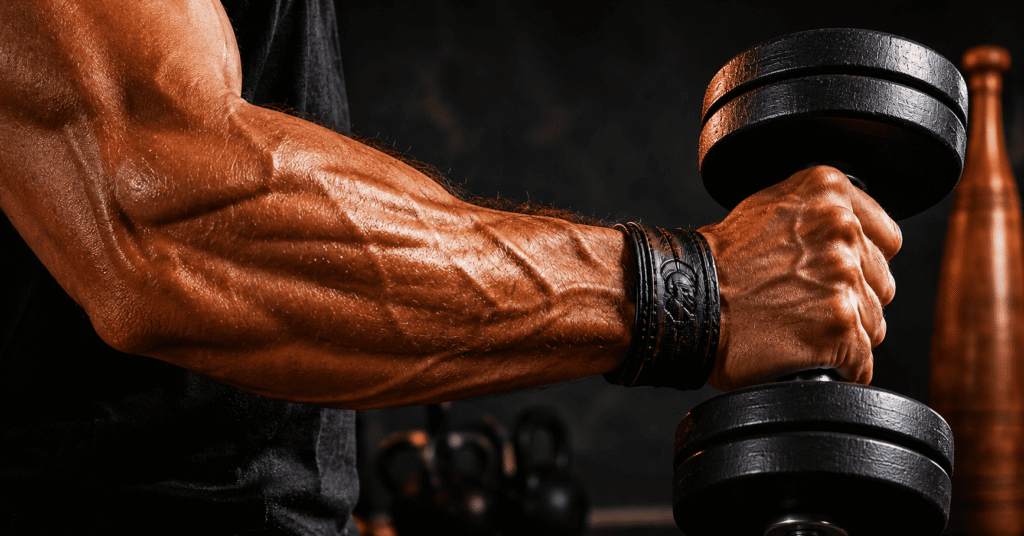
And it matters beyond looks, in the PURE study published in The Lancet, researchers tracked nearly 140,000 adults across 17 countries and found that grip strength predicted all-cause mortality more strongly than systolic blood pressure. Stronger forearms are not just cosmetic. They are increasingly recognised as a meaningful marker of long-term health and physical resilience.
Every rep counts, but only if your form is right. Watch the full exercise demo here:
Can You Actually Make Your Wrists Bigger? The Honest Answer
Wrist width is set by bone, and that doesn’t change in adults. What creates a dense, powerful look is everything around the joint: the muscle bellies and tendons of the forearm that insert near the wrist. Develop those and the whole area thickens.
The problem is that most lifters only train one slice of the forearm. Pull-ups, rows, and deadlifts hammer the flexors (underside) while the extensors (top) and the pronators and supinators (rotation) get almost no attention. Building bigger wrists naturally means training all three.
The Three Muscle Groups That Create Thicker Forearms Naturally
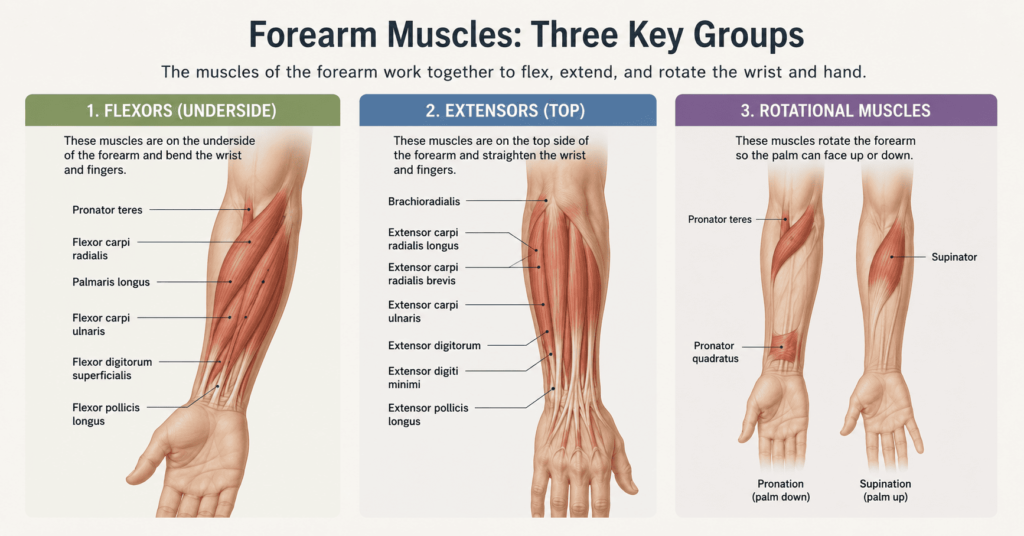
1. Flexors
These muscles sit underneath the forearm and help close the hand and flex the wrist. Most gym exercises already hit them indirectly.
Wrist curls and heavy pulling movements train this area well.
2. Extensors
The extensors sit on top of the forearm and are one of the most neglected muscle groups in fitness training.
Ironically, they are also one of the biggest contributors to visible forearm thickness and wrist balance.
Reverse wrist curls and finger extension work target this region effectively.
3. Pronators and Supinators
These deeper rotational muscles help turn the forearm inward and outward.
Most people never train them directly, which is why rotational strength often becomes a missing piece in forearm development.
This is where many traditional warrior inspired methods were surprisingly effective.
Warrior-Inspired Forearm Training Exercises
The framing here is inspired by old strength traditions, Persian club swinging, Indian wrestling, the relentless grip of rowing, but the prescriptions below are grounded in modern exercise science, not folklore.
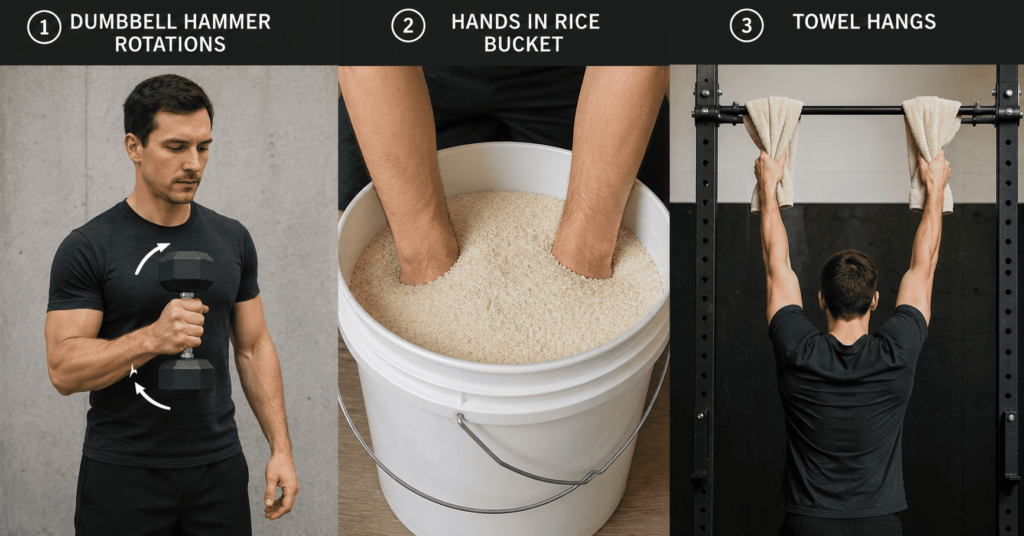
1. Rotational strength. Hold a dumbbell like a hammer, elbow tucked at your side and bent to 90 degrees, then rotate slowly from palm-down to palm-up and back. That’s one rep. Pinning the elbow means the rotation comes entirely from the forearm, firing the pronators and supinators most people never activate. Start light, this position exposes how weak they really are. 3 sets of 12–15 reps each direction.
2. Extensor and finger power. Bury your hand in a bucket of rice and open, close, twist, and spread your fingers nonstop until they burn. The rice resists in every direction, hitting the extensors and finger muscles that wrist curls miss. No rice? Loop a rubber band around your fingertips and extend outward against it. 3–5 rounds of about 2 minutes.
3. Grip endurance and tendon density. Throw a towel over a pull-up bar, grab both ends, and hang, or wrap it around something sturdy and row. The thick, unstable grip forces constant tension through the wrist and builds the tendon density that makes forearms look powerful even at rest. 3 sets, holding as long as you can, aiming for 60+ seconds.
Your Weekly Wrist and Forearm Routine
Run the three core methods, dumbbell rotations, rice bucket work, and towel hangs, three times a week, then add reverse wrist curls and standard wrist curls to round out the extensors and flexors. A simple session: rotations first while you’re fresh, then wrist and reverse wrist curls, finishing with rice bucket work and towel hangs to failure. Fifteen focused minutes is enough.
You can train forearms on their own days or at the end of an upper-body or pull workout. If you stack it after heavy pulling, save the grip-intensive towel work for last so it doesn’t compromise your main lifts.
Progress through progressive overload: add load, slow the tempo for more time under tension, or add a fourth weekly session as you adapt. Forearms recover quickly and tolerate frequency better than most muscle groups, but they’re not invincible, chasing soreness every session is how nagging tendon issues start.
Be patient. Muscle responds in a few weeks, but tendons remodel far more slowly, so give the plan a solid 8 weeks before judging results.
Recovery, Injury Prevention, and Nutrition
Training extensors alongside flexors isn’t just about size, it keeps the joint balanced and helps prevent the wrist and elbow pain that plagues heavy pullers and desk workers alike. A forearm strong in only one direction is a setup for overuse injury. If you feel sharp or persistent tendon pain, back off and let it settle; that’s a signal, not something to push through. A quick warm-up of wrist circles and unloaded rotations before your working sets goes a long way here.
Growth also needs fuel. A slight calorie surplus paired with roughly 0.7-1g of protein per pound of bodyweight daily gives the forearms the raw material they need, and consistent sleep handles most of the actual repair.
Sustainable Habits That Keep Wrists Strong for Life
Strong wrists are not just about aesthetics.
Grip strength plays a major role in lifting performance, manual work capacity, athletic performance, and long term joint resilience.
The people who maintain strong forearms as they age usually train movement variety consistently. They rotate, carry, grip, extend, and stabilise instead of relying on one repetitive movement pattern.
That is why old school training methods still hold value today. They trained the hands and forearms as tools for real world function, not just gym appearance.
Conclusion
Building bigger wrists naturally is not about changing your bone structure or chasing exaggerated fitness myths. Real wrist development comes from consistently training all three major forearm systems: flexion, extension, and rotation. Most gym routines only focus on gripping and flexion, which is why many people struggle to build thicker-looking wrists despite years of lifting. The combination of rotational work, extensor training, and grip endurance creates the dense, powerful forearm appearance that standard workouts often miss. There are no magic exercises or secret shortcuts involved. Just smarter movement variety, progressive overload, proper recovery, and patience. Over time, that consistent approach builds stronger, thicker, and more functional wrists that improve both performance and overall forearm strength.
Ready to turn skinny wrists into powerful forearms? Explore more practical strength and muscle-building guides at Fitness Geekz.
Frequently Asked Questions
Most people notice early strength and endurance improvements within 3 to 4 weeks. Visible forearm thickness changes typically take around 6 to 8 weeks of consistent training.
Yes. Bone width may stay relatively narrow, but the surrounding muscles, tendons, and connective tissue can absolutely become denser and more developed.
There is no single best movement. The most effective approach combines wrist flexion, extension, rotational training, and grip endurance together.
Three sessions per week works well for most people. Forearms recover relatively quickly, but excessive daily volume can irritate tendons if recovery is poor.
Indirectly, yes. Grip training strengthens the forearms and connective tissue surrounding the wrist, especially when combined with rotational and extensor focused work.