
More than 80 percent of adults experience lower back pain at some point in life. Chronic stiffness, weak knees, poor posture, and declining balance are often treated as unavoidable parts of aging. In reality, they are usually the result of long periods of sitting, reduced movement, and the gradual shutdown of deep stabilising muscles that keep the body strong and coordinated.
Most modern workouts focus on burning calories or building visible muscle. Very few rebuild the deep muscular control and tendon resilience that protect joints for decades. High impact training can even add stress to already compromised knees, hips, and shoulders.
This is where shaolin monk training stands apart.
For centuries, Shaolin monks developed extraordinary functional strength through yielding isometrics, static holds maintained under sustained tension. Instead of repetitive movement, the body learns to stabilize itself under control. These holds strengthen deep muscles, improve tendon integrity, and restore brain to body communication without impact or heavy equipment.
Shaolin monk training works for modern life because it directly targets one of the biggest causes of age-related weakness, the loss of stabiliser muscle activation caused by sedentary living.
This guide covers five powerful Shaolin inspired holds that rebuild strength naturally in under 10 minutes a day.
Stop guessing, start growing. See exactly how it’s done, watch the full exercise demo here:
What Makes Shaolin Monk Training Different From Conventional Exercise
The Science of Yielding Isometrics
Shaolin monk training relies heavily on yielding isometrics, where muscles hold tension against gravity for extended periods instead of producing explosive movement.
Extended holds create adaptations that traditional gym training often misses completely. Sustained tension encourages tendon collagen remodelling, improves neural efficiency, and strengthens the stabilising muscles surrounding joints.
When the body shakes during a hold, especially after prolonged tension, it is not a failure. It is the nervous system reactivating dormant stabilisers that daily sitting rarely uses.
That process improves balance, posture, joint control, and movement quality in ways traditional exercise machines cannot replicate.
Why Modern Sedentary Life Requires This Approach
Long hours of sitting weaken the deep muscles around the spine, hips, and shoulders. Superficial muscles may still function reasonably well, but the stabilisers responsible for safe movement slowly stop activating properly.
This creates instability, stiffness, and poor coordination.
Shaolin inspired isometric holds restore those missing connections without placing additional strain on vulnerable joints. Instead of forcing movement through pain, they rebuild the foundation that movement depends on.
The 5 Shaolin Holds That Rebuild Strength Naturally
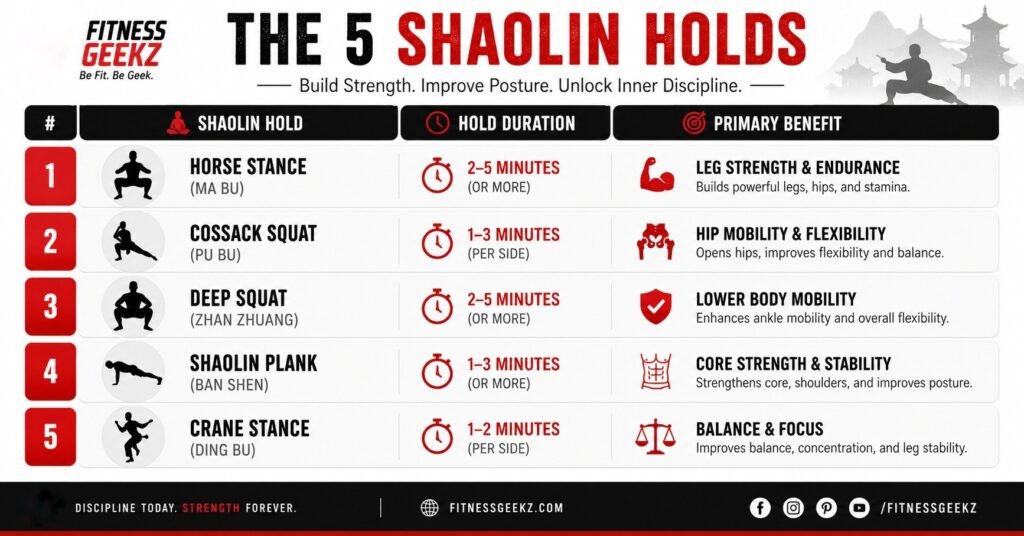
Each movement addresses a specific weakness modern lifestyles create. Together they form a complete monk workout routine with zero equipment and virtually no joint impact.
1. Hollow Body Hold for Core Control and Spinal Stability
The Hollow Body Hold strengthens the deep muscles surrounding the spine and teaches the core to stabilise properly again.
Lie flat on the floor and press the lower back firmly into the ground. Slowly lift the shoulders and legs a few inches off the floor while maintaining that spinal contact.
If needed, bend the knees slightly.
t=60 secondst=60\text{ seconds}t=60 seconds
The moment the lower back lifts away from the floor, reset the position. Controlled tension matters more than duration.
Beginners should aim for 20 to 30 seconds and gradually progress toward 60 seconds.
2. Bear Crawl Hold for Full Body Coordination
The Bear Crawl Hold restores coordinated movement between the shoulders, hips, and core.
Start on all fours with hands under shoulders and knees under hips. Tuck the toes and lift the knees one inch off the floor while keeping the back flat.
The position looks simple until the full body begins firing simultaneously. That integrated activation pattern is exactly what modern sedentary living suppresses.
Hold for 20 to 60 seconds while breathing steadily.
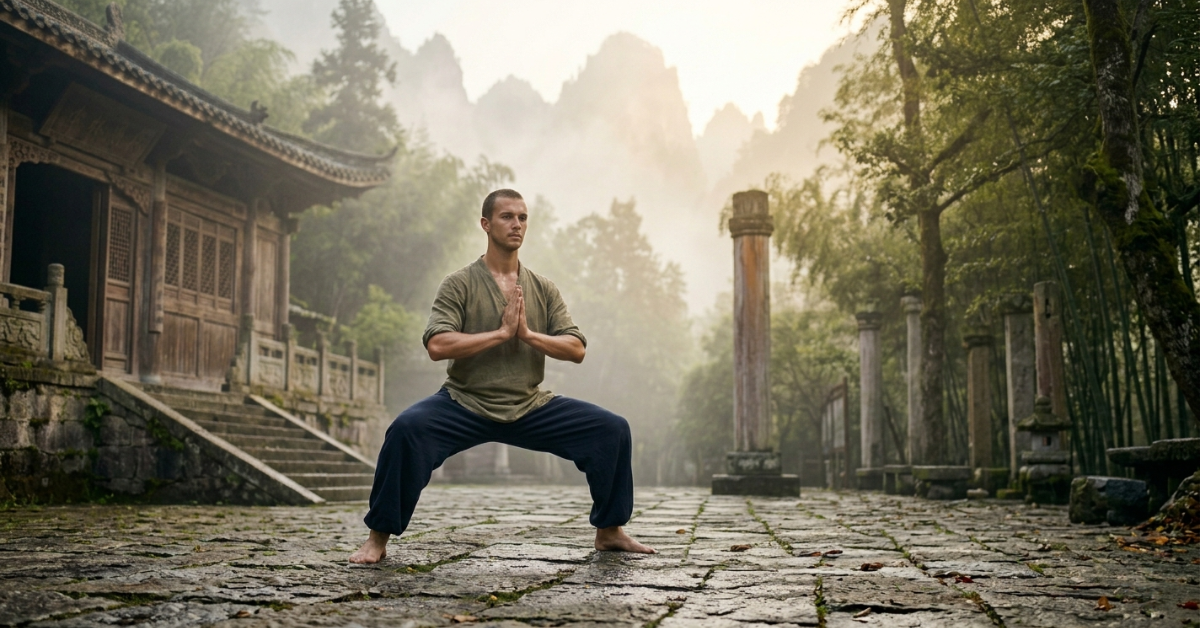
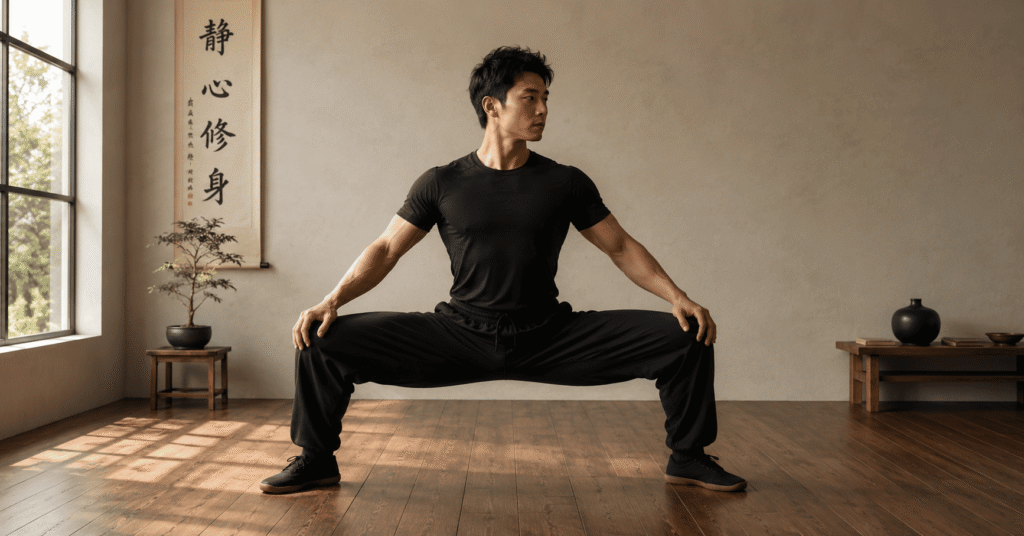
3. Horse Stance for Hip and Leg Strength
Shaolin training has long viewed leg strength as the foundation of healthy aging.
Stand with feet wider than shoulder width and toes slightly turned outward. Lower the hips until the thighs approach parallel with the floor while keeping the chest tall.
The burning sensation in the legs is not damaged. It is underused muscles finally being challenged again.
Start with 20 to 30 seconds and add five seconds weekly until reaching 60 seconds or beyond.
4. Shaolin Wall Push for Upper Body Strength
Traditional pressing exercises can place significant stress on the shoulders and elbows over time. The Shaolin Wall Push creates intense muscular tension without movement or impact.
Stand facing a wall with hands at chest height. Step slightly back and push against the wall as hard as possible.
Nothing moves. Only tension exists.
Perform six rounds of 10 second maximum effort holds while breathing continuously throughout the contraction.
5. Wall Sit for Knee Stability and Endurance
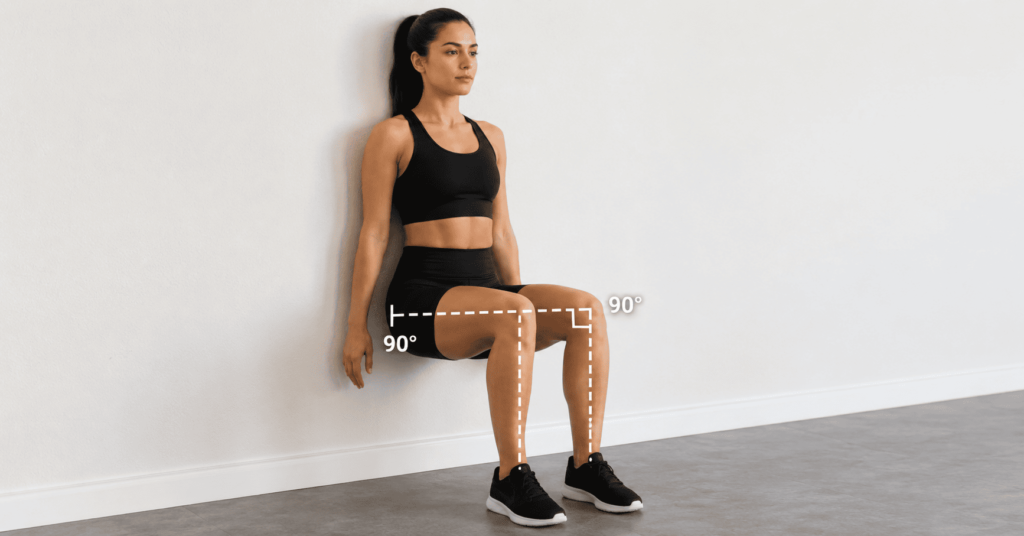
The Wall Sit strengthens the muscles and tendons supporting the knees without impact or spinal loading.
Lean against a wall and slide down until the knees form a 90 degree angle. Keep the heels planted and maintain full back contact with the wall.
Stay controlled and resist the urge to rise out of the position as fatigue builds.
Work toward 60 seconds initially, then gradually progress to 90 seconds.
Ancient Strength Training vs Modern Gym Work at a Glance
| Shaolin Hold | Conventional Equivalent | Joint Impact | Primary Benefit |
| Hollow Body Hold | Sit ups | Zero | Deep spinal stability |
| Bear Crawl Hold | Plank machine work | Zero | Neural coordination |
| Horse Stance | Leg press | Zero | Hip and leg endurance |
| Shaolin Wall Push | Bench press | Zero | Tendon and upper body strength |
| Wall Sit | Leg extension machine | Zero | Knee stability |
How to Build the Daily Modern Monk Protocol
Perform each hold in sequence with short rests between movements.
The routine flows like this:
- Hollow Body Hold
- Bear Crawl Hold
- Horse Stance
- Shaolin Wall Push
- Wall Sit
The entire session takes between 5 and 10 minutes.
Progress comes through duration, not added weight. Increase each hold gradually while maintaining perfect control and breathing.
Because isometric training produces less muscle damage than conventional strength training, recovery demands remain relatively low. Most people can practice this routine five to six days per week consistently.
Protein intake and vitamin C also support tendon collagen synthesis and recovery.
Who Benefits Most From Shaolin Monk Training
People over 40 dealing with stiffness or joint discomfort often respond extremely well to this approach because it builds strength without aggravating sensitive joints.
Desk workers benefit from the spinal and hip stabilisation these holds provide after years of prolonged sitting.
Athletes can use the routine as a neural activation circuit before regular workouts to improve movement quality and muscle recruitment.
Anyone returning to exercise after a long break may find these holds far more sustainable than high impact training.
Conclusion
Age itself is not what destroys strength and movement quality. Inactivity, poor posture, and the gradual loss of stabiliser muscle activation are the real causes behind most chronic pain and physical decline.
Shaolin monk training addresses those problems directly.
These five ancient holds rebuild deep muscular control, improve tendon resilience, and restore the neural coordination that modern sedentary life slowly erodes.
Most people notice improved stability and reduced tension within a few weeks of consistent practice. Bigger changes in posture, strength, and movement confidence often become noticeable within four to six weeks.
No heavy weights. No impact. No complicated equipment.
Just controlled tension that rebuilds real world strength from the inside out.
Build real-world strength, stability, and resilience naturally with more expert training guides at Fitness Geekz.
Frequently Asked Questions About Shaolin Monk Training
Shaolin monk training refers to traditional methods that use controlled static holds and disciplined body positioning to develop strength, coordination, and resilience. Beginners can absolutely perform these exercises because each hold can be shortened or modified based on current ability.
Most people notice improved body awareness and reduced stiffness within two to three weeks. Visible improvements in posture, endurance, and stability usually appear after four to six weeks of consistent practice.
These holds are commonly used in rehabilitation settings because they strengthen muscles without repetitive joint stress. Anyone with a medical condition should still consult a physiotherapist before starting.
Traditional gym exercises mainly train muscles through movement. Isometric holds train stabilisation, tendon resilience, and neural coordination through sustained tension without motion.
Most people benefit from practicing the full circuit five to six days per week. The low impact nature of the routine makes consistent training realistic and sustainable over the long term.