
Research consistently shows that bodyweight training produces comparable muscle growth to gym-based resistance training when progressive overload and time under tension are applied correctly. Yet millions of people still believe a gym membership is the only way to build a strong, muscular body. That belief is not just wrong. It is holding a lot of people back.
Spartan warriors had no barbells, no machines, and no gym culture. They marched 30 miles a day, fought brutal hand-to-hand battles, and built bodies that looked carved from stone using nothing but movement, tension, and relentless consistency. The training principles behind that kind of physique are still the most effective framework for building functional muscle today.
Here is something worth being honest about upfront. Many of the exercises modern gym culture treats as essential, heavy bench presses, barbell squats, and endless machine work, are not actually the most efficient path to building muscle. Some of them quietly wear down joints over years of use. The Spartan approach builds maximum muscle tension while protecting the joints, which is exactly what makes it sustainable for the long haul.
This guide covers 6 Spartan-inspired bodyweight exercises for muscle gain, the science behind why they outperform many gym alternatives, how to structure them into a practical no gym workout plan, and what to do to keep making progress month after month.
Struggling with proper form? Watch the full exercise breakdown here: Watch Now
Why Bodyweight Training Builds Real Muscle?
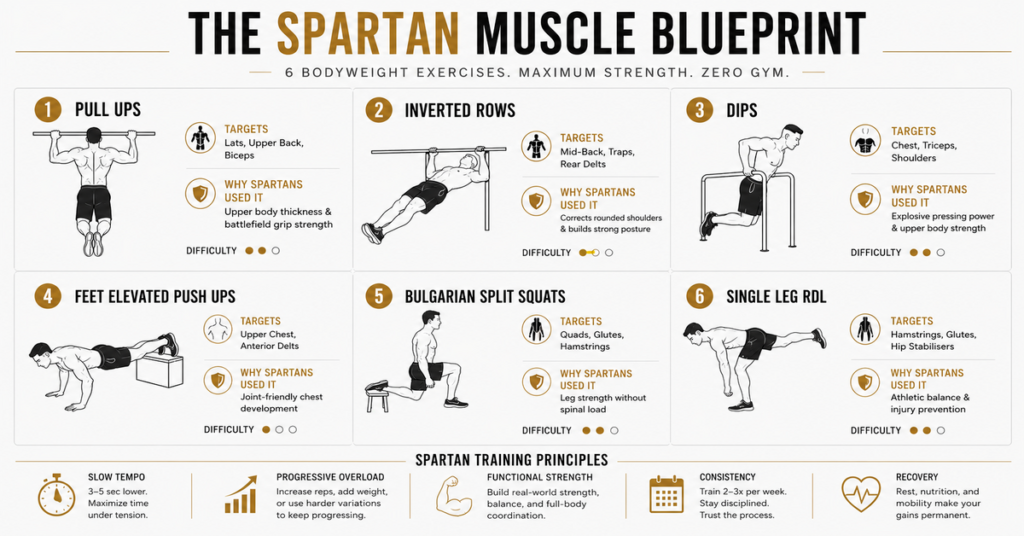
Most people understand that muscles grow when they are challenged. What most people miss is that the challenge does not have to come from a barbell or a machine. It has to come from mechanical tension, metabolic stress, and muscle damage. Controlled bodyweight training delivers all three without compressive spinal loading or the kind of joint stress that accumulates quietly over years of heavy lifting.
The single most important variable that separates effective bodyweight training from a casual warm up is time under tension. Taking 3 to 5 seconds on the lowering phase of any movement, whether it is a push up, a split squat, or a pull up, dramatically increases muscle fibre recruitment and the growth stimulus that comes with it. That one adjustment turns exercises most people dismiss into genuinely challenging, muscle-building movements.
The Spartan philosophy of functional strength training is built around movements that require the entire body to stabilize and generate force at the same time. A lat pulldown machine guides the movement path for the user, removing most of the stabilisation demand. A pull up forces every muscle in the upper body to coordinate simultaneously. That is exactly why people who can perform 10 or more clean pull ups almost always have noticeably more upper body development than people who spend the same time on machines.
One important truth worth stating clearly: bodyweight training has a real ceiling if progression is ignored. Once a movement becomes easy, the body adapts and stops growing. Progressive overload through slower tempos, increased reps, more challenging variations, and added resistance is essential to keep building muscle at home consistently over time.
The 6 Spartan Bodyweight Exercises
Exercise 1: Pull Ups- For Upper Body Thickness and Strength
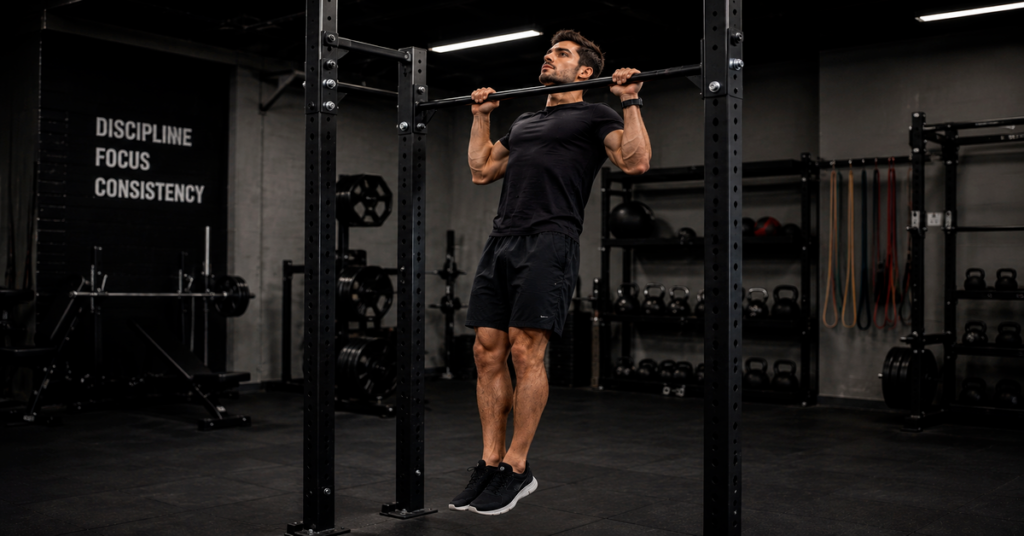
Pull ups are not just a back exercise. Done correctly, they force the lats, upper back, biceps, forearms, shoulders, and core to work together just to move the body through space. That full-body coordination is something most machines simply cannot replicate.
Grip slightly wider than shoulder width, start with arms fully extended, and pull the chest to the bar rather than just the chin. Pause briefly at the top, then lower for a full 5 seconds. That slow descent is where much of the muscle building actually happens.
For anyone who cannot yet do a full rep, start with slow negatives. Jump to the top position and lower down as slowly as possible. Once 10 clean reps become achievable, add a weighted vest or a loaded backpack to keep the challenge moving forward.
Aim for 3 sets of 6 to 10 reps.
Exercise 2: Inverted Rows- For Posture and Shoulder Health
Most people push far more than they pull. Push ups, dips, and pressing movements dominate the average home workout while the mid-back, traps, and rear delts get almost nothing. That imbalance is one of the primary reasons people develop rounded shoulders and chronic shoulder pain over time.
Inverted rows fix that directly. Use a bar, rings, straps, or even a sturdy table edge. Grip just outside shoulder width, keep the body in a perfectly straight line, pull the chest toward the bar, and squeeze the shoulder blades together firmly at the top. Lower with complete control on the way down.
Unlike bent-over barbell rows, inverted rows place no compressive stress on the lower back, making them one of the smartest pulling movements available for long-term shoulder health and postural correction.
Elevate the feet once the standard version becomes too easy. Aim for 3 sets of 8 to 12 reps.
Exercise 3: Dips- For Triceps and Pressing Power
Here is something most gym-goers do not know. Research shows that dips produce equal or greater triceps muscle activation compared to the close-grip bench press, with better long-term shoulder outcomes when technique is applied correctly. That makes dips one of the most underrated upper body exercises available.
Keep the shoulder blades pulled down and back throughout the entire movement. Lean slightly forward rather than staying completely upright, lower until the upper arms are parallel to the floor, pause briefly at the bottom, then press back up with control.
If full dips are not yet achievable, start with bench dips to build the baseline strength. Once 12 to 15 clean reps become easy, add weight to keep driving muscle growth.
Aim for 3 sets of 8 to 12 reps.
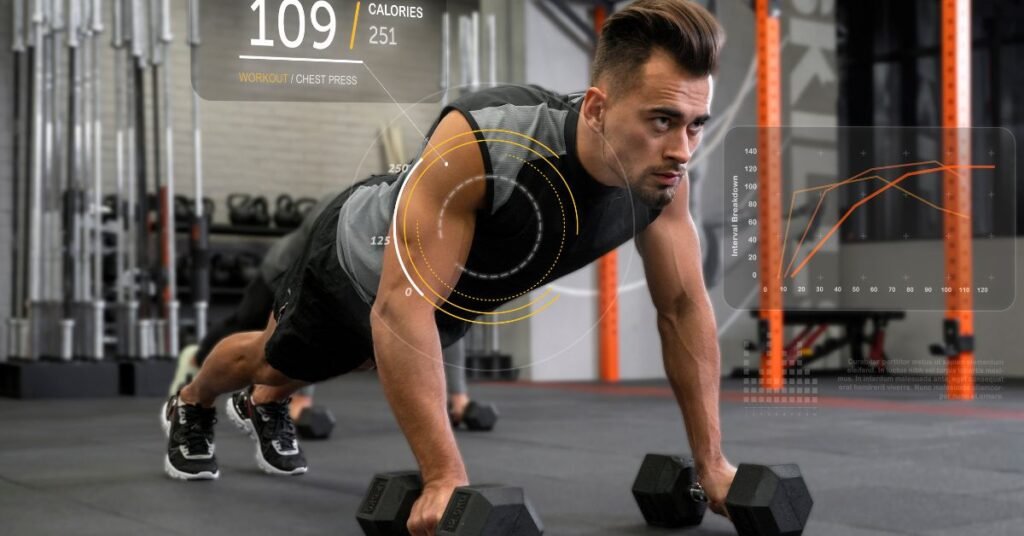
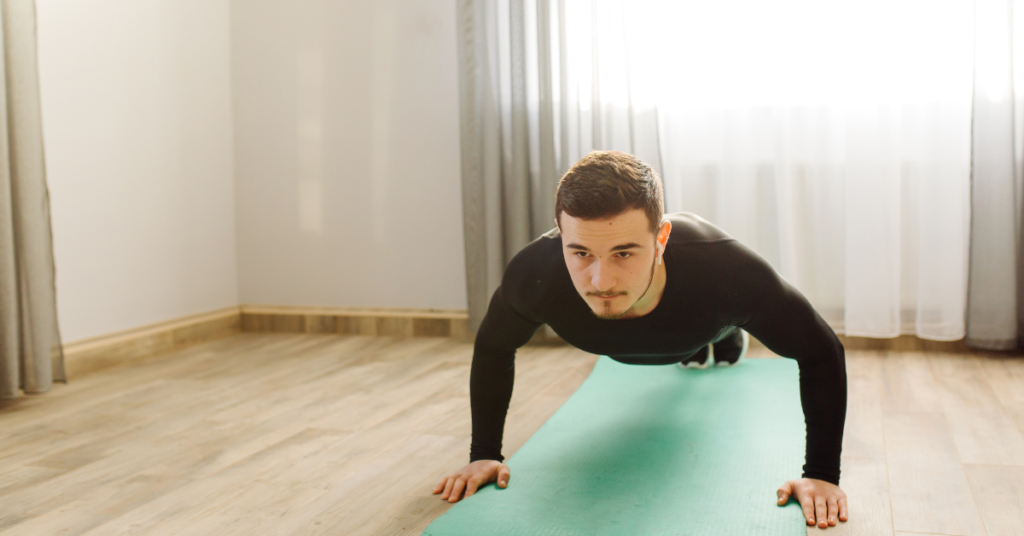
Exercise 4: Feet Elevated Push Ups- For Upper Chest and Shoulder Development
Standard push ups are a genuinely effective exercise until they are not. Once 20 consecutive reps feel manageable, the stimulus for muscle growth drops off significantly because the load is simply not demanding enough anymore. Elevating the feet solves that problem immediately.
Placing the feet on a bench or box 18 to 24 inches high increases the total load, shifts emphasis toward the upper chest and anterior deltoids, and increases the range of motion through which the muscle works. All three of those changes drive greater hypertrophy from what is still, at its core, a push up.
Hands slightly wider than shoulder width, body rigid from head to heels, lower slowly for 3 to 4 full seconds, then press back up with control.
Aim for 3 sets of 8 to 12 reps.
Exercise 5: Bulgarian Split Squats- For Legs Without Loading the Spine
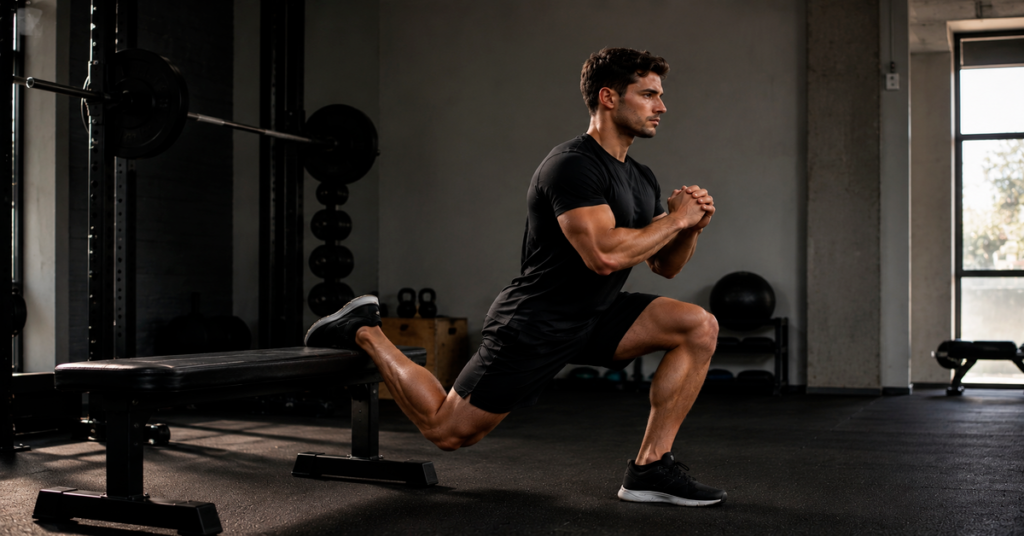
Traditional barbell squats place significant compressive load on the spine. For many people, that load accumulates into discomfort and injury over years of training. Bulgarian split squats train each leg independently with the spine relatively unloaded, and research shows they often produce equal or greater muscle activation in the quads and glutes compared to bilateral squats.
Stand roughly two feet in front of a bench and place the back foot on top of it. Lower the back knee toward the floor while keeping the front shin mostly vertical, then drive through the front heel to return to the starting position.
Start with bodyweight only. It is considerably harder than it looks, and the balance demand alone makes the first few sessions genuinely challenging. Once the movement pattern feels solid and reps become easier, add load progressively.
Aim for 3 sets of 8 to 10 reps per leg.
Exercise 6: Single Leg Romanian Deadlift- For Posterior Chain Strength and Injury Prevention
The posterior chain, meaning the hamstrings, glutes, and hip stabilisers, is the most chronically undertrained area in people who build muscle at home without structured guidance. These muscles are directly responsible for power output, postural alignment, and keeping the lower back and knees healthy over the long term. Neglecting them is one of the most common reasons people develop pain and injury as training volume increases.
Stand on one foot with a slight bend in the knee. Hinge at the hips and let the hands or a light weight travel down the standing leg while the free leg extends behind for counterbalance. Lower until a clear hamstring stretch is felt, then drive the hips forward to return.
If balance is a challenge at first, lightly hold a wall with one hand and reduce the contact gradually over time as stability improves.
Aim for 3 to 4 sets of 8 to 10 reps per leg.
Spartan Routine vs Gym Machines: What the Research Actually Shows
| Exercise | Muscle Targeted | Gym Equivalent | Key Advantage | Difficulty |
| Pull Up | Lats, upper back, biceps | Lat Pulldown | Full body stabilisation required | Intermediate |
| Inverted Row | Mid-back, traps, rear delts | Seated Cable Row | No spinal load, helps correct posture | Beginner |
| Dips | Triceps, chest, shoulders | Cable Pushdown | Equal or greater triceps activation | Intermediate |
| Feet Elevated Push Up | Upper chest, anterior delts | Incline Bench Press | Greater range of motion and more joint friendly | Beginner |
| Bulgarian Split Squat | Quads, glutes, hamstrings | Leg Press | Unilateral training with minimal spinal load | Intermediate |
| Single Leg RDL | Hamstrings, glutes, hip stabilisers | Leg Curl Machine | Builds balance and stabilisation simultaneously | Intermediate |
How to Structure This as a No Gym Workout Plan
- Train this routine 2 to 3 times per week, keeping at least one full rest day between sessions to allow proper recovery and muscle growth. During each workout, perform all 6 exercises in sequence as a complete full body circuit.
- Beginners should start with 2 total rounds and take around 60 seconds of rest between exercises. Intermediate and advanced trainees can increase the challenge by performing 3 to 5 rounds while reducing rest periods to 30 to 45 seconds.
- One of the biggest factors for muscle growth in bodyweight training is tempo control. Slow down the lowering phase of every repetition and take around 3 to 5 seconds during each eccentric movement. This increases time under tension and significantly improves the training stimulus without requiring extra equipment.
- Track your repetitions during every session. Once you can consistently complete 12 clean reps with full control across all sets, increase the difficulty. This can be done by adding a weighted vest, progressing to harder exercise variations, or shortening rest intervals.
- To build a more complete athletic physique, include one conditioning session each week featuring sprint intervals and timed burpees. Adding one longer endurance run weekly can further improve cardiovascular fitness, stamina, and overall work capacity.
- Stay consistent with the program for at least 6 months. That is typically the point where visible strength gains, muscle development, and long term physical transformation become clearly noticeable.
Train Hard, Train Smart, Train for the Long Run
Always warm up with 5 to 10 minutes of light jogging or dynamic movement before beginning the circuit. Cold muscles under load are the primary cause of preventable training injuries, and a proper warm up costs less than 10 minutes.
Never sacrifice form for extra reps. Every compensated rep reinforces a faulty movement pattern that compounds quietly into injury over months of training. One clean rep is worth five sloppy ones every single time.
Cool down with static stretching across all major muscle groups, holding each stretch for 20 to 30 seconds. This supports recovery, maintains the mobility needed for clean movement patterns, and makes the next session feel significantly better than skipping it would.
Conclusion
The spartan workout routine covered in this article is not a beginner shortcut or a travel day substitute. It is a structured, science-informed, joint-friendly approach to building real functional muscle that has centuries of real-world proof behind it and modern research supporting it.
Six months of consistent training using these six movements, with progressive overload and controlled tempo applied throughout, will produce visible and lasting muscle development that carries over into every area of physical life. No complicated machines. No unnecessary gimmicks. Just movement done well and done consistently.
For more science based workout routines, evidence backed muscle building strategies, and practical fitness guides focused on real world results, explore more training resources on Fitness Geekz. Those looking to complement this routine with added resistance will find the best dumbbell exercises for muscle mass a practical next step. And for anyone over 60 looking to apply these principles safely, the guide on strength exercises after 60 is worth reading before starting.
Frequently Asked Questions
Yes. Muscle growth depends on mechanical tension, progressive overload, and time under tension, all of which can be achieved with bodyweight training. Increasing difficulty through slower tempo, harder exercise variations, or added resistance keeps the muscles adapting and growing.
For most people, 2 to 3 sessions weekly is ideal. This provides enough stimulus for muscle growth while allowing proper recovery between workouts.
Functional training uses movements that improve strength, balance, coordination, and stability together. Exercises like pull ups and Bulgarian split squats train the body as a complete system rather than isolating muscles on machines.
Absolutely. Advanced bodyweight progressions, weighted variations, slower eccentric tempo, and training close to failure can create a highly demanding muscle building stimulus even for experienced athletes.
Most people notice better strength, posture, and endurance within 4 to 6 weeks. More visible muscle and physique changes usually become noticeable between 3 and 6 months with consistent training and progressive overload.