

Strength does not fade after 60. It waits to be called back. The real culprit is inactivity, not age, and the fix is simpler than most people think. Three targeted movements, done in just 10 minutes a day, are enough to rebuild balance, restore leg strength, and reactivate the muscles that make everyday life feel effortless again. No gym, no equipment, no complicated routine. Just three exercises that work together as a system to address exactly what breaks down fastest after 60. Start these today and the difference will show up in how you move, stand, and live.
Most people think strength fades after 60. That’s a lie.
Here’s the truth: adults lose roughly 3 to 5 percent of muscle mass per decade after 30, but research consistently shows that strength training reverses this process at any age. The muscles do not disappear. They go dormant. And with the right stimulus, they wake right back up.
The real problem is not age. It is inactivity. It is not knowing where to start. It is the assumption that a gym membership, heavy weights, or an hour of complicated exercise is required before anything changes.
None of that is true.
Three targeted moves, 10 minutes a day, done consistently, are enough to rebuild real functional strength after 60. No equipment. No gym. No complicated programming.
And the last exercise on this list? Most people underestimate it completely, until they feel what it actually does.
Want to see exactly how this exercise is done, step by step? Watch the full video here 👉Watch Now
Why Strength Training After 60 Is Non-Negotiable?

Before getting into the moves, it helps to understand what is actually happening inside the body after 60, because once you understand it, the motivation to act becomes very different.
The medical term is sarcopenia. It refers to the gradual loss of muscle mass and strength that comes with age, or more accurately, with reduced physical activity over time. It is not a death sentence. It is a wake-up call.
What makes sarcopenia genuinely dangerous is not just the weakness it creates. It is the instability that follows. Falls are the leading cause of injury-related death in adults over 65. And most falls do not happen because someone is dramatically weak. They happen because the body’s internal navigation system, called proprioception, starts to fade. Proprioception is your body’s ability to sense where it is in space, to adjust automatically when the ground shifts or a foot catches an edge. When that system weakens, a stumble on a slick floor becomes something far worse.
The good news is that low impact strength training directly addresses this. It rebuilds the muscles, restores stability, and retrains the nervous system to respond faster. These three exercises do exactly that.
The 3-Move Home Workout for Older Adults
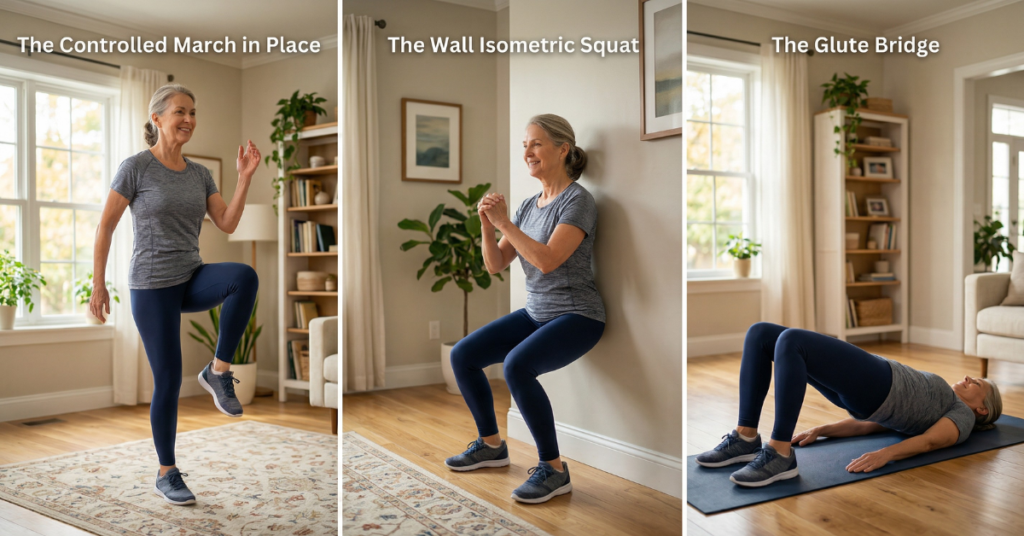
These three moves are not random selections. They work together as a system, targeting balance, leg strength, and the posterior chain, the three areas that break down fastest after 60 and matter most for everyday movement.
Exercise 1: The Controlled March in Place
How to do it: Stand tall with shoulders back and chest open. Lift one knee up to hip level. Pause for 3 to 5 seconds at the top. Lower with control. Switch sides. That is one rep. Aim for 8 to 10 repetitions per side for 2 to 3 sets.
Marching in place sounds almost too simple. It is not.
The pause is what makes this exercise. When the knee is held at hip level for several seconds, the hips, abdominals, lower back, and every stabilising muscle in the standing leg are forced to fire together simultaneously. There is no momentum to cheat with. No bounce. Just controlled, intentional effort.
This is exactly what happens in real life when the body needs to catch itself. A stumble on uneven pavement. A foot that catches a rug edge. A slippery step. The body has a fraction of a second to respond, and if those stabilisers have not been trained, the response is too slow.
Regular practice of the controlled march rebuilds proprioception, sharpens the nervous system’s response time, and restores the kind of quiet confidence that comes from knowing your body will catch you before you fall.
Within a few weeks, walking on uneven ground feels steadier. Navigating stairs feels more certain. That is not a small thing.
Exercise 2: The Wall Isometric Squat
How to do it: Stand with your back against a smooth wall. Walk your feet forward until your knees are at roughly a 90-degree angle, as if sitting in an invisible chair. Keep your back flat against the wall. Hold this position for 20 to 30 seconds. Rest and repeat for 2 to 3 holds.
At first glance, this looks passive. It is anything but.
Within seconds, the quadriceps, glutes, and core are all working hard to maintain that position. This is what isometric training does. It creates significant muscular effort without any joint movement, which makes it uniquely valuable for older adults who experience discomfort with traditional squats.
Here is the science behind why this matters specifically after 60. The body contains two main types of muscle fiber. Fast-twitch fibres handle explosive movements. Slow-twitch fibres, the endurance fibres, handle sustained effort, posture, and stability. These slow-twitch fibres are the ones responsible for keeping you upright during a long walk, holding your posture while standing in a queue, or giving you the stamina to climb a full flight of stairs without needing to stop.
They are also the fibres that weaken first with age and inactivity.
Isometric holds target these fibres directly. The trembling sensation most people feel after 15 to 20 seconds is not a warning sign. It is the sound of those fibres being recruited, challenged, and rebuilt.
Within a few weeks of consistent practice, standing from a chair becomes easier. Climbing stairs stops feeling like a task. Long walks stop ending in that heavy-legged fatigue. The wall squat also quietly retrains the alignment between the spine, pelvis, and legs so they work as a single coordinated unit rather than competing against each other.
Exercise 3: The Glute Bridge
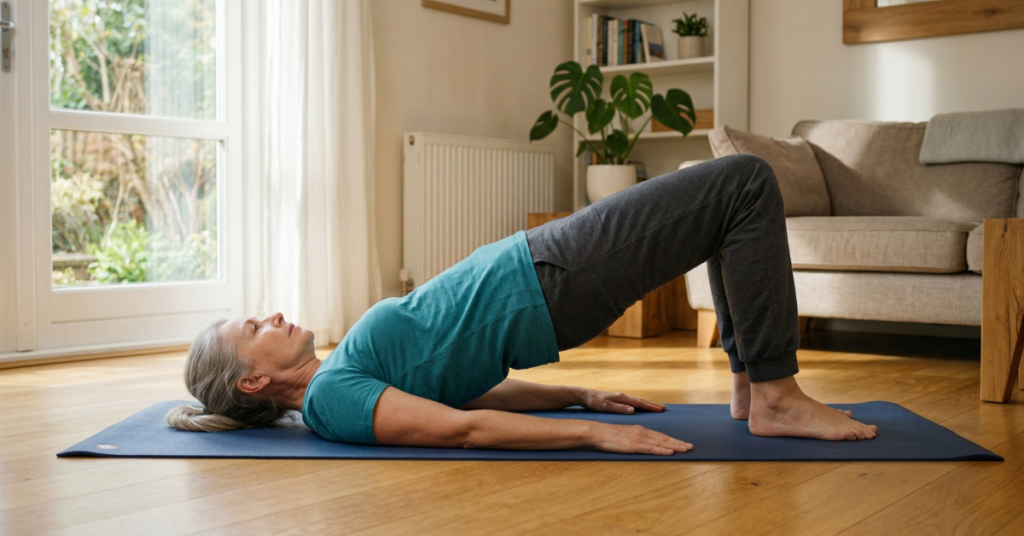
How to do it: Lie on your back with knees bent and feet planted flat on the floor, hip-width apart. Press firmly through both heels and lift the hips until the body forms a straight line from shoulders to knees. Pause at the top for 2 to 3 seconds. Lower slowly with control. Aim for 10 to 12 repetitions for 2 to 3 sets.
This is the move that surprises people the most.
It looks gentle. It feels manageable. And then, consistently over 3 to 4 weeks, things start to change. Lower back discomfort eases. Walking feels lighter. Getting up from a low chair or sofa stops requiring effort.
The glute bridge targets the posterior chain, a group of muscles running along the back of the body including the glutes, hamstrings, and lower back. This chain is responsible for nearly every meaningful movement, from standing and walking to climbing and lifting. It is also the first group of muscles to switch off when someone spends long hours sitting, which is exactly what makes it such a critical target for adults over 60.
Physical therapists routinely prescribe this exercise because consistent practice has been shown to reduce chronic lower back pain significantly. It also opens tight hips, improves circulation in the lower body, and strengthens the exact muscles that give each step its power and stability.
The pause at the top is not optional. That held contraction at full extension is where the real muscular work happens.
Your 30-Day Routine at a Glance
| Exercise | Sets and Reps | Target Area | Key Benefit | Level |
| Controlled March in Place | 2–3 sets, 8–10 reps per side (3–5 sec pause) | Hips, core, stabilisers | Restores balance and proprioception | Beginner |
| Wall Isometric Squat | 2–3 holds, 20–30 seconds | Quads, glutes, core | Builds leg strength without joint stress | Beginner to Intermediate |
| Glute Bridge | 2–3 sets, 10–12 reps | Glutes, hamstrings, lower back | Eases back pain, restores hip mobility | Beginner |
Do all three back to back. Rest 30 to 60 seconds between sets. Total time: around 10 minutes.
Staying Safe and Progressing Without Injury
Starting is the most important step. Staying injury-free is what keeps the progress going.
1. Warm Up Before Every Session Spend 2 to 3 minutes before each session with slow walking in place or gentle ankle circles. It primes the body and reduces injury risk significantly.
2. Set Up Your Space the Right Way Keep a sturdy chair or wall nearby during the march and squat until balance feels consistently solid. A little preparation goes a long way.
3. Know the Difference Between Good Pain and Bad Pain A dull muscle burn during the exercises is completely normal and expected. Sharp joint pain is not. If that happens, stop immediately and reassess before continuing.
4. Progress Gradually as the Body Adapts Once the moves start feeling manageable, here is how to level up:
- Extend the wall squat hold from 20 seconds to 40
- Add a light resistance band above the knees during the glute bridge
- Reduce rest time between sets week by week
5. Who Should Check With a Doctor First Anyone managing osteoporosis, recovering from recent surgery, or dealing with severe arthritis should get medical clearance before starting.
6. The Bottom Line For most healthy adults over 60, these exercises are safe, joint-friendly, and genuinely effective. Starting is the most important step. Staying injury-free is what keeps the progress going.
The Bottom Line
Strength does not disappear after 60. It simply waits to be called back.
The controlled march rebuilds the balance and stability the body needs to move with confidence. The wall squat reactivates the leg strength that makes everyday movement feel effortless. The glute bridge restores the posterior chain that powers every step, every climb, and every moment of upright living.
Three moves. Ten minutes. Thirty days.
Your best years of movement are not behind you. They are ahead.
Ready to Move Better, Feel Stronger, and Live Fully?
Join the Fitness Geekz community and get practical, no-fluff fitness guidance built for real people at every stage of life. Whether you are just starting out or leveling up, there is a place for you here.
Follow Fitness Geekz for weekly workouts, expert tips, and honest advice that actually works.
Because staying strong is not just a goal. It is a lifestyle.
FAQs
Absolutely. The research is clear on this. Older adults can build both strength and muscle mass at any age with consistent resistance or bodyweight training. The process may be slightly slower than in younger adults, but it is entirely real and measurable.
Twice a week is the minimum to see meaningful results. Three times weekly with at least one rest day between sessions is the sweet spot for muscle building after 60 without overloading the body’s recovery capacity.
All three are specifically designed to be low impact and joint-friendly. The wall squat avoids deep knee flexion. The glute bridge directly strengthens the muscles that support the lower back. The march builds stability without loading the spine. That said, anyone with acute injury should consult a physiotherapist before starting.
Most people notice improved steadiness and reduced fatigue within 2 to 3 weeks. Visible strength changes and improved muscle tone typically follow between weeks 4 and 8 with consistent training and adequate protein intake.
The controlled march in place is one of the most effective tools available. It directly retrains proprioception and strengthens the stabiliser muscles that protect against slips and stumbles during everyday movement. Consistency with this exercise builds the kind of automatic balance response that catches you before a stumble becomes a fall.