
What if you could seriously transform your body right from home in just three weeks? No gym, no fancy equipment, just pure bodyweight power. With the right approach, you can build strength, improve mobility, and actually see visible muscle growth using nothing more than your own body and consistent effort.
Research shows that bodyweight exercises, when programmed correctly, can activate major muscle groups, enhance muscular endurance, and improve overall mobility in surprisingly short periods. The key is progressive overload, gradually increasing the challenge so your muscles adapt and grow.
This 3 week home workout plan is designed to leverage that principle. By combining full-body circuits, targeted muscle activation, and smart recovery strategies, it helps you build muscle at home effectively without any equipment. Each session focuses on functional strength, balance, and conditioning to ensure that every repetition counts toward your transformation.
Whether you’re short on time, space, or access to a gym, this no equipment workout gives you a practical, results-driven path to improve your physique and overall fitness from the comfort of your home.
Why Bodyweight Training Works
Bodyweight training is often underestimated, but it’s a powerhouse for building strength, muscle, and functional fitness. When you perform exercises with proper form and controlled tempo, you achieve time under tension, a critical factor for muscle growth. Progressive overload doesn’t have to mean heavier weights, you can increase repetitions, extend hold times, slow down the eccentric phase, or add challenging variations.
Beyond muscle, bodyweight workouts enhance core stability, joint health, and overall mobility. Movements like push-ups, squats, lunges, and plank variations recruit multiple muscles at once, making every rep count. And the best part? These exercises are completely scalable and can be performed anywhere, with minimal equipment, or none at all. This plan is your bodyweight transformation program.
Watch this workout demonstration in the video below:
Weekly Training Schedule
Consistency and recovery are key. Here’s a simple schedule to follow for optimal results:
| Day | Workout Focus | Details |
| Mon / Wed / Fri | Full-Body Circuit | 3 rounds of 7 exercises, 30 sec rest between moves, 2–3 min between rounds |
| Tue / Thu / Sat | Active Recovery | Walking, yoga, or mobility drills |
| Sun | Rest | Full recovery for muscle repair |
If you want a slightly higher frequency, you can also follow a 4 day home workout split, two full-body strength days and two cardio/mobility days. Recovery ensures your muscles grow, not just fatigue.
The 7 Essential Exercises
This bodyweight transformation program combines strength, stability, and explosive movement to maximize muscle growth at home. Perform three rounds, resting 30 seconds between exercises and 2–3 minutes between rounds.
- Superman Hold – Posterior chain, glutes, lower back
Lie flat on your stomach, extend arms and legs, and lift them off the floor. Hold for 30–60 seconds, squeezing glutes and hamstrings as if cracking a walnut. - Chair Dips – Triceps, shoulders, chest
Sit on a sturdy chair edge, slide hips off, and lower until elbows reach 90°. Press back up, keeping shoulders down and movement controlled. - Push-Ups – Chest, shoulders, triceps, core
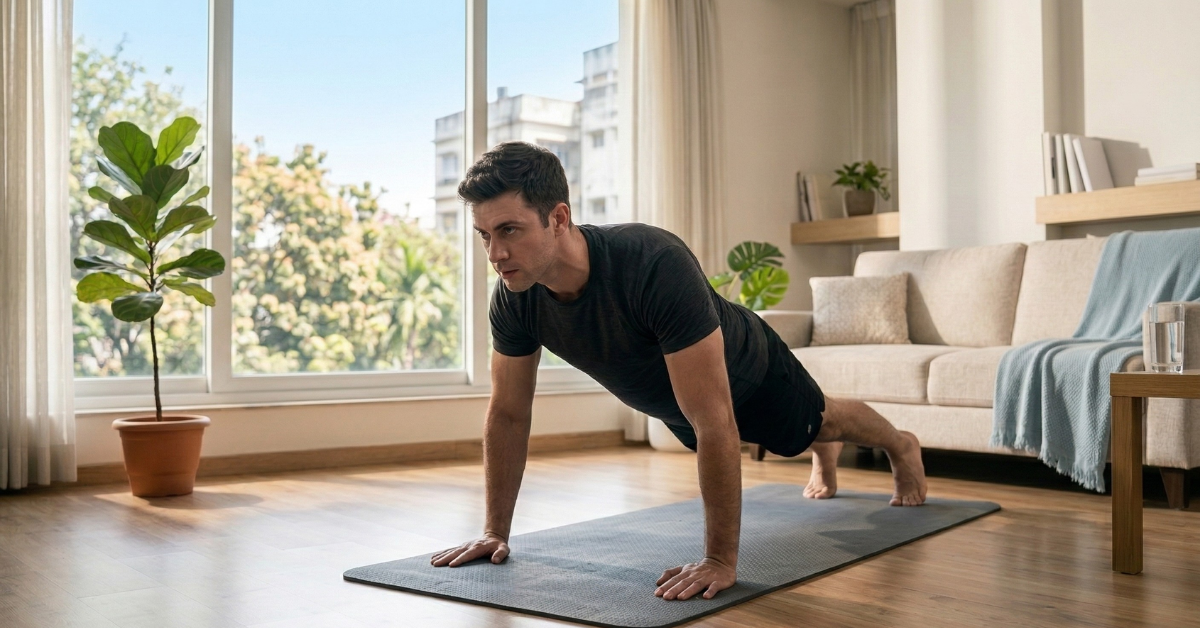
Hands shoulder-width apart, body straight from head to heels. Lower chest toward the floor, then press up without locking elbows. Modify with knee or incline push-ups if needed. - Squats – Quads, glutes, hamstrings
Feet shoulder-width apart, chest tall. Sit back like hovering over a chair, thighs parallel or deeper, then push through heels to rise. - Mountain Climbers – Core, cardiovascular system
Start in high plank, wrists under shoulders. Drive knees toward chest alternately and quickly, keeping hips low and core tight. - Lunges – Quads, glutes, core stability
Step forward, lower until both knees are at 90°, then push back through the front heel. Alternate legs. - Floor Towel Pull-Ups – Upper back, lats, biceps
Lie on your stomach holding a towel with arms extended. Pull the towel toward your chest, squeezing shoulder blades together. Move in a controlled, deliberate manner.
Progressive Overload & 3-Week Plan
Muscle growth depends on challenging your body progressively. Here’s how to scale this plan over three weeks:
| Week | Reps / Hold Times |
| Week 1 | Base reps/hold times (e.g., push-ups 12 reps, squats 20 reps) |
| Week 2 | +3–5 reps or +10–15 sec holds |
| Week 3 | Max reps/hold times with perfect form |
Tips for maximum adaptation:
- Controlled Eccentrics: Lower yourself slowly (3 sec) during push-ups, squats, and dips.
- Form First: Proper posture reduces injury risk and targets muscles effectively.
- Track Progress: Keep a notebook or app to record reps and hold times.
Nutrition & Recovery
Muscle growth happens outside the workout, so proper nutrition and recovery are just as important as training.
- Protein: Lean sources like eggs, beans, and poultry support muscle repair and growth.
- Sleep: Aim for 7–9 hours per night to optimize hormone balance and recovery.
- Hydration: Staying well-hydrated maintains performance, energy, and muscle function.
- Stretching & Mobility: Regular stretching prevents tightness, improves flexibility, and supports joint health.
Focusing on these habits ensures your home strength training routine delivers the best results and helps you maximize gains from your 3-week program.
Safety & Injury Prevention
Even with bodyweight exercises, proper form is essential to prevent injury and maximize results:
- Knee Alignment: Keep knees tracking over toes during squats and lunges.
- Joint Protection: Avoid wrist or shoulder strain during push-ups and chair dips by maintaining proper alignment.
- Controlled Movements: Focus on slow, deliberate reps rather than rushing through sets.
- Exercise Modifications: Adjust or skip movements if you have existing injuries or mobility limitations to stay safe while training.
Following these guidelines ensures your 3-week home workout plan is effective, sustainable, and injury-free.
Tracking Progress & Motivation
Keep your home strength training routine effective by monitoring progress:
- Record Performance: Track reps, hold times, and completed rounds each week.
- Visual Feedback: Take progress photos or body measurements to see tangible results.
- Celebrate Small Wins: Recognize improvements, no matter how minor, consistency always beats perfection.
Regular tracking keeps you motivated and ensures your bodyweight transformation program delivers real, measurable results.
Conclusion
This 3-week home workout plan proves that you don’t need a gym to build real muscle. By following a structured routine, focusing on progressive overload, and prioritizing proper recovery, you can strengthen your entire body, improve posture, and boost overall conditioning, all from the comfort of home. Each session is designed to challenge major muscle groups, improve functional movement, and enhance endurance without any equipment. Tracking your reps, rounds, and progress photos ensures you stay motivated and see tangible results. Commit to the full three weeks, stay consistent, and embrace the process, and you’ll be amazed at how effective no equipment workouts can be.
Your body will thank you.
Transform your body at home in just three weeks. Follow the plan, stay consistent, and see real results. Explore more expert home workouts and fitness tips at Fitness Geekz and start your transformation today.
FAQs
1. Can I really build muscle without weights?
Yes. Bodyweight exercises can stimulate hypertrophy when programmed with progressive overload and proper form.
2. How often should I do this 3-week home workout plan?
Three times a week is ideal. Include active recovery days to promote muscle growth and prevent overuse injuries.
3. What if an exercise feels too difficult?
Modify to a simpler version: knee push-ups, assisted lunges, or shorter holds. Focus on perfect form first.
4. Can I combine this routine with cardio for fat loss?
Absolutely. Light cardio, walking, or HIIT on recovery days complements this plan and supports fat loss.
5. How do I know if I’m making progress without a gym?
Track reps, hold times, and rounds. Visual progress photos or measurements of arms, legs, and waist are great indicators.