
Quick Answer: Functional strength training builds movement patterns the body actually uses in daily life and sport, rather than isolating single muscles. It develops grip, core stability, hip power, and joint resilience together, creating strength that holds up under fatigue, awkward positions, and long-term use.
- Functional strength training trains movement patterns (squatting, hinging, carrying, crawling) rather than isolated muscles
- Multi-joint, integrated training tends to translate more directly into daily tasks and athletic performance than isolation work
- Core stabilizers, grip strength, and neck strength are commonly under-trained in traditional gym routines
- Isometric holds, like wall sits, build joint-friendly endurance with less compressive stress than dynamic lifting
- A basic functional routine can be built from bodyweight movements alone, no machines required
Introduction
Most gym-built muscle fades within weeks of stopping training. Muscle built through integrated, real-world movement tends to stick around far longer. The difference isn’t genetics or luck, it’s what the muscle was actually trained to do. A body trained only in isolation knows how to perform a single, predictable motion. A body trained through integrated movement knows how to hold up under pressure, fatigue, and awkward positions it’s never rehearsed.
That distinction is the entire premise behind functional strength training. Rather than working one muscle at a time in a fixed plane of motion, functional training conditions the body to coordinate multiple muscle groups at once, the way daily life and sport actually demand. This guide breaks down what functional strength training really means, six exercises that target commonly neglected areas like the neck, grip, and deep core, and how to build them into a realistic weekly routine.
Want to see this exercise in action? Click here to watch the full demo:
What Is Functional Strength Training?
Functional strength training builds strength through movement patterns that mimic real-world demands, carrying, bracing, crawling, changing position, rather than isolating a single muscle the way traditional machine-based lifting often does. It’s less concerned with how a muscle looks and more concerned with how the whole body performs under load.
This isn’t a case against isolation training, which still has real value for targeted muscle growth, aesthetics, and certain rehab protocols. The distinction is about goal and application: isolation trains a muscle to do one thing well, while functional training conditions several muscle groups to work together, which tends to matter more once a person steps outside the gym.
Why Functional Strength Lasts Longer Than Isolated Muscle
Functional training conditions multiple muscle groups to coordinate together under load, and that coordination, not just the muscle tissue itself, is what tends to be retained longer than strength built through isolated, single-joint movements alone. This isn’t a claim that isolation work has no place; it simply explains why movement-based strength tends to hold up better once consistent training stops.
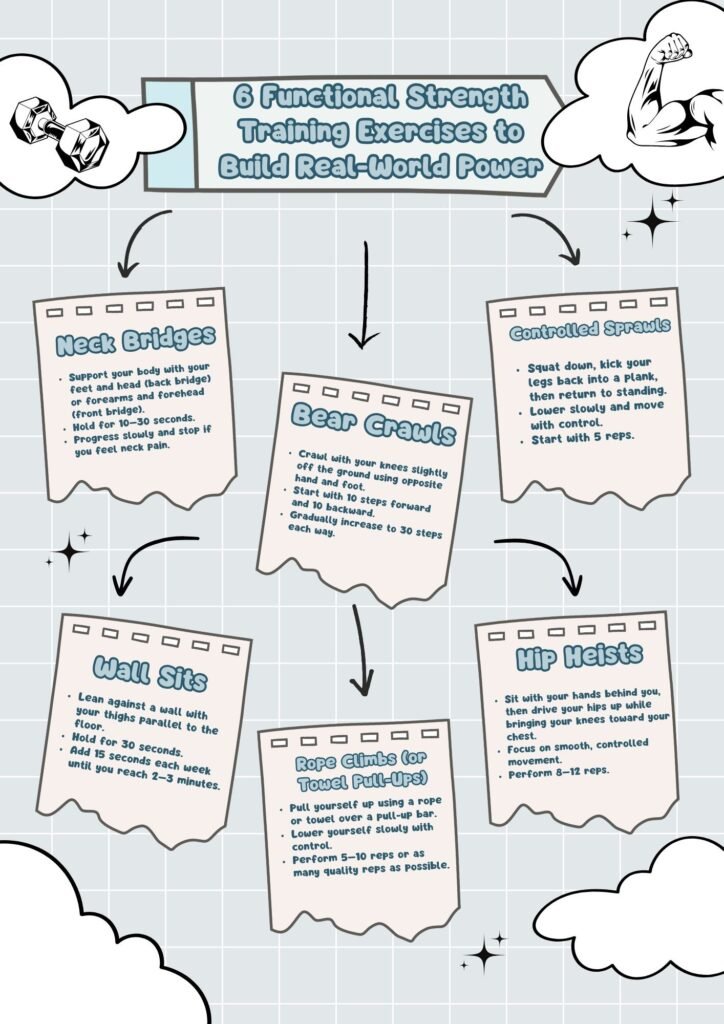
6 Functional Strength Training Exercises to Build Real-World Power
The six exercises below target areas that most conventional gym routines quietly skip, the neck, grip, deep core, and stabilizing muscles that rarely get direct attention but matter enormously for long-term durability.
1. Neck Bridges: Building an Injury-Resistant Neck
A weak, undertrained neck contributes to poor posture, tension headaches, and a higher risk of injury during everyday movement, yet it’s one of the most commonly ignored areas in strength training.
- Back bridge: lie on the back with feet flat, place the crown of the head lightly on the floor, lift the hips, and distribute weight between the feet and head.
- Front bridge: start in a plank, lower the forehead gently to the floor, and keep most of the weight on the forearms.
Start with 10-second holds and build toward 30 seconds before progressing further, neck muscles adapt slowly, and rushing this movement is a real way to get hurt rather than stronger. Beyond the neck itself, this movement recruits the glutes, hamstrings, and spinal muscles simultaneously, making it full-body tension disguised as isolated neck work.
A caution worth taking seriously: neck bridges carry genuine injury risk if progressed too quickly or performed with poor control. Anyone with existing neck or spine concerns should check with a healthcare professional before attempting them, and everyone else should treat slow, conservative progression as non-negotiable.
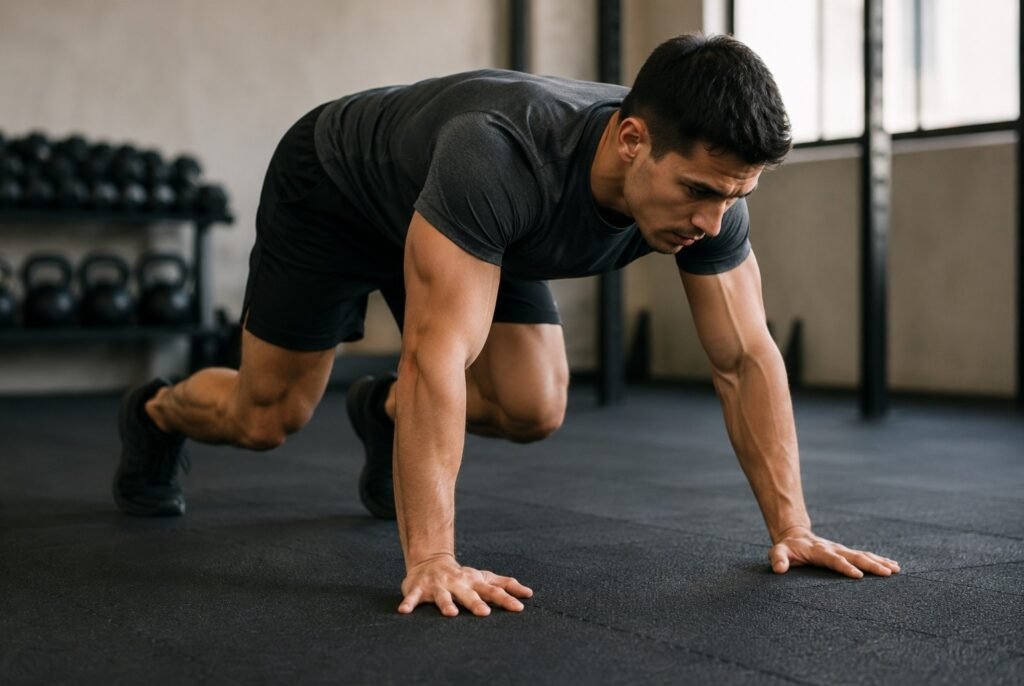
2. Bear Crawls: Total-Body Integration and Core Stability
Where a deadlift loads the spine vertically, a bear crawl distributes force across the entire body at once. Place the hands under the shoulders and knees under the hips, lift the knees about two inches off the ground, and crawl slowly using opposite hand and foot.
The most common mistake is rushing the movement, which turns it into a cardio drill and strips away most of the strength benefit. Start with 10 steps forward and 10 steps backward, gradually building toward 30 steps in each direction. Because the core has to stabilize the body while it’s actively moving, not just holding a fixed position like in a plank, bear crawls tend to challenge the midsection harder than most people expect. For readers without access to a gym, this movement fits naturally into a three-week home workout plan built without equipment.
3. Controlled Sprawls: Explosive Hip Power
Looking strong and being strong aren’t the same thing, and sprawls expose that gap by training explosive hip power under unstable conditions. Start standing, drop into a squat, kick the legs back into a plank position, lower under control for a three-second count, then explode back to standing.
Begin with five clean, well-controlled reps rather than rushing volume. The glutes and hamstrings work together through the movement while the core prevents the lower back from collapsing under the transition. Progress by increasing range of motion, slowing the eccentric lowering phase, or adding brief pauses at the bottom before exploding back up.
4. Wall Sits: Joint-Friendly Isometric Leg Strength
Dynamic squatting compresses the spine and knees repeatedly with every rep, which isn’t a problem for most people but can be a real limitation for those managing joint sensitivity. Wall sits build comparable lower-body endurance with significantly less compressive stress, making them a smart substitute or complement.
Place the back flat against a wall, lower until the thighs are parallel to the floor, and keep the knees stacked directly over the ankles, no bouncing, no cheating the depth. Start with a 30-second hold and add 15 seconds each week until reaching 2 to 3 minutes. This kind of isometric strength, the ability to hold a position under fatigue rather than move through one, is exactly the training gap covered in this isometric workout guide for beginners, along with a deeper look at the broader benefits of isometric training for anyone wanting to understand why holding still can build real strength.
5. Rope Climbs (or Towel Pull-Ups): Real-World Grip Strength
Machines isolate; rope climbs integrate. Without access to an actual rope, draping a towel over a pull-up bar and gripping both ends recreates the same core stimulus. Pull up using the towel, then lower slowly and under control.
Unlike a standard pull-up, this movement forces the grip to continuously adjust and rotate as the body shifts position, building the kind of forearm and hand endurance that holds up under real fatigue, not just for a few controlled reps in a gym. Progress by climbing higher, slowing the descent, or adding brief pauses along the way. Grip strength shows up constantly in daily life, from carrying groceries to hauling luggage, which is the same logic behind why the farmer’s walk builds full-body strength and grip endurance so effectively.
6. Hip Heists: Explosive Core Power and Hip Mobility
Long hours of sitting tighten the hips and quietly weaken the glutes over time. Hip heists work against that pattern directly. Sit with the legs extended and hands planted behind the body, then explosively drive the hips upward while bringing the knees toward the chest, landing softly.
Start small, gradually building height and speed as control improves. What makes this movement valuable long-term is that the core isn’t just resisting motion here, it’s actively coordinating it, which is a very different and often under-trained skill. That kind of floor-to-standing strength becomes increasingly relevant with age, when the ability to get up off the ground easily starts to matter far more than it did at 25.
Functional Strength Exercises Compared
| Exercise | Primary Area Trained | Equipment Needed | Best For |
| Neck Bridges | Neck, posterior chain | None | Posture, neck injury resilience |
| Bear Crawls | Core, shoulders, grip | None | Total-body coordination |
| Controlled Sprawls | Hips, glutes, core | None | Explosive power |
| Wall Sits | Quads, glutes | Wall | Joint-friendly leg endurance |
| Rope Climbs / Towel Pull-Ups | Grip, forearms, lats | Rope or towel + pull-up bar | Real-world grip strength |
| Hip Heists | Core, hip mobility | None | Explosive core power, floor-to-stand strength |
How to Program Functional Strength Training Into a Weekly Routine
Building these six movements into a routine works best as a gradual process rather than attempting all of them at once:
- Avoid performing all six exercises in a single session, especially early on
- Start Week 1 with a smaller subset, neck bridges, bear crawls, and wall sits work well together, trained three times per week with at least one rest day between sessions
- Progress static holds (neck bridges, wall sits) by adding roughly 10 seconds per week
- Progress dynamic movements (bear crawls, sprawls, hip heists) by adding two reps at a time
- Prioritize control and clean form before increasing intensity, hold time, or load
- Introduce the remaining exercises, sprawls, rope climbs, hip heists, in later weeks as movement quality improves
Moving Forward With Functional Strength

Muscle built in isolation often fades once training stops, simply because it was never taught to work with anything else. Strength built through integrated, real-world movement tends to last, because it’s built through coordination, tension, and control rather than one muscle working alone in a fixed pattern.
The next step is straightforward: pick three of the six exercises above, follow the progression guidance, and build from there rather than trying to do everything at once. For a complete, structured way to apply these principles at home, explore more equipment-free training resources on Fitness Geekz and start building strength that’s designed to hold up.
FAQs
Functional strength training builds strength through movement patterns that mirror real-world demands, like carrying, bracing, and changing position, rather than isolating one muscle at a time the way many traditional gym exercises do.
Neither approach is universally better. Functional training tends to build strength and coordination that carries over more directly into daily activities and sports, while traditional isolation lifting can be more effective for targeting specific muscles, so many well-rounded programs use both.
Yes, most functional strength exercises, including bear crawls, wall sits, sprawls, and hip heists, require no equipment at all, and even grip-focused movements like rope climbs can be replicated with a towel and a pull-up bar.
A common and sustainable approach is three sessions per week with at least one rest day between them, gradually adding exercises and increasing hold times or reps as movement quality improves.
Most are beginner-friendly when introduced gradually and performed with strict control, though movements like neck bridges carry real injury risk if rushed and should be progressed slowly, with anyone experiencing existing neck or spine issues consulting a professional first.