


Quick Answer: Boost energy and mobility with this 10-minute morning routine: Cat-Cow Stretch (8–10 breaths) wakes the spine, Bodyweight Squats (10–15 reps) increase circulation, Plank (20–60 sec) builds core stability, Glute Bridge (10–15 reps) activates the posterior chain, and Forward Fold (20–30 sec) releases hamstrings while calming the nervous system. This sequence improves oxygen delivery to the brain, restores overnight joint stiffness, and regulates cortisol more effectively than caffeine, creating steady energy that lasts through the day instead of spiking and crashing.

Most people wake up reaching for coffee before their feet hit the floor. The body has been still for seven or eight hours. Joints are compressed, muscles are shortened, and the nervous system is still in full rest mode. Another cup of caffeine masks that. Five minutes of deliberate movement actually fixes it.
A morning workout routine does not need to be long or intense to work. Five targeted exercises done back to back take less than ten minutes and deliver real, measurable results: better strength, improved flexibility, corrected posture, and steady energy that lasts through the afternoon instead of crashing before lunch.
Light morning movement increases oxygen delivery to the brain and muscles within minutes. It restores joint mobility that stiffens overnight, regulates cortisol more effectively than intense early training, and creates energy that builds gradually rather than spiking and dropping. Short daily routines performed consistently outperform longer sessions done irregularly every single time.
Here is exactly what to do, why each movement belongs in the sequence, and how to progress when it starts feeling easy.
Ready to master this move? Watch the full step-by-step demonstration here:
Why a Morning Workout Routine Actually Boosts Energy
Morning exercise works because it interrupts grogginess at the source rather than covering it up.
Light movement slightly elevates the heart rate, improving oxygen delivery to the brain and muscles, and this alone reduces mental fog and sharpens focus within minutes. Movement also shifts the nervous system from sleep-dominant rest mode into alert, engaged readiness without triggering the stress response that intense early training creates. That distinction matters enormously. Overly hard morning workouts leave the body depleted before the day has started. Controlled movement creates readiness, not fatigue.
Stretching and mobility work rehydrate connective tissue that stiffens overnight. Restoring that tissue quality removes background tension that quietly drains energy as the day progresses. Coordination-based movements activate both hemispheres of the brain, reducing the foggy, slow feeling many people carry through the first hour of the morning.
The goal is to wake the body up gradually so energy builds naturally and lasts longer. Everything in this routine is designed around that principle.
The 5 Morning Exercises That Build Strength, Mobility, and Energy Every Day
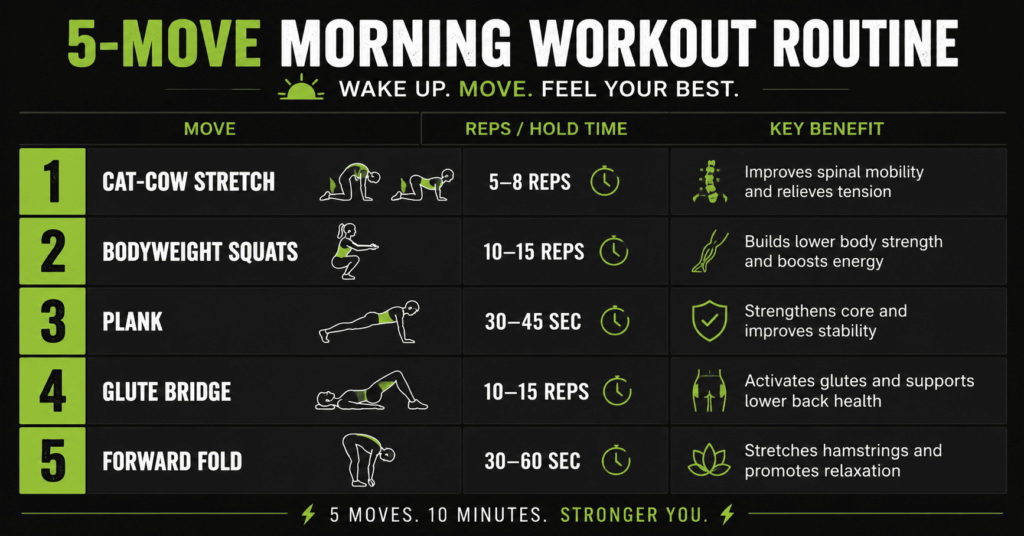
Exercise 1: Cat-Cow Stretch: Wake Up the Spine First
Get on all fours with wrists under shoulders and knees under hips. Inhale and arch the back, lifting the head and tailbone into Cow position. Exhale and round the spine, tucking the chin and pelvis into Cat position. Repeat for 8 to 10 controlled breaths.
The spine has been compressed and still for hours. Cat-Cow is the most effective low-load way to restore mobility before any weight-bearing movement begins. Alternating between spinal flexion and extension lubricates the discs, reduces morning back tension, and improves posture alignment for everything that follows. Pairing breath with movement initiates the body’s natural transition from rest to readiness. This goes first for a reason, it sets the foundation for every other exercise in the sequence.
Exercise 2: Bodyweight Squats: Activate the Lower Body and Boost Circulation
Stand with feet shoulder-width apart. Push the hips back as if sitting into a chair. Lower until thighs are parallel to the floor. Push through the heels to return to standing. Perform 10 to 15 reps. To progress, add a jump at the top or hold a weight.
The legs are the body’s largest muscle group. Engaging them early in the morning drives a significant increase in circulation and core temperature. Even one to two minutes of squats noticeably increases alertness by delivering oxygenated blood to the brain. Squats also mirror fundamental daily movements, standing from a chair, climbing stairs, picking things up off the floor, making this the most functionally transferable exercise in any morning routine. Builds lower-body strength and boosts metabolism simultaneously. Developing a deeper, more controlled squat position also has significant long-term benefits, and understanding the Asian squat and what it does for hip mobility and lower body mechanics is worth exploring as a natural progression from this movement.
Exercise 3: Plank: Build the Core Stability That Protects Everything Else
Place elbows directly under shoulders. Keep the body in a straight line from head to heels. Engage the core and glutes and avoid letting the hips sag or arch. Hold for 20 to 30 seconds and work progressively toward one minute.
The plank is not just an abdominal exercise. It works the shoulders, back, glutes, and deep spinal stabilizers simultaneously. The isometric core strength built through consistent planking directly improves posture, reduces lower back pain, and supports safe movement patterns throughout the day. Placed after squats, the plank capitalizes on elevated circulation from the previous movement. No single equipment-free exercise delivers more full-body stability benefit per second of effort. Planks also feature prominently alongside wall sits and the horse stance in anti-aging exercises that support long-term strength and joint health, making them one of the most valuable movements to keep in any daily routine.
Exercise 4: Glute Bridge: Activate the Posterior Chain and Relieve Hip Tightness
Lie on the back with knees bent and feet flat on the floor. Press through the heels and lift the hips. Squeeze the glutes firmly at the top. Lower back down slowly and with control. Perform 10 to 15 reps. Progress with a single-leg variation or place a light weight across the hips.
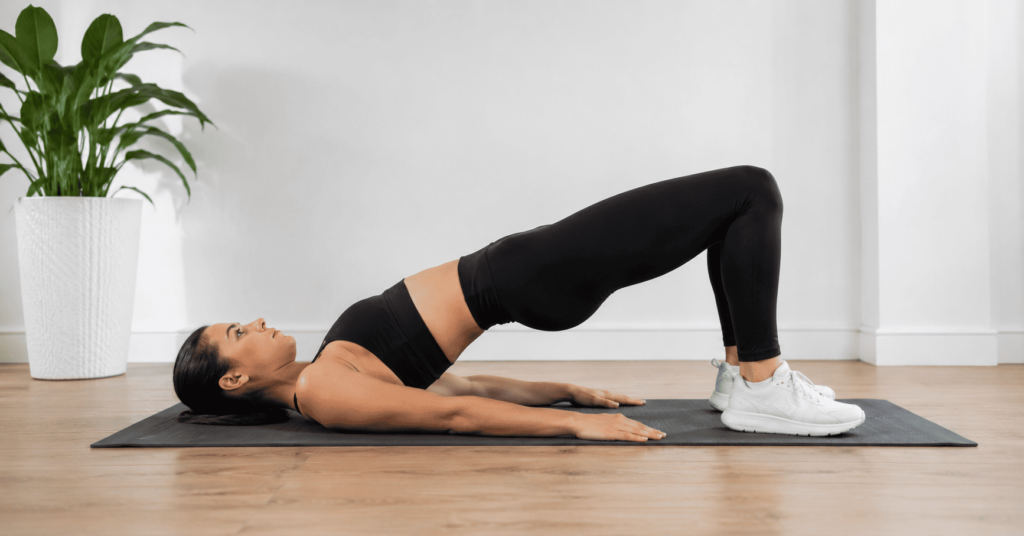
The glutes are the most powerful muscles in the body and among the most underused in sedentary daily life. Prolonged sitting essentially switches them off, which creates tight hips and places excess strain on the lower back. Glute bridges directly counter this by activating the entire posterior chain, glutes, hamstrings, and lower back stabilizers together. Relieving hip tightness through this movement improves posture alignment and reduces the lower back tension that builds throughout a long workday. The floor position also provides a natural recovery moment before the final movement.
Exercise 5: Forward Fold: Release the Hamstrings and Reset the Nervous System
Stand tall, then hinge at the hips and fold forward. Let the hands reach toward the floor and relax the neck completely. Keep a slight bend in the knees if needed. Hold for 20 to 30 seconds while breathing deeply.
After four activation and strength movements, the forward fold is the deliberate signal to the nervous system that the session is complete. It targets the hamstrings and lower back simultaneously, the two areas most shortened by overnight rest and sedentary posture. Deep breathing during the hold expands lung capacity, lowers cortisol, and shifts the mind into calm, focused readiness for the day. This movement ends the routine in exactly the right physiological state: body activated, tension released, energy steady and building.
Morning Workout Routine at a Glance
| Exercise | Primary Target | Reps or Hold | Key Benefit | How to Progress |
| Cat-Cow Stretch | Spine, back, breathing muscles | 8 to 10 breaths | Restores spinal mobility and helps reduce morning stiffness | Add a gentle lateral neck stretch between repetitions |
| Bodyweight Squats | Quadriceps, glutes, hips, core | 10 to 15 reps | Increases circulation and builds functional lower-body strength | Progress to jump squats or hold a dumbbell/kettlebell |
| Plank | Core, shoulders, glutes, back | 20 to 60 second hold | Improves full-body stability, posture, and core endurance | Increase hold time or advance to side planks |
| Glute Bridge | Glutes, hamstrings, lower back | 10 to 15 reps | Activates the posterior chain and helps relieve hip tightness | Perform single-leg bridges or add resistance across the hips |
| Forward Fold | Hamstrings, lower back, calves | 20 to 30 second hold | Releases overnight muscle tension and promotes relaxation | Incorporate a slow neck release or additional calf stretch |
How to Make This Morning Routine Actually Stick
- Keep it simple. The best morning routine is the one you can repeat consistently. Overcomplicating the process often leads to missed days.
- Attach it to an existing habit. Perform the routine immediately after waking up, before your first coffee, or right after brushing your teeth to make it easier to remember.
- Scale down instead of skipping. On low-energy mornings, complete just three movements rather than abandoning the routine altogether. Consistency matters more than perfection.
- Focus on maintaining the habit chain. Partial completion helps preserve momentum and makes it easier to stay on track long term.
- Monitor how your body responds. Pay attention to changes in stiffness, energy levels, mobility, and posture during the first week.
- Use early results as motivation. Feeling better physically is often the strongest reason to continue the routine.
- Progress gradually after 2 to 3 weeks. Once the routine feels automatic, increase the challenge with:
- Longer plank holds
- Jump squats
- Single-leg glute bridges
- Push-up variations for upper-body strength
- Adjust intensity to match your readiness. Some mornings call for more effort, while others may require a lighter approach.
- Prioritize recovery when needed. On difficult mornings, gentle mobility work is often more beneficial than intense exercise.
- Think long term. The goal is to support daily movement, energy, and health—not to turn every morning into a workout challenge.
Five Minutes of Intention Can Change How the Whole Day Feels
Strength, flexibility, posture improvement, and sustained energy do not require a gym or an hour of training. Five deliberate movements performed consistently every morning accumulate into real physical change, in how the body feels, how it moves, and how well it holds up through a full day of work, movement, and everything in between.
The only requirement is showing up for the first five minutes. The body takes care of the rest. For anyone ready to take the next step beyond a daily morning routine, the three-week home workout plan to build muscle without equipment provides a structured progression that builds directly on the same foundation.
Explore Fitness Geekz for expert fitness insights, workout guidance, and practical strategies that fit real life.
Frequently Asked Questions About Morning Workout Routines
For beginners, the most effective morning routine combines gentle spinal mobility, lower-body activation, and controlled stretching without equipment. The five-exercise sequence above covers all of these in under ten minutes. Start with the recommended rep ranges, focus on proper form, and progress only when the movements feel consistently easy.
Five to fifteen minutes is usually enough. Short, controlled movement often sustains energy better throughout the day than longer, exhausting sessions. Consistency matters more than duration. A five-minute routine performed daily is often more effective than a longer workout done only occasionally.
For short, low-to-moderate intensity routines, eating beforehand is generally unnecessary. The body typically has enough stored energy for a ten to fifteen minute session. Drinking water before starting and eating a balanced meal afterward can help support recovery and maintain energy levels.
A short morning routine is designed to complement regular training rather than replace it. Its primary purpose is to improve mobility, reduce stiffness, and increase daily energy. With added resistance and progression, it can become a more complete workout, but consistency and movement quality remain the priority.
Morning exercise helps increase circulation, loosen stiff joints, and activate the nervous system as the body transitions out of sleep. This combination often creates a noticeable boost in alertness and energy that can carry through the rest of the day.