


Here is the biggest lie in fitness. That building a stronger, more resilient body requires constant movement, dripping sweat, and hours logged at the gym. Research from the Journal of Strength and Conditioning Research tells a very different story. Isometric training produces similar strength and power gains to explosive plyometric training with significantly lower impact forces and a fraction of the injury risk.
The fitness world has quietly known about isometric training for decades. Physical therapists use it for rehabilitation. Elite athletes use it for pre-exhaustion and deloading. Yet most beginners have never been properly introduced to it, and that is a genuine gap worth closing.
What makes isometric training so effective is the science behind staying still. When a muscle holds tension without moving, it recruits a higher proportion of muscle fibres simultaneously than most dynamic exercises can match. That sustained neural recruitment drives strength, stability, and postural improvement from the inside out, targeting the deep stabilising muscles that conventional training consistently misses.
This guide walks through six powerful isometric exercises that rebuild strength and stability without a single step, jump, or piece of equipment. Each movement is chosen for a specific reason, and together they form a complete low impact workout routine that anyone can start today, regardless of fitness level or starting point.
Take your workout form to the next level. Watch the full exercise demo here: Watch Now
What Makes Isometric Training So Effective for Beginners?
Most people understand that muscles need to be challenged to grow stronger. What most people miss is that the challenge does not have to involve movement at all. An isometric exercise is a static muscle contraction where the muscle generates force without changing length and the joint stays completely still. Unlike a squat or a push up where the muscle shortens and lengthens through a range of motion, isometric training holds a fixed position and sustains tension throughout the entire duration of the hold.
That sustained tension triggers something called high neural recruitment, where the brain and spinal cord engage a greater proportion of muscle fibres to maintain the contraction. Over time this builds genuine muscular endurance and functional strength, the kind that supports carrying groceries, maintaining posture at a desk, climbing stairs without fatigue, and moving through daily life without pain.
A separate research review confirmed substantial improvements in muscular hypertrophy and maximal force production from isometric training regardless of training intensity. That means the stimulus works whether the effort feels moderate or intense, which is particularly valuable for beginners who are still learning how to train with intention.
One thing worth being honest about upfront: isometric training is not the fastest route to building muscle mass. Dynamic resistance training remains more effective for pure hypertrophy. Where isometrics genuinely excel is in building muscular endurance, joint stability, postural correction, and providing a safe and accessible entry point into beginner strength training for anyone returning to fitness, managing joint pain, or starting completely from scratch.
There is also a motivational advantage that does not get talked about enough. Progress is immediately measurable. Hold duration increases week by week, which gives beginners a clear and visible marker of improvement in a way that rep counting often fails to deliver in the early stages of training.
The 6 Isometric Exercises That Rebuild Strength From the Inside Out
These six movements address the specific weaknesses that a sedentary lifestyle creates. Together they cover the full body, correct postural collapse, reactivate muscles that sitting has switched off, and build the foundational stability that makes every other form of exercise safer and more effective.
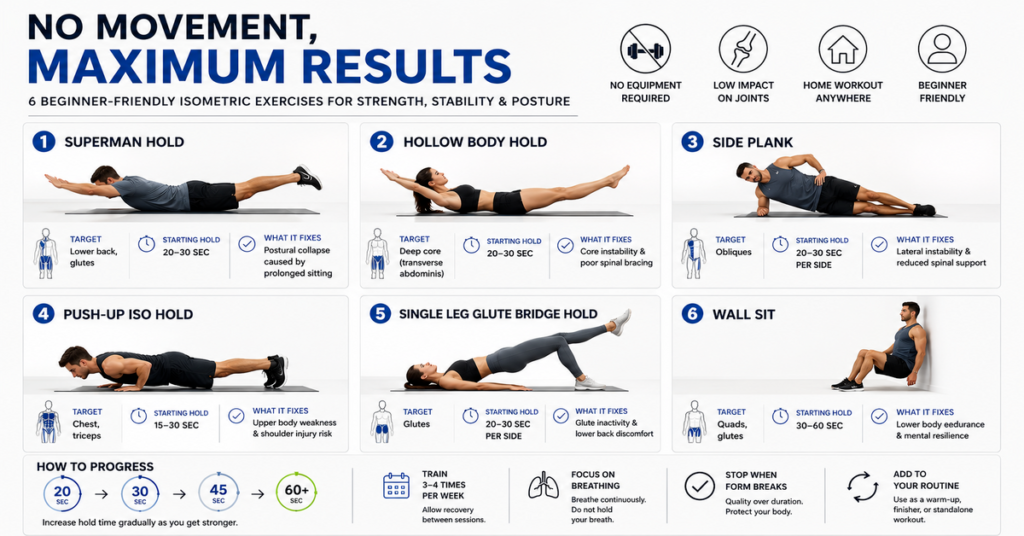
Exercise 1: Superman Hold- For the Posterior Chain and Posture
Years of sitting compress and gradually weaken the entire posterior chain, the group of muscles responsible for upright posture, lower back health, and hip extension power. The Superman Hold is the direct antidote to that damage.
Lie face down with arms extended overhead. Simultaneously lift the arms, chest, and legs off the floor until only the stomach and hips remain in contact with the ground. Stretch actively from fingertips to toes and hold that full extension throughout the entire duration.
The glutes should feel completely firm and engaged during this hold. The back should feel fully switched on. Breathe steadily and resist the urge to let anything collapse toward the floor when the effort builds.
Start with 20 to 30 second holds and build toward 45 seconds. Perform 3 sets.
Exercise 2: Hollow Body Hold- For Deep Core Stability
This is not an ab exercise. It is core re-education, and that distinction matters. Most beginners have never learned how to properly brace and stabilise the spine under load. The hollow body hold teaches the nervous system exactly how to generate and maintain full core tension, which is the foundation every other strength movement is built on.
Lie on the back and press the lower back completely flat into the floor. Lift the shoulders and legs simultaneously until the body forms a shallow boat shape. There should be no space whatsoever between the lower back and the floor at any point during the hold.
The shaking that begins within the first 15 to 20 seconds is not a sign to stop. That is the nervous system learning to coordinate properly. That is the exercise working exactly as it should.
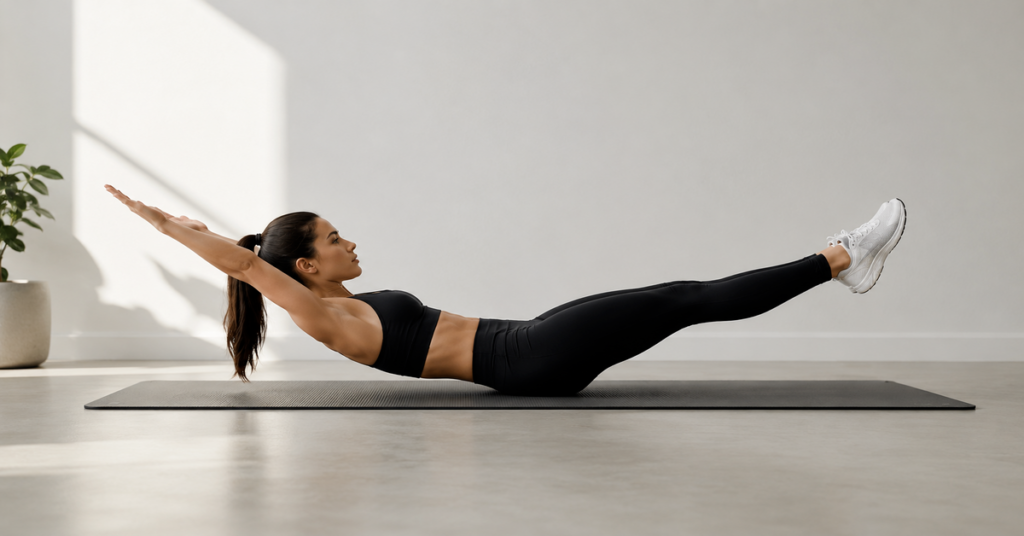
Start with 20 to 30 second holds and build toward 45 seconds. Perform 3 sets.
Exercise 3: Side Plank- For Lateral Stability and Spinal Protection
Real world strength is not just about pushing and pulling in a forward direction. Every time the body resists a twisting or lateral force, whether that is carrying a bag on one shoulder, stepping off a curb, or changing direction quickly, the obliques and lateral stabilisers are doing the work. Neglecting them leaves the spine vulnerable and the hips unstable in exactly the movements that matter most in daily life.
Place the elbow directly under the shoulder, lift the hips high off the floor, and form a completely straight line from head to feet. The key cue here is to actively drive the hips upward rather than simply preventing them from dropping. That one distinction changes the difficulty and the benefit significantly.
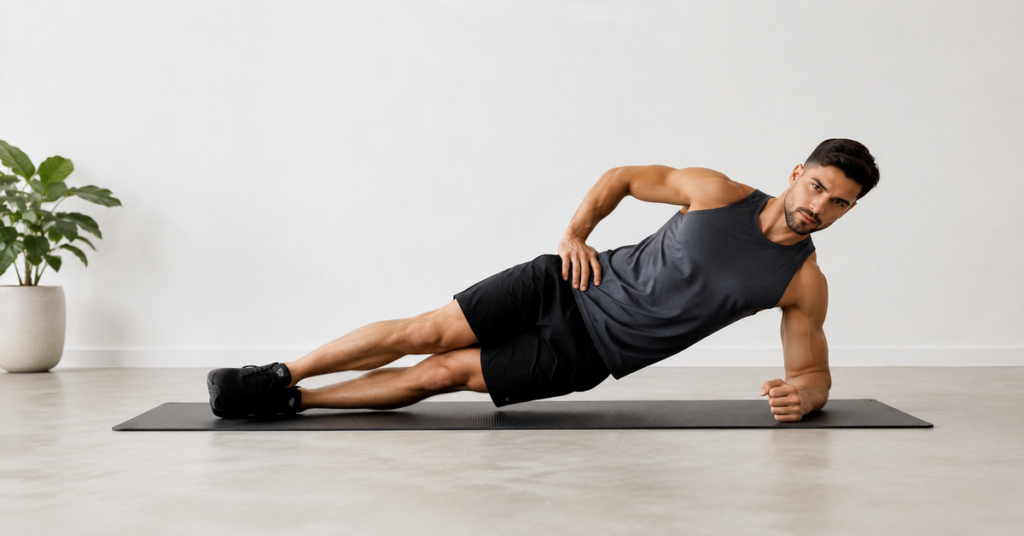
Start with 20 to 30 seconds per side and build toward 45 seconds. Perform 3 sets per side.
Exercise 4: Push Up Isometric Hold- For Upper Body Strength and Shoulder Health
Most beginners either skip push ups entirely because they feel too hard or rush through poor-form reps that build compensatory patterns rather than real upper body strength. Holding the lowered position solves both problems at once. It builds the pressing strength and shoulder stability needed to perform full push ups safely, without the momentum and form breakdown that rushing through dynamic reps creates.
Lower into the bottom of a push up until the chest is a few inches from the floor. Hold that position with the elbows at 45 degrees, hips braced, fingers spread wide, and the entire body completely rigid from head to heels.
This single position trains the chest, triceps, anterior deltoids, and core simultaneously while teaching the shoulder joint to stay properly positioned under load, which directly reduces the injury risk that poor push up mechanics accumulate over time.
Start with 15 to 30 second holds and build toward 45 seconds. Perform 3 sets.
Exercise 5: Single Leg Glute Bridge Hold- For Glute Activation and Lower Back Relief
Gluteal amnesia is one of the most widespread physical problems in people who spend significant time sitting. When the glutes stop firing properly the lower back and hamstrings compensate, creating chronic pain and weakness that builds quietly over months and years. The single leg variation of the glute bridge isolates each glute independently, corrects the side to side imbalances that bilateral exercises consistently mask, and forces the body to relearn how to generate hip extension power from the right place.
Lie on the back with one foot planted flat on the floor and the other leg extended straight. Drive the hips upward through the planted heel and hold the top position with full glute engagement throughout.
The working glute should feel completely contracted and firm during the hold. If the lower back is doing most of the work, consciously squeeze the glute harder before driving the hips up. That mental cue is often all it takes to shift the effort to exactly where it belongs.
Start with 20 to 30 seconds per side and build toward 45 seconds. Perform 3 sets per side.
Exercise 6: Wall Sit- For Lower Body Endurance and Mental Toughness
Lower body muscular endurance underpins almost every daily physical activity from climbing stairs to standing through a long day on your feet. The wall sit builds that endurance directly while also training the mental resilience to stay under tension when the body wants to stop.
Back completely flat against the wall, thighs parallel to the floor, knees at 90 degrees positioned directly above the ankles, heels flat on the ground. Hold without letting the hips rise up the wall when the burn begins.
The sequence is always the same. At first it feels manageable. Then the burn arrives. Then the shake sets in. Around the 45 to 60 second mark it becomes more mental than physical. That is exactly the point. The moment the hips rise to escape the difficulty the muscles get a break and the benefit disappears. Stay at depth and breathe through it.
Start with 30 seconds and build toward 60 to 90 seconds. Perform 3 sets.
The Best Isometric Workout for Beginners at a Glance
| Exercise | Primary Target | Secondary Muscles | Starting Hold | What It Fixes |
| Superman Hold | Lower back, glutes | Posterior chain | 20 to 30 seconds | Postural collapse caused by prolonged sitting |
| Hollow Body Hold | Deep core | Hip flexors, transverse abdominis | 20 to 30 seconds | Core instability and poor spinal bracing |
| Side Plank | Obliques | Lateral hips, spinal rotators | 20 to 30 seconds per side | Lateral instability and reduced spinal support |
| Push Up Hold | Chest, triceps | Shoulders, core | 15 to 30 seconds | Upper body weakness and shoulder injury risk |
| Single Leg Glute Bridge | Glutes | Hamstrings, hip stabilisers | 20 to 30 seconds per side | Glute inactivity and lower back discomfort |
| Wall Sit | Quads, glutes | Hamstrings, calves | 30 seconds | Lower body endurance and mental resilience |
All six movements form a complete home workout without equipment that works for any starting point.
How to Build This Into an Easy Daily Fitness Routine
- Start with 20 second holds for all six exercises.
- Gradually increase hold duration toward 30 to 60 seconds as strength and endurance improve.
- End the hold once form starts breaking down instead of forcing extra time.
- Prioritise clean technique over longer hold durations.
- Perform 1 to 2 full rounds of the circuit per session.
- Train 3 to 4 times weekly for steady progress without excessive fatigue.
- Focus on continuous breathing during every hold.
- Avoid holding the breath, as it can increase blood pressure and reduce cardiovascular benefits.
- Add the circuit at the end of existing workouts to improve muscular endurance.
- As a standalone routine, use it as a morning activation session or evening low stress workout.
- Increase progression gradually:
- Move from 20 seconds to 30 seconds
- Then progress to 45 seconds
- Eventually aim for 60 second holds
- Track hold times regularly to monitor visible and measurable improvement.
Train Safe, Stay Consistent, Build for the Long Term
Because isometric exercises involve no joint movement, impact forces are eliminated entirely. This makes them one of the safest available training options for people returning from injury, managing arthritis, dealing with chronic joint pain, or simply looking for a genuinely accessible entry point into fitness.
For anyone with high blood pressure or a diagnosed heart condition, a healthcare provider should be consulted before starting. The breath holding rule applies here with particular importance since holding the breath during any isometric contraction can cause dangerous blood pressure spikes that far outweigh any training benefit.
For healthy beginners the primary injury prevention principle is straightforward. Form comes before duration, always.
Conclusion
The biggest lie in fitness is that results require constant motion and maximum effort. The six exercises in this isometric workout for beginners prove otherwise. They rebuild the muscles that sitting has switched off, correct the postural patterns that desk work creates, and develop the deep stability that makes every other physical activity safer, more effective, and more sustainable over the long term.
Most beginners notice improved body awareness and reduced joint tension within two to three weeks. Visible strength and postural improvements typically become clear within four to six weeks of consistent three to four times per week practice.
No equipment. No gym. No excuses. Just stillness applied with intention, and results that speak for themselves.
To discover more realistic home workouts, muscle building strategies, and sustainable fitness routines designed for long term results, check out the latest training guides on Fitness Geekz.
Frequently Asked Questions
An isometric workout uses static holds where muscles stay under tension without visible joint movement. Unlike traditional exercises with repeated movement, isometric training focuses on maintaining controlled positions, making it beginner friendly and lower impact on the joints.
Yes. Isometric exercises improve muscular endurance, stability, posture, and functional strength effectively. While they may not build muscle mass as aggressively as heavy dynamic lifting, they create a strong foundation with lower injury risk.
Most beginners should start with 20 second holds and gradually progress toward 30 to 60 seconds as strength and control improve. Always prioritise proper form over longer hold times.
For beginners or those returning after a break, this routine can work well independently for the first few weeks. Over time, it also pairs effectively with strength training, cardio, or mobility work for more complete fitness development.
Training 3 to 4 times per week is ideal for most beginners. This frequency provides enough stimulus for noticeable improvements in strength, posture, stability, and muscular endurance while still allowing proper recovery.