

Most men train hard every week without realising some of their go-to exercises are quietly dragging testosterone levels down. Excessive long distance running, prolonged cycling, deep leg press reps, heavy crunch machines, and chronic overtraining without proper recovery all create the kind of hormonal stress that works against you, not for you. The fix is not training less. It is training smarter. Understanding why these patterns suppress testosterone is the first step to building a programme that actually supports your hormones, energy, and long term performance. If your results have stalled, your routine might be the reason.
Not every workout builds you up. Some tear your hormones down.
That is a difficult truth to accept, especially when you are putting in the work, showing up consistently, and still wondering why energy is low, strength is stalling, and motivation feels like it is running on fumes.
Here is what most fitness content will never tell you: testosterone in men declines roughly 1 to 2 percent every year after 30. That is the natural rate. But certain training habits, done at the wrong volume and intensity without adequate recovery, can accelerate that decline significantly, and the exercises responsible are not obscure or extreme. Most men are doing at least two or three of them every single week.
This is not about fear. It is about training smarter. Understanding which exercise patterns suppress testosterone, and why, is the difference between a programme that builds you and one that quietly works against you.
Watch the complete exercise and take your training up a notch 👉Watch Now
How Exercise and Testosterone Actually Work

Before getting into the specific exercises, it helps to understand the relationship between training and testosterone, because it genuinely cuts both ways.
The right training stimulus causes a temporary testosterone spike roughly 15 to 60 minutes after a session. Heavy compound lifting, sprint intervals, and high-intensity resistance work all produce this acute hormonal response. Over months of consistent training combined with proper recovery and nutrition, this can translate into improved baseline testosterone levels, better body composition, and real performance gains.
But here is where it gets complicated.
When training volume piles up without adequate rest, the body’s stress hormone, cortisol, stays chronically elevated. Cortisol and testosterone cannot comfortably coexist at high levels. When one rises, the other falls. This is not a theory. It is a well-documented hormonal mechanism involving the HPA axis, which governs stress hormones, and the HPG axis, which controls testosterone production. When the HPA axis becomes overactive from relentless training stress, it suppresses the release of luteinizing hormone, which is the chemical signal the brain sends to the testes to produce testosterone.
The result is Overtraining Syndrome, and it does not announce itself loudly. It starts with mild fatigue, a slight dip in motivation, workouts that feel harder than they should. Left unchecked, it progresses into persistent exhaustion, declining strength, disrupted sleep, low libido, and testosterone levels that sit well below the optimal performance range of 600 to 900 ng/dL for adult men.
The goal is not to train less. It is to train in a way that supports hormonal health rather than quietly undermining it.
The 5 Exercises and Habits That Can Lower Testosterone
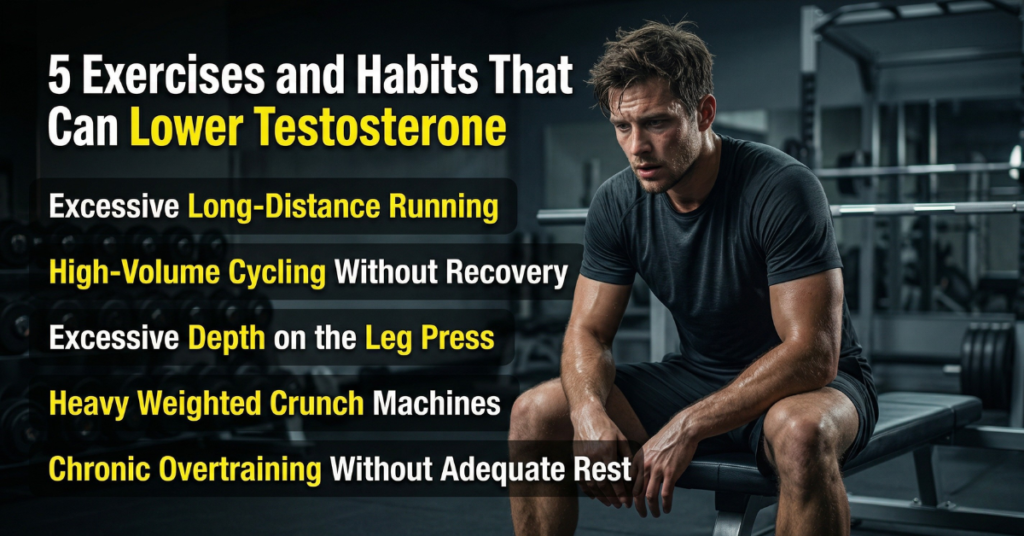
These are not rare or extreme activities. They are common, widely recommended, and done by millions of men every week. The issue is not the exercises themselves in every case. It is how they are being performed, at what volume, and without what recovery.
1. Excessive Long-Distance Running
Running is one of the most accessible and widely practiced forms of exercise on the planet. It builds cardiovascular fitness, supports mental health, and burns calories efficiently. Nobody is arguing against running.
But the research on high-volume distance running and testosterone is genuinely sobering.
Studies have found that male distance runners covering very high weekly mileage can have testosterone levels 30 to 50 percent lower than men who do not run at all. Approximately 25 percent of serious endurance runners develop what researchers call exercise hypogonadal male condition, a state where testosterone production becomes chronically suppressed and recovery can take years, sometimes longer.
The mechanism is straightforward. When the body is subjected to prolonged physical stress, it interprets it as a survival threat. Cortisol surges. The body begins prioritising immediate energy availability over long-term hormonal function. Testosterone, which requires metabolic resources and hormonal signalling to produce, gets deprioritised.
This does not mean running destroys testosterone at every distance. A 20 to 30 minute easy jog carries no meaningful hormonal risk. The problem begins when runs consistently extend beyond that range without adequate rest, nutrition, and strength training to balance the load.
The smarter approach is to keep most cardio sessions short and purposeful. HIIT sessions of 15 to 20 minutes, sprint intervals structured as 30 seconds of hard effort followed by 90 seconds of recovery, and easy aerobic runs kept under 30 minutes all deliver cardiovascular benefits without the sustained cortisol spike that suppresses testosterone over time.
2. High-Volume Cycling Without Recovery
Cycling enjoys a reputation as a low-impact, joint-friendly, highly effective form of cardio. For the most part, that reputation is deserved. But there is a specific physiological problem with prolonged cycling that rarely gets discussed openly.
Studies have found that serious competitive cyclists can show testosterone levels 20 to 40 percent lower than comparable athletes or even sedentary men. Part of this reflects the overtraining dynamic described above. But cycling carries an additional mechanical risk that running does not.
Extended time on a narrow bike saddle places sustained pressure on the perineal region, which directly restricts blood flow and circulation to the testicular tissue. Testosterone production depends on adequate oxygen and nutrient delivery through circulation. When that circulation is compromised for hours at a time, repeatedly over weeks and months, the body’s capacity to produce testosterone is measurably affected. In more serious cases, prolonged saddle pressure has been linked to fertility concerns and sexual health complications.
This is not a reason to abandon cycling. It is a reason to cycle smarter. Ergonomic saddles designed to reduce perineal pressure make a meaningful difference. Limiting continuous saddle time, building in standing intervals during rides, and balancing cycling volume with regular compound strength training all reduce the hormonal and vascular risk considerably.
3. Excessive Depth on the Leg Press
The leg press machine looks safe. No balance required, no barbell on the back, and the ability to load significant weight without the technical demands of a squat. For many gym-goers, it feels like a responsible choice.
The problem is not the leg press itself. It is the common belief that deeper is always better.
When the leg press is taken to extreme depth, the thighs compress against the abdomen and pelvis. This creates significant intra-abdominal pressure that pushes downward into the pelvic region, briefly compressing the blood vessels that supply the testicular tissue. For those few seconds at maximum depth, circulation to that area is effectively restricted.
Done occasionally, this is unlikely to cause lasting damage. But done repeatedly, session after session, with heavy loads and maximum depth, the cumulative effect on circulation and testosterone production is worth taking seriously.
The practical fix is simple and costs nothing in terms of training effectiveness. Research confirms that stopping the leg press at approximately 90 degrees of knee flexion produces equivalent quadriceps activation compared to extreme depth. The same muscle stimulus, none of the vascular compression risk. There is no performance benefit to pushing beyond that range, only additional stress on the joints and the pelvic circulation.
For anyone serious about leg strength and hormonal health, prioritising free weight squats over the leg press machine is the more complete solution. Squats recruit more total muscle mass, produce a greater hormonal response, and build functional strength that transfers directly to real movement.
4. Heavy Weighted Crunch Machines
The cable crunch machine and weighted abdominal machines are gym staples. The idea behind them is logical enough: if bodyweight core work builds some strength, adding resistance should build more. And to a degree, that is true.
But there is a hidden physiological cost to loading the crunch pattern with significant weight, particularly over extended periods.
Heavy loaded crunching generates substantial intra-abdominal pressure. Unlike a plank or a dead bug, where core muscles work to resist movement and stabilise the spine, the crunch machine forces the trunk into repeated flexion under load. That pressure has to go somewhere, and it travels downward into the pelvic cavity.
Over time, this repeated pelvic compression can impair the circulation required for testosterone production, in much the same way that extreme leg press depth does. Men who use heavy abdominal machines consistently over months or years and begin experiencing unexplained fatigue, reduced libido, or declining energy by mid-afternoon are often overlooking this as a contributing factor.
The alternative is not to skip core training. A strong, well-conditioned core is fundamental to every compound lift and every aspect of functional movement. The alternative is to train the core the way it actually functions, as a stabiliser. Planks, dead bugs, pallof press variations, and anti-rotation exercises build genuine core strength without the repeated pelvic compression that comes with heavy loaded flexion work.
5. Chronic Overtraining Without Adequate Rest
This is the broadest and most common entry on the list, and in many ways the most damaging.
Overtraining Syndrome is not just being tired after a hard week. It is a systemic breakdown that affects the nervous system, the immune system, hormonal output, and mood simultaneously. It builds gradually, usually when someone is training hard, not sleeping enough, and not eating sufficient calories to support the workload they are imposing on their body.
The warning signs are easy to dismiss individually. Workouts that feel harder than usual. A slight plateau in strength. Waking up tired despite a full night of sleep. Getting ill more frequently. A noticeable drop in motivation or sex drive. These are the early signals. If training continues at the same pace without addressing them, the hormonal consequences become more pronounced and significantly harder to reverse.
The fix is not complicated, but it does require honesty about how much the body can genuinely absorb and recover from. At minimum, one to two full rest days per week. Structured periodization that cycles intensity and volume rather than maintaining constant high output. Seven to nine hours of quality sleep every night, which is not optional for anyone trying to maintain healthy testosterone. And enough calories, particularly from protein, healthy fats, and carbohydrates around training sessions, to actually fuel the recovery process.
Training hard is a virtue. Training without recovery is a slow hormonal leak.
What Actually Supports Healthy Testosterone Levels

The best thing anyone can do for testosterone, beyond avoiding the patterns above, is to build a programme around compound strength training with progressive overload. Squats, deadlifts, rows, presses, and loaded carries recruit the most total muscle mass, produce the strongest acute hormonal response, and when done consistently over 8 to 12 weeks, drive measurable improvements in both body composition and baseline testosterone.
Nutrition underpins all of it. Chronic calorie restriction suppresses testosterone as reliably as overtraining does. The body will not prioritise hormone production when it is running an energy deficit. Adequate protein, healthy dietary fats, and sufficient carbohydrates around training sessions create the hormonal environment that makes training adaptations possible.
Sleep is where testosterone is actually produced. Even a handful of nights below seven hours has a documented suppressive effect on morning testosterone levels. No training programme, however well-designed, can compensate for consistently poor sleep.
And moderate alcohol intake, stress management, and avoiding the chronic under-eating trap are the lifestyle foundations that support everything else. The basics are not glamorous, but they are what the science consistently points back to.
The Bottom Line
Exercise is one of the most powerful tools available for maintaining healthy testosterone levels throughout life. But that power depends entirely on how training is structured, how well recovery is prioritised, and whether the body is being fuelled adequately for the work being asked of it.
The five patterns covered here are not rare or extreme. Excessive long-distance running, prolonged cycling, deep leg press compression, heavy loaded crunching, and chronic overtraining without rest are all common, widely practiced, and regularly contributing to hormonal suppression in men who have no idea the connection exists.
The solution is not to train less. It is to train smarter. Audit your current programme against these five points. Ask whether the volume matches the recovery being built around it. Ask whether the exercises are creating mechanical stress that compounds over time. One honest adjustment this week could change how you feel, perform, and recover within a month.
Train hard. Recover harder. And eat enough to make both worth something.
Want More Training Advice That Actually Makes a Difference?
Follow Fitness Geekz for no-nonsense fitness content built around real results. No fads, no fluff, just smarter training.
Frequently Asked Questions
Yes. Excessive endurance training, chronic overtraining, and poor recovery elevate cortisol and disrupt hormonal signalling, actively suppressing testosterone despite the effort being put in.
High-volume long-distance running at heavy weekly mileage without adequate rest and nutrition can lower testosterone significantly. Short runs under 30 minutes and interval-based cardio do not carry the same risk and can actually support healthy levels.
Prolonged high-volume cycling on a narrow saddle can restrict pelvic circulation and drive cortisol-based suppression. Moderate cycling with ergonomic equipment alongside strength training does not pose the same problem.
Training too frequently without rest, using extreme ranges of motion that compress pelvic blood vessels, skipping compound lifts for isolation machines, and chronically under-eating relative to training volume.
Watch for persistent fatigue, declining strength, low libido, disrupted sleep, and mood shifts like irritability or low motivation. If these persist despite good sleep and nutrition, getting bloodwork to check total testosterone, free testosterone, and cortisol is the smartest next step.