
Most people are chasing TikTok fitness trends with chrome dumbbells and algorithmically optimised moves. Meanwhile, research shows that grip strength alone is directly linked to longevity, with every 11-pound drop in grip strength associated with a 16 percent higher risk of early death. That single statistic tells a story the modern fitness industry consistently ignores.
Paleolithic ancestors had no barbells, no machines, and no structured programmes. They were leaner, more resilient, and less prone to chronic illness than the average modern office worker. Not because of better supplements or smarter training splits, but because survival demanded constant, varied, functional movement every single day. That is ancestral fitness training in its purest form, and it remains the most effective framework for building real, lasting strength available today.
The ancient Greek physician Galen categorised exercises into Strong, Rapid, and Violent movements, a framework that looks remarkably like modern athletic conditioning. The Indian physician Susruta prescribed daily exercise to half of one’s capacity around 600 BCE, the first recorded approach to managing training load and preventing overtraining. These were not guesses. They were systems built through centuries of observing human performance under real conditions.
This guide breaks down 7 ancient-inspired movements that build raw functional power, explains the science behind why they outperform most modern alternatives, and shows how to structure them into a practical minimalist workout routine that requires minimal equipment and delivers results that gym machines rarely match.
Want to perfect your workout technique? Watch the full practical exercise tutorial here:
Why Ancient Training Methods Produce Results Modern Gyms Often Miss?
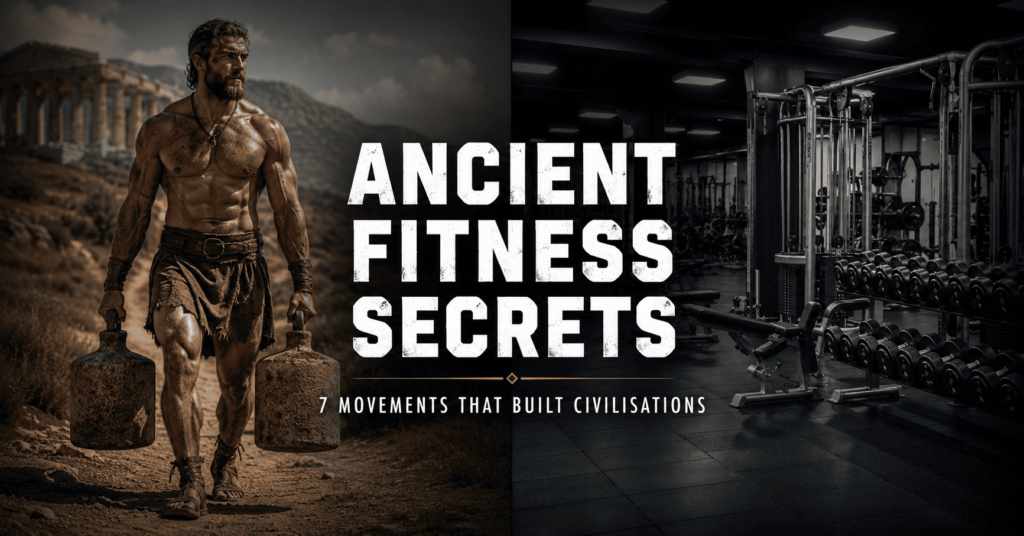
Modern training isolates muscle groups on machines that guide the movement path and remove the stabilisation demand entirely. Ancient movement integrated the entire body around solving physical problems, carrying, dragging, climbing, crawling, and hauling. The difference is not just philosophical. It is neurological. Full body integrated movements recruit more muscle fibres, build greater neural coordination, and produce functional strength that transfers directly into daily life.
The human body did not evolve under consistent, repetitive, machine-guided loading. It evolved under chaos, irregular terrain, varied loads, and unpredictable physical demands. That variety built bodies that did not require warm-ups or ergonomic chairs. Prolonged sameness, not disorder, is the root cause of most modern chronic conditions from lower back pain to metabolic dysfunction.
Ancient fitness traditions across every culture share one principle. Strength was never the goal. Capability was. Greeks trained for battlefield readiness. Romans trained for endurance under load. Indian wrestlers trained for rotational power and grip. The exercises looked different but the underlying demand was identical. Build a body that works.
The 7 Ancient Inspired Exercises That Build Primal Strength
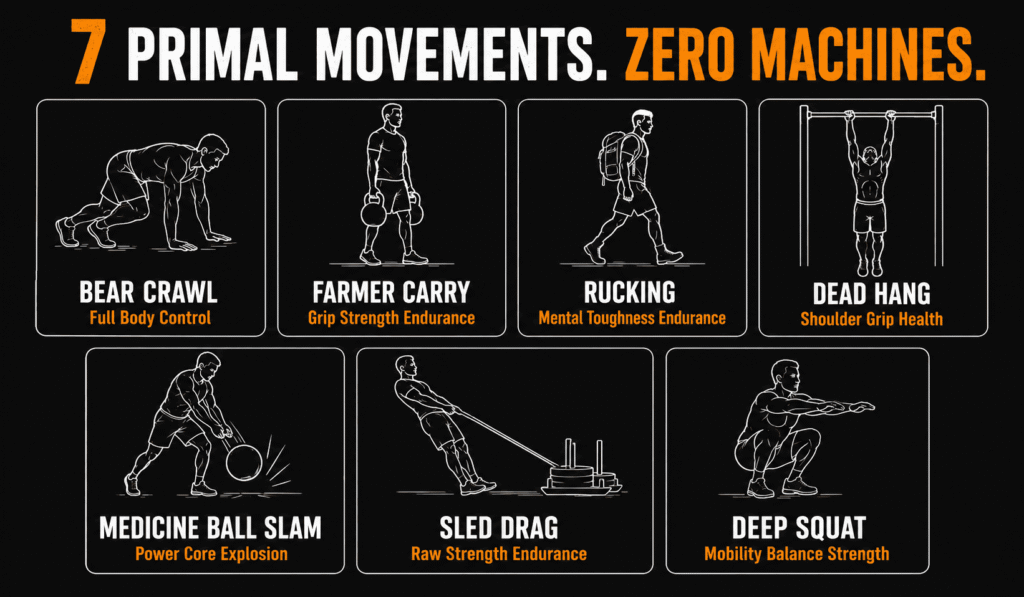
Exercise 1: Bear Crawls- Full Body Strength and Shoulder Stability
Bear crawls directly mimic how ancestors chased prey, carried wounded companions, and scrambled through difficult terrain. This was not exercise. It was a survival movement, and it built structural integrity that modern training consistently fails to replicate.
Bear crawls are essentially a moving plank that simultaneously develops shoulder stabilisers, core strength, quad and glute activation, and wrist integrity. They specifically address weak shoulder stabilisers and poor overhead mechanics, two of the most widespread structural weaknesses in people who spend significant time sitting or training only in linear planes of movement.
Start on hands and feet with knees hovering just above the floor. Move the opposite hand and foot forward simultaneously while keeping the back flat and hips level. Keep the core braced throughout every step. Begin slowly with controlled movement and progress to speed, backward crawls, uphill crawls, or lateral crawls to build strength across all planes.
Aim for 3 sets of 20 to 30 metres.
Exercise 2: Farmer Carries- Grip Strength and Posterior Chain Power
Imagine hauling heavy jugs of water under a hot sun for miles. That was not a workout. That was Tuesday. And it built crushing grip strength, durable backs, and the kind of full-body endurance that conventional training rarely develops.
Farmer carries build grip strength, activates the entire posterior chain, locks in core stability under sustained load, and trains the body to maintain structural integrity while moving forward. Given that research directly links grip strength to longevity, loaded carries are genuinely one of the most important exercises available for long-term health and natural strength building.
Pick up two heavy objects of equal weight, whether kettlebells, dumbbells, loaded bags, or filled water jugs. Stand tall, brace the core, pull the shoulders back and down, and walk for the prescribed distance without letting posture collapse at any point.
Aim for 3 sets of 30 to 40 metres.
Exercise 3: Rucking- Endurance, Strength and Mental Grit Combined
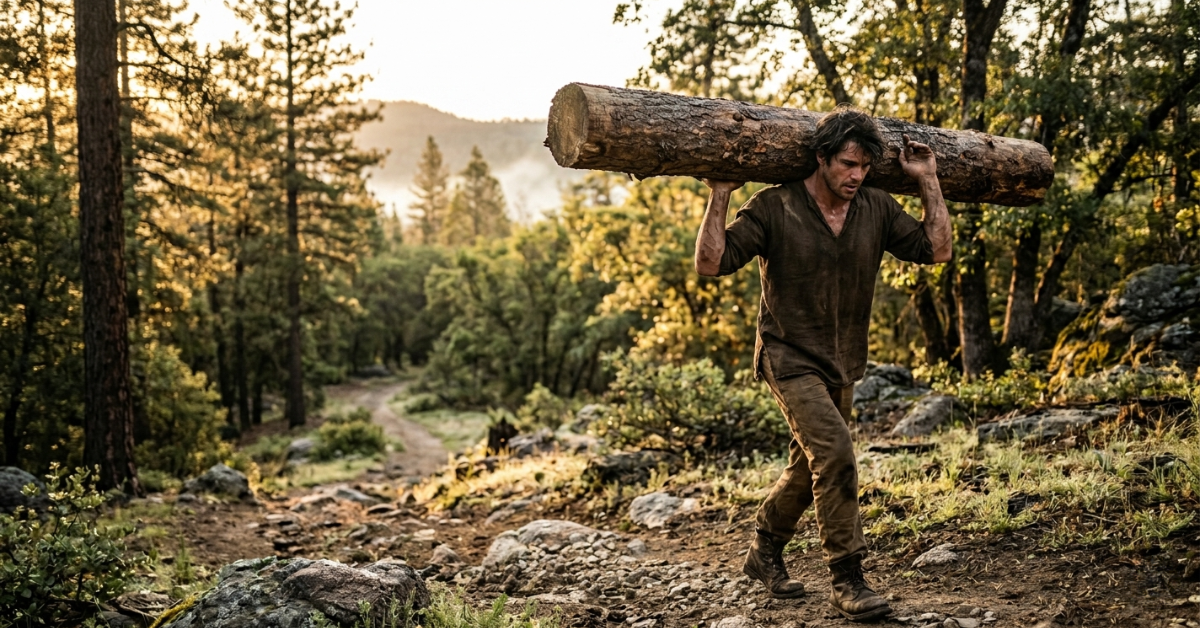
Ancestors did not jog for cardio. They carried supplies, children, weapons, and food across miles of varied terrain as a matter of daily survival. Roman legionaries marched 25 kilometres in five hours carrying packs weighing up to 20 kilograms. That was a standard expectation on any given day, not a special challenge.
Rucking builds bulletproof legs, durable backs, and genuine cardiovascular endurance while being significantly lower impact than running. The added load increases calorie burn above walking while the sustained duration builds aerobic capacity and mental resilience simultaneously. It is arguably the single most complete activity available for developing endurance, lower body strength, and the kind of grit that structured gym sessions rarely produce.
Load a backpack with 10 to 15 percent of bodyweight and walk at a brisk but sustainable pace on varied terrain. Start with 20 to 30 minute sessions and build duration and load progressively over weeks.
Exercise 4: Dead Hang and Swinging- Spinal Decompression and Shoulder Health
Before humans lifted weights, they swung. Climbing trees for fruit, crossing obstacles, and traversing rough terrain all required hanging, gripping, and moving through the full range of shoulder motion that the joint was designed for. The shoulder is a ball-and-socket joint built for overhead movement, not the limited plane that most modern training permanently restricts it to.
Dead hangs build grip strength, improve scapular stability, and decompress the spine by reversing the compressive forces that prolonged sitting and loaded training create throughout the day. Adding gentle swinging builds shoulder health across a broader range of motion and provides spinal traction that genuinely resets the body between training sessions. Physical therapists widely recommend hanging variations for both shoulder rehabilitation and spinal decompression for exactly this reason.
Start with a passive hang for 20 to 30 seconds, letting the body relax completely and the shoulders rise naturally. Progress to an active hang by pulling the shoulder blades down and engaging the upper back. Add gentle swinging as grip and mobility improve. Build toward 3 sets of 45 to 60 seconds.
Exercise 5: Medicine Ball Slams- Explosive Power and Triple Extension
Throwing heavy objects was a training staple across ancient cultures. Greeks practised stone throws and discus training. Egyptian soldiers swung heavy sand-filled sacks. The pattern of lifting, twisting, and explosively releasing a load is one of the most fundamental human power movements, and it is largely absent from conventional gym training.
Medicine ball slams train triple extension through the hips, knees, and ankles simultaneously, the exact same movement pattern that underpins sprinting, jumping, and virtually every explosive athletic activity. They also develop force absorption on impact, a quality that is critical for injury prevention and joint resilience across all the physical demands of daily life. Few exercises combine strength, power, and genuine stress relief as effectively in a single movement.
Stand with feet shoulder-width apart, hold the medicine ball overhead with arms extended, engage the core, then slam the ball into the floor with the entire body behind the effort. Catch or pick up and repeat without losing tension between reps. Perform 3 sets of 8 to 10 reps with maximum intent on every single slam.
Exercise 6: Sled Drags and Pulls- Joint Friendly Posterior Chain Strength
Dragging heavy loads, whether animal carcasses, logs, or construction stones, was a fundamental feature of ancestral physical life. Egyptian workers moved massive stone blocks across desert terrain. This kind of sustained heavy dragging built the posterior chain and lower body endurance that sustained entire civilisations, and it did so without the joint stress that conventional barbell training accumulates over years.
Sled training is uniquely joint-friendly because it involves no eccentric muscle contraction, meaning the muscles do not lengthen under load the way they do during squats or deadlifts. This eliminates the primary driver of muscle damage and soreness, allowing more frequent training and significantly faster recovery. Backward drags target the hamstrings and glutes. Forward pulls hit the quads and upper back. Together they build complete posterior chain strength without the cumulative joint wear that heavy conventional loading creates.
Attach a rope or strap to a weighted sled or any suitably heavy object. For backward drags, face away from the load and pull while walking forward. For forward pulls, face the load and pull it toward you in a rowing motion while walking backward. Perform 3 to 4 sets of 20 to 30 metres per direction.
Exercise 7: Deep Resting Squat- Hip Mobility and Spinal Health
Ancestors did not sit in chairs. They squatted to cook, rest, socialise, and work. Populations that maintain a regular resting squat position consistently show fewer lower back problems and significantly better hip mobility than chair-dependent populations, and the reason is straightforward. The deep squat is the natural resting position the human hip joint was designed to inhabit.
Daily resting squat practice decompresses the spine, opens the hips through their full range of motion, activates the deep stabilising muscles of the pelvis, and restores the joint position that prolonged sitting progressively removes. It is the simplest and most accessible tool available for reversing postural damage from sedentary modern life, and it requires absolutely nothing but the floor.
Stand with feet slightly wider than hip-width and toes turned out naturally. Lower into a full squat until the hips are below the knees. Use a doorframe or resistance band for support initially if needed. Work toward holding the position unassisted for 1 to 2 minutes. Aim to accumulate 5 to 10 minutes of total resting squat time throughout each day.
Ancient Workout Routine vs Modern Gym Training at a Glance
| Movement | Ancient Origin | Primary Benefit | Equipment Needed | Difficulty |
| Bear Crawl | Hunting and terrain navigation | Full body stability and shoulder health | None | Beginner |
| Farmer Carry | Water and supply hauling | Grip strength and posterior chain development | Any heavy object | Beginner |
| Rucking | Military and survival marching | Endurance and mental resilience | Backpack and added weight | Beginner |
| Dead Hang | Tree climbing and traversal | Spinal decompression and shoulder health | Overhead bar | Beginner |
| Medicine Ball Slam | Stone and object throwing | Explosive power and force absorption | Medicine ball | Intermediate |
| Sled Drag and Pull | Load dragging and hauling | Joint friendly posterior chain strength | Sled or heavy object | Intermediate |
| Deep Resting Squat | Daily resting position | Hip mobility and spinal health | None | Beginner |
All seven movements support a complete minimalist workout routine with minimal or zero equipment requirements.
How to Structure This Into a Practical Weekly Routine
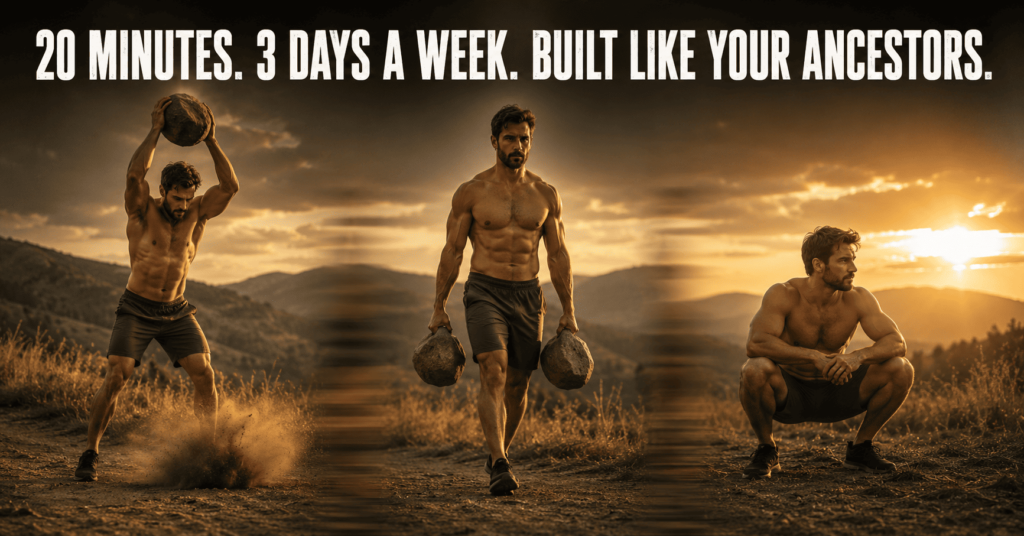
1. Train these movements 3 to 4 times weekly in short full body sessions lasting around 20 to 30 minutes. Start each workout with explosive exercises like medicine ball slams while the nervous system is still fresh and capable of producing maximum power.
2. After the explosive work, move into the heavier strength focused movements such as farmer carries, rucking, and sled drags. These exercises create sustained muscular tension while building grip strength, endurance, and full body resilience.
3. Finish the session with lower intensity movements including bear crawls, dead hangs, and deep resting squats. This final phase improves mobility, posture, spinal health, and recovery while reinforcing better movement patterns throughout the body.
4. The deep resting squat can also be practised daily outside formal workouts. Spending a few minutes in the position throughout the day gradually improves hip mobility, ankle flexibility, posture, and lower back comfort.
5. On days where fatigue is higher, reduce overall intensity instead of pushing maximum effort. Consistent moderate training performed over months produces better long term results than short periods of excessive intensity followed by burnout or injury.
Train Hard, Recover Like a Warrior
Ancient training cultures universally understood that recovery was not optional. Greeks relied on whole-animal diets for connective tissue repair. Romans used contrast hot and cold baths. Indian wrestlers combined physical training with breathwork and spiritual practice. Chinese training explicitly balanced hard physical effort with deliberate recovery, internal health work, and rest.
The movements in this routine are deliberately selected to minimise joint stress over the long term. Sled training eliminates eccentric loading. Bear crawls and resting squats improve joint range rather than compressing it. Dead hangs actively decompress the spine. The result is a functional fitness at home programme that can be sustained for years without the cumulative joint damage that heavy machine-based training often produces when continued indefinitely.
The most important injury prevention principle from the ancient world is variance. Moving in multiple planes, at varied loads, and across different types of terrain keeps the body genuinely adaptive and resilient in ways that repetitive linear training simply cannot match over time.
Conclusion
The fitness industry spends billions trying to recreate in gyms what human beings once did by accident every single day. Bear crawls, loaded carries, rucking, hanging, explosive throws, dragging heavy loads, and resting in a deep squat were not workouts. They were life. And they built bodies capable of outrunning predators and constructing entire civilisations with bare hands.
Adding even two or three of these movements into a weekly routine will produce changes in grip strength, hip mobility, shoulder health, and overall resilience that conventional training rarely delivers. Stop chasing shiny hacks. Start training like the humans who survived everything the world threw at them without a single machine to help.
The journey to primal strength starts with the movements the human body was built to perform. For more practical, ancestral-inspired training guides built around real movement and long-term health, explore the full resource library at Fitness Geekz.
Frequently Asked Questions
Ancestral fitness training focuses on natural human movement patterns such as carrying, crawling, hanging, dragging, and squatting. These movements train the body as a complete system rather than isolating muscles, improving functional strength, coordination, mobility, and long term joint health.
Yes, although traditional resistance training remains more efficient for maximum muscle hypertrophy. Ancestral training excels in building practical strength, endurance, movement quality, and physical resilience while placing less repetitive stress on the joints. Those looking to complement this approach with targeted resistance work will find the guide on full body dumbbell workouts a practical next step.
Very little equipment is required. Many exercises only need open space and bodyweight. Optional tools include:
A backpack for rucking
Heavy objects for carries
An overhead bar for dead hangs
A sled or weighted bag for dragging movements
These movements strengthen stabilising muscles, improve mobility, and train the body through natural movement patterns. Exercises like bear crawls, dead hangs, and deep squats help improve posture, spinal health, shoulder stability, and hip mobility while reducing excessive joint stress.
Most people benefit from 3 to 4 training sessions weekly. On lower energy days, reducing intensity instead of forcing maximum effort helps maintain consistency, recovery, and long term progress without excessive fatigue or injury risk.