


Picking up heavy weights and walking sounds too simple to matter. But the farmer’s walk might be the most underrated exercise out there. It builds crushing grip strength, fixes posture, fires up your core, and conditions your entire body, all in one movement. No machines, no complicated setup, just you, the weight, and controlled steps. The real world strength this builds shows up everywhere, from carrying groceries to moving furniture. If you want a full body exercise that actually works, this is it. Start light, focus on form, and let the results speak for themselves.
If there’s one deceptively simple move that can completely change how your body looks, feels, and performs, it’s the farmer’s walk.
At first glance, it’s just walking while holding weights. Nothing fancy. No complicated setup. But that simplicity is exactly what makes it powerful. This is one of the few exercises that delivers real-world strength, the kind that shows up in everyday life, not just in the gym.
Most people expect just one or two benefits from this movement. In reality, the farmer’s walk benefits go much deeper. From grip strength and posture to endurance and mental toughness, this is a true full body strength exercise that trains your body the way it’s meant to move.
Before you jump in, watch this first 👉Full exercise video here
What Is the Farmer’s Walk? (And Why It Works So Well)

The farmer’s walk, also known as a farmer’s carry, involves picking up a pair of weights and walking for time or distance while maintaining proper posture.
That’s it.
But here’s why it works: it mimics real-life movement. Carrying groceries, lifting luggage, moving heavy objects, these are all variations of the same pattern. Unlike isolated gym exercises, this movement trains your body as one connected system.
That’s what makes it so effective. You’re not just building muscle. You’re building usable strength.
The Real Benefits of Farmer’s Walk for Full Body Strength
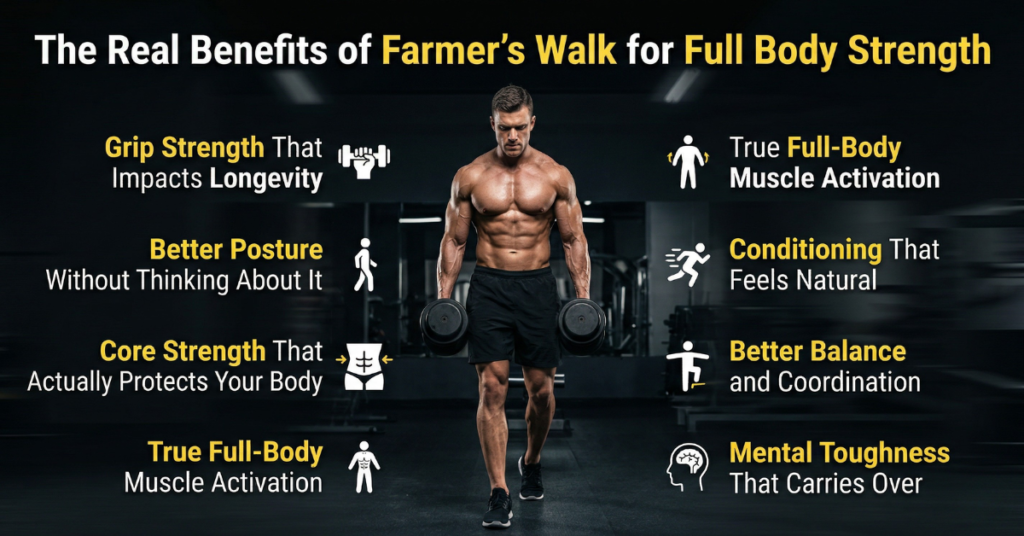
1. Grip Strength That Impacts Longevity
The first thing that changes when you start doing farmer’s walks consistently is your grip.
It sounds basic, but it’s not. Grip strength is strongly linked to overall health, injury prevention, and long-term function. Weak grip often means weak support muscles throughout the body.
Farmer’s walks directly train:
- Forearms
- Wrists
- Fingers
- Small stabilizer muscles
Even light weights can wake up your nervous system and build strength in areas most people ignore. Over time, everyday tasks feel easier, whether it’s carrying bags, holding onto bars, or simply maintaining control under load.
2. Better Posture Without Thinking About It
If you spend long hours sitting, chances are your posture has taken a hit. Rounded shoulders, forward head, and a collapsed chest are common.
Farmer’s walks fix this.
By keeping your shoulders back and down while carrying weight, you activate the upper back muscles:
- Traps
- Rhomboids
- Rotator cuff
Within a few weeks, you’ll notice a difference. You stand taller. You move better. And the best part is, it happens naturally without constant reminders.
3. Core Strength That Actually Protects Your Body
Forget endless crunches. This is real core training.
The moment you pick up the weights, your body wants to twist and lean. Your core has to resist that movement to keep you stable.
This builds:
- Anti-rotation strength
- Spinal stability
- Deep core engagement
This is the kind of strength that protects your lower back, improves lifting mechanics, and supports everyday movements like bending, carrying, or even sudden actions like catching yourself from a slip.
4. True Full-Body Muscle Activation
One of the biggest benefits of a farmer’s walk for full body strength is how many muscles it engages at once.
You’re working:
- Grip and forearms
- Upper back and lats
- Core stabilizers
- Glutes, quads, and calves
All of this happens while you’re moving, not just holding a position. That combination of strength and movement makes it far more effective than many traditional exercises.
5. Conditioning That Feels Natural
If you hate traditional cardio, this is your alternative.
Farmer’s walks elevate your heart rate quickly while still building strength. It’s conditioning that feels purposeful, not repetitive.
You’re not just burning calories. You’re improving:
- Work capacity
- Muscular endurance
- Overall fitness
It’s simple, effective, and easy to scale based on your fitness level.
6. Better Balance and Coordination
Every step you take under load challenges your stability.
Your body has to constantly adjust to stay upright, which improves:
- Balance
- Coordination
- Movement control
This becomes especially important as you age. Better balance means fewer injuries, fewer falls, and more confidence in daily movement.
7. Mental Toughness That Carries Over
Farmer’s walks aren’t easy.
As the weight gets heavier and your grip starts to fade, your mind tells you to stop. Pushing through that discomfort builds mental resilience.
You learn to:
- Stay calm under stress
- Control your breathing
- Keep moving when it gets tough
That mindset carries over into every part of your training and daily life.
How to Perform Farmer’s Walks Correctly

Getting the most out of this exercise depends on proper form and control.
Basic Steps
- Pick up the weights using a deadlift motion.
- Stand tall with a neutral spine.
- Walk slowly with controlled, steady steps.
- Keep the weights close to your body throughout.
Key Cues
• Brace your core as if preparing for impact
• Pull your shoulders back and down
• Keep your chest up and eyes forward
• Avoid leaning or swaying while walking
Common Mistakes to Avoid
Even simple exercises like farmer’s walks can lose effectiveness when form breaks down. Paying attention to these common mistakes helps improve results and reduce injury risk.
- Shoulders rolling forward
Letting the shoulders round forward places stress on the neck and upper back. Keep them pulled back and down to maintain proper posture and engage the upper back muscles. - Walking too fast and losing control
Rushing through the movement reduces tension and stability. Slow, controlled steps ensure better muscle activation and balance throughout the walk. - Not bracing your core
A relaxed core leads to poor posture and unnecessary strain on the lower back. Actively brace your core to keep the spine stable and protect against injury. - Using excessive weight too early
Starting too heavy often leads to compromised form. Choose a manageable weight that allows you to maintain control, then gradually increase as strength improves.
Focus on clean, controlled movement first. Strength and results will follow with consistency.
How to Add Farmer’s Walks to Your Routine
| Phase | Sets | Duration | Weight | Rest | Notes |
| Beginner | 2–3 sets | 30–45 seconds | Moderate | 60 seconds | Focus on posture, grip, and controlled steps |
| Progression | 3–4 sets | 45–60 seconds | Moderate to heavy | 30–45 seconds | Increase time under tension and reduce rest |
| Variation | 2–3 sets | 30–45 seconds | Moderate | 60 seconds | Try single-arm carries to challenge core stability |
Conclusion: Simple, Effective, and Built for Real Life
The farmer’s walk proves that the simplest exercises are often the most effective.
It builds strength, improves posture, enhances endurance, and develops resilience, all in one movement. More importantly, it trains your body for real life, not just the gym.
The benefits of farmer’s carry go far beyond muscle. This is about building a stronger, more capable body that performs well every day.
Stay consistent, focus on form, and let this movement do its work. For more practical strength training tips and real-world fitness strategies, explore expert guides at Fitness Geekz.💪
FAQs: Farmer’s Walk Benefits & Training
For most people, start with a load that allows 30–60 seconds of controlled walking while maintaining perfect posture. A practical benchmark is 40–60% of body weight (total load) for beginners. As strength improves, gradually increase weight while keeping form strict. The goal is quality tension, not just surviving the set.
Yes, farmer’s walks are an effective full body strength exercise that can build muscle, especially in the forearms, traps, shoulders, and core. While they may not replace traditional hypertrophy lifts entirely, they significantly enhance muscle density, grip strength, and overall functional size when programmed correctly.
Farmer’s carries can reduce the need for traditional ab exercises because they train anti-rotation, anti-flexion, and stability, the core’s real job. However, for complete development, combine them with targeted movements. That said, in terms of real-world strength, the benefits of farmer’s carry often surpass basic crunch-based routines.
For optimal results, include them 2–3 times per week. They can be added at the end of strength sessions or used as a conditioning finisher. Recovery matters here, especially for grip and nervous system fatigue, so avoid doing them daily at high intensity.
Farmer’s walks combine strength, stability, and conditioning into one movement. The benefits of farmer’s walk for full body strength come from constant tension across multiple muscle groups while moving under load. This improves posture, grip, endurance, and coordination simultaneously, making it one of the most efficient exercises for long-term fitness.